

A deductible is what you pay for covered care before your plan starts paying its share. A copay is a flat fee you pay for a specific service, like a doctor visit or a prescription. They are two different kinds of cost-sharing, and most plans use both. What trips people up is the order: on many plans, a copay only kicks in at certain points, and for some services you owe the deductible first.
We’re licensed independent health insurance brokers, and this is the question we hear most from self-employed people and families comparing plans for the first time. Let’s clear it up without the jargon.
TL;DR
- A deductible is a yearly amount you pay for covered services before your plan begins paying. A copay is a fixed dollar amount you pay for a specific service.
- Depending on the plan, a copay may apply right away, or only after you’ve met the deductible. The plan’s summary of benefits and coverage shows which.
- Neither number tells you the whole story. Add the premium, coinsurance and the out-of-pocket maximum to see what a bad year could cost.
- A low deductible usually means a higher monthly premium, and the reverse. Pick based on how you actually use care.
Table of Contents
- What is a deductible?
- What is a copay?
- Copay vs. deductible at a glance
- How copays and deductibles work together
- Does a copay count toward the deductible?
- What does “$30 copay after deductible” mean?
- Do you still pay copays after you meet your deductible?
- Where coinsurance and the out-of-pocket maximum fit
- What’s free before the deductible?
- Is it better to have a deductible or a copay?
- Our perspective: don’t shop on one number
- Questions to ask before you enroll
- Want a second pair of eyes on your plan?
- FAQ
- Sources
What is a deductible?
Think of the premium as the price of getting in the door. The deductible is the first chunk of covered care you pay for yourself once you’re inside.
HealthCare.gov describes it as what you spend for certain covered health services and prescription drugs before your plan pays anything, except for free preventive services. CMS adds that it’s the amount you may owe during a coverage period, usually one year, for covered services before the plan begins to pay for services that are subject to the deductible.
A few things worth knowing:
- It resets. On most plans the deductible starts over at the beginning of each plan year.
- It may not apply to everything. The AMA’s patient guide notes that the deductible may not apply to all services, so you need to read the policy details.
- Your premium doesn’t count. Monthly premiums are separate from what you pay toward the deductible.
If you want a deeper walk-through, we wrote a separate guide on what a deductible is in health insurance.
What is a copay?
A copayment, or copay, is a fixed dollar amount a patient pays for a covered health care service, usually at the time the service is received. You hand over $25 at the front desk, and that’s it.
Copays are predictable, which is why people like them. Typical places you’ll see them:
- Primary care and specialist visits
- Urgent care and emergency room visits
- Generic and brand-name prescriptions
- Some therapy or telehealth visits
The dollar amount is set by your plan and can differ for each type of service. A primary care copay is usually lower than a specialist copay, for example. Your plan’s documents list each one.
Copay vs. deductible at a glance
| Deductible | Copay | |
|---|---|---|
| What it is | A yearly amount you pay before the plan shares costs for covered services | A flat fee for a specific service |
| When you pay | Spread across your first covered bills of the year | Usually at the time of the visit or pickup |
| How much | Varies by bill until the deductible is met | Same amount each time for that service |
| Resets | Typically each plan year | Doesn’t “reset”; it applies each time you use the service |
| Applies to | Covered services that are subject to it | Services the plan assigns a copay to |
| Why it matters | Drives your early-year costs | Makes routine care easier to budget |
One caution: this table is the general picture. Plans differ, and some copays apply before the deductible while others apply after it.
How copays and deductibles work together
Here is the sequence CMS describes. Before you meet your deductible, you pay the full allowed amount for a service subject to the deductible. Afterward, you pay coinsurance or a copayment, if your plan has one for that service.
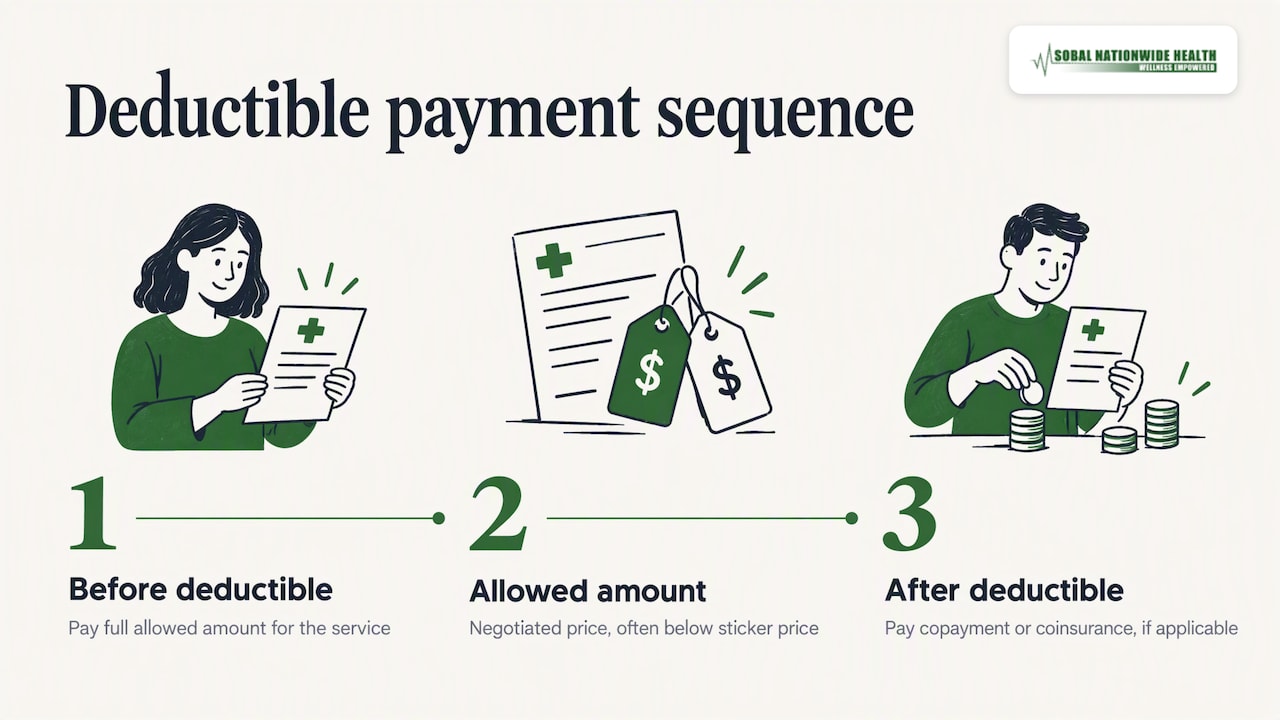
The “allowed amount” is the price your insurer has agreed on with an in-network provider, which is often lower than the provider’s sticker price.
A worked example
CMS uses an in-network office visit with a $100 allowed amount and a $20 copayment. After the deductible is met you pay $20. Before it’s met, you pay the full allowed amount, or only the remaining amount needed to finish the deductible if that’s less.
Let’s walk it through with numbers of our own. This is a made-up example, not a real plan.
- Your plan has a $1,000 deductible and a $20 copay for office visits, with the copay applying after the deductible.
- Visit 1, in January: the allowed amount is $100 and you haven’t paid anything toward the deductible. You pay $100. Your remaining deductible is $900.
- Later in the year: after you’ve paid the full $1,000, the same $100 visit costs you the $20 copay.
- In between: if you have $30 of deductible left and a $100 visit comes up, you pay $30 to finish the deductible, then the plan applies its normal share.
And on a plan where the primary care visit copay is not subject to the deductible, you’d pay $20 at that first visit instead of $100. The structure matters more than the label.
Some plans make you meet the deductible first for certain services
The Bureau of Labor Statistics glossary notes that some plans require the deductible to be met first for specific services before a copayment applies to that service. That’s why two plans with the same $30 copay can feel very different in practice.
Does a copay count toward the deductible?
It depends on the plan, and this is the answer we’d rather give you honestly than simplify.
The two numbers do different jobs. The deductible is a running total of what you’ve paid for services subject to it. A copay is a flat charge for a service. On some plans, the copay you pay is credited toward your deductible, and on others it isn’t. Your summary of benefits and coverage (SBC) and your plan’s full policy document should say which one you have. If it doesn’t read clearly, call the number on your insurance card or ask your broker to check.
What we can say with confidence: deductible and coinsurance payments count toward your out-of-pocket costs, and once you reach the out-of-pocket maximum, the insurer pays for covered services for the rest of the plan year. Whether your particular copays also count toward that maximum is another line to confirm in your plan documents.
What does “$30 copay after deductible” mean?
You’ll see this phrase in the cost-sharing columns of an SBC. It means the $30 copay for that service only applies once you’ve met the plan’s deductible. CMS explains that in an SBC, the deductible referenced in these fields is the medical deductible, and “$X copay after deductible” is stated in reference to it.
In plain terms:
- Before you meet the deductible: you typically pay the full allowed amount for that service, up to what’s left on the deductible.
- After you meet it: you pay the $30 copay.
Compare that with “$30 copay” with no “after deductible” note. That one usually means you pay $30 from day one, without having to meet the deductible first, as long as the service is covered.
Do you still pay copays after you meet your deductible?
Yes, if your plan has them. Meeting the deductible doesn’t erase copays. After meeting the deductible you pay the copayment amount, if one applies to the service. What changes is that you stop paying the full allowed amount.
Some plans use coinsurance instead of a copay after the deductible, where you pay a percentage of the bill. We break that down in our guide to coinsurance vs. copay and what 20% really costs.
Where coinsurance and the out-of-pocket maximum fit
There are really four moving parts, and it helps to see them together.
| Term | What it does |
|---|---|
| Premium | What you pay monthly to have the plan |
| Deductible | What you pay first for covered care before the plan shares costs |
| Copay | A flat fee for a specific service |
| Coinsurance | A percentage of the bill you pay after the deductible |
| Out-of-pocket maximum | The most you’ll pay for covered care in a plan year |
HealthCare.gov’s example follows a person named Jane. She pays all costs for most covered health services until she reaches her $1,500 deductible. Then she pays 20% coinsurance until she hits a $5,000 out-of-pocket maximum. After that, the plan pays 100% of covered services.
The out-of-pocket maximum is your financial safety net. MedlinePlus puts it this way: once you reach it, you won’t pay more out-of-pocket costs for that year. Premiums, and care your plan doesn’t cover, sit outside of that protection.
What’s free before the deductible?
Certain preventive services are the exception to the “deductible first” rule. HealthCare.gov notes that the deductible doesn’t apply to free preventive services. Which ones are free depends on the plan and the service, so it’s worth reading up. We cover that in what’s free and what isn’t in preventive care. If you or a parent is on Medicare, the rules are separate, and this overview of Medicare preventive service coverage explains how screenings are handled there.
Is it better to have a deductible or a copay?
You don’t really choose one over the other. Almost every plan has a deductible, and many add copays on top. What you’re choosing is the balance:
- Lower premium, higher deductible. You pay less each month but more when you use care early in the year. This can suit healthy people who rarely go to the doctor and can cover a surprise bill from savings.
- Higher premium, lower deductible and more copays. Costs are more predictable. This tends to suit families with regular visits, ongoing prescriptions or planned care.
People also ask whether a $500 or $1,000 deductible is better. Neither is, on its own. Do the math: the difference in annual premiums versus the extra $500 you’d pay if you hit the deductible. If the premium savings from the higher deductible are bigger than $500 and you’re unlikely to hit it, it can come out ahead. If you expect a surgery, pregnancy or steady specialist care, the lower deductible often wins.
A quick way to compare two plans
- Add up the full-year premiums for each plan.
- Estimate your visits, prescriptions and any planned care for the year.
- Run those through each plan’s deductible, copays and coinsurance.
- Add the premium to the result, then check the out-of-pocket maximum for the worst case.
- Confirm your doctors and hospitals are in the network, since out-of-network care may cost more than in-network care.
Our health insurance FAQ and cost calculators can help with the math.
Our perspective: don’t shop on one number
As brokers, we see the same pattern. Someone sees a $20 copay or a $500 deductible in an ad and picks the plan because of that one number. Then a bill arrives and they find the plan has a narrow network, a separate prescription deductible, or a high out-of-pocket maximum.
Our approach at Sobal Health is to start from your life, not the plan. How often do you see a doctor? Do you take regular medications? Do you have a doctor or hospital you won’t give up? Are you self-employed with irregular income, so a surprise bill would hurt more in some months than in others? We help people compare plans, including private, medically underwritten plans that aren’t sold on the public marketplace, with no sales pressure and with brokers available in English or Spanish.
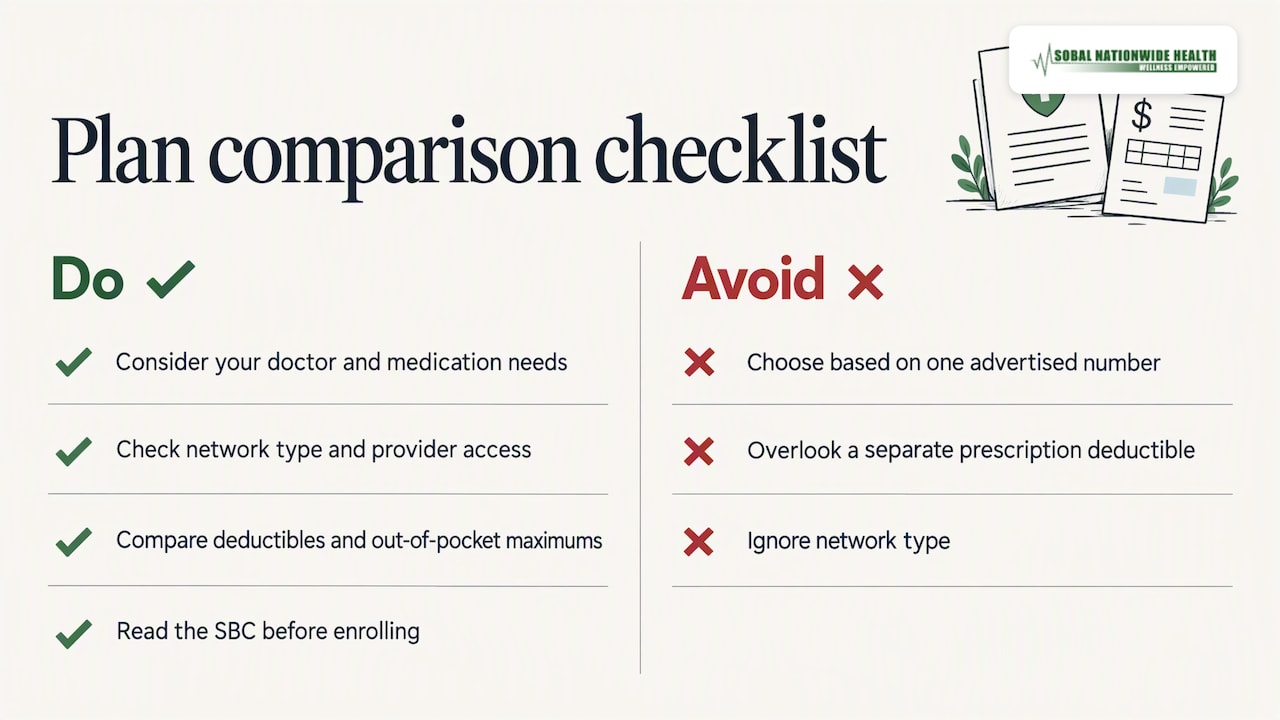
If you earn too much for marketplace subsidies, or you’re between jobs and weighing COBRA, the cost-sharing design matters even more, because you’re paying the full premium. In those cases we also look at network type. A PPO lets you see a wider range of providers, and it’s worth reading how POS and PPO plans compare using the SBC.
One more thing: please read your SBC before you enroll. It’s a standardized document, and it’s the fastest way to see how copays, deductibles and coinsurance actually work on that plan.
— Bernie S
Questions to ask before you enroll
Bring this list to your insurer or broker. The AMA’s advice is to review your plan details closely and contact customer support with questions.
- Which services have a copay, and which are subject to the deductible first?
- Do my copays count toward the deductible? Toward the out-of-pocket maximum?
- Is there a separate deductible for prescriptions?
- Is the deductible per person or per family, and is there an embedded individual limit?
- What is the out-of-pocket maximum, in network and out of network?
- Are my doctors, hospital and pharmacy in the network?
If a bill surprises you, know that the No Surprises Act protects against certain surprise bills for some out-of-network emergency, non-emergency and air ambulance services. If you have a plan with bigger gaps, our piece on avoiding a five-figure bill with health sharing vs. insurance is worth a read.
Want a second pair of eyes on your plan?
If you’re self-employed, a freelancer, a small business owner or a family looking at plan options, we can walk you through the real costs of each one. We work with personal and family coverage, including private medically underwritten plans, and with business health insurance for small employers. Reach out through sobalhealth.com and we’ll compare your options in plain English.
FAQ
What is the difference between a copay and a deductible?
A deductible is the amount you pay for covered services in a plan year before your plan starts sharing costs. A copay is a fixed fee for a particular service, such as a doctor visit. Many plans have both, and some copays apply only after the deductible is met.
Do you still pay copays if you meet your deductible?
Yes, if your plan includes copays for that service. After the deductible is met you pay the copay instead of the full allowed amount. Some plans switch to coinsurance, a percentage of the bill, instead.
Does a copay count toward the deductible?
It depends on the plan. Some count copays toward the deductible and others don’t, and some services are excluded from the deductible altogether. Check the SBC and the plan’s policy document, or ask your insurer or broker to confirm.
What does a “$30 copay after deductible” mean?
It means you pay the full allowed amount for that service, up to what’s left on your deductible, until it’s met. After that you pay a $30 copay per visit or service. A plain “$30 copay” usually applies from the first visit.
Is a $500 or $1,000 deductible better?
Neither is better by default. Compare the yearly premium savings with the extra $500 you could owe, and think about how much care you expect to use. If you rarely use care and can cover the bill, the higher deductible may save money. If you expect regular care, the lower one often does.
Sources
- Health insurance terms you should know | CMS
- No Surprises: Health insurance terms you should know | CMS
- Your total costs for health care | HealthCare.gov
- Coinsurance glossary | HealthCare.gov
- Health Plan 101 for Patients | AMA
- Definitions of health insurance terms | BLS
- Enhancements by Individual and Family Template | CMS
- Understanding your health care costs | MedlinePlus
- Understanding Cost Sharing: Deductibles, Copayments & Coinsurance | HealthyChildren.org
- What Medicare covers for preventive services and annual screenings
