

If you earn too much for ACA subsidies, you can still buy good health insurance. You just pay the full price, and you have more choices than most people realize. You can buy an ACA plan at full price, with or without the Marketplace. You can also look at private, medically underwritten PPO plans, or at COBRA or an employer arrangement if you have access to one.
I’m a licensed independent broker, and this is the conversation I have most often with self-employed people, freelancers and business owners. The sticker shock is real. But the right plan, chosen on purpose, often costs far less than the default one.
TL;DR
- “No subsidy” means you pay the full premium. You may be over the income limit, offered affordable job-based coverage, or eligible for public coverage instead.
- As of October 2026, the temporary subsidy enhancements have expired. Federal premium tax credits are generally unavailable above 400% of the federal poverty level.
- Your main options are an unsubsidized ACA plan, a private medically underwritten plan, COBRA, or an employer-funded arrangement.
- Compare total yearly cost, not just the monthly premium: deductible, copays and out-of-pocket maximum all count.
- A free review with a broker costs you nothing and can show you all of these side by side.
Table of Contents
- What “no subsidy” really means
- Why you might get no subsidy
- What does it cost without a subsidy?
- Your options when you pay full price
- How the options compare
- Ways to lower the bill
- Our perspective
- Get a side-by-side look
- FAQ
- Sources
What “no subsidy” really means
A subsidy here means the ACA premium tax credit, which lowers your monthly premium, and cost-sharing reductions, which lower your deductible and copays. Having no subsidy doesn’t mean you can’t get coverage. It means nobody is helping with the bill.
The temporary boost to these credits ended with 2025. As of October 2026, federal premium tax credits are generally unavailable to households above 400% of the federal poverty level. Before that, the extra help had reached higher earners. Now the original rules apply again, and the line is sharp.
If you want to see where that line falls for your household size, our guide to 2026 ACA subsidy income limits walks through the numbers.
Why you might get no subsidy
Income is the reason most people think of, but it isn’t the only one. Here is the full list.
Your income is too high (or, less often, too low)
Eligibility for the tax credit generally requires income between 100% and 400% of the federal poverty level. Income is measured with a formula called MAGI. It starts with your adjusted gross income and adds a few items, such as untaxed foreign income, non-taxable Social Security benefits and tax-exempt interest.
For the self-employed, that matters. Your MAGI comes from your net profit after business deductions, not your gross revenue. Legitimate deductions can move you under or over the line, so talk with your tax professional before you decide.
You have affordable job-based coverage
You can’t get the credit if your employer offers coverage that is both affordable and meets minimum value. For 2026, affordable means a self-only premium that doesn’t exceed 9.96% of household income. Notice that the test looks at the employee’s own cost, not what it would cost to add the family.
You qualify for other public coverage
People eligible for Medicaid or Medicare generally don’t receive marketplace credits either. Immigration status matters too: the credit is for U.S. citizens and certain lawfully present immigrants.
Your employer offers an ICHRA or CHOICE arrangement
Some employers reimburse workers for individual-market premiums through CHOICE Arrangements, formerly called ICHRAs. An affordable offer can affect your credit eligibility. If you own a small business, this is also a tool for you. Our piece on group versus individual coverage and when ICHRA matters covers both sides.
What does it cost without a subsidy?
The honest answer is that it depends on your age, county and plan level. But there is a useful yardstick. KFF reports that the average benchmark premium in 2026 is $625 a month for a 40-year-old. That is the second-lowest-cost Silver plan, and it varies a lot by state. In the same data, a few states in our service area look like this:
| State | Average benchmark premium (2026, per month) |
|---|---|
| Maryland | $414 |
| Indiana | $474 |
| Ohio | $513 |
| Texas | $661 |
| Florida | $683 |
| Tennessee | $711 |
| West Virginia | $1,073 |
| Wyoming | $1,090 |
Those are averages for one age. Premiums rise with age, and a family pays for each member. So treat the table as a ballpark, not a quote.
How to preview your own full price
You can preview full-price Marketplace plans and estimated costs at HealthCare.gov, though final quotes appear only after a completed application. When you run the numbers, don’t stop at the premium. HealthCare.gov points out that your total yearly cost includes the deductible, copayments and out-of-pocket maximum.
Think of it this way: the premium gets you in the door. The deductible and out-of-pocket maximum decide what happens once you’re inside. The out-of-pocket maximum is your financial safety net, the most you pay in a year for covered care.
Here is how the pieces work together:
| Piece | What it is | What it does for you |
|---|---|---|
| Premium | The monthly bill | Keeps your coverage active |
| Deductible | What you pay before the plan starts sharing costs | Sets your early-year exposure |
| Copay or coinsurance | Your share after the deductible | Shapes the cost of each visit or procedure |
| Out-of-pocket maximum | The yearly cap on covered care | Protects you from a catastrophic bill |
When you pay full price, routine care deserves the same attention. Knowing what a same-day telehealth cost looks like can help you decide when a quick virtual visit beats a copay.
Your options when you pay full price
1. An ACA plan bought outside the Marketplace
You can buy ACA-compliant plans directly from insurers outside the Marketplace, but those plans don’t qualify for premium tax credits or cost-sharing subsidies. If you already know you won’t get a subsidy, this changes little on price. Some people prefer it for the insurer’s direct service, and you keep guaranteed issue and pre-existing condition protections.
2. An ACA Marketplace plan at full price
Same protections, same plan designs, and it keeps the door open if your income dips mid-year. Cost-sharing reductions are only for people who enroll in a Silver plan through the Marketplace, so if you might qualify later, enrolling there keeps that option alive.
3. Private, medically underwritten PPO plans
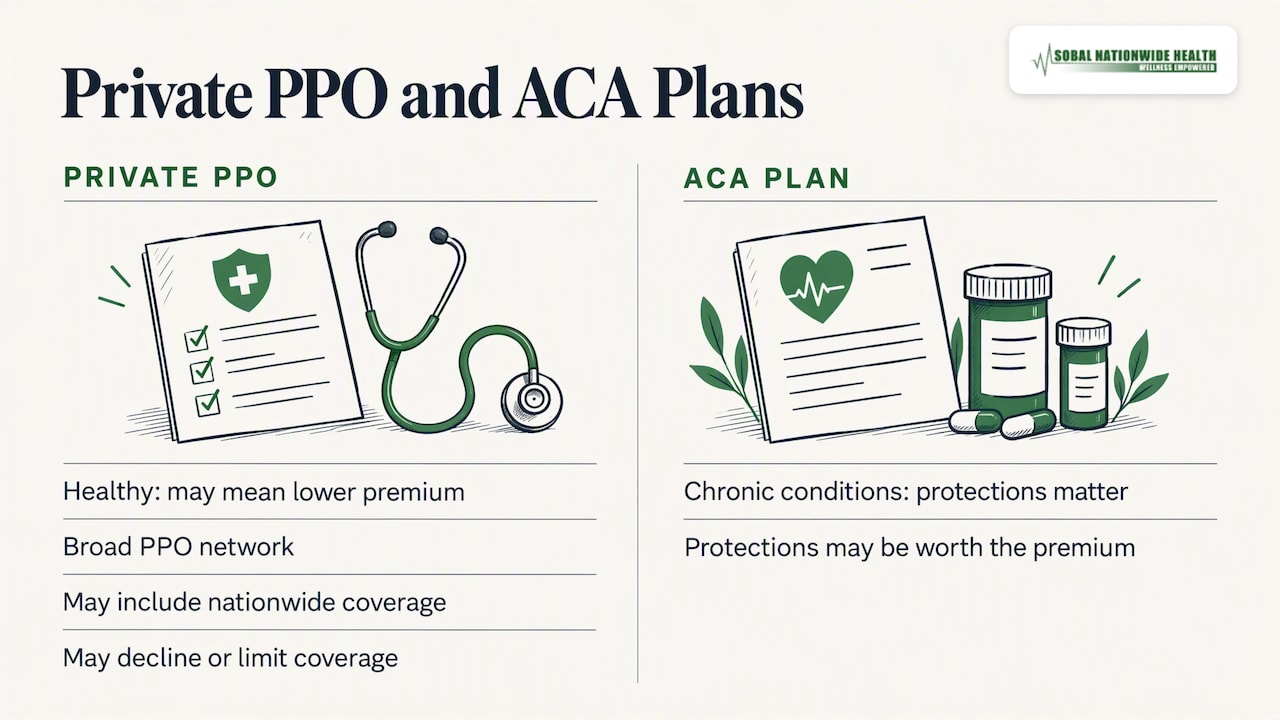
This is where I spend much of my time. These plans look at your health history when you apply, much like life insurance does. If you’re healthy, that can mean a noticeably lower premium than an ACA plan, often with a broad PPO network that lets you see almost any doctor or hospital, and in many cases nationwide coverage.
The trade-off is real. Because the plan can decline you or limit coverage based on your history, it isn’t right for everyone. Someone with a chronic condition may do better on an ACA plan. Our guide to how medically underwritten insurance works and who it fits explains the details, and some of our clients have reported savings of up to $400 a month after switching.
4. COBRA
If you’re between jobs, you can usually keep job-based coverage through COBRA, typically for up to 18 months. You generally pay the full premium plus an administrative fee, so it’s a no-subsidy plan by design. It’s a good fit if you’ve nearly met your deductible. Otherwise, compare it first. We break down the trade-offs in COBRA versus Marketplace after a job loss.
There is a useful wrinkle if you’re waiting on a new employer’s plan. You can buy a Marketplace plan in the meantime, and may qualify for savings based on income. But if you keep it after the new coverage starts, you pay full price for it.
5. Short-term plans: read the fine print
Short-term limited-duration plans are cheaper because they skip the ACA’s protections. CMS notes these plans are not subject to guaranteed coverage for pre-existing conditions or rules against health-status discrimination. The agency describes them as designed to fill temporary gaps and says they may provide little or no coverage when you need it. Rules have shifted over the years, so check what your state allows. I treat them as a bridge, never a long-term plan.
6. Supplemental coverage
Dental, vision, accident, critical illness and fixed indemnity plans aren’t health insurance replacements. Fixed indemnity in particular pays set amounts and doesn’t replace major medical. Used alongside a real plan, they cover gaps. There are no subsidies for standalone dental and vision either, so these are always priced at full cost.
How the options compare
| Option | Pre-existing conditions | Typical fit | Watch for |
|---|---|---|---|
| ACA plan, full price | Covered, no health screening | Anyone, especially with ongoing care | Highest premiums for many |
| Private underwritten PPO | Health history reviewed | Healthy self-employed, families wanting broad networks | May be declined or limited |
| COBRA | Continues your current plan | Between jobs, mid-treatment | Full premium plus fee |
| Short-term plan | Often excluded | Brief gap only | Little protection if you get sick |
Ways to lower the bill
A few moves help no matter which route you pick:
- Check your MAGI. If you’re near the 400% line, ask a tax professional about legitimate deductions and retirement contributions before enrolling.
- Pick the plan level on purpose. A higher deductible lowers the premium, but only if you can cover that deductible if something happens.
- Compare networks. A cheaper plan that excludes your doctor isn’t cheaper.
- Time your start date. Applying alone doesn’t start coverage, so read about health insurance effective dates to avoid a gap.
- Review every year. Premiums, your income and your health all move. What was best last year may not be this year.
If you do take advance credits some months and your income rises, remember the tax-time rule. If advance credits exceed the final credit on your return, you repay the excess. That makes a mid-year income swing a good reason to call your tax preparer.
Self-employed in Florida? Our guide to seven options for 1099 workers is a good next stop.
Our perspective
Most people who call us believe they have two choices: a Marketplace plan at a price that stings, or nothing. That’s not the full picture. When we sit down with someone who earns too much for help, we start by asking what they actually use: which doctors, which prescriptions, and how much risk they can carry in a bad year.
For many healthy self-employed people and families, a private medically underwritten PPO can be a better value than an unsubsidized ACA plan. For others, particularly anyone with ongoing conditions, the ACA’s protections are worth the premium. We’d rather tell you that plainly than sell you the wrong plan.
We are independent, so we can show you both worlds. There’s no sales pressure, and you can talk with us in English or Spanish. Our job is to explain things in plain language and let you decide.
— Bernie S
Get a side-by-side look
We help self-employed people, families and small businesses in 31 states compare private PPO plans, ACA plans, dental, vision and supplemental coverage. Tell us your age, county and doctors, and we’ll show you real options at full price. Start on our personal and family plans page, or if you run a business, see our business health insurance options.
Prefer to read first? Our resource guide has plain-English explainers on every plan type mentioned here.
FAQ
Are ACA subsidies still available?
Yes, but in a narrower form. Premium tax credits still exist for people between 100% and 400% of the federal poverty level who meet the other rules. As of October 2026, the temporary enhancements have expired, so households above 400% generally get nothing.
How much is health insurance with no subsidy?
It depends on your age, county and plan level. The 2026 national average benchmark premium is $625 a month for a 40-year-old, with wide state differences. Get a quote for your own ZIP code and household before you budget.
Can I still buy a Marketplace plan if I don’t qualify for a subsidy?
Yes. Anyone eligible to use the Marketplace can enroll at full price. You’ll also keep the option to claim a credit later if your income changes and falls into range.
Is a private plan cheaper than an ACA plan?
Often, for healthy applicants, because the insurer reviews your health history. But those plans can decline or limit coverage, so they don’t replace ACA protections for everyone. A broker can compare both against your health and budget.
Sources
- Will you receive an ACA premium subsidy? (healthinsurance.org)
- Advance Payments of the Premium Tax Credit and cost-sharing reductions overview (CMS)
- Who is eligible for Marketplace premium tax credits? (KFF)
- CHOICE Arrangements (HealthCare.gov)
- Marketplace average monthly benchmark premiums (KFF)
- Health plan research information (HealthCare.gov)
- Your total costs for health care (HealthCare.gov)
- Frequently asked questions about the ACA’s Health Insurance Marketplace (KFF)
- Cost-sharing reductions (HealthCare.gov)
- If you lose job-based coverage (HealthCare.gov)
- CMS press release on short-term limited-duration insurance
- Same-day telehealth cost
