






If your Texas family is already paying the full premium, you can still get strong coverage, and private PPO-style plans with nationwide doctor choice are one route worth pricing. I’m Bernie Sobalvarro, a licensed broker (NPN 19189235), and this guide shows how to compare those options on yearly cost when you are paying the full price.
TL;DR
- Premium tax credits generally apply to household income of 100% to 400% of the federal poverty level (FPL). Above that line, you pay the full premium on a marketplace plan.
- For 2027, 400% FPL is $132,000 for a family of four.
- Private, medically underwritten plans are priced on your family’s health profile, so healthy families may find a better fit than a full-price marketplace plan. Approval and pricing are never guaranteed.
- Compare total yearly cost (premium, deductible and out-of-pocket maximum), not the monthly premium alone.
- We’re licensed in Texas and Florida, among 31 states, and can walk you through it in English or Spanish. We don’t offer Medicare or Medicaid.
Table of Contents
- What paying the full premium means for a Texas family
- How household income is counted
- What the full price looks like on a guaranteed-issue plan
- Your options as a higher-earning Texas family
- How to compare plans by total yearly cost
- Perspective
- How we help Texas and Florida families
- FAQ
- Sources
What paying the full premium means for a Texas family
The premium tax credit is the federal help that lowers monthly premiums on marketplace plans. The IRS says it generally requires household income of 100% to 400% of FPL. Cross 400% and the credit stops. It’s a cliff, not a slope.
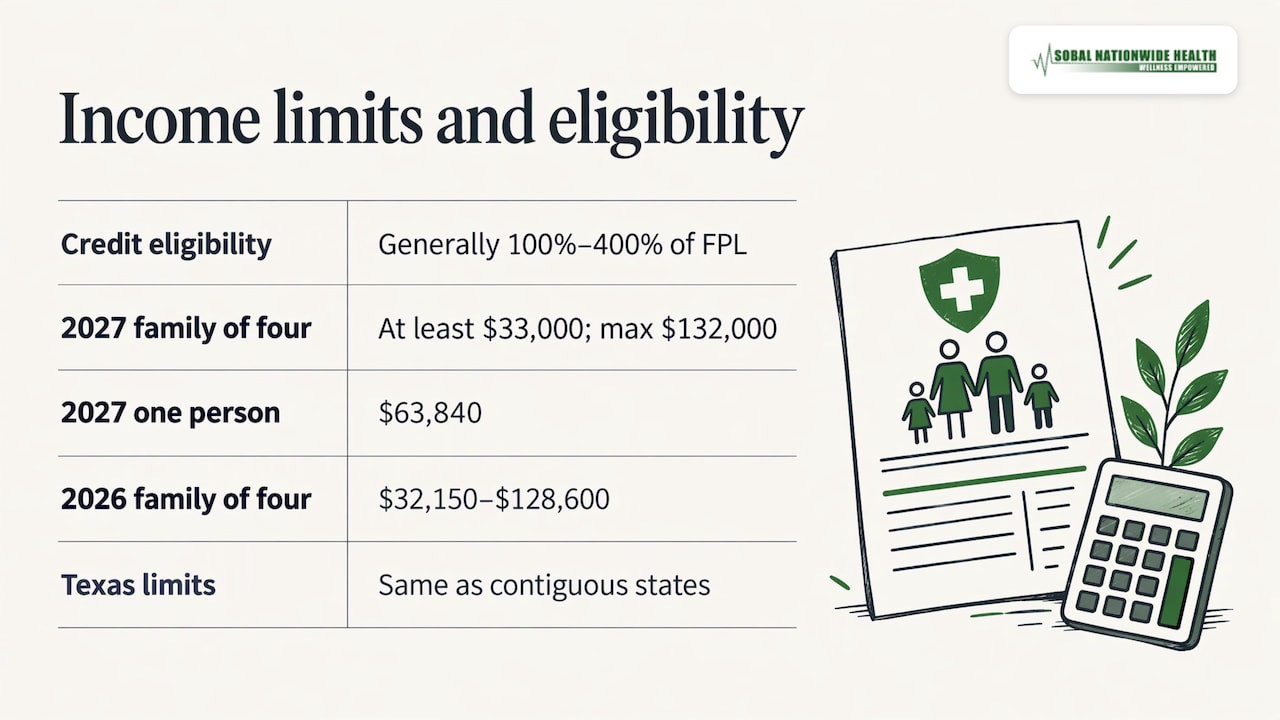
The limits are the same in Texas as in other contiguous states. KFF reports that in 2027 the range runs from at least $33,000 to no more than $132,000 for a family of four, and $63,840 for one person. For 2026, the Congressional Research Service lists $32,150 to $128,600 for four people. The enhanced subsidies from earlier federal laws expired on January 1, 2026, so the original ACA rules apply.
For a deeper look at the numbers, see our guide on ACA subsidy income limits for a family of four.
How household income is counted
The number that matters is not your paycheck or your business revenue. It’s your modified adjusted gross income (MAGI), counted for your household. The IRS defines household income as your MAGI plus that of each family member required to file. MAGI starts with adjusted gross income and adds items such as tax-exempt interest.
HealthCare.gov explains that the household includes you, your spouse and your claimed tax dependents, and that savings are based on your expected income for the coverage year. CMS adds that projected annual income is what the marketplace uses.
For self-employed families, that means net profit after business deductions, not gross sales. A realtor or owner-operator trucker with uneven months should estimate the full year. A quarterly tax estimate helps here, and a quarterly estimated tax guide can help you project your annual figure.
Why the line matters more now
Two changes raise the stakes near the cliff. First, the draft 2026 IRS instructions for Form 8962 say that for tax years after 2025, you must repay the full excess of advance credits over what you were allowed. Second, KFF notes that first filings under those uncapped rules won’t happen until early 2027, so families near the line should estimate carefully and update when income changes. If you’re a trucker, a reminder that filing obligations like Form 2290 also affect your yearly paperwork.
What the full price looks like on a guaranteed-issue plan
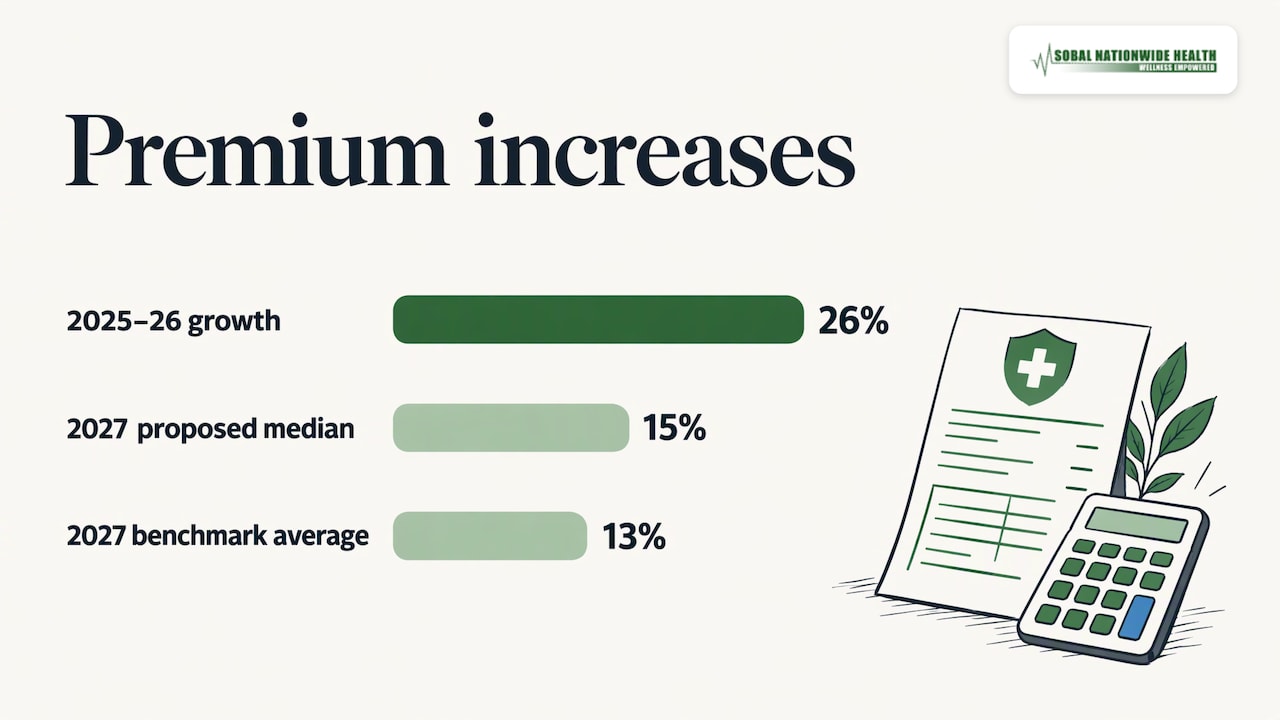
Above 400% FPL, you pay the whole premium. KFF’s 2027 outlook says insurers proposed a median 15% increase for 2027, and the average finalized benchmark silver increase is 13%, after 26% growth from 2025 to 2026. The same report says people above 400% FPL are particularly hard hit because they pay the full cost.
Out-of-pocket limits matter too. CBIZ reports the 2027 maximum is $12,000 for an individual and $24,000 for a family, up from $10,600 and $21,200 in 2026. That’s the most a compliant plan can ask you to pay in a year for covered in-network care. Think of it as a financial safety net, and also as the number you could face in a bad year.
Your options as a higher-earning Texas family
Here are the main routes, with the one we’d price first listed first.
| Option | How it works | Best fit |
|---|---|---|
| Private, medically underwritten PPO-style plan | Priced on your family’s health history; broad doctor choice | Healthy families who want nationwide doctor and hospital choice |
| Full-price marketplace plan | Same ACA rules for everyone, no income cap on buying | Families who prefer ACA-style standardized benefits |
| Employer family plan | Spouse’s job-based coverage | Families where the employee share is manageable |
| COBRA | Continuing a former employer’s plan | A short bridge after leaving a job |
Private underwritten plans are our specialty. Because they are priced on health rather than on a one-size community rate, healthy families can find real savings. We don’t promise any specific result. Eligibility, benefits and premiums depend on the carrier’s review of your applications. To understand how it works, read how medically underwritten insurance works and our private versus marketplace cost check.
If a spouse’s employer plan costs too much
Many families are priced out of the spouse’s family plan. KFF notes that a worker can qualify for marketplace subsidies if the employee share exceeds 10.22% of income in 2027 or the plan fails minimum value. That test looks at the employee-only premium. If your income is above 400% FPL anyway, it doesn’t help. In that case, compare the employer family premium against a private PPO-style plan for the whole household.
Leaving COBRA or a job
COBRA can keep your old coverage, usually at the full premium. Texas.gov describes employer coverage and COBRA among the state’s options. If you’re comparing, see our COBRA alternatives in Texas and the 60-day special enrollment guide.
Young adults turning 26
A young adult can stay on a parent’s plan until 26. CMS says on a federally facilitated marketplace plan they can stay until December 31 of the year they turn 26, while job-based coverage usually ends the month they turn 26. In both cases a special enrollment period opens, so plan ahead for a replacement.
How to compare plans by total yearly cost
The premium gets you in the door. It isn’t the whole bill. Use this routine for any family plan:
- Add up 12 months of premiums. Include every family member.
- Check the deductible. Ask whether it is per person, per family or both.
- Find the out-of-pocket maximum. This is your worst-case yearly figure for covered care.
- Confirm the network. If you want any doctor or hospital, ask how a PPO-style plan treats out-of-network care and out-of-state visits.
- Check prescriptions and kids’ care. List your family’s regular visits and medications.
- Weigh the worst year against your budget. Choose the pairing of premium and deductible you could live with.
A broker can do this side by side with you. For a cost overview, see what a family plan costs.
Pairing with an HSA
If you choose a qualifying high-deductible plan, a health savings account (HSA) lets you set aside pre-tax money for medical costs. Limits change yearly, so confirm the current family limit on the IRS site before you fund it.
Perspective
Most families who call me aren’t confused about whether they earn too much. They’re frustrated that the bill is suddenly the full price. I tell them the same thing: the marketplace is one door, not the only one.
We specialize in private, medically underwritten plans, including portable and nationwide PPO coverage, for self-employed people, families and small businesses. Our approach is education first, with no sales pressure, so you understand every number before you decide.
Clients have told us about savings of up to $400 a month, but we never promise savings or coverage. Your result depends on your family’s health profile and the carrier’s review. What we can promise is a clear comparison, in English or Spanish.
Bernie S
How we help Texas and Florida families
We’re a commission-based brokerage: carriers pay us when you enroll, and we help you compare private plans, review policies and handle enrollment. Our personal and family plans include medically underwritten health insurance, dental, vision, accident and critical illness coverage. If you want local help, a health insurance broker in Texas can walk you through options. I’m based in Plantation, Florida, and we also serve Florida families; see above 400% FPL in Florida.

Self-employed readers can also read our self-employed health insurance guide for Texas, and small business owners can see Texas small business health insurance. More articles are in our resources library.
FAQ
Is there a hard income cutoff for family health insurance subsidies in Texas?
Yes. Premium tax credits generally cover household income up to 400% of FPL. For 2027, KFF puts that at $132,000 for a family of four. Above it, you pay the full marketplace premium.
What counts as household income?
It’s modified AGI for you, your spouse and claimed dependents who must file, per the IRS. For the self-employed, that is based on net profit. Your tax professional can confirm your figure.
How long can my child stay on my plan?
Until 26. On a federally facilitated marketplace plan, coverage runs to December 31 of the year they turn 26. Job-based plans usually end the month they turn 26.
Can I still get a PPO-style plan with any doctor or hospital?
Many private plans are built around PPO-style networks and nationwide access. Availability, networks and approval vary by carrier and by your family’s health information. We’ll review them with you.
Do you help with Medicare or Medicaid?
No. We don’t offer Medicare or Medicaid. We focus on families, self-employed people and small business owners under 65.
Sources
- IRS: Questions and answers on the Premium Tax Credit
- HealthCare.gov: How to estimate your expected income
- CMS: Reporting income on a Marketplace application
- CRS: Health Insurance Premium Tax Credit and Cost-Sharing Reductions
- IRS: 2026 Instructions for Form 8962 (draft)
- KFF: Frequently asked questions about the ACA marketplace
- KFF: 9 things to watch for the 2027 ACA open enrollment period
- CBIZ: August 2026 regulatory and legislative update
- Texas.gov: Health insurance
- CMS: Turning 26
- Quarterly estimated tax guide
- IRS Form 2290 guide
Ready to compare? Get a free quote at https://sobalhealth.com/contact or call (305) 680-0125.