






If you work for yourself in Texas, you have two main routes: an ACA Marketplace plan, which may come with a premium tax credit, or a private, medically underwritten PPO plan bought through a licensed broker. Marketplace plans fit best when your income qualifies you for savings, and private PPO plans are worth a close look when you are healthy, earn too much for subsidies, or want to see any doctor or hospital.
I’m Bernie Sobalvarro, a licensed broker (NPN 19189235), and I talk with 1099 workers, realtors, truckers and small business owners about this every week. This guide walks through the options in plain English so you can decide with confidence.
You can also work with a health insurance broker in Texas by phone and video.
TL;DR
- Self-employed Texans with no employees can enroll through the individual Marketplace, and the application shows whether you qualify for premium tax credits.
- Above roughly $62,757 a year for a single person, no premium subsidy is available, which is where private PPO plans often get interesting.
- Open enrollment on HealthCare.gov runs November 1 through January 15. Outside it, a qualifying life event gives you a 60-day window.
- You may be able to deduct your premiums on your federal return, even if you don’t itemize.
Table of Contents
- Your main options as a self-employed Texan
- Private PPO vs. Marketplace: an honest comparison
- How the premium tax credit works when your income moves
- Where the subsidy line sits in 2026
- Enrolling: open enrollment and special enrollment
- Who tends to choose what
- The tax deduction most self-employed people should know
- How to compare plans without getting lost
- A simple way to decide
- Get a plan reviewed by a licensed broker
- FAQ
- Sources
Your main options as a self-employed Texan
Think of this as a short menu. Each item suits a different kind of business owner.
- ACA Marketplace plan. Sold through HealthCare.gov in Texas. Based on income and household size, you may get a premium tax credit.
- Private, medically underwritten PPO plan. Bought through a licensed broker, outside the Marketplace. The insurer looks at your health history when you apply.
- Group-style coverage. Texas law allows Health Group Cooperatives that can include single-employee businesses if the cooperative has at least 10 participating employers.
- Short-term plans. These are a bridge, not a long-term home. The Texas Department of Insurance explains that they can deny coverage based on health status and don’t have to cover all essential health benefits.
- Add-ons. Dental, vision, accident and critical illness coverage can sit next to a main plan. We also arrange life and disability income coverage.
We help with the Marketplace, private plans, dental, vision and supplemental coverage under one roof, so you don’t have to pick a lane before you’ve seen the numbers.
Private PPO vs. Marketplace: an honest comparison
Neither route is “better” for everyone. Here is how they line up for a typical self-employed Texan.
| What you’re weighing | ACA Marketplace plan | Private medically underwritten PPO |
|---|---|---|
| Who can enroll | Anyone eligible, regardless of health status. The Texas Department of Insurance notes Marketplace plans cannot deny coverage based on health status | Applicants approved through health underwriting, so it suits healthy buyers best |
| Savings on premiums | Premium tax credits possible, based on income | No income-based subsidy |
| Your income | Drives your premium help, and you must estimate it | Does not change the plan or its price |
| Networks | Varies by plan and insurer | Often a broad PPO network. Our advisors review each plan’s network with you before you apply |
| When you can enroll | Open enrollment, or a special enrollment period | Offered by our advisors outside the usual Marketplace window. Ask us about timing for the plan you want |
| Best fit | Lower to middle incomes who can use the credit | Healthy, higher earners, active families, young adults, and anyone who wants a wider choice of doctors |
For many of my clients, the Marketplace makes sense when a subsidy shrinks the premium. A private plan makes sense when there’s no subsidy to be had. Some clients tell us they’ve saved as much as $400 a month by switching to a private plan, though your result depends on your age, health and the plan you choose.
A word on pre-existing conditions: underwriting looks at your history, and some conditions can still be covered. We’ll tell you plainly how a specific carrier is likely to view your application before you apply.
How the premium tax credit works when your income moves
If you earn income as a freelancer, your earnings probably go up and down. That matters on the Marketplace.
When you apply, you estimate your net self-employment income for the year you’re getting coverage, not last year’s. Net means what you’d report on Schedule C: revenue minus business expenses.
Here’s the part to plan for. HealthCare.gov says that if you end up making more than you reported, you could have to pay back some or all of the credits you took during the year. If you make less, you could qualify for more savings.
The IRS describes the process in its Publication 974: you file Form 8962 to reconcile advance payments with the credit you’re actually owed. If the advance was larger, you repay the excess. If it was smaller, you get the difference.
A few habits that help:
- Estimate income from your real invoices and recent months, not your hopes.
- Update your Marketplace application if your income changes meaningfully mid-year.
- Set aside a small cushion in case a strong fourth quarter pushes you over.
- Keep your books clean. If you run an S corporation, the S corp owner salary you set is one more piece of the income picture, so talk it through with your payroll provider or tax pro.
If your income is steady and well above the subsidy line, this whole reconciliation worry goes away, which is one reason higher earners often prefer a private plan.
Where the subsidy line sits in 2026
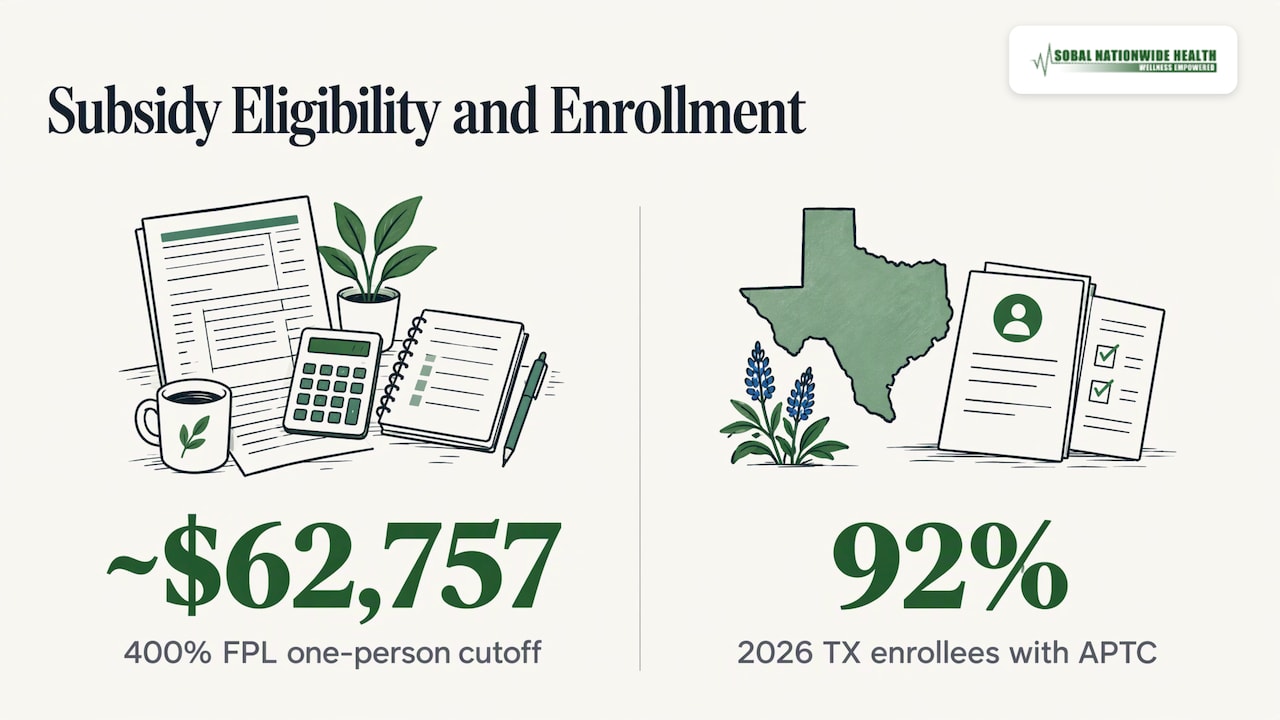
The enhanced premium tax credits have expired, so the 400% federal poverty level cap is back. For one person, that’s about $62,757 a year. Earn above it and you’re not eligible for any premium subsidy.
The same source reports that about 92% of Texas Marketplace enrollees received advance premium tax credits in 2026. That tells you how much the Marketplace depends on subsidies. If you’re among the self-employed professionals who earn too much to qualify, the Marketplace premium is the full sticker price.
For family-size figures, our guide to ACA subsidy income limits walks through the numbers by household size.
Enrolling: open enrollment and special enrollment
The Texas Department of Insurance’s 2026 guide says HealthCare.gov open enrollment runs November 1 through January 15. Check HealthCare.gov for the exact coverage start dates each year, because they depend on when you sign up.
Outside that window, you generally need a qualifying life event. The same guide says a Special Enrollment Period is usually 60 days before or after the event. Common ones include:
- Losing existing health coverage
- Turning 26 and losing coverage through a parent’s plan
- A change in income that makes you newly eligible for the premium tax credit
BenefitsUSA’s Texas guidance agrees that, for most Texans, the window is 60 days from the event, and that your COBRA coverage ending is also a qualifying event. Don’t let the 60 days slip by. Gather your termination letter or coverage-end notice early.
Leaving a job or COBRA
COBRA gives you 60 days after leaving your job to decide whether to elect continuation coverage, according to the Texas Department of Insurance. Many people discover COBRA is expensive because you pay the full premium. Before you sign, compare it with a Marketplace plan and a private plan. Our page on comparing COBRA and Marketplace coverage lays out the steps within that 60-day window.
Turning 26
If you’re leaving a parent’s plan, you have a window to choose your own coverage. Young, healthy adults are often the people who benefit most from a private PPO, since underwriting tends to favor them. A short call lets us compare it with a Marketplace plan for you.
Who tends to choose what
Here are the patterns I see most often among Texas clients. They’re not rules, just a starting point for your own conversation.
- 1099 contractors and freelancers. If your net income is high enough that credits vanish, a private PPO is worth pricing. Our page on health insurance for freelancers and gig workers covers the basics of choosing a plan.
- Realtors. Income swings month to month, so the income-estimate step above matters. Many realtors want a plan that follows them across the state.
- Owner-operator truckers. You’re on the road, so a nationwide PPO network can matter more than a local one. We design plans around where you actually travel.
- Families priced out of a spouse’s employer plan. Adding family members to a job-based plan can be costly. We compare that against a private family PPO.
- Small business owners with 2 to 30 employees. You may be looking at group coverage. See our business health insurance page.
- People leaving COBRA. Compare before the 60 days run out.
What about small business owners with employees?
Self-employed people with no employees can’t use SHOP. CMS guidance says SHOP is not open to a self-employed individual unless at least one employee enrolls. Small employers generally with 1 to 50 full-time employees must offer coverage to all full-time employees, and may qualify for a tax credit worth up to 50% of premium contributions. That’s from older SHOP material, so confirm current rules with an advisor before you plan around it.
Private and group designs can also work for teams. We’ll look at your headcount and budget and show you the options side by side.
The tax deduction most self-employed people should know
This one is easy to miss. Per the IRS, self-employed people may be able to deduct what they pay for medical, dental and vision insurance and qualified long-term care insurance, for themselves, a spouse and dependents. Coverage can include a child who was under 27 at the end of the year, even if that child isn’t your dependent.
You report it on Schedule 1 (Form 1040), line 17, and you don’t need to itemize. If your plan came through the Marketplace and you took advance premium tax credits, the IRS points you to Publication 974, because the deduction and the credit affect each other. Have your tax professional run those numbers.
We’ve put the steps in one place: self-employed health insurance deduction, Form 7206 and Schedule 1.
How to compare plans without getting lost
Insurance vocabulary is confusing. Here’s the short version, the way I explain it to clients.
- Premium: what you pay each month. It gets you in the door.
- Deductible: what you pay for care before the plan starts sharing costs.
- Cost-sharing: copays and coinsurance you pay after that.
- Out-of-pocket maximum: your financial safety net, the most you’d pay in a year for covered care.
The Texas Department of Insurance notes that Marketplace plans have out-of-pocket limits. For any plan you consider, look at all four numbers together, not just the premium. A low premium with a high deductible can cost more than a mid-priced plan if you use care regularly.
Then check the network. A PPO lets you see providers in or out of network, usually at different cost levels. Ask which hospitals, specialists and your own doctors are included before you enroll. We’ll check the network on each plan for you.
Also look at the loss-ratio rule. Federal law requires individual and small employer plans to spend at least 80% of premiums on health care, which gives you a baseline for how premiums are used. The same guide notes that individual plan premiums are locked in for one year.
A simple way to decide
- Estimate your net income for the coverage year.
- Check subsidy eligibility. Use the Marketplace application or ask us to run it with you.
- Price a private PPO if you’re healthy or above the subsidy line.
- Compare networks and out-of-pocket maximums, not just premiums.
- Add dental and vision if you’ll use them.
- Confirm the tax deduction with your tax professional.
That’s about 20 minutes of conversation, not a week of research.
Our perspective
When a self-employed Texan tells me their premium doubled, the story is almost always the same: they earn a bit above the subsidy line, so the Marketplace shows them the full price. They assume that’s the only price in town.
It isn’t. We work with private, medically underwritten plans that aren’t on the public Marketplace, including portable and nationwide PPO designs. For healthy people, those plans can deliver real savings and a wide choice of doctors and hospitals.
We also arrange Marketplace plans, so we have no reason to push you one way. Our job is to explain the choices, show you the trade-offs, and let you decide without sales pressure. You can talk to us in English or Spanish.
Bernie S
Get a plan reviewed by a licensed broker
We’re an independent brokerage helping self-employed individuals, families and small businesses in 31 states, Texas included. We handle private medically underwritten plans, ACA Marketplace plans, dental, vision, supplemental accident and critical illness coverage, and group packages, with policy review and enrollment support. See our personal and family coverage page or start from sobalhealth.com.

For a Texas-specific walkthrough, read how to find affordable health insurance in Texas, and browse our resource guide for more plain-English explainers.
FAQ
Can I get health insurance in Texas if I’m self-employed with no employees?
Yes. Freelancers, consultants and independent contractors can enroll through the individual Marketplace, per HealthCare.gov. You can also look at private medically underwritten plans through a licensed broker. Which is better depends on your income and health.
Do I qualify for a subsidy as a self-employed Texan?
It depends on your estimated net income and household size. The Marketplace application calculates it for you. For a single person, the cap is about $62,757 a year in 2026, and above that there is no premium subsidy.
Can I deduct my health insurance premiums?
You may be able to. The IRS allows self-employed people to deduct premiums for medical, dental and vision coverage on Schedule 1, line 17, without itemizing. If you took Marketplace credits, Publication 974 coordinates the two. Ask your tax professional to confirm your figures.
What if I miss open enrollment?
A qualifying life event, such as losing coverage, your COBRA ending or turning 26, opens a Special Enrollment Period, usually 60 days before or after the event. Talk to us early if you think you’re approaching one, so you don’t run out of time.
Is a short-term plan a good substitute for a regular plan?
Short-term plans are best seen as a bridge between coverages. They use medical underwriting and don’t have to cover all essential health benefits, per the Texas Department of Insurance. If you need ongoing coverage, we’ll compare a private PPO and a Marketplace plan with you.
Ready to see your options? Get my free quote
Sources
- HealthCare.gov: Coverage for the self-employed
- HealthCare.gov: Reporting self-employment income
- Texas Department of Insurance: 2026 Texas Health Coverage Guide
- LegalClarity: Self-employed health insurance in Texas
- IRS: Instructions for Form 7206 (2025)
- IRS: Publication 974 (2022)
- CMS: SHOP Marketplace overview
- Glendale Payroll: S corp owner salary