






As a Texas owner-operator, you have two main routes to health coverage: an ACA Marketplace plan, or a private, medically underwritten PPO plan that you can often use with doctors and hospitals in many states. Which one fits depends on your income, your health, and how far from home you drive.
I’m Bernie Sobalvarro, a licensed independent broker (NPN 19189235), and I help self-employed drivers sort through this every year. No sales pressure here. The goal is that you understand the options well enough to choose with confidence.
Table of Contents
- TL;DR
- Why owner-operators have to buy their own coverage
- Private PPO vs. Marketplace: an honest comparison
- Network matters more than the label “PPO”
- What an ACA-compliant plan covers
- What does it cost?
- Leased to a carrier or fully independent: does it change your health coverage?
- When can you enroll?
- Texas-specific tips for owner-operators
- What to check before you pick any plan
- How we help Texas drivers
- FAQ
- Sources
TL;DR
- Owner-operators are self-employed, so there is no employer plan to join. You buy your own, usually through the Marketplace or a private PPO.
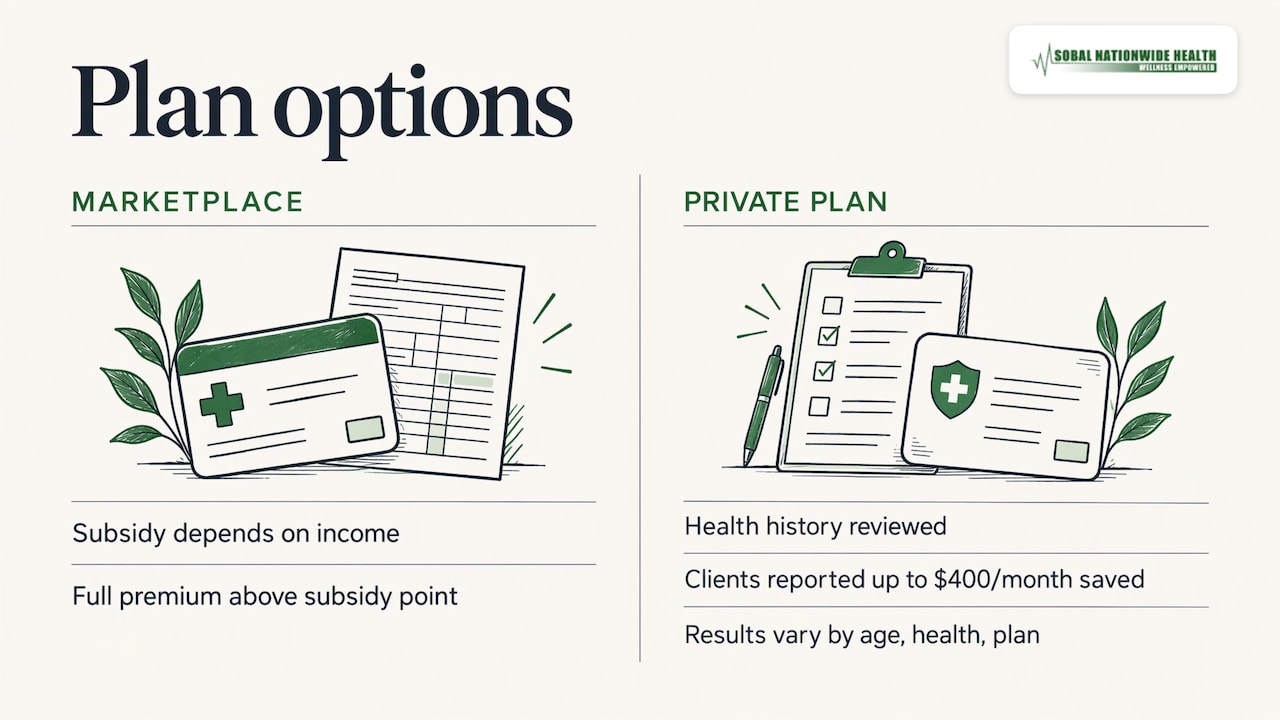
- Marketplace plans are built around a subsidy check. If your income is too high for help, a private medically underwritten plan may cost less and offer a wider network.
- For a driver who crosses state lines, the network, out-of-network benefits and emergency rules matter more than the word “PPO.”
- The Marketplace open enrollment window runs November 1 to January 15 each year. A qualifying life change opens a special window.
- Private plans ask health questions. They are designed for healthy buyers, so they suit many active drivers.
We don’t offer Medicare or Medicaid.
Why owner-operators have to buy their own coverage
When you run your own authority or lease on to a carrier as an independent contractor, you are not an employee. That means no employer group plan, no HR department enrolling you, and no employer paying part of the premium. Everything lands on you.
You are far from alone. A U.S. Treasury analysis found that 3.3 million self-employed workers and small-business owners ages 21 to 64 had Marketplace coverage at some point in 2022, about 28% of Marketplace enrollment in that age range. Buying direct is the normal path for people who work for themselves.
Your realistic choices in Texas come down to these:
- An individual ACA Marketplace plan, with or without a premium tax credit.
- A private, medically underwritten plan, often with a PPO network.
- A spouse’s job-based plan, if one is offered and the family price makes sense.
- A small-group plan, once your company has employees. We cover this on our business health insurance page.
- Supplemental coverage, such as accident, critical illness or fixed indemnity, which adds cash protection but does not replace a real health plan.
Private PPO vs. Marketplace: an honest comparison
Both can be a good answer. The right one depends on your numbers and your route. Here is how they compare side by side.
| What you’re weighing | ACA Marketplace plan | Private medically underwritten PPO |
|---|---|---|
| How you qualify | Open enrollment or a qualifying life event | Health questions answered at application; often available outside the Marketplace window |
| Premium help | Premium tax credits if your income qualifies | No tax-credit subsidy |
| Health questions | None | Yes, which is why healthy buyers may see lower rates |
| Network | Varies by insurer and Texas service area | Often a broad, nationwide PPO network, depending on the plan |
| Essential health benefits | Required in every plan | Depends on the plan design; read the benefits summary |
| Best fit | Drivers whose income qualifies for meaningful subsidies | Healthy drivers above subsidy limits, or who want a wider network |
Think of the premium as what gets you in the door. What you pay once you need care, through the deductible, coinsurance and out-of-pocket maximum, is the part that decides whether the plan really protects you. The out-of-pocket maximum is your financial safety net: the most you pay for covered, in-network care in a plan year.
When the Marketplace usually wins
If your net income after business expenses is modest, subsidies can shrink the premium a lot. HealthCare.gov explains that self-employed people without employees use the individual Marketplace, where one application checks whether you qualify for premium tax credits and other savings. Marketplace plans also include the full set of ACA benefits, and you can’t be turned away for health reasons.
That is worth knowing before anyone sells you anything. If a subsidy would cut your premium sharply, it deserves a serious look. We also enroll clients in ACA Marketplace plans, so we can run that comparison with you.
When a private PPO often makes sense
Many owner-operators have a good year, buy a newer truck, and find their income is above the point where subsidies help. Then the Marketplace premium is the full, unsubsidized price. For a healthy driver, a private plan that looks at your health history can come in lower, and some of our clients have reported savings of up to $400 a month compared with what they were paying. Your result depends on your age, health and the plan you choose, so treat that as a real client experience, not a promise.
Private plans are also where many drivers find the flexible network they want. If you’d like a deeper explanation of how underwriting works, read our guide to medically underwritten insurance.
Network matters more than the label “PPO”
You may be in Laredo on Monday, Memphis on Wednesday and Atlanta by Friday. A plan that is wonderful in Dallas but thin everywhere else is a poor fit for your life.
Here’s the catch: not every plan with PPO in its name behaves the same way. According to an official insurance regulator FAQ on health care reform, some plans provide no out-of-network coverage at all, and the plans that do usually charge you more for it. Emergency services are generally covered without higher out-of-network cost sharing under the ACA, but routine and follow-up care is another story.
Before you enroll in any plan, check these items in the plan’s Summary of Benefits and Coverage and its provider directory:
- Which network is it? Ask for the network name and look up hospitals along your usual lanes.
- What happens out of network? Look for a separate deductible and a higher coinsurance rate.
- How are emergencies handled? Know where to find an in-network urgent care near truck stops you use.
- What are the deductible, coinsurance and out-of-pocket maximum? These tell you the worst-case year.
- How are prescriptions covered? Check the formulary for anything you take regularly.
- Is the provider directory current? Confirm your own doctor at home is listed.
That last point is why a conversation with a broker helps. We look up your doctors and your lanes, then show you plans that work on both ends of the trip.
What an ACA-compliant plan covers
Marketplace plans must address ten categories of essential health benefits. Per federal guidance on essential health benefits, these are:
- Ambulatory (outpatient) services
- Emergency services
- Hospitalization
- Maternity and newborn care
- Mental health and substance use treatment
- Prescription drugs
- Rehabilitative and habilitative services
- Laboratory services
- Preventive and wellness services
- Pediatric services, including oral and vision care
This is the baseline you get on the Marketplace. When you look at a private plan, line up its benefits against this list so you know what you are choosing and what you are not.
What does it cost?
I won’t make up a price for you. Premiums depend on age, location, plan level, tobacco use, income and network type, and the only honest number comes from a quote for your situation.
For a rough sense of scale, one 2026 owner-operator budgeting guide gives broad ranges of $400 to $1,000 or more per month for unsubsidized single coverage and $1,200 to $2,500 or more for a family, with subsidized single premiums possibly falling between $0 and $400 depending on eligibility. Those are ballpark figures, not quotes, and your own number could land outside them.
A few levers you control:
- Plan tier. A higher deductible lowers the monthly premium, but make sure you could cover that deductible from savings.
- Network breadth. A broader nationwide network can cost more than a regional one.
- Health history. On a private plan, your answers shape the rate.
- Who is covered. Pricing a spouse or kids on the same plan versus a separate one can change the total.
Taxes can lower the real cost
Self-employed drivers may be able to deduct the premiums they pay for themselves, their spouse and dependents. This is the Self-Employed Health Insurance Deduction, claimed on your personal return through Form 7206 and Schedule 1, not as a business expense on Schedule C. Our guide to the self-employed health insurance deduction walks through the steps, and your tax preparer can confirm how it applies to you. If you are eligible for a Health Savings Account with a qualifying plan, our page on HSA for the self-employed explains the limits and setup.
Leased to a carrier or fully independent: does it change your health coverage?
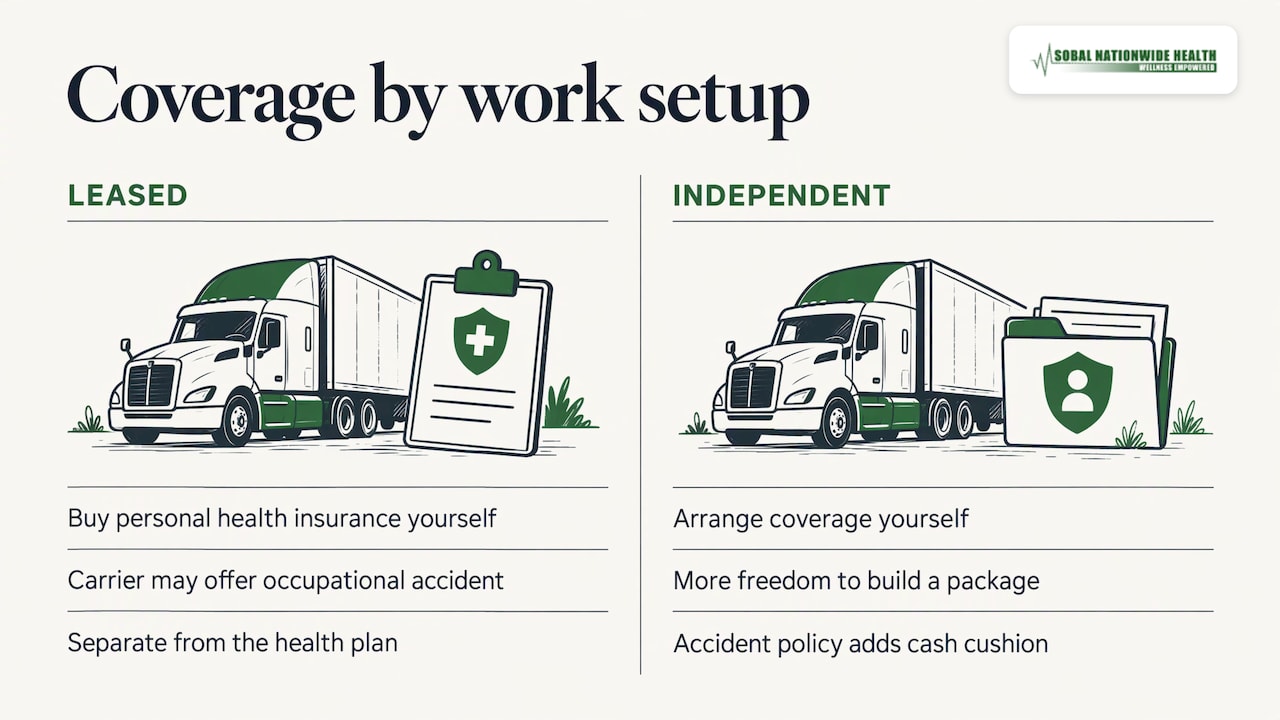
Not much. Whether you lease on to a carrier or run under your own authority, you buy personal health insurance yourself. The difference shows up in other coverage.
If you are leased on, your carrier may offer or require occupational accident coverage. That is designed to respond to work-related injuries, and it is separate from your personal health plan. It does not replace health insurance, so you still need a plan for illness, routine care, prescriptions and non-work injuries. Ask your carrier for the details in writing so you can see what it covers and what it leaves out.
If you are fully independent, you arrange everything yourself, which gives you more freedom to build a package. Pairing a health plan with accident insurance for the self-employed is one way drivers add a cash cushion for the days they can’t haul.
When can you enroll?
The Marketplace has a set yearly window. Open enrollment runs November 1 to January 15, unless you have a qualifying life change such as marriage, a new baby, a move or losing other coverage. Confirm the current year’s deadlines on HealthCare.gov, because the date your coverage starts depends on when you sign up.
Private medically underwritten plans work differently. They are typically not tied to the same yearly window, so you can apply when it suits you, subject to approval. If you’re leaving a spouse’s plan, COBRA, or a job with benefits, don’t wait until the last day. Gaps in coverage are stressful and, for a driver, risky.
Texas-specific tips for owner-operators
Texas has some of the longest hauls in the country, so your home network may be far from where you are when you get sick. A few practical points:
- Check your home-base doctors first. Make sure the primary care doctor and hospital near your Texas address are in the plan.
- Map your regular lanes. If you run I-35, I-10 or I-20 often, look up in-network hospitals in the cities you pass through.
- Look at telehealth. Many plans include virtual visits, handy when you’re parked far from home.
- Think about your family’s location. If your spouse and kids stay in Texas while you drive, they need a strong local network even if yours is nationwide.
- Plan for the business side. If you hire drivers, the rules change. Our guide to Texas small business health insurance covers group options for small teams, and our guide to affordable health insurance in Texas is a good state-level starting point.
The Marketplace application will tell you what savings you qualify for. If you want to compare that with a private plan, we do it side by side.
What to check before you pick any plan
Every option, including plans outside the Marketplace, deserves a careful read. Here’s a short checklist I use with clients:
- Is it comprehensive major medical insurance? Fixed indemnity and accident plans pay set amounts and are meant to add to health coverage, not stand in for it.
- What are the exclusions and waiting periods? Read the list of what the plan does not cover.
- Who is in the network, and where? Look at the provider directory, not just the brochure.
- What is the worst-case year? Add the deductible and the out-of-pocket maximum.
- What does renewal look like? Ask how premiums can change from year to year.
- Is the broker licensed in Texas? Ask for the NPN and check it.
If you are new to the language, our page on plan types that still use underwriting explains what each one is.
Our perspective
We talk with self-employed drivers every week, and the pattern is the same. Most arrive after a year of paying a Marketplace premium that kept climbing, or after a gap they never planned for. They are healthy, they work hard, and they earn too much for meaningful subsidies.
For those drivers, we believe a private, medically underwritten PPO deserves a look next to the Marketplace. Our approach is to start with your doctors, your lanes and your budget, and then show you both. If the Marketplace is the better fit, we’ll say so and enroll you there. If a private plan can give you a wider network and a lower premium, we’ll walk you through exactly how it works, including what it does not do.
You can reach a broker directly, in English or Spanish, with no pressure and no pushy follow-up. Our job is to help you understand your plan before you need it, not after the bill arrives.
Bernie S
How we help Texas drivers
Sobal Health is an independent brokerage licensed in Texas and 30 other states. We compare private medically underwritten plans and ACA Marketplace plans, and we also place dental, vision, accident and critical illness coverage. You get a direct broker who reviews your current policy, looks up your doctors, and helps with enrollment.
See the full range of what we offer on our personal and family insurance page, or read our hub for 1099 contractors if you are newly self-employed. For more guides, visit our resource library. If you run a company with drivers on payroll, start with business health insurance. Broker fees, where they apply, are explained on that page.
FAQ
Can an owner-operator get health insurance through the company they lease to?
Usually not as an employee benefit, because owner-operators are independent contractors. Some carriers offer occupational accident coverage, which is separate and does not replace personal health insurance. You still need your own medical plan.
Is a PPO plan better than an HMO for a truck driver?
For most drivers who cross state lines, a PPO with a broad network is easier to live with, since you can see providers without a referral. The details of the network and out-of-network benefit matter more than the label, so check the Summary of Benefits and Coverage.
Can I deduct my health insurance premiums as a self-employed driver?
Many self-employed people can deduct premiums for themselves, a spouse and dependents using Form 7206 and Schedule 1, rather than as a Schedule C expense. Eligibility rules apply, so confirm with your tax professional. Our deduction guide explains the steps.
When can I sign up for a plan in Texas?
Marketplace open enrollment runs November 1 to January 15 each year, and a qualifying life change opens a special window. Private medically underwritten plans are generally not tied to that calendar, though approval depends on your health answers.
Will a private plan work if I get sick far from home?
It can, if you choose a plan with a strong nationwide network and know its out-of-network rules. Emergency care is generally covered without higher out-of-network cost sharing under the ACA. A broker can check hospitals along your regular routes before you enroll.
Sources
- Affordable Care Act Marketplace Coverage for the Self-Employed and Small Business Owners, U.S. Treasury
- Health Care Insurance Coverage for Self-Employed, HealthCare.gov
- Health coverage for self-employed, HealthCare.gov
- Frequently Asked Questions About Health Care Reform, Indiana Department of Insurance
- Essential Health Benefits Bulletin, Alabama Department of Insurance
- Owner Operator Health Insurance (2026): Options & Costs, LogRock