






If you buy your own coverage, open enrollment for 2027 Marketplace plans starts November 1, and December 15 is the date to plan around if you want coverage on January 1. Outside that window you generally need a qualifying life event to enroll in a Marketplace plan, but private medically underwritten plans sit outside the Marketplace calendar, so it pays to compare both before the deadline.
Table of Contents
- TL;DR
- The 2027 open enrollment dates at a glance
- Can you use the Marketplace if you are self-employed?
- What counts as a Special Enrollment Period?
- How your income shapes what you pay
- Private PPO vs. Marketplace: an honest comparison
- Who should do what before December 15
- Don’t forget the tax deduction
- Our perspective
- A simple plan for the next few weeks
- Get a second set of eyes on your options
- FAQ
- Sources
TL;DR
- Marketplace open enrollment for 2027 coverage begins November 1. Enroll by December 15 for a January 1 start, per HealthCare.gov.
- Miss it, and you generally need a Special Enrollment Period (a qualifying life event) to enroll in a Marketplace plan.
- Your Marketplace savings depend on your estimated net self-employment income for the coverage year, not last year’s.
- A private PPO is a second path for healthy buyers, with broader doctor choice, but it is medically underwritten, so approval depends on your health history.
- We don’t offer Medicare or Medicaid.
I’m Bernie Sobalvarro, a licensed independent broker (NPN 19189235). Today is November 9, so the clock is already running. Here is how I’d walk a self-employed client through it.
The 2027 open enrollment dates at a glance
Open enrollment is the once-a-year window when anyone can sign up for, renew or change an individual Marketplace plan. Think of it as the one door that is open to everybody. After it closes, you need a key, and the key is a qualifying life event.
Here are the dates HealthCare.gov lists for 2027 coverage:
| Date | What happens |
|---|---|
| November 1 | Open enrollment starts. First day to enroll, renew or change plans. |
| December 15 | Last day to enroll for coverage that starts January 1. |
| January 15 | Open enrollment ends on the federal calendar. |
| February 1 | Coverage start date if you enroll December 16 through January 15 and pay your first premium. |
Source for the table: HealthCare.gov’s dates and deadlines page.
Here is the catch. Reporting on the 2027 season describes the window as shrinking to roughly six weeks, and some states set their own dates. For instance, the Texas Department of Insurance lists November 1 to December 15 for marketplace and individual plans. Rules and calendars can shift from year to year.
My advice: treat December 15 as your real deadline. If a later date turns out to apply to you, you have gained a cushion. If you assume the later date and it doesn’t, you could be uninsured in January.
For a deeper look at the calendar, see our guide on when open enrollment for health insurance 2027 starts.
Can you use the Marketplace if you are self-employed?
Yes. HealthCare.gov defines a self-employed person as someone who runs a business that takes in income but has no employees, and that person can use the individual Marketplace. If you have even one employee who isn’t you, your spouse, a family member or another owner, the small business (SHOP) Marketplace may be the route instead.
That covers a lot of people:
- 1099 contractors and freelancers
- Realtors and real estate agents
- Owner-operator truckers
- Gig workers
- Solo consultants and sole proprietors
A Treasury Department analysis found that in 2022, 18 percent of self-employed workers and small business owners ages 21 to 64 had Marketplace coverage, compared with 6 percent of everyone else in that age range. If you buy on the Marketplace, you are in very good company.
When you apply, you will estimate your net self-employment income. The application then shows whether you qualify for premium tax credits and other savings based on that income and your household size.
What counts as a Special Enrollment Period?
A Special Enrollment Period (SEP) is the exception to the once-a-year rule. It opens when something big changes in your life. Federal guidance lists events such as getting married, having a baby, adopting a child, or losing eligibility for other coverage. Depending on the type, you may have 60 days before or after the event to enroll.
This is the answer to the question I hear most: open enrollment versus special enrollment. Open enrollment is for everyone, once a year. Special enrollment is for people with a qualifying event, on a clock that starts with that event.
A few situations I see often with self-employed clients:
- You are leaving a job and a group plan. Losing employer coverage is a classic qualifying event. You may also be weighing COBRA, which continues the same plan temporarily, is usually costly, and runs 18 to 36 months.
- You are a young adult turning 26. Aging off a parent’s plan is a common trigger, and it comes with its own enrollment clock.
- Your family is priced out of a spouse’s employer plan. Being offered coverage doesn’t always mean it is affordable. Federal guidance explains that if your share of the premium for your employer’s plans is more than 9.12% of household income (that figure comes from 2023 to 2024 guidance), or the plan doesn’t meet minimum value, you may be eligible for a tax credit if you decline it.
- You had a baby, got married or adopted. All of these can open a window.
Worried you have missed your window? We cover that for Floridians in our Special Enrollment Period guide, and the rules are similar in our other states.
How your income shapes what you pay
This is where self-employed buyers get tripped up, because your income isn’t a number on a pay stub. It is an estimate.
HealthCare.gov explains that Marketplace savings are based on your estimated net income for the year you are getting coverage, not last year’s income. Net income is what you report on Schedule C of your federal tax return: what is left after business expenses.
The CMS application instructions list many deductible expenses that reduce that net figure, including car and truck expenses, rent for business property, advertising, contract labor, retirement plan contributions and the cost of self-employed health insurance. Work through your own numbers carefully before you enter an estimate.
A simple way to start is to run your numbers through an adjusted gross income calculator, then compare the result with the subsidy thresholds below.
The income line high earners need to know
The enhanced subsidies from the American Rescue Plan and the Inflation Reduction Act raised credits and opened them to households above 400% of the poverty level. Those enhancements have since expired. One professional analysis puts the 400% cutoff for 2026 at $62,600 for a single person, $84,600 for a couple and $128,600 for a family of four, and crossing it by even a dollar can mean repaying thousands in advance credits. Poverty-level figures update annually, so confirm the 2027 numbers when you apply.
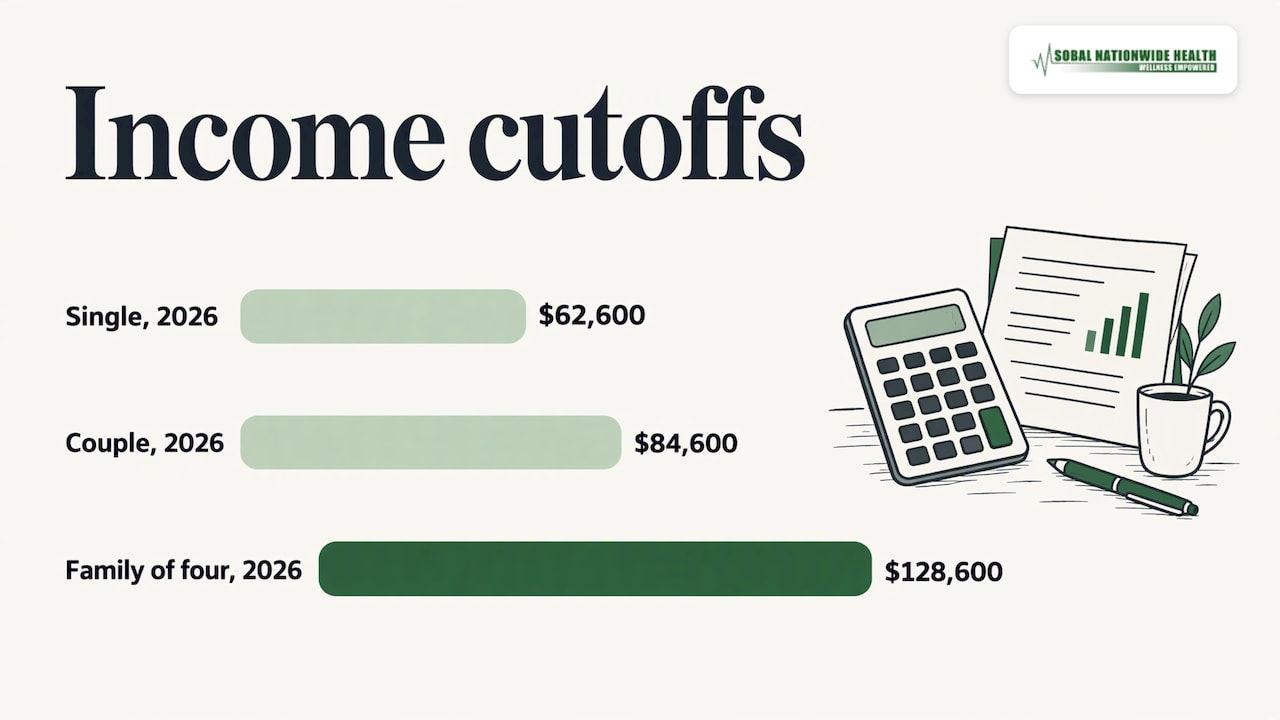
The same analysis notes that self-employed people have some flexibility to manage income. Contributions to pre-tax retirement accounts, HSAs and FSAs can lower the AGI used for credit calculations. Talk to your tax professional about what fits your situation.
If you earn too much for subsidies, the Marketplace may not be your best value, and that is exactly the situation where I suggest comparing a private plan.
Private PPO vs. Marketplace: an honest comparison
Both paths can be the right answer. Here is how they differ.
| Marketplace (ACA) plan | Private medically underwritten PPO | |
|---|---|---|
| When you can enroll | Open enrollment, or a Special Enrollment Period | Not set by the Marketplace calendar. Timing depends on the carrier and your state, so we check it with you. |
| Health questions | None. Plans can’t exclude treatment based on pre-existing conditions | Yes. Approval depends on your health history, which is why it suits healthy buyers |
| Subsidies | Premium tax credits based on estimated net income | Not subsidized |
| Benefits | All plans cover 10 essential health benefits | Varies by plan design, so we review the policy line by line with you |
| Doctor and hospital choice | Depends on the plan’s network | Our private PPO options are built around broad, portable and nationwide choice |
| Best fit | Lower to moderate incomes, anyone who wants guaranteed approval | Healthy, higher-income buyers, and families who want to keep their doctors |
Here is how I’d frame it. If your income is in subsidy range, the Marketplace credit can be hard to beat, and I’ll tell you so. If your income is above the subsidy line, or your family wants to see any doctor or hospital without worrying about networks, a private PPO is worth a serious look. The premium gets you in the door, but the deductible, copays and out-of-pocket maximum decide what you actually pay when you use care.
HealthCare.gov describes the Marketplace range well: some plans have low premiums that mostly protect you in worst-case scenarios, while others cost more each month but less when you get care. Private plans work the same way, so compare all four numbers, not only the monthly bill.
We also walk through this in more detail in our Private PPO vs. Marketplace guide and in how medically underwritten insurance works.
Short-term plans and other stopgaps
Short-term plans can bridge a gap, but they have limited duration, benefit caps and usually exclude pre-existing conditions. Treat them as a bridge between coverage, not a replacement for a full plan.
Who should do what before December 15
Different self-employed situations call for different first moves.
1099 contractors and freelancers. Estimate your net income first, then see if you land in subsidy range. Our guide on estimating income first can help.
Realtors and agents. Income swings month to month, so build your estimate from a realistic year, not your best quarter.
Owner-operator truckers. Business expenses like fuel, repairs and vehicle costs reduce net income. A plan with a nationwide network matters when you work on the road, so ask about portability.
People leaving COBRA or a job. Compare COBRA’s cost against a new individual plan. Mind the 60-day clock after losing coverage.
High earners above subsidy limits. Run the numbers on both a Marketplace plan with no subsidy and a private PPO.
Families priced out of a spouse’s plan. Compare the family premium on the employer plan against buying a plan of your own.
Small business owners with 2 to 30 employees. You may be looking at a group plan rather than the individual market. See our pages on business health insurance and small business health care options.
Young adults turning 26. Start looking before your birthday, not after.
If you are 65 or older, or have a low income: we don’t offer Medicare or Medicaid.
Don’t forget the tax deduction
Self-employed people with a net profit may be able to deduct health insurance premiums as an adjustment to income. IRS guidance says this can cover you, your spouse, your dependents and children under age 27 at year-end. The deduction can’t exceed your earned income from the business, and you can’t deduct months when you were eligible for a plan subsidized by your or your spouse’s employer. If you used the Marketplace and claim the premium tax credit, the IRS points you to Publication 974 to figure the amount.
The deduction lowers your AGI, which can in turn affect your subsidy. That is one more reason to bring your tax preparer into the conversation. The IRS page above is for 2021 returns, so confirm current-year rules.
Our perspective
I’ve sat across from hundreds of self-employed clients, and the same story repeats. Someone shops the Marketplace in the last week of November, sees a premium that doesn’t make sense, and either overpays or goes without.
We built Sobal Health around a different habit: slow down, learn the terms, and compare every realistic option side by side. For healthy self-employed people, active families and young adults, private medically underwritten plans can open up broader PPO networks and, for many of our clients, real savings. Some clients have told us they save as much as $400 a month. Results depend on your age, health, state and plan.
We also tell people when the Marketplace is the better fit. If your income qualifies you for a strong credit, that matters, and we’ll enroll you there. We can place you in either path, in English or Spanish, and we explain the policy before you sign, with no sales pressure.
The best time to ask questions is before the deadline, not after.
Bernie S
A simple plan for the next few weeks
- Estimate your 2027 net income. Use last year’s Schedule C as a starting point, then adjust for changes you expect.
- Mark December 15 on your calendar. Aim to finish a week earlier.
- List the doctors and hospitals you use. Check them against any network you consider.
- Compare four numbers per plan: premium, deductible, copays or coinsurance, and out-of-pocket maximum.
- Ask about both paths. Get a Marketplace quote and a private PPO quote, then compare.
- Confirm your start date. Enrolling by December 15 gives you a January 1 start, and later enrollment on the Marketplace starts February 1 per HealthCare.gov.
If you want questions to bring to a broker, our list of 10 broker questions for private insurance is a good place to start. More explainers live in our resource guide.
Get a second set of eyes on your options
We are an independent brokerage helping self-employed people, families and small businesses in 31 states compare private medically underwritten plans, ACA marketplace plans, dental, vision and supplemental coverage. Our advisors review policies with you, answer questions in English or Spanish, and help with enrollment.
Ready to see your options? Start with personal and family coverage, or look at our business health insurance page if you have employees.
FAQ
Can I enroll in health insurance outside open enrollment if I’m self-employed?
For Marketplace plans, you generally need a Special Enrollment Period, which follows a qualifying event such as marriage, a new baby, adoption or loss of other coverage. Private medically underwritten plans are not run on the Marketplace calendar, so ask us about timing for the carrier and state you are in.
What is the difference between open enrollment and special enrollment?
Open enrollment is a yearly window when anyone can sign up for Marketplace coverage. Special enrollment is a shorter window triggered by a life event, and depending on the event you may have 60 days before or after it to act.
How do I report income on a Marketplace application when mine changes every month?
You estimate your net self-employment income for the year you want coverage, meaning revenue minus business expenses. Build the estimate from a realistic full year and revisit it if your income changes substantially. Your tax professional can help you check the number.
Do I have to answer health questions to get a private PPO?
Yes. Private medically underwritten plans review your health history, which is why they tend to suit healthy buyers. Marketplace plans don’t ask, and they can’t exclude treatment for pre-existing conditions. Some pre-existing conditions can still be covered on private plans, depending on the carrier, and we can review that with you.
Can I deduct my health insurance premiums as a self-employed person?
If you have a net profit, you may be able to take the self-employed health insurance deduction, within the limits the IRS sets. Ask your tax preparer how it applies to your situation, especially if you claim the premium tax credit.
Sources
- HealthCare.gov: When can you get health insurance?
- HealthCare.gov: Health coverage for self-employed
- HealthCare.gov: Health care insurance coverage for self-employed
- HealthCare.gov: Reporting self-employment income
- Texas Department of Insurance: Health care coverage guide
- SelfEmployed.com: ACA open enrollment shrinks to six weeks
- DOL: Health Insurance Marketplace coverage options
- CMS: Instructions for the individual application
- U.S. Treasury: ACA Marketplace coverage for self-employed and small business owners
- Kitces.com: Reducing ACA premiums after the enhanced credit expiration
- healthinsurance.org: Self-employed health insurance guide
- IRS Publication 502
- Thrive X DNA: Adjusted gross income calculator
Get my free quote: https://sobalhealth.com/contact.html#cform Health Advisors/new-members-policy-review