

Open enrollment is the yearly window when you can sign up for or change health coverage without a special reason, and the 2027 Marketplace window runs from November 1, 2026, to January 15, 2027, with enrollment by December 15, 2026, required for coverage to start January 1. Medicare’s Annual Enrollment Period runs October 15 to December 7, while Medicaid and CHIP accept applications year-round. If your income puts you above the subsidy cutoff, we’ll also show you where private medically underwritten plans might fit in, and where they may not.
TL;DR:
- Marketplace open enrollment runs from November 1, 2026, to January 15, 2027, with coverage starting January 1 for enrollments completed by December 15.
- Missing the December 15 deadline shifts your coverage start to February 1, and some states like Illinois may have later deadlines, so check local dates.
- Income thresholds of $63,840 for singles and $132,000 for families determine subsidy eligibility, and crossing these may eliminate premium assistance.
- Private medically underwritten plans can be an option if your income exceeds subsidy limits, but they depend on health questions and vary by state.
- Medicaid and CHIP accept applications year-round, making them often the best value for those who qualify, regardless of enrollment periods.
Table of Contents
- Key dates and what they mean for your coverage
- How Marketplace coverage works and who it’s built for
- Medicare enrollment windows, allowed changes, and penalties
- Medicaid and CHIP: coverage you can apply for anytime
- Special Enrollment Periods: qualifying events and deadlines
- Preparing your application: a checklist that avoids delays
- Private medically underwritten plans: where they fit and where they don’t
- Why broker-led guidance helps during open enrollment
- How Sobal Nationwide Health can help you compare options
- FAQ
- Sources
Key dates and what they mean for your coverage
Every deadline on this list maps to a specific coverage start date, and missing one by even a day can push your plan back a full month.
- Marketplace Open Enrollment runs November 1, 2026, through January 15, 2027, with coverage starting January 1 if you enroll by December 15.
- Enroll between December 16 and January 15 and your coverage starts February 1 instead.
- Medicare’s Annual Enrollment Period runs October 15 to December 7, and changes take effect January 1 as long as your plan receives the request by December 7.
- Medicare’s Initial Enrollment Period surrounds your 65th birthday, and the General Enrollment Period (January through March) is a fallback with coverage starting July 1.
- Some state-run marketplaces extend past January 15. Illinois, for example, keeps its window open longer, so check your own state’s dates before assuming the federal deadline applies to you.
How Marketplace coverage works and who it’s built for
The Marketplace sets your premium subsidy based on your household’s projected annual income, which is why HealthCare.gov asks about income and job-based coverage for everyone in your household, not just the people enrolling. That number determines whether you get help paying premiums or pay full price. It’s also why the $63,840 single and $132,000 family-of-four cutoffs matter so much: cross them, and subsidies disappear entirely.
A few things worth knowing before you let the Marketplace auto-renew your plan:
- Marketplace plans often re-enroll you automatically each year, sometimes into a plan with a higher premium or a smaller network than you realize.
- If you’re managing an ongoing condition or planning a pregnancy, Marketplace coverage is usually the safer home base because it can’t turn you away or charge more for your health history.
- If your income sits above the subsidy threshold, a Marketplace plan at full price may not be your cheapest option.
Pro Tip: Before you let your Marketplace plan renew automatically, log in and check your renewal notice. A five-minute review can save you from a premium increase you never saw coming.
Medicare enrollment windows, allowed changes, and penalties
If you’re on or approaching Medicare, four windows matter, and each one allows different changes.
- The Annual Enrollment Period (October 15 to December 7) lets you switch between Original Medicare and Medicare Advantage, or change Part D drug plans, with changes effective January 1 if your request reaches the plan by December 7.
- Your Initial Enrollment Period surrounds your 65th birthday; missing it can mean permanent penalties and a delayed start date.
- The General Enrollment Period (January through March) is a backup window, but coverage doesn’t start until July 1.
- The Medicare Advantage Open Enrollment Period (January 1 to March 31) is narrower than AEP: it only lets you switch Medicare Advantage plans or drop back to Original Medicare, not add a new Part D plan from scratch.
Part D late-enrollment penalties add up over time. The penalty is calculated as a percentage of the national base beneficiary premium, multiplied by the number of full months you went without creditable drug coverage, and it can stay on your premium for as long as you carry Part D. A partner resource breaks down how IEP, AEP, OEP, and SEP interact if you want a deeper walkthrough of how the windows connect.
Medicaid and CHIP: coverage you can apply for anytime
Unlike the Marketplace and Medicare, Medicaid and CHIP don’t close. You can apply the day your income drops, and coverage can start right away if you qualify.
- Medicaid and CHIP accept applications year-round, with no deadline tied to a calendar window.
- States can expand access through continuous eligibility periods or express lane enrollment, so the rules in your state may be more generous than the federal baseline.
- If you qualify for Medicaid or CHIP, that coverage is almost always your best value compared with a private plan, since there’s no premium to weigh against a deductible.
Check your state’s Medicaid office directly, since eligibility thresholds and program names vary widely from state to state.
Special Enrollment Periods: qualifying events and deadlines
Life doesn’t wait for open enrollment, and the Marketplace knows it. A Special Enrollment Period lets you enroll outside the normal window when a qualifying event changes your situation.
- Losing job-based coverage typically gives you 60 days from the loss date to enroll in a new plan.
- Moving to a new coverage area opens a similar 60-day window, often with proof of your new address required.
- Marriage qualifies you for a SEP, and coverage can start the first day of the month after you enroll.
- Having or adopting a child usually lets coverage start retroactively to the date of birth or adoption if you act within 60 days.
- A major income change that shifts your subsidy eligibility can also trigger a SEP, which matters if you’re hovering near the cutoff.
Readers in Florida dealing with a mid-year change can see how the timing works in our guide to changing health insurance outside open enrollment. Whatever the event, submit your proof documents quickly: a late upload is one of the most common reasons coverage gets delayed.
Preparing your application: a checklist that avoids delays
A little prep work before you sit down to apply saves you from the back-and-forth that stalls so many Marketplace applications.
- Gather Social Security numbers or immigration document numbers for everyone applying.
- Pull together proof of income: recent pay stubs, your most recent W-2, or a self-employment ledger if your income varies month to month.
- Complete the Employer Coverage Tool for any job where you’re eligible for employer-sponsored insurance, even if you don’t plan to enroll in it. Skipping this step is one of the most overlooked mistakes, and it can quietly affect your subsidy calculation.
- Upload verification documents as soon as the Marketplace requests them. Verification deadlines run around 90 days, and missing that window can mean losing coverage you already started.
- Pay your first premium promptly and confirm your enrollment is active before assuming your coverage start date is locked in.
Pro Tip: If your income swings month to month, keep a simple running ledger instead of relying on a single pay stub. It makes verification faster and reduces the odds of an unpleasant subsidy reconciliation later.
Private medically underwritten plans: where they fit and where they don’t
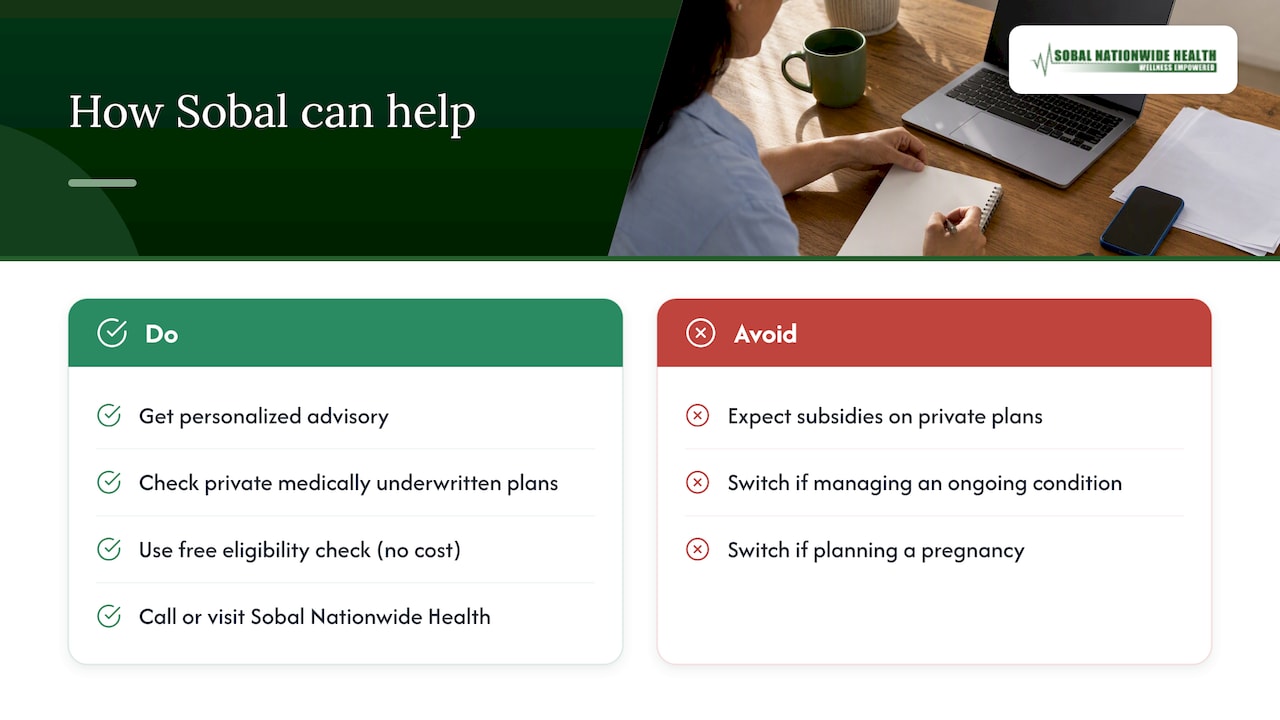
If your income lands above the subsidy cutoff, we think it’s worth comparing private medically underwritten plans before you commit to a full-price Marketplace policy. These plans work differently: instead of guaranteed acceptance, approval depends on a set of health questions, and carriers decide case by case which applicants and which pre-existing conditions they’ll accept. Some applicants find a $0 deductible option paired with a PPO network; others don’t qualify at all, since availability and underwriting rules vary by state.
A few things to weigh honestly:
- These are not Marketplace plans, and no subsidy applies to the premium, so the comparison only makes financial sense once you’re paying full price anyway.
- Underwriting means your health history matters; not everyone qualifies, and which conditions are accepted depends on the carrier and your state.
- If you have an ongoing condition you’re actively managing, or you’re planning a pregnancy, staying on a Marketplace plan is almost always the safer choice, since Marketplace coverage can’t deny you or rate you up for your health history.
- Because rules shift by state, a licensed broker who knows your state’s underwriting landscape can tell you quickly whether it’s worth applying.
Why broker-led guidance helps during open enrollment
I’ve spent years helping self-employed workers and families sort through subsidy math and underwriting questions during this exact window. The most expensive mistakes I see aren’t bad plans, they’re decisions made without knowing a cheaper or better-fitting option existed.
— Bernie S
How Sobal Nationwide Health can help you compare options
We built our brokerage around the exact situation this article describes: helping people who are above the subsidy cutoff consider whether a private medically underwritten plan might fit their needs, without steering anyone away from the Marketplace when it’s clearly the better fit. We offer personalized advisory across personal and family insurance, access to private medically underwritten plans where available in your state, and enrollment support in English or Spanish.

To be clear: these private plans are not Marketplace plans, and no subsidy applies to them. If you’re managing an ongoing condition or planning a pregnancy, we’ll tell you to stay on the Marketplace, because that’s usually the right call for you. For everyone else, it costs nothing to find out what you qualify for. Call us at (305) 680-0125. There’s no fee to use a broker, and you can also start by visiting our Sobal Nationwide Health page.
This article is general information, not a substitute for advice from a qualified financial advisor. Consult a qualified financial professional about your own circumstances before acting on anything here.
FAQ
Has open enrollment been extended for 2026?
Marketplace plans sold during the 2026 open enrollment season follow the standard federal window, and the 2027 plan year’s enrollment period runs November 1, 2026, through January 15, 2027. Some state-run marketplaces set their own extended dates, so check your state’s exchange directly.
What does open enrollment mean?
Open enrollment is the annual period when you can sign up for, switch, or drop health coverage without needing a qualifying life event. Outside this window, you generally need a Special Enrollment Period to make changes, unless you’re applying for Medicaid or CHIP, which accept applications year-round.
What are the Medicare open enrollment dates for 2026?
Medicare’s Annual Enrollment Period runs October 15 through December 7 each year, and any changes you make take effect January 1 as long as your plan receives the request by December 7. This window lets you switch between Original Medicare and Medicare Advantage or change your Part D drug plan.
What are the rules for open enrollment?
Marketplace rules require enrollment by December 15 for coverage starting January 1, with a second window running through January 15 for February 1 coverage. Outside open enrollment, you need a qualifying event, such as losing job coverage or having a baby, to trigger a Special Enrollment Period.
