

If you’re a Nevada employer looking to offer health coverage, your three realistic paths are a QSEHRA, an ICHRA, or a direct small-group plan arranged through a carrier or broker. The one wrinkle that shapes everything else: Nevada’s carriers aren’t currently offering SHOP plans, so the state marketplace’s small-business channel isn’t an option right now. Your next move depends mostly on your budget and whether you qualify for the Small Business Health Care Tax Credit.
TL;DR:
- The 2026 QSEHRA caps are $6,450 annually for individual coverage and $13,100 for family coverage, and employers may set lower allowances.
- Employers below 25 FTEs may qualify for a credit covering up to 50% of premiums if average wages and employer contributions meet IRS thresholds.
- Offering either HRA can change employees’ eligibility for marketplace premium tax credits, so compare subsidy effects before setting reimbursement allowances.
- ICHRA enrollment triggers a Special Enrollment Period for employees buying individual coverage outside open enrollment.
- Compare premiums with expected deductibles and copays, since a low premium can leave employees paying more when they need regular care.
Table of Contents
- QSEHRA, ICHRA, and Small-Group Plans: What Fits Your Business
- What Coverage Actually Costs, and the Tax Credit Most Owners Miss
- Nevada’s Market Quirks That Affect Your Timing
- How to Choose: A Decision Checklist for Nevada Employers
- Setting Up Coverage: Notices, Paperwork, and Free Help
- Where a Broker Actually Saves You Money
- Nevada’s Rules That Shape Your Small-Group Options
- Add-On Benefits That Extend Your Budget Further
- What Actually Drives Your Premium Costs
- Comparing Deductibles and Coverage Levels
- Working With a Broker Without Getting Pressured
- State Resources Worth Knowing About
- Benefits, Wages, and What Actually Keeps Employees Around
- Getting Started With Business Health Insurance in Nevada
- FAQ
- Sources
QSEHRA, ICHRA, and Small-Group Plans: What Fits Your Business
Each of these three approaches solves a different problem, and picking the wrong one usually means either overpaying or under-delivering for your team.
A QSEHRA (Qualified Small Employer Health Reimbursement Arrangement) lets employers with fewer than 50 full-time employees reimburse workers tax-free for individual health insurance premiums and medical expenses, up to an annual cap. You’re not managing a group plan at all. You just set a reimbursement allowance, and employees go buy their own coverage.
An ICHRA (Individual Coverage Health Reimbursement Arrangement) works on a similar principle but has no employer size limit and no reimbursement cap. You can set different allowances for different employee classes (full-time versus part-time, for example), and enrolling in one triggers a Special Enrollment Period for employees who need to buy an individual plan outside the normal window.
Small-group plans (covering 1 to 50 employees) are traditional employer-sponsored coverage, usually arranged directly with a carrier or through a broker since Nevada’s SHOP exchange isn’t active.
- QSEHRA fits very small employers who’ve never offered group coverage and want a capped, predictable cost.
- ICHRA fits growing businesses that want flexibility across employee classes and don’t want a reimbursement ceiling.
- Small-group plans fit employers who want one standard plan for everyone and more predictable year-over-year renewal terms.
What Coverage Actually Costs, and the Tax Credit Most Owners Miss
The dollar figures matter here, because they set your budget ceiling before you even start comparing carriers.
For 2026, the maximum annual QSEHRA contribution is $6,450 for employee-only coverage and $13,100 for family coverage, which works out to roughly $537 and $1,091 a month. Those are caps, not requirements, so you can set your allowance lower if the full amount doesn’t fit your budget.
The Small Business Health Care Tax Credit can cover up to 50% of what you contribute toward employee premiums (35% for tax-exempt employers), available for two consecutive taxable years. Eligibility requires fewer than 25 full-time equivalent employees, average wages below the IRS threshold, and employer contributions covering at least half of employee-only premium costs.
To estimate your net cost:
- Add up your planned monthly contribution per employee.
- Check whether your FTE count and average wage fall under the credit’s thresholds.
- Subtract the estimated credit percentage from your gross contribution to see your real out-of-pocket number.
One caveat worth knowing early: offering a QSEHRA or ICHRA can affect whether your employees still qualify for their own premium tax credits on the individual marketplace, so it’s worth running the numbers both ways before committing.
Nevada’s Market Quirks That Affect Your Timing
Nevada has a few state-specific wrinkles that change how and when you should act.
- Nevada Health Link confirms that carriers are not offering SHOP health or dental plans, so small employers work directly with carriers or a licensed broker instead of the state exchange.
- Open enrollment for individual marketplace coverage follows the standard federal window each fall, which matters if your employees will be buying their own plans under a QSEHRA or ICHRA; outside that window, they generally need a qualifying event or an ICRA-triggered Special Enrollment Period to enroll.
- The Nevada Division of Insurance previews proposed rate changes each year ahead of open enrollment, and those filings are worth checking before locking in a renewal date, since carrier participation and pricing can shift year to year.
How to Choose: A Decision Checklist for Nevada Employers
Rather than guessing, walk through these steps in order:
- Count your full-time equivalent employees. This determines whether QSEHRA’s 50-employee limit applies to you and whether you might qualify for the tax credit’s 25-FTE threshold.
- Check if you already offer a group plan. QSEHRA generally can’t be combined with an existing group health plan for the same employees.
- Set a realistic monthly budget per employee, then compare it against the 2026 QSEHRA caps to see if you’re under or over the limit.
- Decide what you value more: ICHRA’s flexibility and uncapped reimbursement, or QSEHRA’s simplicity and lower administrative lift.
- Bring your numbers to a broker or carrier, including headcount, average wage, and current benefits, before you commit to a structure.
Pro Tip: If you’re unsure whether your business qualifies for the tax credit, run the math before picking a plan structure. It can change which option actually costs less.
Watch for red flags like a broker who pushes one plan type without asking about your FTE count or budget. That’s usually a sign they’re not tailoring the recommendation to you.
Setting Up Coverage: Notices, Paperwork, and Free Help
Each approach comes with its own administrative checklist, and skipping a step can delay reimbursements or create compliance headaches.
- QSEHRA requires a written notice to eligible employees at least 90 days before the plan year starts, detailing the benefit amount and reminding them it may affect their eligibility for premium tax credits. Reimbursements need documentation proving the employee has qualifying coverage.
- ICHRA requires you to define employee classes clearly, issue an offer notice before the plan year, and track which employees accept versus waive the arrangement, since waiving affects their marketplace subsidy eligibility.
- Small-group enrollment through a broker typically means submitting census data (ages, ZIP codes, dependent counts) to get quotes, then handling paperwork directly with the chosen carrier.
- For employees shopping individually, Nevada Health Link offers free enrollment assistance, and a broker directory can help employers find licensed local help.
Where a Broker Actually Saves You Money
We’ve seen the same pattern play out again and again: owners assume a broker’s value is just paperwork, when the real savings usually come from access.
We offer advisory support, enrollment help, and access to private medically underwritten health plans that aren’t available through the public marketplace. These plans can sometimes deliver meaningful savings over standard group or ACA options, particularly for smaller groups with younger or healthier workforces where underwriting works in their favor.
Where broker guidance tends to pay off most is in comparing QSEHRA, ICHRA, and group options side by side, since the right structure depends on your specific headcount and budget. We’d still recommend validating any plan choice with a licensed broker and a tax advisor before you finalize it.
Nevada’s Rules That Shape Your Small-Group Options
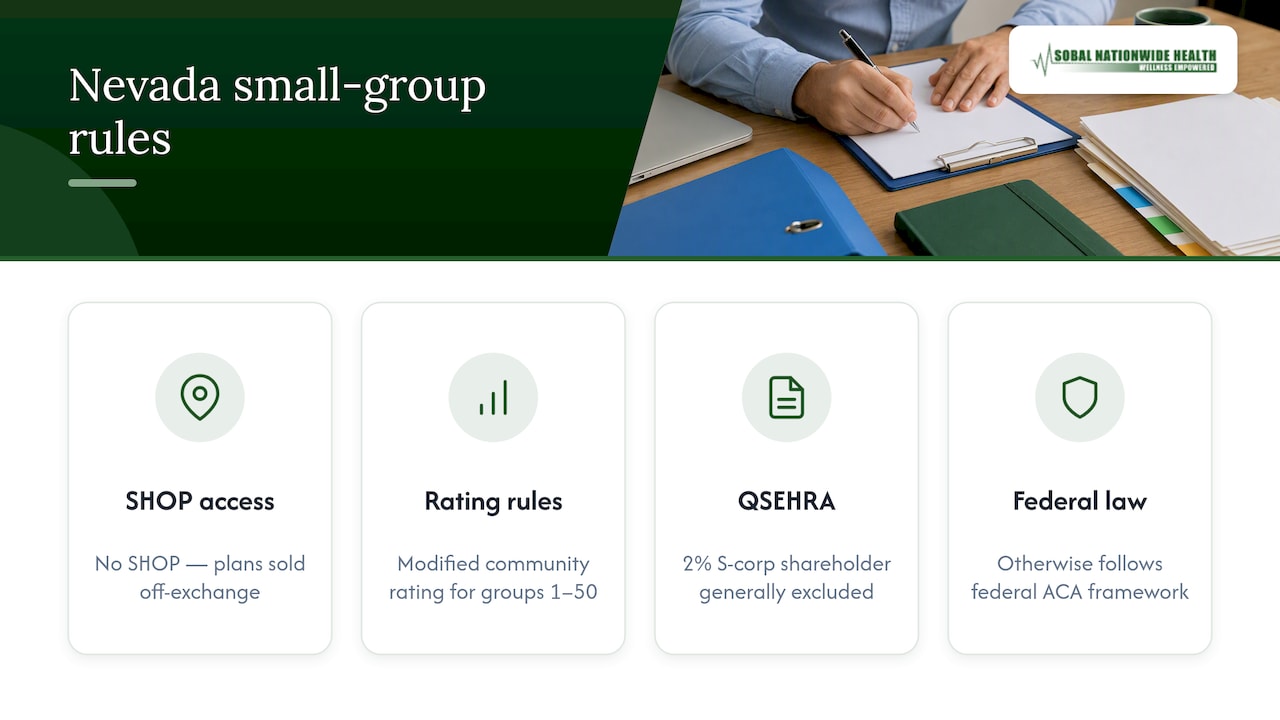
Nevada doesn’t impose unique mandates that most small employers need to worry about beyond federal ACA requirements, but a few state-level realities shape how coverage actually gets delivered.
The most consequential one is structural: because Nevada’s exchange carriers aren’t offering SHOP plans, the state’s small-group market runs almost entirely off-exchange. That means your plan options come from direct carrier contracts or broker-arranged group policies rather than a centralized state marketplace, which is different from how small-group shopping works in states with an active SHOP exchange.
Nevada also follows standard ACA small-group rating rules, meaning premiums for groups of 1 to 50 are set using modified community rating based on age, location, tobacco use, and plan tier, not on a group’s claims history. This protects employers with employees who have health conditions from facing inflated group rates based on individual risk.
If you’re setting up an HRA structure, federal rules still apply statewide: a 2% S-corp shareholder-employee generally can’t participate in a QSEHRA, which is worth flagging early if your business is structured that way. Beyond that, Nevada employers mostly operate under the same federal framework as the rest of the country, with the SHOP gap being the one meaningful local difference.
Add-On Benefits That Extend Your Budget Further
Once a base medical plan or HRA structure is in place, many Nevada small employers look at supplemental coverage to round out the benefits package without a major cost jump.
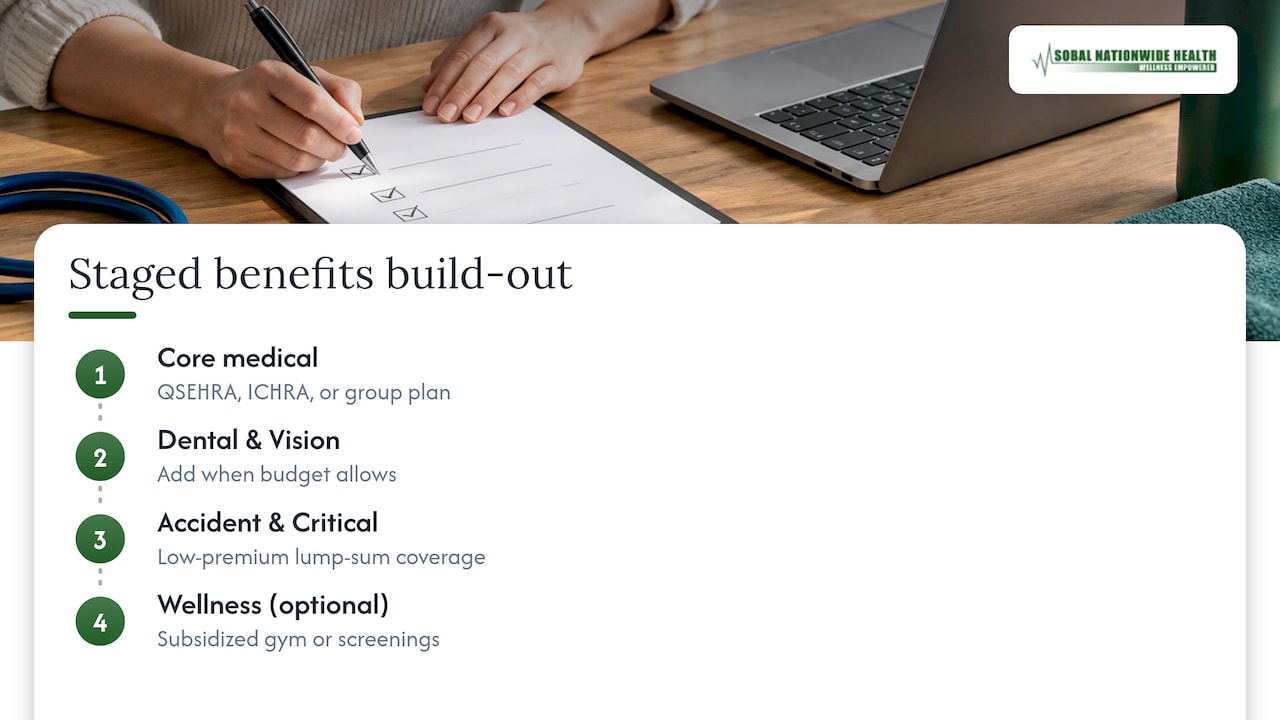
Common additions include dental and vision coverage, which can often be added at a modest per-employee cost regardless of whether the core medical coverage comes through QSEHRA, ICHRA, or a group plan. Critical illness and accident insurance are also popular add-ons, since they provide a lump-sum payout for specific events and tend to carry low premiums relative to the protection offered.
Some employers also explore basic wellness programs, like subsidized gym memberships or simple health screenings, though these aren’t mandated and vary widely in design since there’s no single standard format.
For businesses building out a benefits package in stages, a practical sequence looks like this: start with the core medical structure (QSEHRA, ICHRA, or group plan), add dental and vision once the budget allows, then layer in supplemental products like accident or critical illness coverage as a lower-cost way to round out protection. This staged approach lets you offer something meaningful on day one without overcommitting before you know what your team actually uses.
What Actually Drives Your Premium Costs
Three factors do most of the work in determining what you’ll pay: age, location, and industry.
Age is the biggest lever under ACA rating rules, since premiums increase with age according to a standard age curve, meaning a team with an older average age will see higher baseline premiums than a younger one, regardless of plan choice. Location matters because Nevada’s rating areas affect premiums, with urban areas like Las Vegas and Reno sometimes pricing differently from more rural parts of the state due to differences in provider networks and cost of care.
Industry plays a smaller but real role, mostly through the indirect effect of workforce demographics rather than direct industry-based rating, since ACA small-group rules prohibit pricing based on occupation or claims history. A construction company and a tech startup with similarly aged, similarly located employees should see comparable base rates, even though their risk profiles might feel different on paper.
The practical takeaway: before you assume a plan is expensive because of your industry, check whether it’s really your team’s age distribution and ZIP code doing the pricing work. Those two variables alone explain most of the variation you’ll see between quotes.
Comparing Deductibles and Coverage Levels
Small-group plans in Nevada, like elsewhere, are generally categorized into Bronze, Silver, Gold, and Platinum tiers, each reflecting a different balance between monthly premium and out-of-pocket costs at the point of care.
Bronze plans carry the lowest premiums but the highest deductibles, meaning employees pay more before the plan starts covering costs, which fits a younger, healthier workforce that rarely seeks care. Gold and Platinum plans flip that balance: higher premiums, but lower deductibles and copays, which can matter more for teams with employees who have ongoing medical needs.
QSEHRA and ICHRA don’t have their own coverage tiers since employees buy individual marketplace plans with the reimbursement funds, meaning the coverage level depends entirely on what plan the employee chooses to purchase. This is actually one of the appeals of ICHRA in particular: employees with different health needs can select different tiers that fit their own situation, rather than everyone being locked into one group plan’s tier.
Whichever structure you choose, it’s worth comparing the total potential cost, premium plus expected out-of-pocket spending, rather than premium alone, since a lower-premium plan with a high deductible can cost more overall for an employee who needs regular care.
Working With a Broker Without Getting Pressured
Because Nevada’s SHOP exchange isn’t active, brokers play a bigger role here than in states where small employers can shop a centralized marketplace directly.
A good broker should ask about your FTE count, budget per employee, and whether you’ve offered coverage before, rather than pitching a single plan type immediately. They should also be able to explain the mechanics of QSEHRA, ICHRA, and group plans clearly enough that you understand the trade-offs, not just the recommendation. Licensed brokers in Nevada are regulated by the state and typically don’t charge employees directly, since they’re compensated by carriers when a policy is placed.
If you have employees nearing 65, it’s worth asking your broker how Medicare eligibility interacts with your group coverage decisions, since Medicare coordination rules can affect whether an employee should stay on your plan or transition to Medicare as primary coverage.
The right broker relationship should feel like getting a second opinion, not a sales pitch. If a broker can’t explain why they’re recommending one structure over another for your specific numbers, that’s worth questioning.
State Resources Worth Knowing About
Nevada offers a few direct channels for small employers trying to sort through their options without paying for advice upfront.
Nevada Health Link provides free enrollment assistance for individual employees shopping for coverage, which is especially relevant if you’re setting up a QSEHRA or ICHRA and your team needs guidance picking a marketplace plan. The Nevada Division of Insurance also publishes guidance specifically on QSEHRA mechanics and eligibility, along with periodic rate previews ahead of open enrollment that help employers anticipate budget changes.
Beyond state agencies, the IRS maintains guidance on fringe benefit rules that cover HRA administration, cafeteria plan limits, and participation exclusions relevant to how you structure reimbursements. None of these resources replace a broker or tax advisor for your specific situation, but they’re a solid starting point before that conversation.
Benefits, Wages, and What Actually Keeps Employees Around
We’ve watched plenty of small employers assume a raise beats a benefit. Often it doesn’t. A modest health contribution can do more for retention than an equivalent bump in pay, partly because it’s harder for employees to replace elsewhere.
Start small if you need to: a basic QSEHRA allowance is a reasonable first step. Bring in a broker once the administrative side starts eating your time.
— Bernie S
Getting Started With Business Health Insurance in Nevada
If you’ve made it this far, you probably have a sense of which structure fits, but turning that into an actual plan is where most owners get stuck. We work with small businesses to sort through QSEHRA, ICHRA, and group plan options, with advisory support and no pressure to pick a structure before it makes sense for your numbers.
Before your first consult, it helps to have your headcount, a rough per-employee budget, and details on any current coverage you’re offering. From there, we can walk through which structure fits and what it would actually cost after any tax credit you qualify for.
- We review your FTE count and budget to narrow down realistic options.
- We explain QSEHRA, ICHRA, and group plan trade-offs specific to your situation.
- We help with enrollment paperwork once you’ve picked a direction.
Visit our business health insurance page to see how we can help you get started.
FAQ
What is the best health insurance for small business owners?
There’s no single best option. It depends on your headcount, budget, and whether you want employees choosing their own plans (ICHRA) or a simpler capped reimbursement (QSEHRA). A broker can help match the structure to your specific numbers.
What are the health insurance options available for small businesses in Nevada?
Nevada employers can choose between a QSEHRA, an ICHRA, or a traditional small-group plan arranged directly with a carrier or through a broker. The SHOP marketplace isn’t an option currently, since Nevada carriers aren’t offering SHOP plans.
How much is a health insurance plan for a small business?
Costs vary by plan type, employee age, and location, so there’s no flat number that applies to every business. For QSEHRA specifically, employers can contribute up to $6,450 annually for employee-only coverage or $13,100 for family coverage in 2026.
How much is private health insurance per month in Nevada?
Individual premium costs in Nevada depend heavily on age, location, and plan tier, so there isn’t one standard monthly figure. A broker can run a personalized quote based on your specific details, since public averages rarely reflect what an individual employee will actually pay.
