

If you qualify for subsidies, start with the Marketplace. If you earn too much for meaningful help with premiums and want lower monthly costs, a private medically underwritten plan is worth a real look. The tradeoff comes down to guaranteed protections versus underwriting and price, and timing matters either way: Marketplace enrollment is locked to specific windows, while private plans are available any time of year.
TL;DR:
- Many consumers above 400% of the federal poverty level left the Marketplace in 2026 due to the loss of enhanced premium tax credits, increasing average premiums and deductibles.
- Private plans often cost less for healthy individuals because underwriting allows for lower premiums, but exclusions like maternity and mental health are common outside the Marketplace.
- Marketplace plans guarantee coverage of essential health benefits and protections, while private plans depend on the insurer’s rules and may have narrower networks or exclude pre-existing conditions.
- Enrollment in the Marketplace is limited to open enrollment and qualifying life events, but private plans can be purchased any day of the year, offering more flexibility.
- Florida residents should verify licensure and coverage details before buying private plans, especially outside the Marketplace, to avoid unlicensed plans and coverage gaps.
Table of Contents
- What the ACA Marketplace covers and why its rules matter
- Private off-marketplace options: what they typically include or exclude
- Weighing coverage, cost, timing, and protections
- Who each option usually fits best
- What to check before you buy a plan
- Florida-specific protections worth confirming first
- When private coverage makes practical sense
- A personalized way to compare your private plan options
- FAQ
- Sources
What the ACA Marketplace covers and why its rules matter
Marketplace plans come with a baseline you can count on. Every plan sold on Healthcare must include the 10 essential health benefits, and insurers cannot deny you coverage or charge you more because of a pre-existing condition.
Those 10 categories include:
- Outpatient care and emergency services
- Hospitalization and maternity or newborn care
- Mental health and substance use disorder treatment
- Prescription drug coverage
- Rehabilitative and habilitative services and devices
- Lab services and preventive care
- Pediatric services, including dental and vision care
That list matters because it closes the door on the worst surprises: a plan that looks cheap but quietly skips prescription coverage or maternity care. Subsidies, known as Advance Premium Tax Credits (APTC), lower your monthly bill based on income, and cost-sharing reductions can shrink deductibles for plans in certain income bands.
Marketplace enrollment declined among people earning above 400% of the federal poverty level in 2026, with average premiums and deductibles increasing, according to KFF’s 2026 Marketplace analysis. That shift happened largely because enhanced premium tax credits expired, creating what many advisors call a subsidy cliff for higher earners.
Florida does not run its own exchange. Every resident shopping the Marketplace uses the federal HealthCare.gov platform, and Open Enrollment runs November 1 through January 15. Outside that window, you need a qualifying life event to trigger a Special Enrollment Period. If you have ongoing health needs, a lower income, or a pre-existing condition that private underwriting could flag, the Marketplace is usually the right place to start.
Private off-marketplace options: what they typically include or exclude
Private plans sold outside the Marketplace come in several forms, and they are not interchangeable.
- Medically underwritten individual plans ask about your health history and price or decline coverage based on it.
- Short-term limited-duration insurance (STLDI) fills temporary gaps, often for a few months, and is not required to meet ACA standards.
- Fixed-indemnity plans pay a set dollar amount per service rather than covering a percentage of costs.
- Association and group-sponsored plans bundle individuals under a group policy, sometimes with different underwriting rules than individual plans.
Because these plans are not bound by the essential health benefits list, maternity care, certain mental health services, and prescription drug coverage are common exclusions. Florida’s consumer protection guidance on STLDI warns that these plans typically exclude pre-existing conditions entirely and are intended as temporary coverage, not a long-term replacement for comprehensive insurance.
What private plans trade in exclusions, they can make up in price. Because insurers can decline or rate based on health status, people in good health often see meaningfully lower premiums than an unsubsidized Marketplace plan. They are also available any day of the year, which makes them useful for people who miss Open Enrollment or need coverage to start quickly. The savings show up most clearly for buyers who do not qualify for APTC and who have straightforward, predictable health needs.
Weighing coverage, cost, timing, and protections
Here is how the two paths typically stack up once you line up the details that matter most.
- Coverage: Marketplace plans guarantee the 10 essential health benefits; private plans frequently exclude maternity, some mental health services, or drug coverage.
- Cost: Marketplace premiums before subsidies rose in 2026, and average deductibles climbed too, per KFF; private premiums depend on your underwriting results, which can mean significant savings for a healthy buyer.
- Enrollment timing: Marketplace sign-ups are limited to Open Enrollment or a qualifying Special Enrollment Period; private plans can be purchased year-round.
- Protections: Marketplace plans carry guaranteed issue and renewability; private plans vary by carrier, so licensure and state guaranty fund coverage need to be confirmed separately.
An increasing number of consumers above 400% of the federal poverty level left the Marketplace in 2026 after subsidy support decreased, based on KFF’s analysis, suggesting that this group should consider private alternatives before renewing.
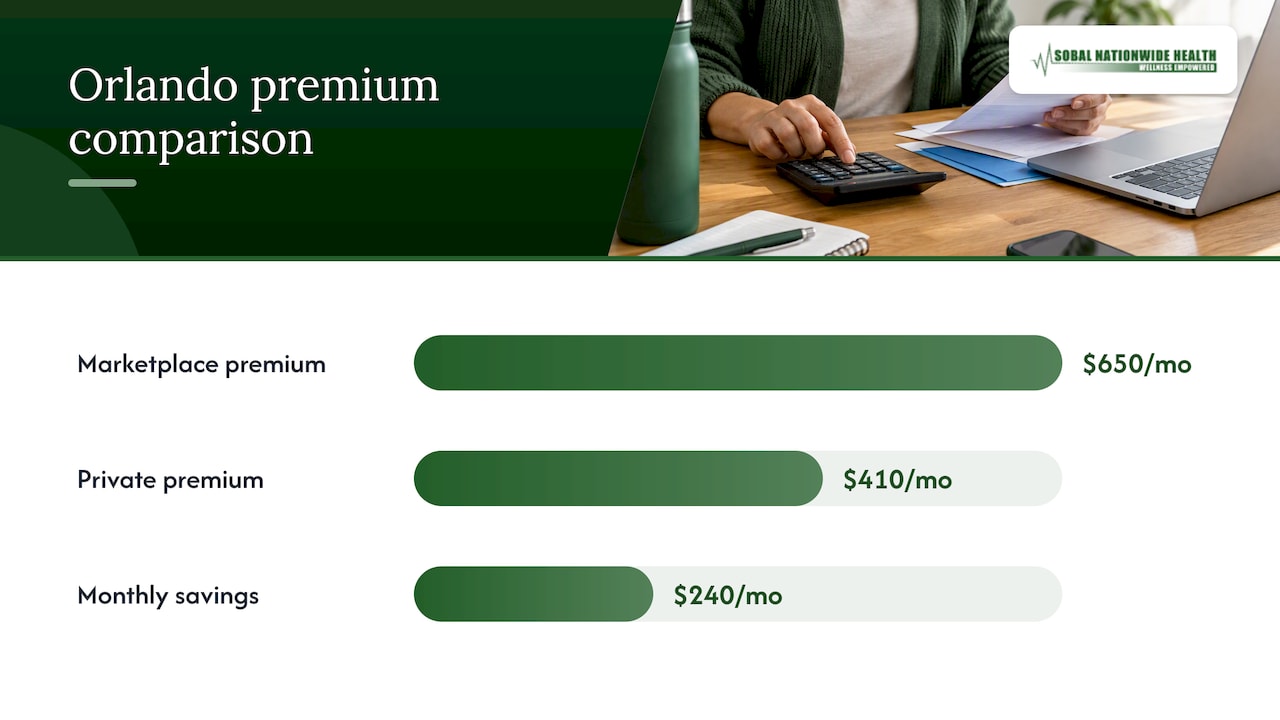
A simple way to test this for yourself: compare your unsubsidized Marketplace benchmark premium against a private quote for your exact age and county, since Florida premiums vary widely by region. Say a 45 year old in Orlando finds an unsubsidized Marketplace plan at $650 a month with a $7,000 deductible, but qualifies for no subsidy because their income sits above the cliff. A medically underwritten plan with similar deductible structure might quote $410 a month if they have no chronic conditions. That gap is exactly where private coverage tends to earn its keep, though the comparison only holds if the private plan’s network and drug formulary actually match what that person needs. Our guide to low-premium plans walks through what to check before assuming the lower number is the better deal.
Who each option usually fits best
Match your situation to the path that serves it:
- Subsidy-eligible with ongoing care needs: Shop the Marketplace first. Guaranteed issue and APTC savings usually outweigh any private premium advantage.
- Higher income, healthy, and price-sensitive: A private medically underwritten plan often delivers real savings once subsidies stop making a meaningful dent in your premium.
- Short coverage gap between jobs or life events: Short-term limited-duration insurance can bridge a few months, but confirm it excludes nothing you expect to use.
- Small-business owner or family with mixed needs: Compare a Marketplace family plan against a private plan priced for your household’s actual health profile before deciding.
Pro Tip: Run the numbers for your own county and age bracket rather than trusting a statewide average. Florida premiums shift significantly by zip code.
The caveats that apply across every profile: underwriting can decline you or exclude specific conditions, private networks may be narrower, and maternity coverage is rarely included outside the Marketplace.
What to check before you buy a plan
Before signing anything, confirm these basics.
- Ask whether the plan is ACA-compliant or sold as a supplemental, short-term, or limited-benefit product.
- Request the Summary of Benefits and Coverage (SBC) and read it line by line, including the maximum out-of-pocket and drug tier structure.
- Confirm your doctors, specialists, and medications are in the plan’s network and formulary before you commit.
- Verify the insurer’s and agent’s licensure through Florida’s regulator resources.
When you talk to an agent or broker, ask directly: Is this plan medically underwritten? What happens to my premium or coverage if I develop a new condition next year? Is this plan guaranteed renewable? Is it sold year-round or only during specific windows?
Pro Tip: If an agent cannot produce an SBC or claims a short-term plan covers pre-existing conditions like a Marketplace plan, walk away. Those are two of the clearest warning signs that something is off. Comparing plan features side by side before you sign is the single best habit you can build here.
Florida-specific protections worth confirming first
Florida residents have direct ways to check who they are dealing with before money changes hands.
- Verify both the insurer and the selling agent’s license through MyFloridaCFO’s consumer protection resources, which flag unlicensed plans that mimic Marketplace-style benefits.
- Understand that STLDI policies in Florida are filed and approved under specific state rules, are not ACA-compliant, and typically exclude pre-existing conditions.
- Confirm the carrier participates in Florida’s guaranty fund system, which protects policyholders if a licensed insurer becomes insolvent; unlicensed plans carry no such backstop.
- Report suspected unlicensed sales activity directly to Florida’s Department of Financial Services rather than assuming a slick website means a legitimate offer.
A few minutes spent verifying licensure can save months of fighting denied claims later. For more on pre-existing condition pitfalls specifically, this overview of common coverage mistakes is a useful companion read.
When private coverage makes practical sense
I have spent years helping Florida families and self-employed workers sort through exactly this decision, and the pattern holds up: people who lose meaningful subsidy support and who are in reasonably good health are often the ones best served by a private medically underwritten plan, especially when bilingual, one-on-one guidance helps them avoid underwriting surprises before they sign anything. For anyone who values broader guaranteed protections, especially people managing a chronic condition or expecting maternity care, the Marketplace remains the more dependable foundation, and a good advisor should say so plainly rather than push a sale that does not fit.
— Bernie S
A personalized way to compare your private plan options
If you want someone to walk through private medically underwritten options with you directly, that is the kind of advisory work offered by some health insurance brokers. Some brokers provide services to self-employed individuals, families, and small businesses with bilingual agents and access to private plans not sold on the public marketplace.
A call with a health insurance advisor typically covers:
- A review of your current policy or quotes against private medically underwritten options
- An estimate of potential savings based on your age, location, and health profile
- Plain-language guidance on enrollment steps and timing, often without pressure to buy immediately
If better coverage and a lower premium both matter to you, especially once subsidies stop moving the needle, start a personalized plan review with our team and see what a private plan quote actually looks like for your situation.
This article is general information, not a substitute for advice from a qualified financial advisor. Consult a qualified financial professional about your own circumstances before acting on anything here.
FAQ
Is private health insurance better than marketplace coverage?
It depends on your income and health. Marketplace plans guarantee essential benefits and protect against pre-existing condition denials, while private medically underwritten plans can offer lower premiums for healthy buyers who no longer qualify for meaningful subsidies.
What’s the best health insurance to have in Florida?
There is no single best plan since Florida residents use the federal HealthCare.gov marketplace, where plans must cover 10 essential health benefits. The right choice depends on whether you qualify for subsidies, your health needs, and whether a private medically underwritten plan fits your budget better.
What are the downsides of using Marketplace health insurance?
Marketplace premiums and average deductibles both rose in 2026, and higher earners above 400% of the federal poverty level often lose meaningful subsidy support, according to KFF’s 2026 analysis. Enrollment is also limited to Open Enrollment or a qualifying Special Enrollment Period, unlike private plans sold year-round.
What is the income limit for marketplace insurance in 2026?
There is no strict income cap to enroll in a Marketplace plan, but subsidy value drops sharply above 400% of the federal poverty level now that enhanced premium tax credits have expired. That shift is a major reason some higher-income consumers are comparing private medically underwritten plans against their Marketplace options this year.
Sources
- Healthcare
- KFF: What we know so far about 2026 ACA Marketplace enrollment, premiums, and deductibles
- MyFloridaCFO: Short-term limited-duration insurance (STLDI)
