

Most Texas small employers should start by checking SHOP eligibility, since it’s the most direct path to the federal tax credit, and if the math doesn’t work, request two to three small-group quotes from a broker instead. Texas sets its SHOP minimum participation rate at 75% of eligible employees, which rules out SHOP for some teams with spotty enrollment. Your next move: confirm your headcount, check that participation threshold, and call a broker if SHOP doesn’t fit.
TL;DR:
- Fewer than 25 full-time employees should prioritize checking SHOP eligibility, especially if aiming for the Small Business Health Care Tax Credit.
- The 75% participation rate in Texas often disqualifies teams with low enrollment or employees with other coverage.
- Private small-group plans and QSEHRA are alternative options if SHOP requirements are not met or if broader plan choices are desired.
- Confirm plan network coverage, especially doctors and prescriptions, by reviewing the Summary of Benefits and Coverage before proceeding.
- Proper preparation includes verifying employee headcount, current costs, contribution levels, and provider networks to compare quotes effectively.
Table of Contents
- Your main coverage routes: SHOP, private group plans, and reimbursement options
- SHOP eligibility and the Small Business Health Care Tax Credit in Texas
- What HMO, PPO, and HDHP plans actually mean for your employees
- What small-group coverage tends to cost in Texas
- QSEHRA: paying for coverage without running a group plan
- Your action checklist for choosing coverage in Texas
- How Sobal Health supports small Texas employers
- A caution worth repeating before you sign anything
- Get a free plan review for your Texas small business
- FAQ
- Sources
Your main coverage routes: SHOP, private group plans, and reimbursement options
We’ve sat across the table from enough Texas business owners to know the alphabet soup gets confusing fast. Here’s the plain version.
SHOP (Small Business Health Options Program) is the federal marketplace built for small employers, and it’s generally the only route to the Small Business Health Care Tax Credit. Private small-group plans come straight from a carrier or through a broker, often with more plan design flexibility and no participation-rate hurdle. Association health plans pool several small employers together to access group-style rates, though availability and rules vary. QSEHRA flips the model entirely: instead of buying a group plan, you reimburse employees tax-free for their own individual coverage.
Which one fits depends on your size and goals:
- Fewer than 25 full-time equivalent employees chasing the tax credit: SHOP is worth checking first.
- Can’t hit the 75% participation rate or want broader plan choice: private small-group coverage usually fits better.
- Under 50 employees who’d rather skip group administration entirely: QSEHRA deserves a look.
- Larger small teams (25 to 50 employees) with varied needs: private group plans or a PEO arrangement often make more sense.
A SHOP-registered agent or broker can run these numbers with you and confirm which path actually qualifies for the credit before you commit.
SHOP eligibility and the Small Business Health Care Tax Credit in Texas
SHOP eligibility hinges on a few concrete rules, and missing one of them is the most common reason Texas applications stall.
- You generally need at least one common-law employee besides yourself; sole proprietors with no staff don’t qualify.
- Your business must meet the small-employer size threshold under SHOP guidelines.
- You must hit Texas’s minimum participation rate before you can enroll.
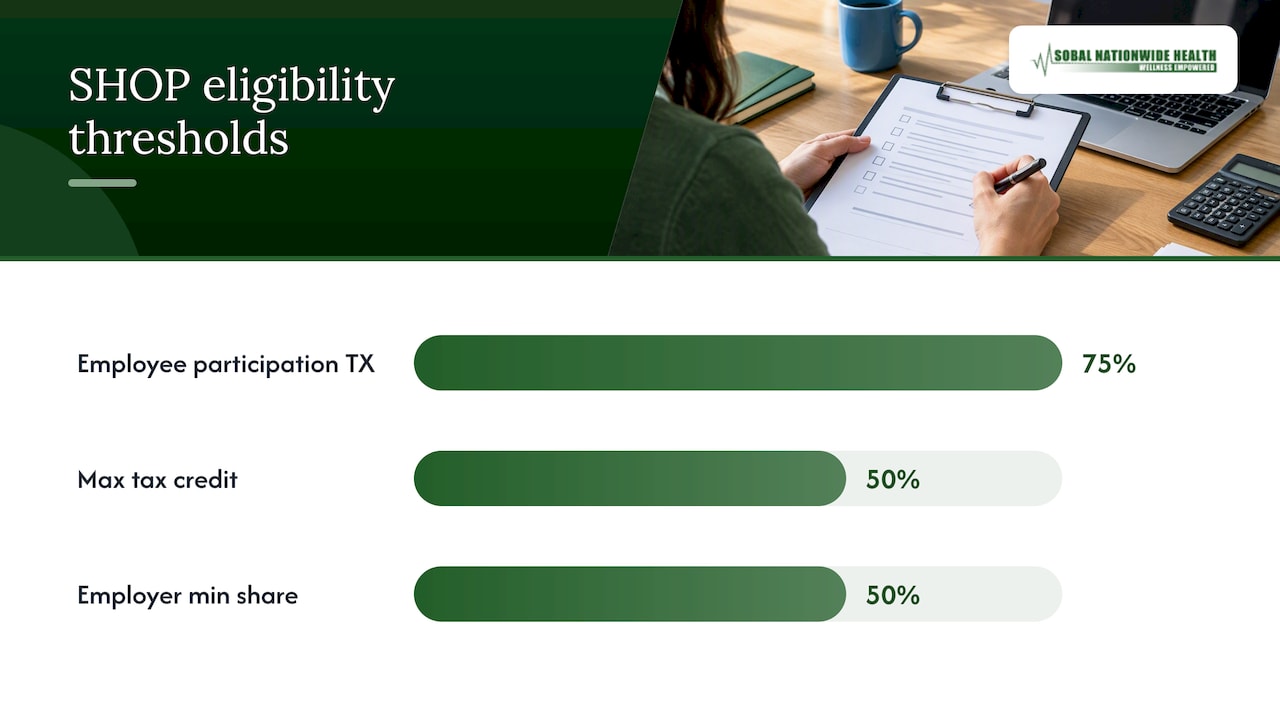
Texas requires 75% of eligible employees to enroll in the plan, one of the stricter participation thresholds among states that set one, according to HealthCare.gov’s employer guide. That single number knocks out a surprising share of small teams, especially ones where a few employees already have coverage through a spouse. The good news: SHOP enrollment runs year-round rather than during a fixed open window, so you’re not racing a calendar deadline the way individual marketplace shoppers are.
If you clear SHOP enrollment, you may qualify for the Small Business Health Care Tax Credit, worth up to 50% of your premium contributions. Eligibility generally requires fewer than 25 full-time equivalent employees, average wages below a capped threshold, and that you cover at least 50% of employee-only premium costs. The credit is claimed on Form 8941, and the IRS page walks through the calculation step by step.
What HMO, PPO, and HDHP plans actually mean for your employees
Premiums grab attention first, but the plan type underneath determines whether your employees can actually see the doctors they already trust.
An HMO keeps costs lower by requiring referrals and in-network care only, which works well for employees who are fine picking a primary doctor and staying within a defined network. A PPO costs more but lets employees see out-of-network providers without a referral, a real advantage in a state as spread out as Texas where the nearest in-network specialist might be a two-hour drive. An EPO sits in between: no referrals needed, but no out-of-network coverage either. A high-deductible health plan (HDHP) pairs a lower premium with a higher deductible, often alongside a health savings account employees can fund pre-tax.
Metal tiers (Bronze, Silver, Gold, Platinum) describe cost-sharing, not quality of care. Bronze means lower premiums and higher deductibles; Platinum flips that ratio. The CMS SHOP overview notes these tiers indicate how costs are split between you and the insurer, not how good the doctors are.
- Check the Summary of Benefits and Coverage (SBC) for every plan you’re considering.
- Confirm your employees’ current doctors and prescriptions are actually in-network and on formulary.
- Compare deductible and out-of-pocket maximum together, not deductible alone.
Pro Tip: Pull the SBC before you compare a single premium number, since two plans at the same price can have wildly different out-of-pocket exposure for a hospital stay.
Every ACA-compliant plan must provide an SBC with standardized coverage examples for situations like having a baby or managing diabetes, which makes it the fastest way to compare plans apples-to-apples instead of guessing from a brochure.
What small-group coverage tends to cost in Texas
Pricing varies by ZIP code, age mix, and plan design, so treat any range as a starting point for budgeting rather than a quote. A small employer in Austin with a younger team and a Bronze HDHP will land in a different place than a similarly sized company in Houston offering a Gold PPO to an older staff.
The factors that move your number most:
- Average age of your employee group.
- ZIP-level cost differences across Texas metros and rural areas.
- Industry risk classification.
- Plan design: metal tier, deductible, and network breadth.
- Group size, since larger pools generally smooth out pricing.
Many small employers structure their contribution using a simple formula, and the employer guide to SHOP notes that employers must contribute at least 50% of the employee-only premium to qualify for the tax credit. A company covering 10 employees at that contribution level is budgeting $2,250 a month before the credit reduces that cost on your tax return.
QSEHRA: paying for coverage without running a group plan
If running a group plan feels like more administration than your team needs, a Qualified Small Employer HRA lets you reimburse employees for their own individual coverage instead of buying a group policy at all.
QSEHRA is available to employers with fewer than 50 full-time employees who don’t offer a group health plan. Employees use the reimbursement toward an individual marketplace plan or other qualifying coverage, but they must carry minimum essential coverage to receive tax-free reimbursement.
- You set a fixed reimbursement allowance, which gives you predictable monthly costs.
- You must provide written notice to eligible employees, generally at least 90 days before the plan year starts.
- Employees get to choose their own plan and keep it if they change jobs.
- You skip SHOP’s 75% participation rule entirely, since there’s no group plan to enroll in.
The tradeoff: QSEHRA doesn’t qualify you for the Small Business Health Care Tax Credit the way SHOP enrollment does, so run both numbers before deciding.
Your action checklist for choosing coverage in Texas
Work through these steps in order, and you’ll avoid the two mistakes we see most often: applying for SHOP without confirming participation first, and comparing premiums without pulling the SBC.
- Count your full-time equivalent employees and confirm whether you clear SHOP’s size and 75% participation thresholds.
- Set a monthly budget and decide your contribution percentage, at least 50% if you’re targeting the tax credit.
- Request the SBC and provider directory for every plan on your shortlist.
- Ask employees which doctors and prescriptions matter most to them before you narrow plan options.
- Get two to three quotes from a broker or insurer for direct comparison.
- Confirm enrollment timing: SHOP runs year-round, but group plan effective dates still depend on your carrier’s cutoff.
Ask your broker directly whether the plan qualifies for the tax credit. A common pitfall is assuming any group plan counts, when the credit normally requires SHOP enrollment or a documented exception.
| What to prepare | Why it matters |
|---|---|
| Employee headcount and FTE count | Determines SHOP and QSEHRA eligibility |
| Current premium costs, if any | Sets your budget baseline |
| Desired contribution percentage | Needed for tax credit qualification |
| List of employee doctors and prescriptions | Confirms network and formulary fit |
How Sobal Health supports small Texas employers
We work alongside Business Health Insurance clients to compare SHOP, private group, and reimbursement paths side by side, including access to medically underwritten private plans not listed on the public marketplace. We’ll ask for your headcount, current coverage, and budget, then walk through options. A plan review costs you nothing to request.
A caution worth repeating before you sign anything
Premium is only half the story. Before you commit, pull the SBC and confirm your employees’ doctors and prescriptions are actually covered, not just assumed to be.
— Bernie S
Get a free plan review for your Texas small business
We offer a free plan review and quotes for Texas small employers weighing SHOP, private group coverage, or QSEHRA.
Before you reach out, gather your current employee count, any existing premium costs, and the contribution amount you’re considering. When checking whether a plan’s network actually includes your team’s providers, it helps to see how clinics list accepted insurance plans directly, since that’s the same verification step we walk clients through.
- Free, no-pressure plan review and quotes.
- Access to medically underwritten plans alongside SHOP and group options.
- Broker support for enrollment and ongoing questions.
Reach out through our business health insurance page to get started.
This article is general information, not a substitute for advice from a qualified financial advisor. Consult a qualified financial professional about your own circumstances before acting on anything here.
FAQ
How do I choose a health insurance plan from an employer?
Start by comparing the Summary of Benefits and Coverage for each plan option, checking that your preferred doctors and prescriptions are in-network and on formulary. Weigh the deductible against the out-of-pocket maximum together, not separately, and confirm whether the plan is an HMO, PPO, EPO, or HDHP based on how much provider flexibility you need.
What are the 7 main types of insurance?
Common categories include health, dental, vision, life, disability, critical illness, and accident insurance, each covering a different kind of financial risk. Small employers often start with health coverage and layer in dental or vision as budget allows.
What is the cheapest state for healthcare?
Healthcare costs vary significantly by state and even by ZIP code within Texas, driven by local provider pricing, plan design, and employee age mix. Rather than chasing a national ranking, request quotes specific to your own metro area and workforce for an accurate comparison.
What are the top health insurance companies in Texas?
Texas small employers typically choose among several national and regional carriers offering SHOP-eligible and private small-group plans, with availability varying by county. A broker registered with SHOP or familiar with the Texas market can confirm which carriers serve your specific area and employee needs.
What is the Small Business Health Care Tax Credit?
The Small Business Health Care Tax Credit can be worth up to 50% of the premiums an eligible employer pays, generally requiring fewer than 25 full-time equivalent employees and SHOP enrollment. Employers calculate and claim it using IRS Form 8941.
