

For most employers with 1 to 50 workers, the fastest path to coverage is checking eligibility for the SHOP Marketplace, comparing that against a direct small-group plan from an insurer, and asking a broker whether the Small Business Health Care Tax Credit applies. All three channels can run at the same time. Enrollment through SHOP or an insurer typically opens year-round, and the tax credit can offset a significant portion of your premium costs if you qualify.
TL;DR:
- The Small Business Health Care Tax Credit is limited to businesses with fewer than 25 full-time equivalents and requires specific wage and contribution thresholds, making many small employers ineligible despite qualifying for SHOP.
- Enrolling through SHOP can be done year-round, but navigating paperwork and plan options often benefits from working with a SHOP-registered broker who can compare multiple carriers and confirm eligibility for tax credits.
- State-specific rules may extend or alter SHOP qualifications, so verifying state regulations and carrier participation is essential before budgeting for coverage.
- Small businesses often face delays and higher costs due to paperwork complexity, limited plan choices, and pricing volatility caused by small-group risk profiles, which brokers can help mitigate.
- The Small Business Health Care Tax Credit serves as a launch subsidy, not a permanent discount, and many companies grow past eligibility before realizing its benefits.
Table of Contents
- What Are Your Health Care Insurance Options for Small Businesses?
- Who Qualifies for the Small Business Health Care Tax Credit?
- How Do You Enroll in Small Business Health Plans?
- How to Choose the Right Small Business Health Plan
- When Does Broker Support Actually Pay Off?
- Do State Rules Change Your Small Business Health Plan Options?
- What Challenges Do Small Businesses Face Getting Health Coverage?
- How Did the Affordable Care Act Change Small Business Insurance?
- Are There Alternatives to Traditional Small Business Health Plans?
- The Real Lesson Small Employers Miss About Health Coverage
- Get Help Comparing Small Business Health Plans
- Sources
- FAQ
What Are Your Health Care Insurance Options for Small Businesses?
You have more than one door into the small-group insurance market, and picking the right one changes both your monthly bill and how much paperwork lands on your desk.
The Small Business Health Options Program (SHOP) is built specifically for employers with 1 to 50 full-time equivalent employees. It gives you a menu of plans across the four metal levels (Bronze, Silver, Gold, Platinum) and lets you set your own contribution level and dependent coverage rules. SHOP enrollment isn’t locked to a single open enrollment window the way individual marketplace plans are, so you can generally start coverage any time of year, which matters if you’re hiring outside the fall rush.
Outside SHOP, three funding structures dominate the small-group market:
- Fully insured plans — you pay a fixed monthly premium to an insurer, and the insurer takes on the risk. Predictable cost, less control over plan design.
- Level-funded plans — you pay a set monthly amount that covers expected claims plus administrative fees and stop-loss protection; if claims run low, you may get money back at year-end.
- Self-funded plans — you pay claims directly as they occur, usually with stop-loss insurance to cap catastrophic risk. Rare below 50 employees because the risk is harder to absorb.
Fully insured plans suit owners who want budget certainty and minimal administrative lift. Level-funded plans appeal to healthier, younger workforces willing to trade some predictability for potential refunds. Self-funded arrangements almost always require deeper cash reserves than a 10-person shop typically has on hand.
Who Qualifies for the Small Business Health Care Tax Credit?
SHOP eligibility generally requires 1 to 50 full-time equivalent employees, though some states extend this threshold, so it’s worth confirming SHOP availability in your state before assuming the standard rule applies. Sole proprietors with no employees don’t qualify for SHOP at all. They belong on the individual marketplace instead.
The tax credit layered on top of SHOP enrollment has its own, tighter eligibility bar:
- Fewer than 25 full-time equivalent employees for the full credit benefit.
- Average annual wages below the IRS threshold (the exact figure adjusts periodically, so check current guidance).
- Employer contribution of at least 50% toward employee premium costs.
- Enrollment in a qualified SHOP plan.
The credit is available for a limited time and can cover a substantial portion of premium costs for eligible employers. That’s according to the IRS’s own guidance on the credit, and it’s the detail owners miss most often. Treat it as a launch subsidy, not a permanent discount.
To claim it, you’ll file Form 8941, which walks through the FTE count, average wage calculation, and premium contribution worksheets. The credit interacts with your premium deduction, so it’s worth a few minutes with an accountant to make sure you’re not double-counting the same dollars.
How Do You Enroll in Small Business Health Plans?
You have three practical routes into coverage, and none of them require you to be an insurance expert going in.
- Verify eligibility. Confirm your FTE count and, if you’re chasing the tax credit, your average wage figures.
- Review plans and pricing. Pull quotes directly from an insurer, browse SHOP options, or ask a broker to run comparisons across carriers at once.
- Contact the insurer, SHOP, or a broker. Each path has different paperwork; a broker typically handles the bulk of it for you.
- Submit any required eligibility forms. SHOP applications ask for basic payroll and employee census data.
Going direct to an insurer can feel simpler on paper, but you’re limited to that carrier’s plan lineup. Working with a SHOP-registered agent or broker means one person compares multiple carriers, checks whether your state’s SHOP rules differ from the federal baseline, and flags whether you qualify for the tax credit before you commit to a plan.
Before you start, gather your employee census (names, ages, zip codes), payroll records for the past few months, and your business’s EIN. Having this ready cuts enrollment time significantly.
Pro Tip: Ask any broker you’re considering whether they’re SHOP-registered specifically. Not every licensed agent carries that credential, and it determines whether they can legally help you claim the small business tax credit.
How to Choose the Right Small Business Health Plan
Picking a plan isn’t about finding the cheapest premium. It’s about matching what you can afford to contribute against what your employees actually need from their coverage.
Start with these criteria before you compare a single quote:
- Employer contribution level you can sustain long-term, not just this year.
- Metal level and what it means for cost-sharing (more on that below).
- Provider network breadth, especially if your team is spread across multiple cities.
- Prescription drug coverage, which varies more between plans than most owners expect.
- Dependent and dental add-ons, since family coverage costs shift the math considerably.
- New-hire waiting periods, which affect how fast you can onboard someone with benefits active.
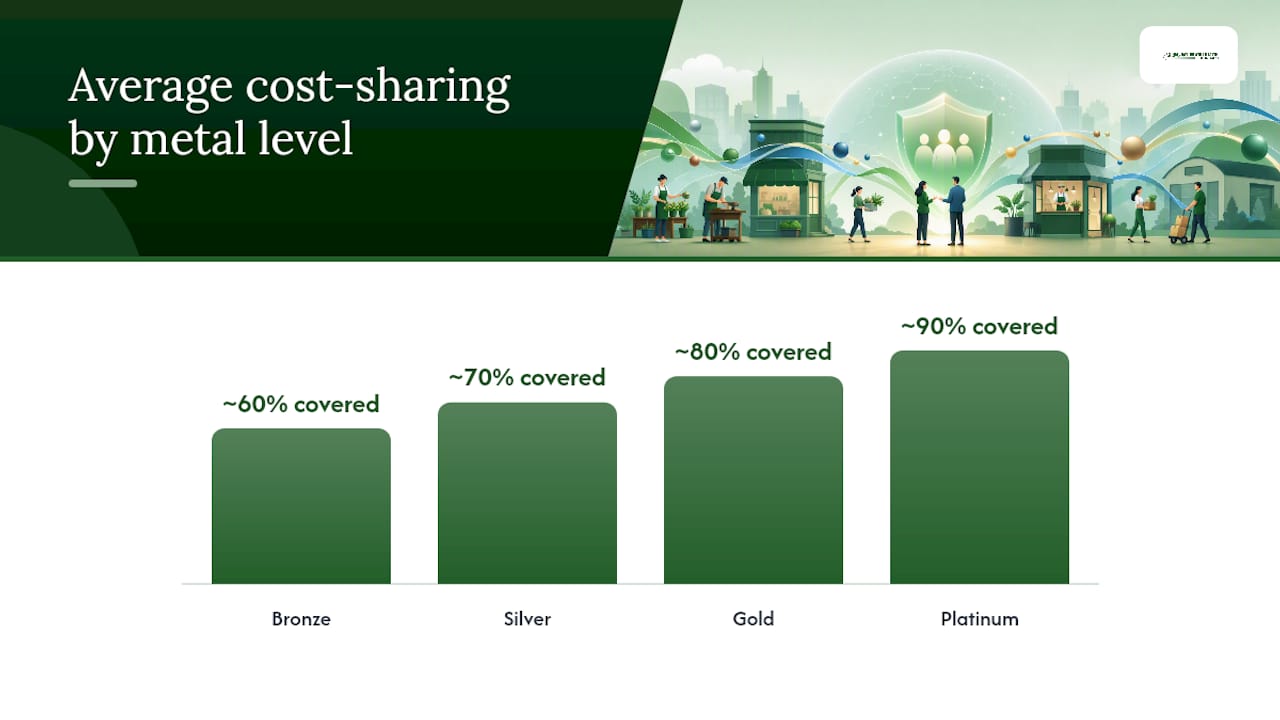
Metal levels are shorthand for average cost-sharing, not care quality: Bronze plans cover roughly 60% of costs, Silver about 70%, Gold around 80%, and Platinum near 90%, with employees picking up the rest through deductibles and copays. A Bronze plan with a lower premium might look attractive until an employee’s out-of-pocket costs pile up mid-year.
| Decision factor | What to check | Why it matters |
|---|---|---|
| Employer contribution | Can you sustain it beyond year one? | Drives take-up rate and retention |
| Metal level | Bronze through Platinum cost-sharing split | Balances premium vs. out-of-pocket risk |
| Network access | Does it cover where your team lives? | Avoids surprise out-of-network bills |
| Waiting period | Days until new hires are covered | Affects hiring speed and morale |
| Tax credit impact | Net cost after up to 50% credit | Changes your real budget comparison |
Because SHOP enrollment often runs year-round, you’re not locked into comparing plans only during a narrow fall window. That flexibility matters if you’re adding staff in spring or summer and don’t want a coverage gap. For a deeper walkthrough of comparing quotes side by side, this plan comparison guide breaks down the math further.
When Does Broker Support Actually Pay Off?
Brokerage support earns its keep the moment your options multiply. If you’re a five-person shop comparing three SHOP plans, you might not need help. But once you’re weighing SHOP against private group plans, factoring in the tax credit, and trying to keep a bilingual team informed, a broker starts saving you real hours.
A broker can work with self-employed individuals, families, and small businesses across multiple states, matching employers with plan options and walking them through enrollment paperwork, including Spanish-language support for owners and staff who prefer it…
Some clients have reported premium reductions after switching from marketplace plans to private, medically underwritten options matched through advisory support. Results vary by household and business situation, and no specific savings amount is guaranteed.
Do State Rules Change Your Small Business Health Plan Options?
Federal guidance sets the baseline, but state insurance departments layer their own rules on top, and the differences aren’t cosmetic.
Some states run their own SHOP marketplace instead of relying on the federal platform, which can mean different enrollment portals, different carrier participation, and occasionally different eligibility mechanics. A handful of states also allow small-group size definitions that stretch beyond the standard 50-employee cutoff, so a business that looks “too big” for SHOP under federal rules might still qualify locally. It’s worth checking your state’s SHOP setup before assuming the national rule applies to you.
State insurance regulators also set their own rate review processes, mandated benefits, and rules around association health plans and level-funded arrangements. A level-funded plan legal in one state might carry extra restrictions in another. Small-group rating rules, meaning how insurers can price based on your workforce’s age and location, also vary enough that identical companies in different states can see meaningfully different quotes for comparable coverage.
None of this means the process is unmanageable. It means the smart move is confirming your specific state’s mechanics before you build a budget around assumptions from a national guide, including this one. A broker licensed in your state, or a SHOP-registered agent, will already know these wrinkles and can flag them before you sign anything.
What Challenges Do Small Businesses Face Getting Health Coverage?
The most common obstacle isn’t cost. It’s complexity that eats time you don’t have.
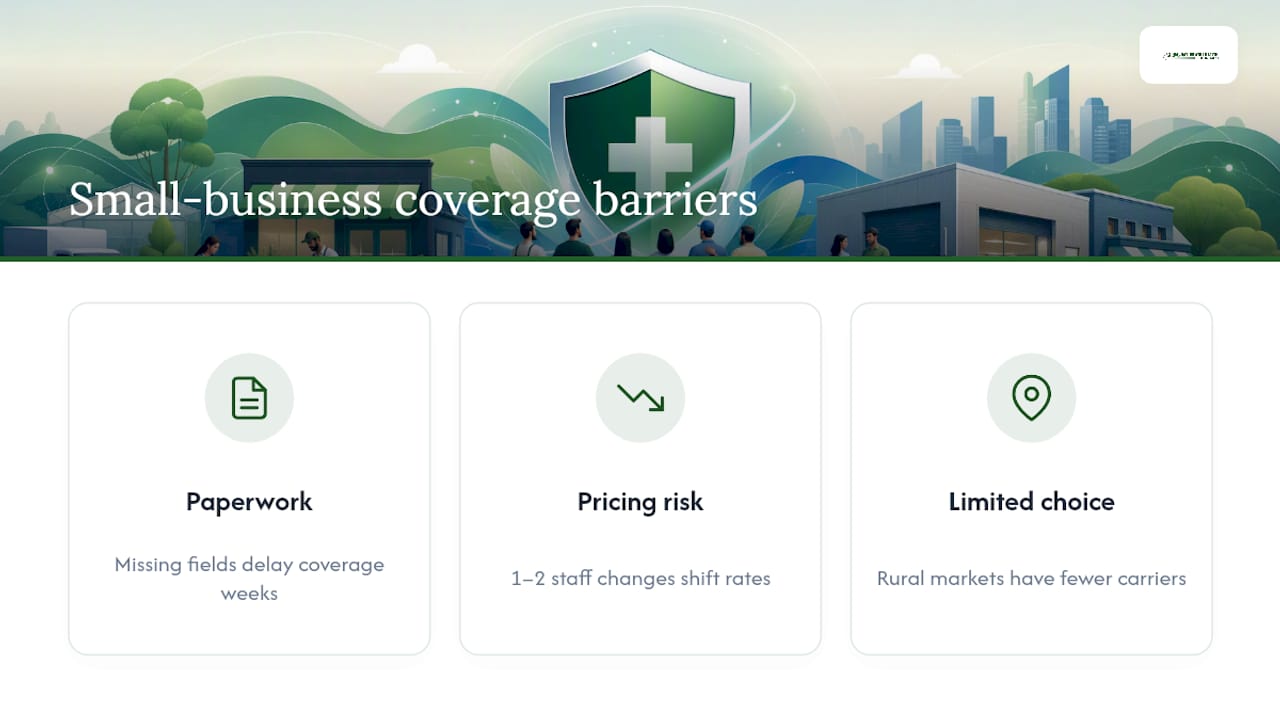
Small employers routinely underestimate how much paperwork stacks up between quote and active coverage: census data, payroll verification, eligibility forms, and carrier-specific enrollment documents. Missing a single field can bounce an application back and delay coverage start dates by weeks.
Pricing volatility is the second major friction point. A small group’s rates depend heavily on the age and health profile of a handful of employees, so adding or losing even one or two people can shift your quote noticeably at renewal. Larger companies absorb that variance across hundreds of workers. A 12-person shop feels it directly.
Limited plan choice is the third recurring complaint, particularly for businesses in rural areas or smaller metro markets where fewer carriers participate in SHOP or the small-group market. Fewer carriers means less leverage to negotiate and fewer network options for employees who live outside a major city.
The practical fixes mirror the problems. Working with a broker or SHOP-registered agent absorbs most of the paperwork burden and catches errors before they cause delays. Locking in your employee census early and keeping it updated smooths renewal pricing shocks. And where carrier choice is thin, private medically underwritten plans outside the standard marketplace sometimes open up options that aren’t visible through SHOP alone, particularly for smaller groups willing to go through individual underwriting.
How Did the Affordable Care Act Change Small Business Insurance?
The Affordable Care Act created SHOP itself, giving small employers a structured marketplace with standardized metal levels and, for many, the first real access to group-style purchasing power that used to be reserved for larger companies.
It also created the Small Business Health Care Tax Credit, which didn’t exist in the small-group market before the law passed. That credit remains one of the more underused benefits available to small employers, largely because the two-year limit and the FTE and wage thresholds make it easy to assume you don’t qualify without actually running the numbers.
The law’s essential health benefits requirements also standardized what a compliant plan has to cover, from prescription drugs to preventive care, which reduced the number of bare-bones plans that used to leave employees exposed to major gaps. On the flip side, those requirements raised baseline costs for some plans compared to pre-ACA offerings, which is part of why level-funded and private underwritten alternatives have grown in popularity among small employers looking for more pricing flexibility.
The net effect for a business with 1 to 50 employees today is more structure and more protection, paired with more places to shop for coverage than existed two decades ago.
Are There Alternatives to Traditional Small Business Health Plans?
SHOP and standard small-group insurance aren’t the only paths, and for some employers they aren’t even the best fit.
Association Health Plans (AHPs) let small businesses band together, often through trade groups or industry associations, to buy coverage as a larger pool. The pitch is leverage: more combined employees can sometimes mean better negotiated rates than any single small business could get alone. The trade-off is less control over specific plan design, since the association sets the terms for the group.
Professional Employer Organizations (PEOs) take a different approach entirely. Instead of you buying insurance directly, you co-employ your staff with the PEO, which then offers benefits through its own larger risk pool. This can unlock better group rates and take HR administration off your plate, but it usually comes with a service fee structure and less flexibility to customize plan choices for your specific team.
Private, medically underwritten plans sit outside the standard marketplace entirely. Instead of community rating, pricing is based on individual health underwriting, which can mean meaningfully lower premiums for a younger or healthier group, though it’s not guaranteed and isn’t available in every state. These plans work best as a comparison point against SHOP and standard group coverage rather than a default first choice, since underwriting outcomes vary by applicant.
None of these alternatives replaces the need to compare actual quotes. They just widen the field before you decide.
The Real Lesson Small Employers Miss About Health Coverage
Most advice on this topic treats health coverage like a single decision made once a year. That framing is backwards for a business with 1 to 50 employees. Your ideal setup this year, built around a specific headcount, wage profile, and hiring plan, may not be your ideal setup in eighteen months.
The tax credit is the clearest example of advice going stale. It’s a two-year window tied to specific FTE and wage thresholds, and plenty of businesses grow past eligibility before they’ve even claimed it once. The smarter move is treating the credit as a launch-phase tool, not a line item you build a permanent budget around.
Where broker support actually earns its cost isn’t in finding the single cheapest plan. It’s in catching the eligibility math you’d otherwise miss, and in knowing which state-specific SHOP quirks change your options. Skip that step only if your situation is genuinely simple. Most growing businesses aren’t.
— Bernie S
Get Help Comparing Small Business Health Plans
Sobal Nationwide Health gives small employers something the standard SHOP comparison tool can’t: access to private, medically underwritten plans alongside traditional small-group options, reviewed one-on-one instead of left for you to sort out alone. That means you’re not just picking from whatever a single carrier’s website shows you. You’re comparing across a wider set of options with someone walking through the trade-offs in plain English, or in Spanish if that’s what your team needs.
If you’re ready to see what fits your business, the next step is straightforward: reach out for a business health insurance consultation and have your employee census and payroll basics ready. A broker fee applies to advisory services, and you can review specifics directly when you get in touch. There’s no cost to start the conversation, and no obligation to enroll through Sobal Nationwide Health once you see your options.
This article is general information, not a substitute for advice from a qualified financial advisor. Consult a qualified financial professional about your own circumstances before acting on anything here.
Sources
- Small Business Health Care Tax Credit and the SHOP Marketplace | Internal Revenue Service
- Healthcare
FAQ
How Does a Small Business Owner Get Health Insurance?
You can enroll through the SHOP Marketplace if you have 1 to 50 full-time equivalent employees, buy a small-group plan directly from an insurer, or work with a SHOP-registered broker who compares carriers for you. Sole proprietors with no employees typically need an individual marketplace plan instead.
What Is the Average Cost for a Small Business to Offer Health Insurance?
Costs vary widely based on group size, age profile, location, and metal level chosen, so there’s no single reliable average to quote. Employers who qualify for the Small Business Health Care Tax Credit can offset up to 50% of premium costs for up to two consecutive tax years, which meaningfully changes the real number for eligible businesses.
What Is the Best Health Insurance for Small Business Owners?
There’s no single best plan. It depends on your headcount, budget, and whether your workforce needs broad network access or lower premiums more. Comparing SHOP plans, direct insurer options, and private medically underwritten plans through a broker like Sobal Nationwide Health gives you the fullest picture before deciding.
Can My LLC Pay for My Health Insurance?
An LLC can generally pay for and deduct health insurance premiums for employees, including yourself if you’re treated as an employee for tax purposes, but the exact treatment depends on how your LLC is taxed. A tax professional or broker can confirm how your specific structure affects deductibility and tax credit eligibility.
