

Healthy, stable groups with enough cash on hand to absorb a rough year usually come out ahead with a level-funded plan, since it opens the door to refunds that a fully insured contract never pays. Groups that want predictable costs and zero exposure to claims swings are better served staying fully insured. Stop-loss coverage is what keeps a level-funded plan’s downside in check. The comparison below will help you figure out which column describes your group.
TL;DR:
- Level funded quotes tend to favor groups with roughly 10 to 99 employees and stable claims, while older workforces or high cost employees may raise underwriting prices.
- Review both stop loss attachment points: specific coverage caps one employee’s claims, and aggregate coverage caps total group claims for the plan year.
- Require every carrier to use the same claims assumption and itemize expected claims, stop loss premiums, and administrative fees so quoted monthly costs are comparable.
- Before switching, confirm two to three years of claims history, cash reserves of three to six months, and reporting and fiduciary duties under self funding.
Table of Contents
- Level-Funded vs Fully Insured: A Side-by-Side Comparison
- What a Fully Insured Plan Is and How It Works
- How Level-Funded Plans Actually Work
- Stop-Loss Insurance: Why Attachment Points Decide Your Real Exposure
- Which Employers Fit Each Model
- How to Compare Quotes From Brokers and TPAs Fairly
- Regulatory and Tax Factors That Affect Your Decision
- Mistakes Employers Make When Moving to Level-Funded Plans
- How We Help Employers Weigh This Decision
- Get Help Comparing Your Funding Options
- FAQ
- Sources
Level-Funded vs Fully Insured: A Side-by-Side Comparison
We like to start here because most employers are comparing two very different risk arrangements without realizing it. A fully insured plan is a fixed-price purchase. A level-funded plan is closer to a payment plan for risk you still own, wrapped in insurance to cap the worst outcomes.
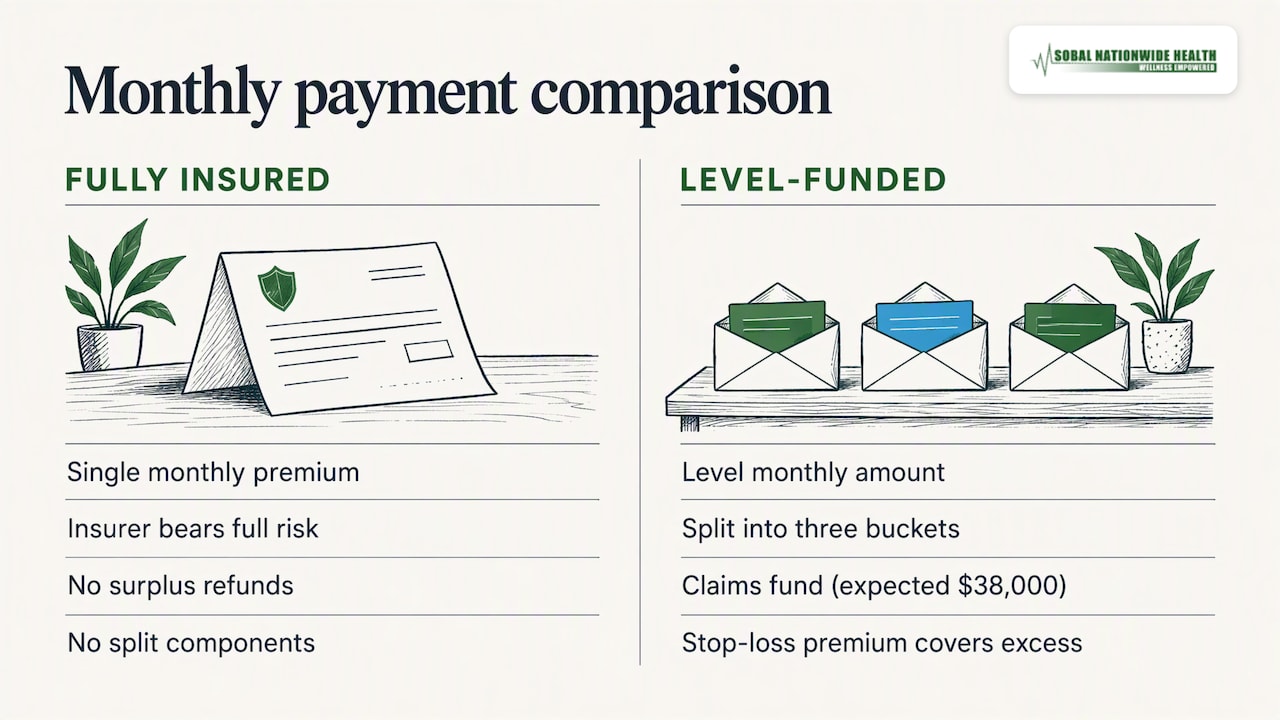
- Cost: Fully insured premiums are a flat monthly rate set by the carrier; level-funded PMPM payments bundle three pieces, expected claims funding, a stop-loss premium, and administrative fees.
- Risk: The insurer absorbs claims volatility under a fully insured contract; under level-funding, you retain risk up to the stop-loss attachment points before the carrier steps in.
- Underwriting: Fully insured small-group plans generally use community rating, meaning your group’s health history matters less; level-funded plans typically go through medical underwriting, which can lower or raise your price based on your group’s actual risk profile.
- Administration: A fully insured carrier handles most compliance and reporting; level-funding shifts more oversight, and some fiduciary duties, onto you and your third-party administrator (TPA).
- Upside: Fully insured contracts never return money even in a light-claims year; level-funded arrangements often include an experience refund when claims come in under the funding target.
None of these differences make one model universally “better.” They make the models suited to different risk tolerances, and that’s the lens worth applying before you request a single quote.
What a Fully Insured Plan Is and How It Works
A fully insured plan is the arrangement most people picture when they hear “group health insurance.” You pay the carrier a set premium every month, and the carrier is contractually on the hook for all covered claims, no matter how expensive your group’s year turns out to be. Pricing in the small-group market is generally set using community rating, which spreads cost across many groups rather than pricing your business based on your employees’ individual health histories.
Premiums are reset at renewal based on your group’s claims experience, broader market trends, and the carrier’s overall book of business in your state. A few things come standard in this model:
- State insurance regulators review and approve rates and plan designs before they reach the market.
- Carriers manage claims processing, member services, and most compliance reporting.
- Mandated benefits and consumer protections apply automatically, varying somewhat by state.
Fully insured plans are also subject to certain federal fees, including the PCORI fee, which the Internal Revenue Bulletin 2025-45 updates annually with the current applicable dollar amount insurers and self-insured plans use for the calculation.
How Level-Funded Plans Actually Work
A level-funded plan is a self-funded arrangement dressed up to feel like a traditional insurance bill. Instead of one premium, you pay a level monthly amount that your TPA splits into three buckets: a claims fund sized to your group’s expected utilization, a stop-loss insurance premium, and administrative or ASO (administrative services only) fees.
Underwriters look at your group’s demographics, industry, and sometimes health questionnaires to set that expected claims number. Groups that underwrite as lower risk often land a lower monthly rate than a comparable fully insured quote, since Milliman’s actuarial analysis notes level-funded plans sit on a spectrum where the attachment points chosen largely determine how much real risk the employer carries, as detailed in level-funded health plans 101.
Here’s how that plays out in practice. Say a group of 40 employees underwrites at $38,000 per month in expected claims. If actual claims come in at $31,000 one year, the surplus often gets returned to the employer as a refund. If a single employee’s cancer treatment pushes claims to $70,000 in a month, stop-loss insurance covers the amount above the attachment point, protecting you from the full hit. The math only works in your favor when your claims stay reasonably close to projections.
Stop-Loss Insurance: Why Attachment Points Decide Your Real Exposure
Stop-loss is the safety net underneath every level-funded plan, and it comes in two forms. Specific stop-loss caps what you pay for any single employee’s claims in a year. Aggregate stop-loss caps your total group claims across the whole plan year.
- Specific attachment point example: A policy set at $50,000 means you’re responsible for the first $50,000 of any one person’s claims; the carrier picks up the rest.
- Aggregate attachment point example: A policy set at 125% of expected claims means your exposure is capped once total group claims cross that threshold.
Milliman’s actuarial framing treats attachment points as the dial that determines how much real risk an employer carries, and it notes that low attachment points can make a level-funded plan behave almost exactly like a fully insured one, according to Milliman’s analysis of level-funded plan dynamics. This matters for a regulatory reason too: the Department of Labor’s technical release on stop-loss and ERISA explains that stop-loss policies are not treated as health insurance under ERISA, and some states have adopted NAIC model limits specifically to prevent attachment points from dropping so low that the arrangement functions as disguised fully insured coverage, raising adverse-selection concerns for the broader small-group market.
Which Employers Fit Each Model
Size alone doesn’t decide this. Claims stability, cash position, and group composition matter more.
- Groups of roughly 10 to 99 employees with stable claims history tend to be the sweet spot level-funded carriers underwrite most favorably.
- Employers with at least three to six months of operating cash set aside are better positioned to absorb a bad-claims year without the refund they were counting on.
- Businesses that prioritize budget certainty over savings potential, including those with thin cash reserves, are usually safer staying fully insured.
- Groups with an older workforce, a physically demanding industry, or known high-cost employees should expect higher level-funded underwriting quotes and may find fully insured community rating more favorable.
- Before requesting quotes, confirm your claims history for the past two to three years, your cash runway, and whether your group’s demographics lean toward higher or lower expected utilization. If your business is approaching 50 full-time equivalents, the rules around group health insurance change meaningfully, so factor that threshold into your timing.
How to Compare Quotes From Brokers and TPAs Fairly
Quotes for level-funded plans are notoriously hard to compare side by side because carriers structure the PMPM breakdown differently. A consistent checklist fixes that.
- Request the full PMPM breakdown: expected claims funding, stop-loss premium, and admin/ASO fees shown separately, not bundled into one number.
- Ask for the specific and aggregate attachment points, along with any exclusions, such as pre-existing condition carve-outs.
- Get the admin fee schedule in writing, including what happens if enrollment changes midyear.
- Clarify gain-sharing and refund terms: how surplus is calculated, when it’s paid, and whether any portion is retained by the carrier.
- Watch for reimbursement timing, recoupment clauses, and run-in or run-out claims liability if you switch carriers midyear.
Loop in your finance lead and, ideally, legal counsel before signing, especially on contract language around retrospective audits. Our comparison checklist for small-business plans walks through normalizing these assumptions in more detail.
Pro Tip: Ask every carrier to quote using the same expected claims assumption so you’re comparing admin fees and stop-loss terms apples to apples, not just the bottom-line number.
Regulatory and Tax Factors That Affect Your Decision
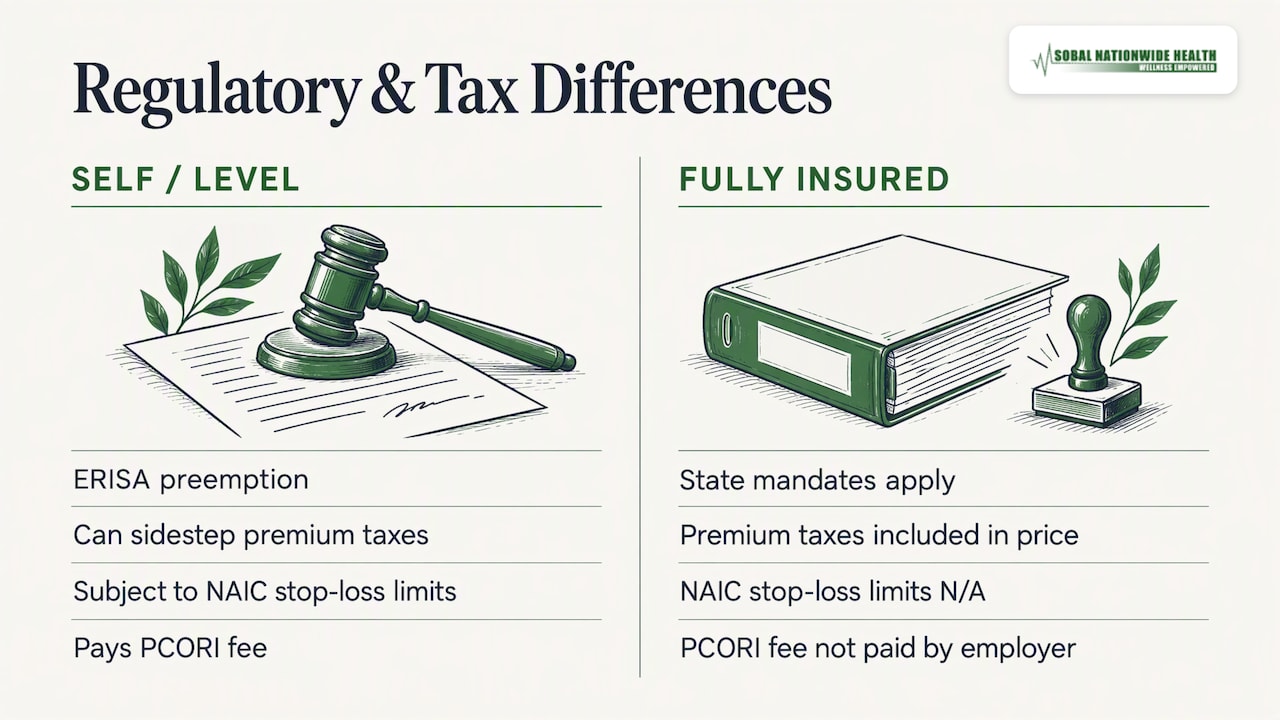
Self-funded and level-funded plans fall under ERISA, which generally preempts state insurance mandates, a point the DOL’s technical release spells out directly. That preemption is part of why level-funded plans can sidestep certain state-mandated benefits and premium taxes that fully insured plans must build into pricing.
States haven’t stayed out of it entirely. Several have adopted NAIC model restrictions on how low stop-loss attachment points can go, specifically to prevent level-funded arrangements from functioning as fully insured coverage in disguise. Self-funded employers also take on the PCORI fee, with the current applicable dollar amount published in IRS guidance, plus added Form 5500 reporting duties and fiduciary responsibilities that a fully insured carrier otherwise handles for you.
Mistakes Employers Make When Moving to Level-Funded Plans
The most expensive mistakes happen before the plan year even starts.
- Accepting a very low stop-loss attachment point without modeling what a bad year actually costs, since that choice can quietly erase most of the savings potential.
- Comparing quotes that use different claims assumptions, which makes the “cheaper” option impossible to verify.
- Underestimating the administrative and fiduciary workload that comes with self-funding, especially for employers without an HR team used to it.
- Skipping a cash-runway stress test, so a catastrophic claims year becomes a cash-flow emergency rather than a budgeted risk.
How We Help Employers Weigh This Decision
We typically ask for two to three years of claims history, current plan documents, and census data before modeling a proposal, because those three pieces reveal whether a group underwrites favorably for level-funding or is safer staying fully insured. We’ve seen employers save meaningfully once attachment points and admin fees are negotiated properly rather than accepted at face value. Our next step is usually financial modeling followed by a side-by-side broker comparison, with stop-loss terms negotiated before any contract is signed.
— Bernie S
Get Help Comparing Your Funding Options
Figuring out whether level-funded or fully insured fits your group shouldn’t mean reading actuarial reports on your own time. We work directly with small and mid-sized employers to pull quotes from multiple carriers, normalize the PMPM assumptions so you’re comparing real numbers, and negotiate stop-loss terms before you commit to anything.
To get started, we typically ask for your current census, a recent claims run-out report, and your existing plan documents, which usually lets us turn around comparable quotes within a couple of weeks. Our advisory services cover both personal and family coverage and business health insurance, with bilingual brokers available if that makes the conversation easier for your team.
- Broker-led quote normalization for clearer comparison across carriers.
- Review of stop-loss attachment points before contract signing.
- Bilingual support throughout enrollment.
If you’re ready to see what a side-by-side comparison looks like for your group, reach out to start your business health insurance review.
This article is general information, not a substitute for advice from a qualified financial advisor. Consult a qualified financial professional about your own circumstances before acting on anything here.
FAQ
What are the downsides of a level-funded health plan?
The main trade-off is unpredictability: if claims run higher than expected, you’re responsible for costs up to your stop-loss attachment point before coverage kicks in. Level-funded plans also carry more administrative and fiduciary responsibility than a fully insured contract, since you and your TPA handle duties a carrier normally manages.
Is level-funded health insurance a good option?
It can be a strong option for healthy, stable groups with enough cash reserves to handle a rough claims year, since surplus funds are often refunded when actual claims come in under projections. Milliman’s analysis frames it as a spectrum where the right attachment points determine whether it’s genuinely advantageous for your group.
Is self-funding or fully insured coverage better for a small business?
Neither is universally better: self-funded and level-funded arrangements tend to suit stable, cash-ready groups chasing refund potential, while fully insured plans suit employers who prioritize predictable monthly costs and minimal administrative burden. EBRI research notes small and mid-sized employers have increasingly shifted toward self-insured arrangements in recent years.
What exactly is a level-funded health plan?
A level-funded health plan is a self-funded arrangement where you pay a consistent monthly amount that covers expected claims, a stop-loss insurance premium, and administrative fees. Stop-loss coverage protects you from catastrophic claims above a set attachment point, and surplus funds are often returned to you when actual claims come in lower than projected.
Sources
- Level-funded health plans 101 — Milliman
- DOL technical release 2014-01 (stop-loss and ERISA)
- Internal Revenue Bulletin: 2025-45
