

For most employers the right starting point is either a traditional group plan or an employer-funded reimbursement arrangement like an ICHRA or QSEHRA. Which one fits depends on your size, your budget, and what your employees actually need. Small employers often lean toward SHOP or a reimbursement model, while larger employers usually default to a traditional group plan and need to watch network breadth and the tax credit rules closely.
TL;DR:
- Providing a network-accessible plan is more critical to employee satisfaction than choosing the lowest premium.
- Employers with fewer than 25 FTEs can qualify for a tax credit if they enroll in SHOP and pay at least half of the employee-only premium.
- The average family premium for employer-sponsored coverage is nearly $27,000 in 2025, with employees paying around $6,850 out of pocket.
- Crossing the 50-FTE threshold shifts employer obligations from offering credits to managing compliance and reporting requirements.
- Enrollment options vary by size, with SHOP for small firms and brokers or direct purchase for larger, multi-state employers.
Table of Contents
- What group health insurance actually covers
- Do you have to offer coverage? Small vs. large employer rules
- What group coverage costs and how to fund it
- How to choose the right plan for your team
- How to actually enroll: SHOP, brokers, or direct
- Why offering coverage pays off
- How Sobal Health supports employers building a benefits package
- What employers get wrong most often
- Get a benefits review built around your team, not a template
- Where to check the rules yourself
- Sources
- FAQ
What group health insurance actually covers
Group health insurance is coverage an employer arranges for a pool of employees, rather than each person shopping for a policy on their own. Because the risk is spread across the group, premiums are often more predictable than what you’d find on the individual market, though “group” doesn’t automatically mean “cheaper.”
Most employer plans fall into three buckets, and each one changes the deal you’re offering your team:
- PPO (Preferred Provider Organization): Wider provider access and out-of-network flexibility, usually paired with a higher premium.
- HMO (Health Maintenance Organization): Lower premiums, but employees pick a primary care doctor and need referrals to see specialists.
- HDHP (High-Deductible Health Plan) with HSA: Lower monthly premium, higher deductible, and a Health Savings Account employees can use to save pre-tax dollars for care.
Here’s the thing I tell employers constantly: the network usually matters more than a small premium gap. If your team’s doctors aren’t in the plan, a cheaper premium won’t feel like a win once someone gets a surprise bill. According to EBRI/Greenwald Research, provider network access and out-of-pocket costs consistently outrank premium price as the top factor employees weigh when choosing a plan.
Do you have to offer coverage? Small vs. large employer rules
Whether you’re required to offer coverage, and which programs you qualify for, comes down to one number: your full-time equivalent employee count.
- Applicable Large Employers (ALEs) are those averaging at least 50 full-time employees, including full-time equivalents, over the prior year, according to the IRS. ALEs are subject to the ACA’s employer shared responsibility provisions and must report offers of coverage.
- Aggregation rules can bundle related companies (common ownership, for example) into one ALE calculation, even if each entity looks small on its own.
- SHOP eligibility generally covers employers with 1 to 50 full-time equivalents, though some states allow up to 100, according to Healthcare. SHOP also requires offering coverage to all full-time employees and typically meeting a minimum participation rate, often around 70%.
If you’re under 50 FTEs, you’re generally exempt from the shared responsibility penalties that apply to ALEs, and you open the door to the Small Business Health Care Tax Credit. Crossing the 50-FTE line flips the calculation: you’re now managing compliance obligations instead of chasing credits. Knowing which side of that line you’re on changes almost everything else in this article.
What group coverage costs and how to fund it
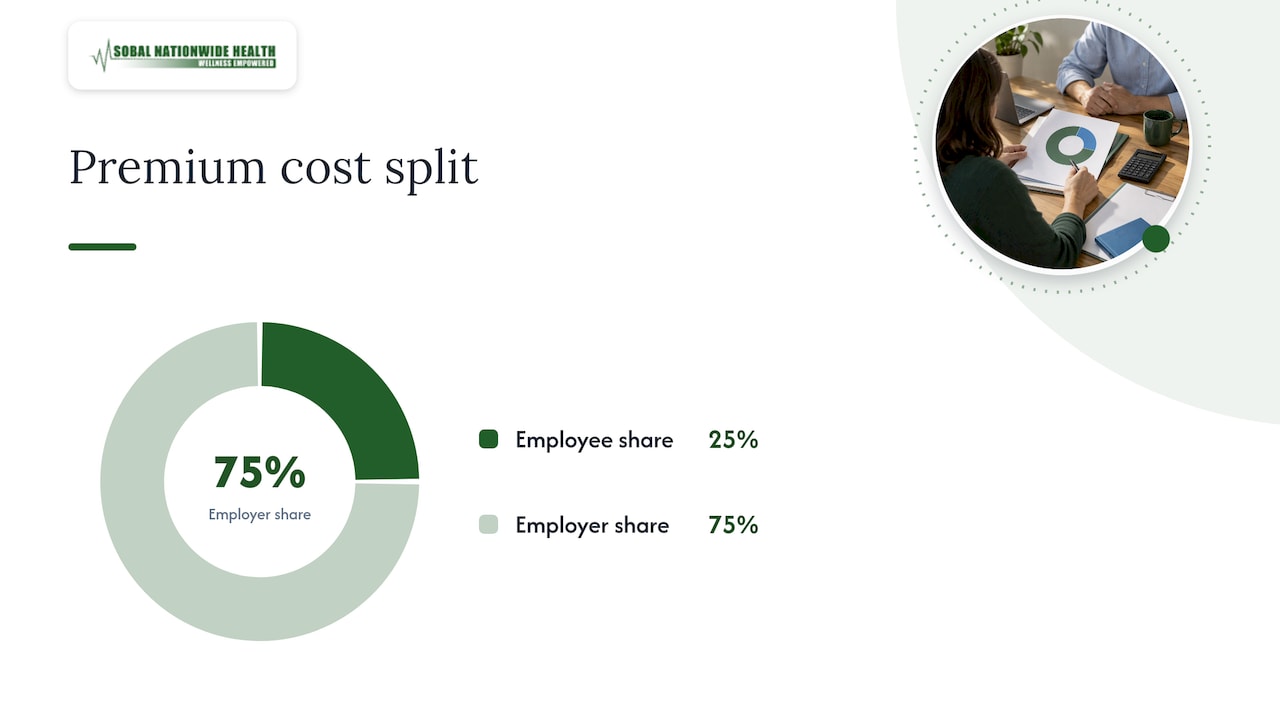
Premiums have been climbing, and it’s worth grounding your budget in the actual numbers rather than last year’s renewal letter. According to KFF’s 2025 Employer Health Benefits Survey, average family premiums for employer-sponsored coverage reached $26,993 in 2025, up about 6% year over year, with workers contributing an average of $6,850 toward family coverage out of their own paychecks.
How you split that cost, and whether you offer a traditional plan at all, comes down to a few paths:
- Traditional employer-paid premiums: You pick a plan, cover a share of the cost (often the full single premium for smaller firms trying to compete for talent), and employees pay the rest.
- Small Business Health Care Tax Credit: Employers with fewer than 25 FTEs may qualify for a credit worth up to 50% of their contribution (35% for tax-exempt employers), but only when they enroll through SHOP and pay at least 50% of the employee-only premium, according to Healthcare. The credit is largest for the smallest employers with lower average wages.
- ICHRA (Individual Coverage HRA): You reimburse employees tax-free for individual-market premiums instead of sponsoring a group plan, with flexible allowances by employee class, though it requires careful affordability testing to avoid ACA penalties.
- QSEHRA: Available to employers with fewer than 50 employees who don’t offer a group plan; it lets you reimburse individual-market premiums and certain medical expenses tax-free, provided the terms are uniform for full-time staff and employees maintain minimum essential coverage, according to HealthCare.gov.
How to choose the right plan for your team
Once you know your funding path, the real work is comparing proposals without getting distracted by the sticker price on page one.
- Start with the network. Pull your top five employee zip codes and check whether their current doctors are in-network before looking at anything else.
- Balance premium against deductible exposure. A lower premium with a high deductible can cost an employee more in a bad year than a higher premium with modest cost-sharing.
- Match plan design to your workforce. A younger team may value a lean HDHP and HSA; a team with families or chronic conditions often needs richer coverage.
- Check portability if you have multi-state staff. A regional HMO won’t help a remote employee two states away.
- Confirm HSA and HRA compatibility if you’re pairing an HDHP with tax-advantaged accounts, and ask about prescription formularies for specialty medications.
- Weigh admin burden and renewal predictability. Ask any carrier or broker for a sample renewal scenario showing what drove last year’s increases.
- Plan your employee communication early. A great plan poorly explained still generates complaints and low enrollment.
Pro Tip: Before you sign anything, ask the broker or carrier to show you a real renewal history, not just this year’s quote. It tells you how the plan actually behaves over time.
How to actually enroll: SHOP, brokers, or direct
Your enrollment path depends on your size and what you’re trying to unlock.
- SHOP enrollment works for employers with 1 to 50 FTEs (up to 100 in some states) and is required if you want to claim the Small Business Health Care Tax Credit, per HealthCare.gov. You’ll need an Eligibility Determination Form and must meet minimum participation thresholds.
- Broker-assisted private-market enrollment often opens up more flexible PPO designs and nationwide network access, particularly useful for multi-state teams.
- Direct carrier purchase can work for larger, single-state employers who don’t need broker guidance and already know their plan design.
Renewal timing matters too: most groups face a 30 to 60 day window to review options before their plan year resets, so start the comparison early.
Why offering coverage pays off
Group coverage isn’t just a line item, it’s a recruiting and retention tool. Employees consistently weigh provider network access and out-of-pocket costs as heavily as, or more than, premium price when evaluating a job offer, according to EBRI/Greenwald Research.
Provider network breadth often matters more to employees than a modest premium discount, which means employers who chase the cheapest plan without checking the network can end up with lower enrollment and more frustration, according to the same EBRI/Greenwald findings.
- Track offer acceptance and enrollment rates each renewal cycle.
- Watch claims trend data, not just premium changes, to spot where costs are really coming from.
- Correlate benefits satisfaction with voluntary turnover where you can.
How Sobal Health supports employers building a benefits package
Some health insurance brokers work with small businesses across multiple states, helping employers compare group packages, medically underwritten plan options, and supplemental coverage like dental, vision, and critical illness insurance without a sales-driven pitch.
Before you sign with any broker, ask three questions:
- Are you licensed in every state where I have employees?
- Can you show me a sample renewal scenario, not just a quote?
- What enrollment and employee communication support do you actually provide?
Bring your current census, prior renewal letter, and a short list of employee priorities to your first conversation, it makes the comparison faster and sharper.
What employers get wrong most often
The two mistakes I see constantly: chasing the lowest premium without checking the network, and skipping renewal-cost modeling until it’s too late to negotiate. Fix both by mapping your employees’ current doctors against any proposed network first, and always ask for a multi-year renewal scenario before you commit.
— Bernie S
Get a benefits review built around your team, not a template
Some health insurance brokers help small businesses put together group coverage that fits their actual workforce, including access to private, medically underwritten plans, ACA marketplace options, and supplemental products like dental and critical illness coverage, with support from brokers who may work in English or Spanish.
A consultation typically starts with a look at your current census, your renewal letter if you have one, and a short conversation about what your employees actually use most. From there, you’ll see a comparison built around your specific network and budget rather than a generic quote. Visit the Sobal Health business insurance page to schedule a review, or explore the practical comparison checklist for small business plans before your call.
Where to check the rules yourself
A few primary sources are worth bookmarking if you want to verify anything in this guide directly:
- Healthcare explains the Small Business Health Care Tax Credit in detail.
- The IRS ALE determination page walks through how the 50-FTE threshold and aggregation rules work.
- KFF’s Employer Health Benefits Survey tracks premium and contribution trends by firm size each year.
- For broader ACA context and plan-selection commentary, XactInsure’s ACA blog offers additional reading on how the law affects employer decisions.
This article is general information, not a substitute for advice from a qualified financial advisor. Consult a qualified financial professional about your own circumstances before acting on anything here.
Sources
- Healthcare
- Determining if an employer is an applicable large employer | Internal Revenue Service
- Annual family premiums for employer coverage rise 6% in 2025, nearing $27,000 | KFF
- Provider networks and out-of-pocket costs drive health plan choice | EBRI/Greenwald Research
- Healthcare
FAQ
What is group health insurance?
Group health insurance is a health plan an employer arranges for its employees as a pool, rather than each person buying an individual policy. It typically includes options like PPOs, HMOs, or HDHPs, and eligibility and funding rules depend on employer size.
How much cheaper is group health insurance?
There’s no fixed discount, and cost depends heavily on employer size, plan design, and how much of the premium the employer covers. Average family premiums for employer-sponsored coverage reached $26,993 in 2025, with workers contributing an average of $6,850 toward that total.
What is the major disadvantage of group health insurance?
The biggest drawback is limited flexibility: employees are locked into whatever plan and network the employer selects, which may not match their preferred doctors or specific medical needs. Employers also carry administrative and compliance responsibilities, especially once they cross the 50-FTE Applicable Large Employer threshold.
When did Group Health become Kaiser Permanente?
This question refers to a specific regional health system’s corporate history, which isn’t something this guide covers or verifies. For accurate details on that organization’s history, check directly with Kaiser Permanente’s official sources.
