
Most vision plans in the United States cover contact lenses, either through an elective allowance or as medically necessary lenses with higher benefits. The catch is that coverage depends on your specific plan’s allowance, fitting fees, and whether contacts replace your glasses benefit for the year. Before you order a year’s supply, check three things on your plan summary: the dollar allowance, whether a fitting exam is included, and the “in lieu of” rule for frames.
TL;DR:
- Most plans cap elective contact lens allowances between $120 and $150 annually, but medically necessary lenses can be covered up to $210 or more, depending on the plan.
- An “in lieu of” clause means using contacts in one year forfeits the frames and lenses benefit, so plan purchases carefully around your benefit cycle.
- Fitting fees are often billed separately, with standard fittings usually fully covered and specialty fittings potentially costing up to $55 out of pocket.
- In-network providers generally bill your insurer directly, offering lower costs and fewer claim forms compared to out-of-network reimbursements.
- HSA and FSA funds can cover the out-of-pocket costs exceeding your plan allowance, including related lens supplies, if properly documented and not double-bipped.
Table of Contents
- How contact lens benefits are structured in your plan
- Elective vs. medically necessary contacts: what changes your coverage
- Contact lens fitting and evaluation: standard vs. premium fits
- In-network vs. out-of-network: what really changes
- Typical dollar ranges you can expect from a U.S. vision plan
- Using HSAs and FSAs to cover what your plan doesn’t
- Common exclusions and limits that catch people off guard
- What to ask HR or your eye-care provider before you use your benefit
- How we help clients make sense of their vision benefits
- How Sobal Health can help you make sense of your vision plan
- Sources
- FAQ
How contact lens benefits are structured in your plan
When you pull up your vision plan’s benefit summary, the contact lens section can look like a foreign language. Three terms matter most: allowance, copay, and “in lieu of.” Once you know what each one means, the rest of the page gets a lot easier to read.
An allowance is a fixed dollar amount your plan puts toward contacts each benefit period, usually once every 12 months. It’s not a blank check. If your lenses cost more than the allowance, you typically pay the difference, sometimes at a discounted rate if you stay in network. A copay, on the other hand, is a flat fee you pay regardless of the final bill, often tied to the fitting and evaluation exam rather than the lenses themselves.
The phrase “in lieu of” shows up in nearly every brochure, and it’s the one most people miss. It means that if you choose contacts, you’re giving up your frame and lens benefit for that same year. OPM-hosted MetLife vision plan brochures spell this out clearly: members get one contact-lens benefit per calendar year, used in place of eyeglass lenses and frames, not alongside them. So if you wear contacts most of the year but want backup glasses too, you’ll want to plan that purchase around your benefit cycle rather than assuming both are covered in the same period.
Here’s where to look on a typical plan document and what each line usually tells you:
- Allowance amount: Found under “Contact Lenses” or “Materials,” this is the dollar figure applied toward your lenses.
- Materials-only vs. fitting included: Some allowances cover lenses alone, while others fold in the fitting and evaluation fee.
- Frequency: Nearly every plan limits you to one purchase or fitted pair per 12 months, reset on your plan’s anniversary date, not the calendar year in every case.
- Replacement language: Look for wording about lost, damaged, or “non-conforming” lenses, since most plans exclude mid-cycle replacements outside this window.
- “In lieu of” clause: This tells you whether choosing contacts means forfeiting your glasses benefit for that cycle.
Frequency rules trip people up more than any other detail. Most plans allow one contact lens purchase, or one fitted supply, every 12 months. That’s different from “one pair,” since a 12 month supply of daily disposables might mean 365 individual lenses counted as a single benefit event. If you wear monthlies or dailies and go through lenses faster than your plan resets, you’ll be paying out of pocket for extra boxes regardless of how generous your allowance looks on paper.
Materials-only allowances are the most common structure, and they catch new contact wearers off guard. The allowance applies strictly to the lenses themselves, while the fitting and evaluation exam, the appointment where your eye doctor confirms the right prescription, size, and lens type, gets billed separately. Some plans wrap both into a single combined allowance, which can be easier to budget around since you know your total out-of-pocket exposure up front. There is no universal rule here: one plan might apply $130 strictly to lenses, while another applies the same figure to lenses and fitting combined. Reading your plan’s actual brochure, not a general summary, is the only way to know which structure you have.
Elective vs. medically necessary contacts: what changes your coverage
Not all contact lenses are treated the same by your insurer, and the distinction between “elective” and “medically necessary” can mean the difference between a modest allowance and a much larger one.
Elective contacts are the default category. If you’re nearsighted, farsighted, or have simple astigmatism and you choose contacts over glasses for comfort or convenience, your plan treats that as elective, subject to the standard allowance and frequency rules already described.
Medically necessary contacts are different. These apply when contacts are the only practical way to achieve functional vision, not just a preference. Plans typically recognize a specific set of clinical situations for this category:
- Keratoconus, a condition where the cornea thins and bulges into a cone shape, often correctable only with specialty lenses.
- Aphakia, the absence of the eye’s natural lens, frequently following cataract surgery.
- High ametropia, meaning a very strong prescription that glasses can’t correct as effectively as contacts.
- Anisometropia, a significant difference in prescription strength between the two eyes.
- Post-surgical corneal irregularities that leave glasses unable to provide usable vision.
If your eye doctor believes you fall into one of these categories, expect to submit documentation. Insurers commonly ask for clinical notes, a diagnosis code, and sometimes a letter explaining why glasses won’t work for your specific condition. This isn’t a rubber-stamp process. Some plans require pre-authorization before the exam even happens, so it’s worth calling your plan’s member services line before you book the appointment rather than after.
One contact lens benefit most plans apply per calendar year typically caps elective coverage in the $120 to $150 range, according to OPM-hosted VSP plan brochures, while medically necessary lenses can be covered at a substantially higher allowance or, in some plans, close to the full cost. That gap is the whole reason the elective versus medically necessary distinction matters: it’s not a technicality, it’s often hundreds of dollars.
The reimbursement outcome depends heavily on how your specific plan defines “medically necessary,” and that definition is not standardized across insurers. One carrier’s criteria might lean strictly on diagnosis codes, while another gives more weight to the treating doctor’s clinical judgment. If your condition sits in a gray area, ask your eye doctor’s office whether they’ve successfully processed similar claims with your specific insurer before, since office staff often know which documentation tends to get approved without a fight.
Contact lens fitting and evaluation: standard vs. premium fits
Every new contact lens wearer needs a fitting and evaluation exam, but not every fitting costs the same, and that’s because not every fitting is the same type of appointment.
A standard fitting applies to common prescriptions: spherical lenses for garden-variety nearsightedness or farsightedness. These are the fittings most plans cover in full or with a modest flat copay, since the lens parameters are straightforward and the appointment is relatively quick.
A premium or specialty fitting applies to anything more complex: toric lenses for astigmatism, multifocal lenses for presbyopia, gas-permeable lenses for irregular corneas, or post-surgical fittings after procedures like LASIK or cataract surgery. These appointments take longer, often require trial lenses and follow-up visits, and plans typically bill them differently.
Here’s generally how the cost-sharing plays out, based on patterns across major federal vision plan brochures:
- Standard fitting: Often covered in full or subject to a routine eye exam copay, with no separate specialty charge.
- Premium or specialty fitting: Commonly subject to a separate copay, sometimes up to $55, or an allowance that only partially offsets the appointment cost.
- Balance billing: Whatever isn’t covered by the allowance or copay typically falls to you, though in-network providers often apply a negotiated discount to that remaining balance.
The classification matters because it changes your bill before you’ve even picked out lenses. A BCBS member booklet specifically recommends asking whether your fitting will be classified as standard or specialty, since that single determination shapes both your copay and whether any allowance applies to the exam itself.
Pro Tip: Ask your eye doctor’s office to confirm the fitting classification and submit the claim directly to your insurer before your appointment ends, so you know your out-of-pocket number before you leave the office.
In-network vs. out-of-network: what really changes
Staying in network isn’t just a suggestion buried in the fine print, it’s usually the difference between a smooth visit and a stack of paperwork.
When you see an in-network provider, the office typically bills your insurer directly. You walk in, get your exam and lenses, and pay only your portion at checkout. There’s no claim form to mail, no waiting weeks for a reimbursement check, and often a lower out-of-pocket cost because in-network providers accept negotiated rates. OPM-hosted BCBS FEP Vision brochures note that in-network care removes the need for claim forms altogether, which is a meaningful convenience most members don’t think about until they’ve dealt with the alternative.
Out-of-network care works on a reimbursement schedule instead. You pay the provider in full up front, then submit a claim to your insurer for reimbursement, capped at whatever the plan’s fee schedule allows for that service, often less than what you actually paid. The gap between what you paid and what the plan reimburses is yours to absorb.
In-network visits also tend to come with extras that out-of-network claims don’t offer:
- Discounts on balances over your allowance, commonly in the 15% to 20% range depending on the provider and plan.
- Reduced or waived copays at certain in-network clinics for routine fittings.
- Direct billing, which eliminates the lag time between paying and getting reimbursed.
Before your appointment, it’s worth running through a short checklist. Verify the provider actually participates in your plan’s network rather than assuming based on a chain name. Ask for an itemized estimate before you commit to a lens brand or supply size. And save every receipt, since you may need it for an HSA or FSA reimbursement, or for an appeal if a claim gets denied later.
Typical dollar ranges you can expect from a U.S. vision plan
Numbers help more than general advice here, so let’s look at what actual federal vision plan brochures show for 2026.
Elective contact lens allowances commonly fall between $120 and $150 across major carriers, according to OPM-hosted VSP plan brochures, with similar ranges reflected in MetLife’s federal vision plan offerings. Medically necessary contact lens allowances often run notably higher, with some plans extending coverage up to $210 or more for qualifying conditions, a figure drawn from OPM-hosted MetLife federal vision brochures. That’s the clearest evidence that the elective versus medically necessary distinction isn’t just paperwork, it’s a real dollar gap.
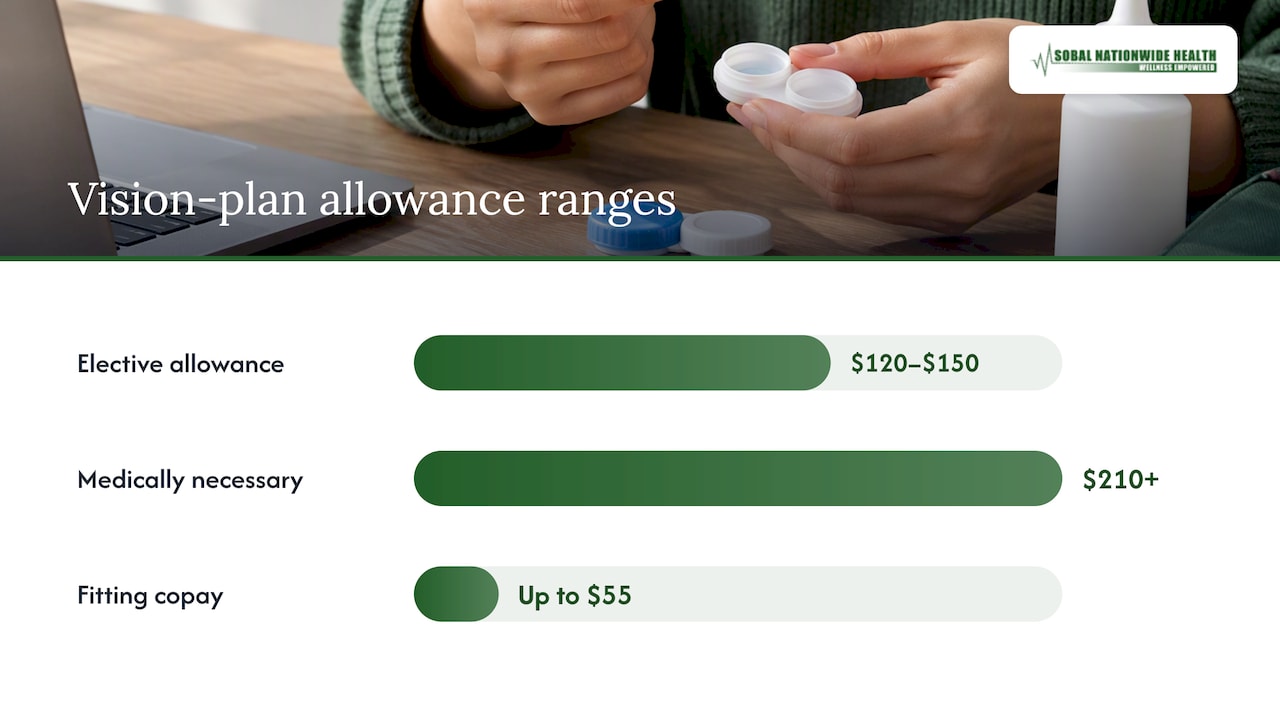
Fitting and evaluation copays vary by classification. Standard fittings are frequently included at no extra charge or folded into your routine exam copay, while specialty fittings commonly carry a separate copay, sometimes up to $55.
When your total bill exceeds your allowance, most in-network providers apply a discount to the remaining balance rather than charging full retail price. OPM-hosted BCBS FEP Vision brochures describe discounts commonly around 15% off the balance over the allowance, which can meaningfully soften the cost of premium lens brands or specialty fits.
These figures are representative, not universal. Your plan’s actual numbers could sit higher or lower depending on your employer, your state, and which carrier administers your benefits. Treat these ranges as a benchmark for sanity-checking your own brochure, not as a substitute for reading it.
Using HSAs and FSAs to cover what your plan doesn’t
If your allowance doesn’t stretch far enough, a health savings account or flexible spending account can pick up the slack, and the rules here are more generous than most people expect.
According to IRS Publication 502, contact lenses needed for vision correction qualify as deductible medical expenses, which means they’re also eligible for tax-free payment or reimbursement through an HSA or FSA. That coverage extends beyond the lenses themselves to related supplies like saline solution and lens cleaners, as long as they’re used for a qualifying medical purpose.
A few practical rules keep this process clean:
- Keep itemized receipts showing the lens purchase or supply cost separately from any unrelated items.
- Attach clinical documentation when the expense relates to a medically necessary diagnosis, in case your HSA or FSA administrator requests it.
- Never double-dip. If your vision plan already reimbursed an expense, you cannot also claim that same dollar amount through your HSA or FSA.
- Use HSA or FSA funds for the gap, meaning the portion of your bill that exceeds your plan’s allowance, rather than trying to run the entire purchase through insurance.
This combination works especially well for anyone whose employer-sponsored vision allowance falls short of their actual lens costs. Say your plan allowance covers $130 and your annual supply runs $280. The remaining $150 is a reasonable candidate for HSA or FSA reimbursement, assuming you have funds available and keep the receipt on file. For context on how vision benefits fit into your broader health coverage picture, it helps to understand how health insurance works as a whole system rather than a collection of separate benefits.
Common exclusions and limits that catch people off guard
Even a generous-looking plan has boundaries, and the exclusions tend to live in the parts of the brochure nobody reads until they get an unexpected bill.
Contact lens insurance or service agreements, the optional protection plans some retailers sell alongside your lenses, are almost never covered by your vision insurance. That’s a separate purchase entirely, and confusing the two is one of the most common billing surprises.
Refitting after your initial fitting window, often capped around 90 days, typically isn’t covered either. If your lenses aren’t comfortable and you need an adjustment appointment well after that window closes, expect to pay for that visit separately. Polishing or modifying existing lenses falls into the same excluded category in most brochures.
Replacement for lost or stolen lenses outside your normal 12 month replacement interval is another common gap. Your plan assumes a certain supply schedule, and losing a lens early doesn’t typically trigger an early replacement benefit.
A few other patterns worth knowing:
- The either/or rule means choosing contacts in a given benefit year generally disqualifies you from also getting a frame and lens pair in that same cycle.
- Replacement wording varies by brochure, so a plan that allows mid-cycle replacement for documented medical reasons may still deny a replacement for simple loss or damage.
- Service agreements and extended warranties sold at the point of purchase are consumer products, not insurance benefits, and should never be confused with your vision plan’s coverage.
Pro Tip: If a claim gets denied, gather your clinical documentation, an itemized bill from the provider, and the exact plan language before you call to appeal. Denials overturned on a vague phone call are rare; denials overturned with paperwork in hand are common.
What to ask HR or your eye-care provider before you use your benefit
A short conversation before your appointment can save you from an unpleasant surprise at checkout. Here’s a sequence worth working through with HR first, then your eye-care provider.
- Ask HR for the allowance amount and frequency. Confirm the dollar figure applied to contacts and whether your benefit year runs on the calendar year or your plan’s anniversary date.
- Ask whether contacts are “in lieu of” frames. Confirm you understand what you’re giving up if you choose contacts over glasses this cycle.
- Ask for the in-network provider list. Getting this list before you book saves a wasted call to a provider who doesn’t participate.
- Ask about pre-authorization for medically necessary lenses. Some plans require documentation submitted before the exam, not after.
- Ask your eye-care provider whether your fitting is standard or specialty. This single answer determines your copay structure.
- Ask if the provider bills your plan directly. Direct billing avoids the reimbursement paperwork that comes with out-of-network claims.
- Ask for the expected retail cost and any available discount on the amount over your allowance, so you know your final number before you commit to a lens brand.
Keep a simple record of what you learn: the relevant pages from your plan brochure, any itemized receipts from your provider, and clinical notes if your situation involves a medically necessary diagnosis. If a claim ever gets questioned, that paper trail is what moves things along quickly instead of dragging into a drawn-out appeal.
How we help clients make sense of their vision benefits
Reading a vision plan brochure for the first time feels a little like decoding a contract written by someone who assumed you already understood insurance. That confusion is exactly what brought me into this work, because I kept meeting people who had decent coverage and no idea how to use it.
At Sobal Health, reviewing a client’s benefits means starting with the brochure itself, not a generic summary. We look for the actual allowance figure, the frequency language, and whether contacts fall under an “in lieu of” structure that might catch someone off guard later. When we spot a gap, say an allowance that won’t come close to covering a client’s actual lens costs, we talk through whether an HSA or FSA strategy makes sense, or whether a supplemental vision plan is worth adding.
That kind of review matters most for self-employed individuals and small business owners, the people we work with most often, since they’re frequently piecing together coverage without an HR department to call with questions. Our approach stays the same regardless of the plan: read the fine print first, identify where the real dollar gaps sit, and walk the client through their options in plain language before they spend a dollar.
— Bernie S
How Sobal Health can help you make sense of your vision plan
If you’ve made it this far and you’re still not sure what your plan actually covers, that’s a completely normal place to land, and it’s exactly where a short conversation with a broker tends to help more than another hour of reading brochures.
A benefits review with Sobal Health typically starts with the brochure itself. We’ll read through your plan’s actual contact lens language, compare your allowance against what your lenses realistically cost, and flag any gap worth covering through an HSA, FSA, or supplemental vision plan.
It’s worth reaching out when:
- Your plan’s language is confusing and you can’t tell whether contacts are covered as elective or medically necessary.
- A medically necessary claim got denied and you want a second set of eyes on the documentation before you appeal.
- Your allowance doesn’t come close to your actual costs, and you want to know whether a supplemental plan or an HSA strategy makes more sense for your situation.
We work with individuals, families, and small businesses in multiple states, offering personalized advisory without the sales pressure that usually comes with insurance shopping. If you want a second opinion on your current coverage or you’re exploring personal and family insurance options, reach out through our contact page and we’ll walk through your plan together.
This article is general information, not a substitute for advice from a qualified financial advisor. Consult a qualified financial professional about your own circumstances before acting on anything here.
Sources
- VSP Vision Care (OPM-hosted brochure)
- Publication 502, Medical and Dental Expenses | Internal Revenue Service
FAQ
How much will VSP cover for contacts?
VSP’s elective contact lens allowance commonly falls between $120 and $150 per year, based on OPM-hosted VSP plan brochures. Medically necessary contacts may qualify for a higher allowance or fuller coverage, but the exact figure depends on your specific plan tier, so check your brochure directly.
Is EyeMed or VSP better?
Neither is universally better, since the right fit depends on your specific allowance amounts, your preferred eye doctor’s network participation, and whether you need standard or specialty lenses. The smartest approach is comparing each plan’s actual brochure for your situation rather than relying on general reputation.
Is VSP or MetLife vision better?
Both carriers offer similar structures: an elective allowance in a comparable dollar range, one contact-lens benefit per year used in lieu of glasses, and higher coverage for medically necessary lenses. OPM-hosted MetLife brochures show allowances up to $210 for necessary lenses, so compare your specific plan’s numbers before assuming one carrier beats the other.
Is it better to use VSP on contacts or glasses?
That depends entirely on the “in lieu of” rule in your plan, since choosing contacts typically means forfeiting your frame and lens benefit for that same year. If you need both contacts and a backup pair of glasses, think through which one costs more out of pocket before deciding which to apply your benefit toward.
Are contact lenses covered by HSA or FSA funds?
Yes, contact lenses used for vision correction qualify as eligible medical expenses under IRS Publication 502, along with related supplies like cleaning solution. Keep itemized receipts, and don’t submit the same expense to both your insurance plan and your HSA or FSA.
