






If you run an HVAC company in Texas, you can look at private PPO-style coverage for yourself and your family, or at a group plan that covers you and your crew. Which route fits depends mostly on whether you have employees, how many, and how many of them actually want the coverage.
TL;DR
- Texas treats a business with 2 to 50 employees as a small employer, and as an owner you can join a group plan only if at least one employee enrolls too, per the Texas Department of Insurance (TDI).
- Most insurers want at least 75% of your eligible full-time employees to take the plan. Employees who already have other coverage don’t count in that math.
- If you work alone or with only 1099 helpers, private PPO-style coverage for you and your family is the place to start.
- You can usually compare several options in one phone call. Our quote form needs only a zip code and birthdates, never health questions.
Table of Contents
- Why HVAC owners shop for coverage differently
- If you work solo or with 1099 helpers
- If you have employees: how Texas defines a small employer
- The 75% participation rule, with an example
- Premiums, deductibles and networks: what to compare
- Cash flow and the HVAC calendar
- When your situation changes
- What we’d tell a friend who owns an HVAC shop
- How we help Texas HVAC owners
- What to have ready for a call
- FAQ
- Sources
Why HVAC owners shop for coverage differently
An HVAC business has a rhythm most offices don’t. Summer is slammed, spring and fall can be uneven, and your own paycheck follows the work. That makes a monthly health premium feel very different from a salary-based person’s payroll deduction.
You are also doing two jobs at once. You are the person who needs coverage, and you may be the person deciding what your techs and installers are offered. Those are two separate questions, and it helps to answer them one at a time.
Here is the first question: who needs to be covered?
- Just you, as a sole owner or a 1099 contractor.
- You and your spouse and kids.
- You and your employees, with or without family members.
Each of those points to a different kind of plan, and the rules change at the point where you hire your first W-2 employee.
If you work solo or with 1099 helpers
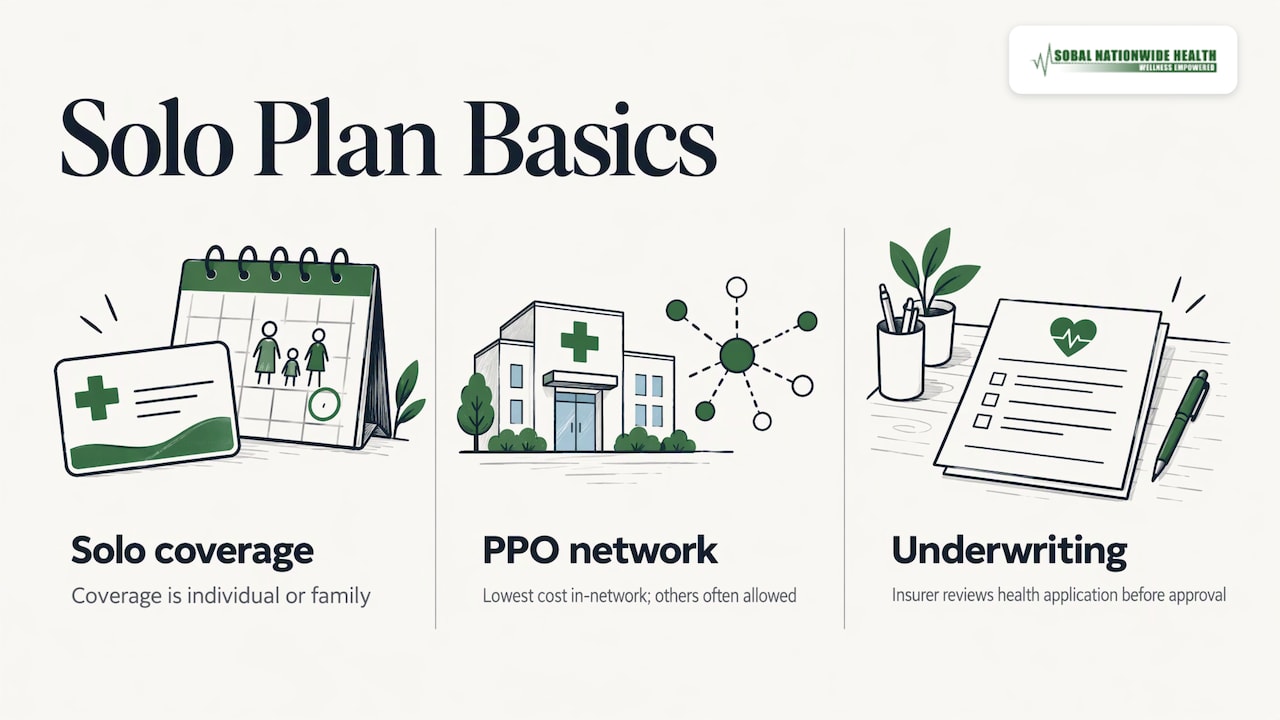
Many HVAC owners start as one-person shops: a van, a set of gauges, a few regular customers and maybe a subcontractor or two for big installs. If that is you, there is no employee group to build. Your coverage is individual or family coverage.
That is where private plans with a PPO-style network often come in. A PPO (preferred provider organization) is a plan design that lets you see doctors and hospitals inside its network at the lowest cost, and in many designs lets you see others as well. For a family that wants to keep the pediatrician they already trust, that choice matters. We cover how those plans work on our page about private PPO health insurance in Texas, and if you travel for jobs or have family in other states, our overview of nationwide PPO health insurance explains how portable networks work.
Private plans are medically underwritten. That means the insurer reviews a short health application before it approves you, instead of accepting everyone. We write for healthy buyers who can qualify, which is why we keep the quote form simple and why the application questions come later, with your advisor, only when you decide to move forward.
For a deeper look at the self-employed side, see our guides on self-employed health insurance in Texas and health insurance for contractors in Texas. If your helpers are paid on a 1099, our page on 1099 contractor health insurance is also a good read.
If you have employees: how Texas defines a small employer
Once you have W-2 employees, group coverage becomes possible. Texas has its own definition of a small employer, and it’s worth knowing because it decides which rules apply to you.
According to TDI’s small employer health insurance guide, Texas defines a small employer as one with 2 to 50 employees. The same guide says the owner can enroll only if at least one employee also enrolls. In plain English: you can’t set up a group plan just for yourself.
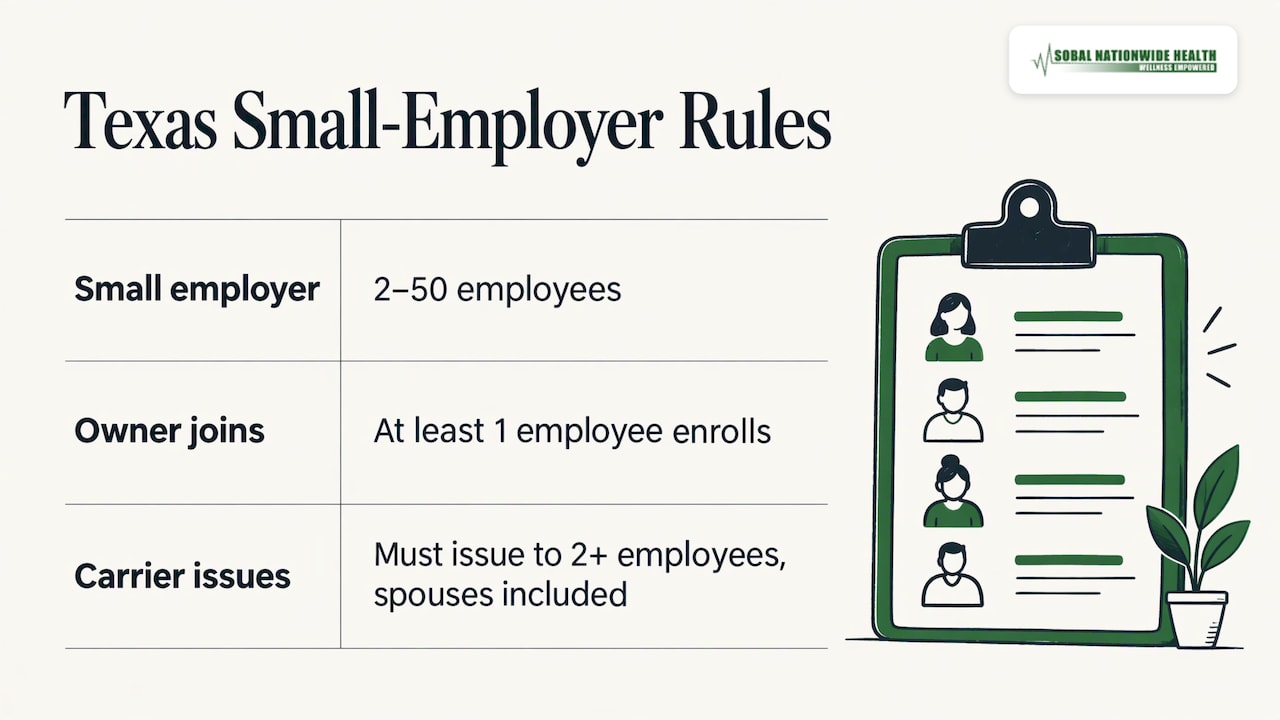
Texas law also helps the smallest groups. TDI’s FAQ for health carriers states that a small group carrier must issue coverage to a small employer with two or more employees, even if those employees are married to each other. So a two-person business, such as an owner and a spouse who answers phones and schedules calls, is not shut out because of the size.
This article is aimed at owners with up to about 30 employees, which covers most local and regional HVAC companies. The details of which plan fits a business your size are something an agent walks you through, because the options change with the size and makeup of your crew.
The 75% participation rule, with an example
Group plans are built on shared participation. That is how insurers keep the plan stable, and it is why they set a minimum number of employees who must sign up.
TDI’s guide explains that most Texas insurers require at least 75% of your full-time employees to participate, and that employees who already have other coverage are not counted in that figure. Here is how that might look for a made-up shop.
| Item | Example |
|---|---|
| Full-time employees | 12 |
| Employees covered elsewhere (a spouse’s job, for instance) | 4 |
| Employees counted for the rule | 8 |
| 75% of those counted | 6 |
In this example, about 6 of the 8 counted employees would need to enroll. The exact number, and how fractions are handled, is something the insurer confirms, so treat this as an illustration of the idea and not a rule of thumb for your own shop.
Two practical points follow from this:
- Waived coverage helps you. A tech who is on a spouse’s plan doesn’t hurt your participation number.
- Employee interest matters. A crew of young installers who would rather skip coverage can make participation harder than a crew with families.
Before you commit to a plan, it is smart to ask your team what they would actually use. A short, friendly conversation in the shop beats guessing.
Premiums, deductibles and networks: what to compare
When you set plans side by side, there are four numbers and one question that matter most.
- Premium: what you pay each month to keep the plan active. Think of it as the price of getting in the door.
- Deductible: what you pay for care before the plan starts sharing costs.
- Cost-sharing: copays and coinsurance after the deductible.
- Out-of-pocket maximum: the yearly ceiling on what you pay for covered care. It works like a financial safety net.
- Network question: are the doctors and hospitals you and your family use in the network, and what happens if you travel?
A low premium with a high deductible can look great on paper and feel painful the first time someone gets hurt on a ladder or a roof. A higher premium with a lower deductible can be the right call for a family that visits the doctor often. Neither is better in general. The right answer is the one that matches how you actually use care and how much cash you keep on hand in the slow months.
Here are a few more things TDI’s 2026 Texas Health Coverage Guide points out that help when you compare:
- Individual plan premiums are locked in for one year, so you aren’t surprised mid-year.
- Federal law requires companies to justify rate increases of 10% or more.
- Children can stay on a parent’s plan until age 26, whether or not they live at home, are in school or are claimed as dependents.
- Fully insured plans are regulated by TDI, while self-funded plans fall under the U.S. Department of Labor, and state rules usually don’t apply to those. That changes where you go with a complaint, so ask which kind of plan you are looking at.
If you want to see how costs tend to be framed around Texas, our page on how much health insurance costs in Texas and our guide to finding affordable health insurance in Texas walk through the factors that move a premium: age, zip code, family size and plan design.
Cash flow and the HVAC calendar
A monthly premium is a fixed bill in a business with variable income. Owners who do well with it tend to treat it like they treat a truck payment or insurance on the van: a standing cost that gets planned for in the budget, not something paid out of whatever is left.
Some simple habits help:
- Set up the premium on autopay from your business or personal account, so a busy July doesn’t cause a missed payment.
- Pick a deductible you could cover from savings in a slow February, not one that only works in a record summer.
- Keep family and business coverage questions separate on paper. Your personal plan and your crew’s plan are different decisions.
If you are also looking at income protection for the days when an injury keeps you off the roof, we offer accident, critical illness and disability income insurance alongside health coverage. Our page on accident insurance for self-employed owners shows how those fit together with your cash runway.
When your situation changes
HVAC owners often hit a handful of moments where coverage needs a fresh look:
- Leaving COBRA. If you or your spouse had job-based coverage and it ends, you don’t have to stay on COBRA, which continues the old employer plan, usually at full cost. Private coverage is one alternative to compare. Our page on special enrollment after losing job coverage in Texas explains the timing for that situation.
- A spouse’s employer plan got too expensive. Family add-on premiums can be steep. Some families find a private family plan priced better, and the way to know is to compare.
- A child turns 26. Per TDI’s guide above, a child can stay on a parent’s plan until 26. After that, your son or daughter needs their own coverage, and a young adult who is healthy may qualify for a private plan.
- You hire your first employee. That is the point where group coverage becomes possible, as described above.
- You grow past a handful of people. The shape of the group, and the 75% participation rule, becomes the main thing to plan around.
In each case the next step is the same: gather the dates, ages and zip code, and talk through the options with a licensed advisor.
What we’d tell a friend who owns an HVAC shop
Most HVAC owners I talk to are not confused about their trade. They’re confused about the paperwork around it. They’ve been told a plan is “good,” but nobody explained the deductible, the network or the rules for adding a crew.
My advice is to start with the people, not the plan. Who needs to be covered, which doctors matter to your family, and how much of a surprise bill you could handle in your slowest month. Once you know that, comparing options gets much calmer.
At Sobal Health, we’re a licensed brokerage that offers private medically underwritten plans, including PPO-style and nationwide networks, for self-employed people, families and small businesses. We offer one-on-one advice focused on education, not pressure, and our brokers speak English and Spanish. If you own a shop with a crew, we can walk you through all the group options that exist for a business your size.
You don’t need to have it figured out before you call. Bring your questions.
Bernie S
How we help Texas HVAC owners
We at Sobal Health help self-employed people, families and small businesses compare private health plans, along with dental, vision and supplemental coverage such as accident and critical illness insurance. Our advisors are licensed, and you can reach one by phone or webinar screen share.

If you have employees, start with our business health insurance page. If it’s just you and your family, see our personal and family coverage options. If you want to talk with someone local to the state, a health insurance broker in Texas can compare options with you, and our Texas self-employed broker page has more for owner-operators. You can also browse our free educational resources at your own pace, or find a health insurance broker on our site.
What to have ready for a call
A short list saves everyone time:
- Your zip code and the birthdates of everyone who would be covered.
- Whether you have W-2 employees, and roughly how many work full time.
- Which of those employees are already covered somewhere else.
- The doctors and hospitals your family wants to keep.
- The monthly amount you’re comfortable with and the deductible you could cover from savings.
That is all you need to begin. We never ask health questions on the quote form.
FAQ
Can I get a group health plan if I’m the only person in my HVAC business?
No. Under TDI’s small employer rules, the owner can enroll in a small group plan only if at least one employee also enrolls. A solo owner looks at individual or family coverage instead, and private PPO-style plans are one option to compare.
Do my 1099 helpers count toward a group plan?
Group plans are built around employees. Independent 1099 contractors generally look for their own individual coverage. An agent can explain how your particular mix of workers is treated.
What is the 75% participation rule?
Most Texas insurers require at least 75% of your full-time employees to join the plan, per TDI’s guide. Employees who have other coverage, such as through a spouse, are left out of the count.
Can my spouse and I be the only two employees?
Possibly. Texas law requires a small group carrier to issue coverage to a small employer with two or more employees, even when they’re married to each other, according to TDI’s carrier FAQ. An advisor can go over what applies to your business.
How old can my kids be on my plan?
Per TDI’s 2026 guide, children can stay on a parent’s plan until they turn 26, whether or not they live at home, are in school or are claimed as dependents.
Sources
- Small employer health insurance guide, Texas Department of Insurance
- Frequently Asked Questions for Health Carriers, Texas Department of Insurance
- 2026 Texas Health Coverage Guide, Texas Department of Insurance
Ready to compare? Get a free quote at https://sobalhealth.com/#quote or call (305) 680-0125.
Recommended
- Health Insurance for Contractors in Texas
- Avoid Losing the SHOP Credit: Texas Small Business Health Insurance
- Self-Employed Health Insurance in Texas (2026 Guide)
- Self-Employed Health Insurance Broker in Texas
Related official guides