






If you work as a contractor in Texas, a private PPO plan lets you see doctors and hospitals across the country without an employer, and a licensed broker can compare carriers for you at no extra step on your side. We help self-employed people and small business owners in Texas do exactly that, and this guide walks you through how.
TL;DR
- Contractors can choose private, medically underwritten PPO plans that let you use in-network and out-of-network providers, according to the Texas Department of Insurance health guide.
- Self-employed people may be able to deduct health insurance premiums for themselves, a spouse and dependents on Schedule 1 of Form 1040, per the IRS Form 7206 instructions.
- Before you enroll, confirm your doctors and hospitals are in the plan’s network and learn how out-of-network costs work.
- Contractors with employees can look at group plans, and Texas small employers have specific rules on who must be offered coverage.
- A broker can compare plans and handle the enrollment paperwork with you.
Table of Contents
- Why contractors need to plan their own coverage
- Your coverage options as a Texas contractor
- How a private PPO works
- What it costs and how to write it off
- What to check before you enroll
- How to get covered, step by step
- If you run a business with employees
- Working with a Texas broker
- Our perspective
- Your next move
- FAQ
- Sources
Why contractors need to plan their own coverage
When you work on a 1099 instead of a W-2, nobody hands you a benefits packet. You pick the plan, you pay the premium, and you live with the network.
That sounds like a burden, and it can feel like one the first time through. It is also an opening. Because you are choosing for yourself, you can choose a plan built around the doctors you already see, the way you travel for work and the budget your income allows.
Think of the premium as the price of getting in the door. Once you are inside, the deductible, copays and coinsurance decide what you pay when you use care. The out-of-pocket maximum is your financial safety net: the most you pay in a plan year for covered in-network care. A good plan choice looks at all four together, not just the monthly number.
Your coverage options as a Texas contractor
The Texas Department of Insurance (TDI) is the state regulator, and its 2026 Texas Health Coverage Guide explains that coverage comes in different forms with different rules, benefits and provider networks. For a contractor, the choices that matter most look like this:
| Option | Who it fits | What to know |
|---|---|---|
| Private PPO, medically underwritten | Healthy self-employed people, families and young adults who want broad doctor choice | You answer health questions at application. PPO plans cover in-network and out-of-network providers. |
| Group plan through your own business | Contractors and owners with employees, usually 2 to 30 | Texas small employers must offer coverage to eligible employees on equal terms. |
| ICHRA or QSEHRA | Small employers who want to give a fixed monthly benefit instead of a group plan | Employees choose their own individual coverage. |
| Supplemental coverage: accident, critical illness, dental, vision | Anyone who wants to fill gaps around a main plan | Pays differently from major medical, so it sits alongside your main plan. |
The TDI guide notes that employers can offer fully insured or self-funded group plans, or use an ICHRA or QSEHRA. Fully insured plans follow Texas rules, including mandated benefits. Self-funded plans are regulated by the U.S. Department of Labor and are generally exempt from state mandates.
How a private PPO works
PPO stands for preferred provider organization. In plain terms, the plan has a network of doctors and hospitals that have agreed to lower rates. Using them costs you less. Going outside the network is allowed, but according to TDI, out-of-network care often means a higher deductible and a higher coinsurance rate.
That flexibility is the reason many contractors want a PPO. You do not need a primary care doctor’s referral to see a specialist on most PPO designs, and if your work takes you across Texas or out of state, your plan can travel with you. Our nationwide PPO options are built around that portability.
Compare that with an EPO, which the Texas Office of Public Insurance Counsel says typically limits coverage to in-network providers but generally does not require a referral. If you drive between Houston, Dallas and San Antonio for jobs, or take projects out of state, how wide the network reaches matters.
Who tends to choose a private PPO
We most often talk with these contractors:
- 1099 freelancers and gig workers who want to keep their current doctors.
- Realtors and real estate agents whose income swings month to month and who want coverage they control.
- Owner-operator truckers who need a plan that works on the road. See our guide to owner-operator truck driver health insurance in Texas.
- Families priced out of a spouse’s employer family plan.
- People between jobs who want a private alternative to COBRA.
- Young adults turning 26 who are leaving a parent’s plan.
Our plans are designed for people ages 18 to 64 who are in good enough health to qualify for medically underwritten coverage. If you want a deeper look at that approach, read how medically underwritten insurance works and who it fits.
What it costs and how to write it off
Prices vary by age, household, plan design and carrier, so we do not publish a single number. What we can tell you is where contractors often find room to move.
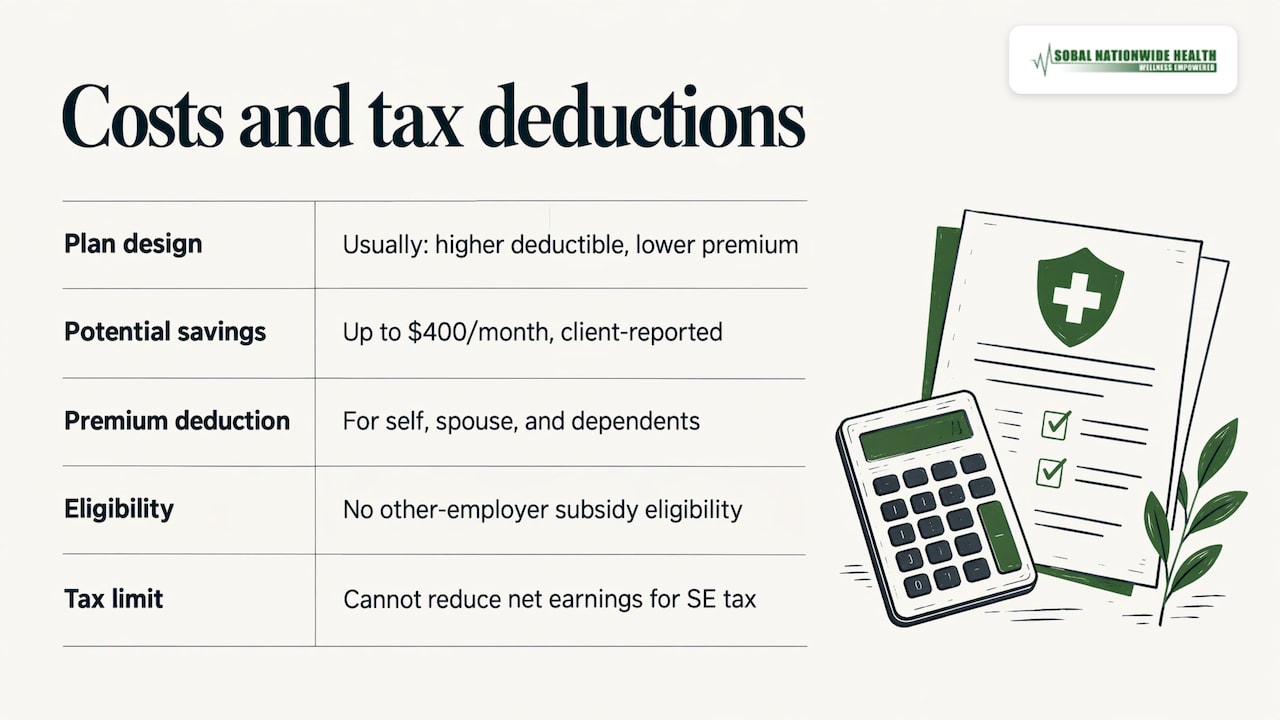
First, plan design. A higher deductible usually means a lower monthly premium, and the reverse is also true. Pick the one that matches how often you actually use care and how much cash you could comfortably cover in a bad month.
Second, carrier choice. Private plans are priced differently from carrier to carrier. Some of our clients report meaningful monthly savings; our 1099 page describes savings of up to $400 a month reported by clients, and your own result depends on your age, household and the plan you choose. We cannot promise any specific saving.
Third, the tax side. The IRS says self-employed people may be able to deduct premiums paid for themselves, a spouse and dependents on Schedule 1 (Form 1040), as long as they are not eligible to participate in a subsidized plan maintained by another employer, in the instructions for Form 7206. The same instructions say this deduction cannot reduce net earnings when you calculate self-employment tax for the business under which the insurance is set up. Those instructions are a 2026 draft, so confirm the final version, and ask your tax professional how it applies to you. Our walkthrough of Form 7206 and Schedule 1 steps shows where the numbers go.
A simple budgeting example
Say your income varies between busy and slow quarters. You could set aside the monthly premium in a separate account on the first of every month, the same way you set aside quarterly estimated taxes. Then add the plan’s out-of-pocket maximum to your emergency fund target. That way a surprise bill is a planned event, not a crisis. The numbers are yours; the habit is what keeps coverage from slipping when work does.
What to check before you enroll
The TDI guide advises reviewing a plan’s provider directory before enrolling to confirm your doctors, hospitals and specialists are in the network. Use this list:
- Your doctors. Search each one by name in the plan’s directory, and confirm the specific office location you use.
- Your hospital. Check the hospital you would go to in an emergency and the one you would choose for planned care.
- Out-of-network rules. Ask what the out-of-network deductible and coinsurance are, since TDI notes they are often higher.
- Prescriptions. Look up your medications on the plan’s drug list.
- Behavioral health. Confirm how the plan covers therapy and counseling. This guide to using insurance for mental health care explains how insurance can apply to treatment costs.
- Out-of-pocket maximum. Know the most you could owe in a year for covered in-network care.
Texas also has surprise-billing protections on fully insured plans. TDI’s surprise billing Q&A says they cover emergency care, out-of-network care at in-network facilities, and diagnostic imaging or lab work ordered in connection with in-network care. Self-funded plans follow federal rules instead, so ask which type you are looking at.
How to get covered, step by step
Step 1: Decide who is covered
List everyone who needs a plan: you, a spouse, children. Include birthdates, since age is a major factor in pricing. Where we help: we gather this with you in one conversation, so you do not fill out the same facts on a dozen forms.
Step 2: Name your must-haves
Write down your doctors, your hospital, the states where you work and your monthly budget. These are the filters for every plan you consider. We turn them into a short list of plans that fit, in English or Spanish.
Step 3: Compare plan designs side by side
Look at premium, deductible, coinsurance and out-of-pocket maximum together. A low premium with a high deductible suits someone who rarely uses care. A higher premium with lower cost-sharing suits a family that uses care regularly. We lay these out so you can see the trade-offs plainly.
Step 4: Complete the application
Medically underwritten plans ask health questions, so answer them completely and accurately. Our advisors help you complete the application and review it with you before it goes to the carrier.
Step 5: Confirm the start date and set up payment
Check when coverage begins and when the first premium is due, and avoid a gap if you are leaving a job or COBRA. Keep your ID cards and plan documents in one place.
Step 6: Review every year
Your income, family and doctors change. Review your plan each year so it keeps matching your life. We offer policy reviews for this.
If you run a business with employees
Many Texas contractors grow into small employers. If you provide group health insurance, TDI’s small employer guide says you must offer it to all employees working 30 hours or more per week and their dependents. Your hours-worked rules should be written down and applied the same way to everyone.
Group plans are one route. An ICHRA, as described in the TDI guide, lets an employer provide a set monthly allowance toward coverage each employee selects. Which route is better depends on your headcount, payroll and what your team values. Our Texas small business health insurance page covers small employer options, and our business health insurance page shows what we offer owners with 2 to 30 employees.
Working with a Texas broker
A broker is a licensed professional who compares carriers and helps you enroll. Ours is paid by the insurance carrier when you enroll in a policy, so the advice itself is not billed to you as a separate charge for the consultation. We do not publish broker fee amounts, so ask us about any fees for a specific product.
If you want someone to walk you through plans in the state, a health insurance broker in Texas can sit down with you, explain terms in plain English and compare private PPO options against your must-haves. For a broader look, read our self-employed health insurance guide for Texas and our overview of PPO coverage for self-employed and 1099 workers. More learning material is at sobalhealth.com/resources.
Our perspective
The most common thing we hear from Texas contractors is that they felt they had to take whatever plan was in front of them. They don’t.
We are licensed brokers, and we spend our days helping 1099 workers, realtors, truckers and small business owners find private PPO coverage that matches the doctors they already trust. Our focus is education first: we explain deductibles, networks and out-of-pocket limits before anyone is asked to decide anything, and there is no sales pressure.
Because our plans are medically underwritten and private, they can be designed around flexibility and nationwide doctor choice. For a healthy contractor who wants to keep control of the network, that is a strong fit. We are licensed in 31 states, and you can talk to a broker directly in English or Spanish.
Start with your must-have doctors and your budget. The right plan is usually the one that fits both.
Bernie S
Your next move
Our personal and family insurance page shows the private plans, dental, vision, accident and critical illness coverage we can help you add. Contractors often pair a main PPO with supplemental coverage for the gaps, for example accident insurance for the self-employed.

If you are covering a family, our page on what a family health plan costs explains the factors behind pricing.
FAQ
How do I get health insurance as a 1099 contractor in Texas?
You can apply for an individual private plan, such as a medically underwritten PPO, or, if you have employees, set up a group plan. Decide who needs coverage, list your must-have doctors, compare plan designs and complete the application. A licensed broker can walk you through each step.
Can I deduct my premiums as a contractor?
Self-employed people may be able to deduct premiums for themselves, a spouse and dependents on Schedule 1 of Form 1040, according to the IRS instructions for Form 7206. There are conditions, including not being eligible for a subsidized plan through another employer. Check your situation with a tax professional.
What is the difference between a PPO and an EPO?
A PPO covers in-network and out-of-network providers, though out-of-network care often costs more. An EPO typically limits coverage to in-network providers and generally does not require referrals. If you want the widest choice of doctors, a PPO is usually the better match.
Do Texas small employers have to offer coverage to every employee?
If a Texas small employer provides group health insurance, TDI says it must be offered to all employees working 30 hours or more per week and their dependents. Apply your rules the same way to everyone. A broker can help you set up the plan correctly.
Are Texas surprise billing protections the same on every plan?
No. TDI explains that Texas protections apply to fully insured plans, while self-funded plans follow federal rules. Ask which kind of plan you are considering and how it handles emergency and out-of-network care.
Sources
- 2026 Texas Health Coverage Guide, Texas Department of Insurance
- 2026 Instructions for Form 7206 (draft), IRS
- Getting Health Insurance From Your Job, Texas Office of Public Insurance Counsel
- Small employer health insurance guide, Texas Department of Insurance
- Surprise medical bills Q&A, Texas Department of Insurance
- Using insurance for mental health care
Ready to compare private PPO plans? Get a free quote or call (305) 680-0125.