

For most self-employed contractors, Marketplace coverage with premium tax credits is the strongest starting point, especially when a spouse’s employer plan isn’t available. COBRA works as a short bridge when continuity of care matters more than cost. But the real lever most contractors miss isn’t which plan you pick. It’s pairing that plan with the self-employed health insurance deduction and, if you qualify, an HSA. Your exact savings hinge on your estimated net income, household size, and enrollment timing, so check official guidance or talk with a broker before you commit.
TL;DR:
- Pairing marketplace plans with the self-employed health insurance deduction and HSA often yields the most substantial savings, especially for healthy contractors.
- COBRA can be useful during ongoing treatments but is rarely cost-effective long-term due to high premiums and fees.
- Accurately estimating net income and maintaining proper documentation are critical to maximize tax benefits and avoid subsidy repayment risks.
- Choosing a low-cost, high-deductible plan with an HSA typically benefits contractors with infrequent healthcare use, while those with ongoing needs favor silver or gold plans.
- Consulting a broker can reveal significant savings by identifying private or underutilized plans suited to your health profile and income fluctuations.
Table of Contents
- Health Insurance Options for 1099 Contractors, Explained
- How the Self-Employed Deduction and HSAs Cut Your Real Cost
- Choosing and Enrolling in the Right Plan
- What Coverage Actually Costs and When to Adjust It
- A Real-World Look at Broker-Assisted Savings
- Where Contractors Get This Wrong
- Get Help Turning This Guide Into Actual Savings
- Verify the Details Yourself
- Sources
Health Insurance Options for 1099 Contractors, Explained
You’ve got more routes to coverage than the marketplace ads suggest, and picking the right one starts with knowing what each actually delivers.
ACA Marketplace plans are the default for good reason. Plans are grouped into metal tiers—bronze, silver, gold, and platinum—based on how costs split between your premium and your out-of-pocket spending. Bronze means a lower premium but higher costs when you actually use care; gold flips that. Premium tax credits are calculated from your estimated net self-employment income for the coverage year, and if you land in the right income band, you may also qualify for cost-sharing reductions that lower deductibles and copays on silver plans. The Health Insurance Marketplace is built specifically to handle this kind of variable, self-reported income.
Spouse or domestic partner employer plans often beat anything you’d buy solo, since group plans typically carry lower premiums than individual policies. The catch is timing: you usually can’t join outside your spouse’s open enrollment or a qualifying life event, so this option needs advance planning, not a last-minute pivot.
COBRA lets you keep your old employer coverage after you leave a W-2 job, but you pay the full premium plus a 2% administrative fee. It’s worth it when you’re mid-treatment with a specialist and don’t want to disrupt care, but rarely makes sense as a long-term plan given the cost.
Association and professional group plans used to be a popular workaround for contractors, but regulatory changes after 2024 closed many of those paths, so treat them as a niche option, not a default fix.
Be cautious with short-term plans and health-sharing ministries. They’re cheap upfront but routinely exclude preexisting conditions and maternity care, and they aren’t required to meet ACA minimum coverage standards. Supplemental plans, accident or hospital indemnity coverage, are worth adding on top of major medical, never as a substitute for it.
How the Self-Employed Deduction and HSAs Cut Your Real Cost
The self-employed health insurance deduction is an above-the-line deduction, meaning it lowers your adjusted gross income directly. You qualify if you have net self-employment profit and aren’t eligible for subsidized coverage through an employer (yours or a spouse’s) for that month. One key limitation: the deduction reduces income tax, but it does not reduce your self-employment tax bill.
If you run an S-Corp, the rules get stricter. Premiums must be paid or reimbursed by the S-Corp and reported as wages on your W-2, then deducted on your personal return. Skipping the W-2 reporting step is a common error that can invalidate the entire deduction, so this is one area where a broker or accountant familiar with S-Corp payroll pays for itself.
HSAs add another layer. If you’re enrolled in a qualifying high-deductible health plan, contributions are tax-deductible going in, grow tax-deferred, and come out tax-free for qualified medical expenses under IRS Publication 502. For contractors who rarely use care, an HDHP paired with an HSA often beats a richer plan on total annual cost.
Both the deduction and HSA contributions lower your modified adjusted gross income, which directly affects Marketplace subsidy eligibility. If you’re near the 400% federal poverty level cliff, estimate conservatively.
Recordkeeping checklist for tax season:
- Save every premium payment record and 1095 form
- Log HSA contributions and confirm they stay under the annual limit
- Confirm S-Corp W-2 wage reporting matches premium amounts
- Review deduction eligibility with a tax preparer before filing
Pro Tip: If your income swings month to month, run your deduction math using your lowest plausible net income estimate, then revise later. It’s easier to report more income than to unwind a subsidy repayment.
Choosing and Enrolling in the Right Plan
Run through four checks before you commit to anything: how much care you actually use (including regular prescriptions), your total expected annual cost (premium plus likely out-of-pocket spending, not just premium alone), whether your doctors and medications are in-network and on formulary, and whether you’re HSA-eligible if that’s part of your plan.
When you apply through the Marketplace, you’ll estimate your net self-employment income for the year, not your gross revenue. Include expected deductions; exclude one-time windfalls that won’t repeat. This estimate ties directly to your quarterly estimated tax payments and gets reconciled against your actual income at tax time, so lowballing it carries real risk.
Enrollment checklist:
- Gather last year’s tax return, current income estimates, and household size
- Apply through HealthCare.gov or your state’s exchange
- Call a broker if you’re weighing COBRA against Marketplace, or juggling S-Corp payroll questions
- Watch for special enrollment triggers: losing coverage, marriage, a new child, or moving states
Pro Tip: If you’re leaving a W-2 job, you get a 60-day window to elect COBRA. Use it to run Marketplace and COBRA costs side-by-side before deciding, not after your COBRA election deadline passes.
What Coverage Actually Costs and When to Adjust It
Marketplace premiums vary widely by age, state, and metal tier, and KFF tracks average premiums by tier to give you a realistic budgeting baseline rather than a guess.
The bigger budgeting risk isn’t the premium sticker price. It’s the subsidy cliff. Enhanced premium credits expired at the end of 2025, restoring the hard cutoff at 400% of the federal poverty level. Cross that line by even a small margin, and you can lose your entire premium tax credit, not just a portion of it.
Here’s how that plays out in practice: a healthy contractor who rarely visits a doctor often comes out ahead with a bronze or HDHP plan paired with HSA contributions, since the lower premium plus tax-advantaged savings can beat a gold plan’s higher monthly cost. Someone managing a chronic condition or expecting regular specialist visits usually comes out ahead on a silver or gold plan despite the higher premium, because the lower deductible and copays offset that cost over a year of care.
If your income shifts materially during the year, update your Marketplace application right away rather than waiting for tax season. It’s the single easiest way to avoid a subsidy repayment surprise.
A Real-World Look at Broker-Assisted Savings
Sobal Nationwide Health works with self-employed contractors across 31 states, and one pattern shows up constantly: contractors default to the first Marketplace plan they see, without realizing private medically underwritten plans or a different HSA pairing might cost less for their specific health profile.
A typical scenario looks like this:
- A contractor in their late 30s, moderate income band, family of three
- Initial pick: a mid-tier Marketplace plan chosen mostly on premium price
- Broker review: identified an HDHP and HSA combination better suited to the family’s low annual care use
- Outcome: some Sobal Health clients report savings of up to $400 per month after switching
A broker call is worth the twenty minutes whenever your income estimate is uncertain, you’re weighing S-Corp payroll questions, or your household has mixed coverage needs across ages and health status.
Where Contractors Get This Wrong
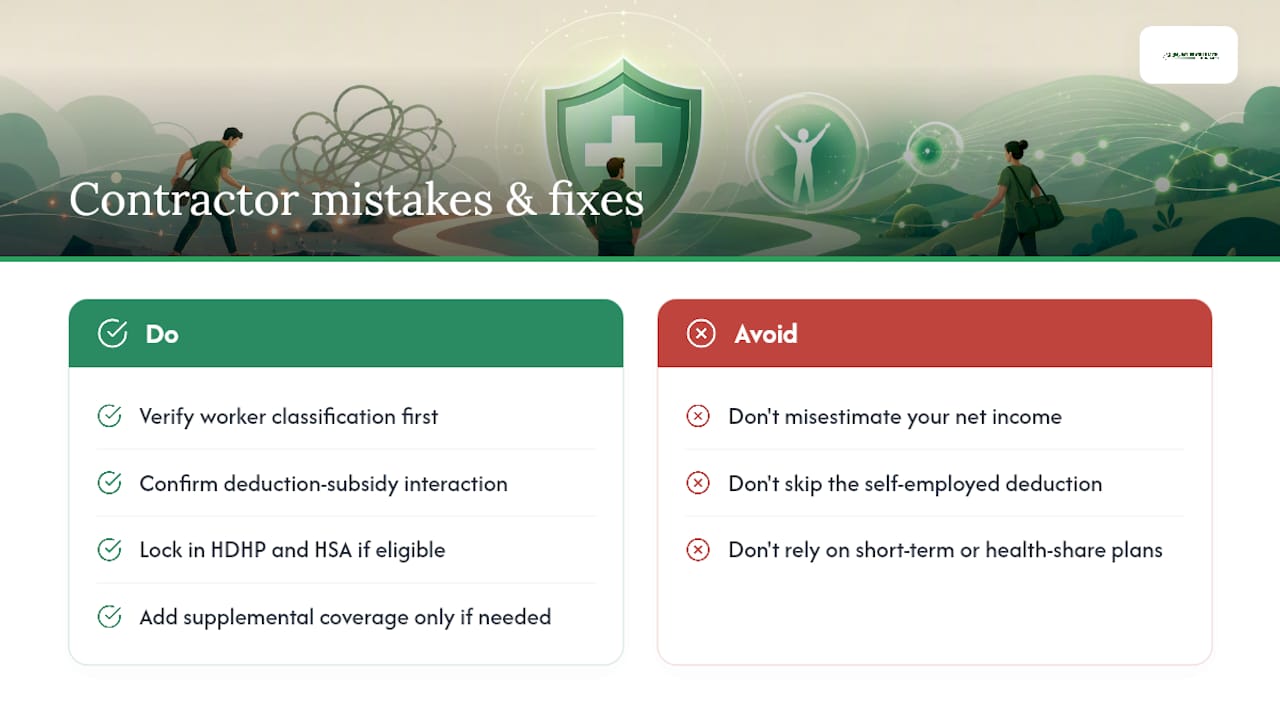
Three mistakes show up again and again. First, contractors misestimate their net income, either too optimistically (triggering repayment) or too conservatively (leaving subsidy money unclaimed they could have used). Second, plenty skip the self-employed health insurance deduction entirely because they assume it only applies to “big” businesses. It doesn’t. Third, some lean on short-term plans or health-sharing arrangements as a permanent fix, then get burned when a real claim exposes what those plans never covered.
My priority order: confirm how your deduction interacts with your subsidy eligibility first, lock in an HDHP and HSA if you’re healthy and eligible, then layer in supplemental coverage only if a real gap remains. And if you’re not fully sure whether you’re a contractor or an employee under IRS rules, verify your worker classification before any of this matters, since misclassification changes your entire tax picture.
— Bernie S
Get Help Turning This Guide Into Actual Savings
Reading about deductions and HDHP math is one thing. Applying it correctly to your specific income, family size, and health needs is another, and that’s exactly where a broker earns their keep instead of a search engine.

Sobal Nationwide Health works across 31 states, pairing ACA Marketplace enrollment with access to private medically underwritten plans that traditional marketplace shopping doesn’t surface. If you’re approaching the subsidy cliff, running an S-Corp with payroll complications, or juggling a family’s mixed coverage needs, a broker conversation typically pays for itself within the first year of premium savings alone. Consultations come with no sales pressure, just a side-by-side comparison of what you’re paying now against what you could be paying. Visit Sobal Nationwide Health to get a free, personalized quote and see whether your current plan is actually your cheapest option.
Verify the Details Yourself
Cross-check your specifics against HealthCare.gov for enrollment and eligibility, IRS Publication 535 for deduction rules, and CMS’s marketplace resources for broker assistance and state exchange links.
This article is general information, not a substitute for advice from a qualified financial advisor. Consult a qualified financial professional about your own circumstances before acting on anything here.
Sources
- Healthcare
- Self-Employed Individuals Tax Center | IRS
- Average marketplace premiums by metal tier | KFF
- Health Insurance for 1099 Employees: Plans, Costs, and Tax Breaks – LegalClarity
