

Most employers pay the majority of the premium, but no federal law sets one number for everyone. In 2026, covered workers paid an average of 18 percent of the premium for single coverage and 27 percent for family coverage, according to the 2026 KFF Employer Health Benefits Survey. That means employers covered roughly 82 percent and 73 percent. If you run a small business, the practical answer to “how much should I contribute?” is somewhere between a benchmark you can defend and a budget you can sustain.
I’m a licensed independent health insurance broker, and this question comes up in nearly every small business conversation. Below, you’ll find the real numbers, the rules that matter, and a simple way to choose your own contribution.
TL;DR
- The average employer pays about 82% of a single premium and 73% of a family premium in 2026, per KFF.
- The law doesn’t set a flat minimum for small employers. Larger employers (50 or more full-time equivalent employees) face penalties if coverage is not offered or not affordable.
- Small employers with fewer than 25 full-time equivalent employees may qualify for a tax credit of up to 50% of premiums if they contribute at least 50% of the employee-only premium.
- Employer-paid premiums are not taxed as income for employees, so every dollar you contribute goes further than a raise.
- If a group plan is too much, defined contribution options like QSEHRA and CHOICE Arrangements let you set a fixed monthly amount.
Table of Contents
- How an employer contribution works
- What employers actually pay in 2026
- How much should you contribute?
- What the law requires
- Tax advantages worth knowing
- The small business tax credit
- Fixed-budget options: QSEHRA and CHOICE Arrangements
- Choosing a plan that makes your contribution count
- Get a clear contribution plan with us
- FAQ
- Sources
How an employer contribution works
An employer contribution is the part of the monthly premium your company pays toward an employee’s health plan. The employee pays the rest, usually through a payroll deduction. Think of the premium as the price of getting in the door: your contribution decides how much of that price your team carries themselves.
There are two common ways to set it:
- A percentage of the premium. For example, you pay 75% of the employee’s premium and the employee pays 25%. If the premium rises, both of you share the increase.
- A flat dollar amount. You pay a fixed amount, say $400 a month, and the employee covers the difference. Your costs stay predictable even when rates climb.
Many employers pay a larger share for the employee than for dependents. That is allowed, and it is how most family coverage ends up costing the employee more.
The contribution is also a meaningful part of what you spend on people. Employer contributions to health insurance made up 6.9 percent of total compensation for private industry as of June 2025, according to KFF’s employer-sponsored insurance overview.
What employers actually pay in 2026
Here are the current averages, all from the 2026 KFF Employer Health Benefits Survey unless noted:
| Measure (annual, 2026) | Single coverage | Family coverage |
|---|---|---|
| Average total premium | $9,804 | $28,303 |
| Average employee contribution | $1,672 | $7,471 |
| Average employee share of premium | 18% | 27% |
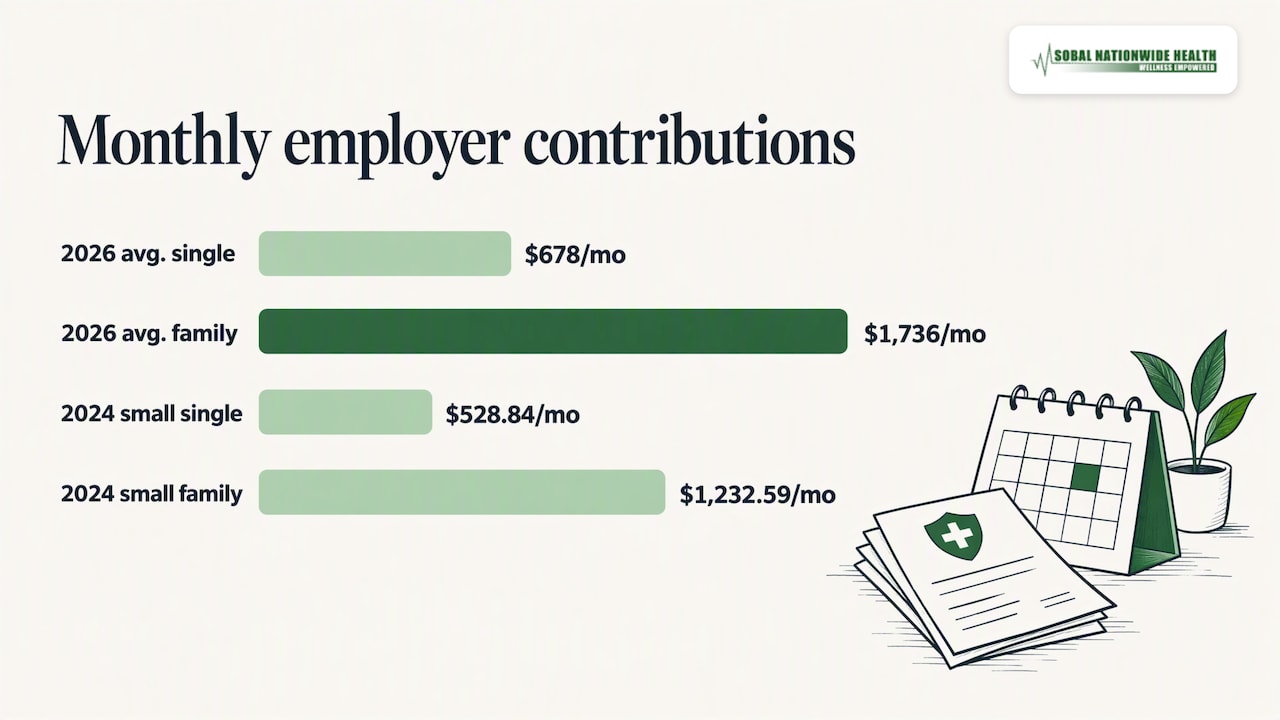
The employer side of the same survey, as reported by Stateline, came to an average of $8,132 for single coverage and $20,833 for family coverage per year. Divided by 12, that is about $678 a month for a single worker and about $1,736 a month for a family.
Smaller employers look a little different. The U.S. Bureau of Labor Statistics found that in establishments with fewer than 50 workers, average monthly employer contributions were $528.84 for single coverage and $1,232.59 for family coverage as of March 2024. That is an older data point, so treat it as a sense of scale rather than a current price.
Small firms are also more likely to be generous. KFF reports that 29 percent of covered workers at smaller firms are in a plan where the employer pays the entire single premium, compared with only 5 percent at larger firms.
The share has stayed steady while the dollars climbed
Premiums have risen steadily for years. Even so, the share workers pay has stayed fairly stable, because employers and employees tend to absorb similar rate increases, KFF analysts note. That matters for planning: if you set a percentage, your dollar cost will grow with the market. If you set a flat amount, your employees will feel the increases instead.
If you want to see how employer premium costs compare with another kind of coverage altogether, this guide on employer coverage compared with Medicare walks through the differences in cost-sharing and who pays what.
How much should you contribute?
There is no single correct figure. I’d work through it in this order.
- Start with the benchmark. Paying around 75% to 80% of the employee-only premium puts you close to the national average. Paying less isn’t wrong, but you should expect employees to compare your offer with others they have seen.
- Check your legal floor. Your size and your goals decide this. The next section covers it.
- Set your monthly ceiling. Multiply your per-employee contribution by your headcount, then add a cushion for a renewal increase. If the total makes you wince, adjust the percentage or switch to a flat dollar amount.
- Decide how to treat dependents. A common approach is a high share for the employee and a lower share, or none, for dependents. The savings are real, but so is the impact on a parent with three kids. Say it clearly in your benefits guide.
- Be consistent. Contribution rules should apply to defined classes of employees, not hand-picked individuals.
A quick example. Say the employee-only premium is $600 a month and you have six enrolled employees. At 75%, you pay $450 each, or $2,700 a month. At 50%, you pay $300 each, or $1,800 a month. The difference is $900 a month, and a real conversation about recruiting, retention, and what your team can afford out of pocket. These figures are illustrations, not quotes.
What the law requires
The rules depend on how many people work for you.
Under 50 full-time equivalent employees
There is no federal requirement to offer coverage or to contribute any amount. You choose. Some states have their own rules, so check with your state insurance department or ask your broker before you finalize a plan.
50 or more full-time equivalent employees
Under the Affordable Care Act, applicable large employers may face tax penalties if they do not offer minimum essential coverage to at least 95 percent of full-time employees, or if the coverage is deemed unaffordable or lacks minimum value, as KFF explains. The IRS describes the payments: generally $2,000 per full-time employee (excluding the first 30) if you don’t offer coverage, and generally $3,000 for each full-time employee who receives a premium tax credit. Both amounts are indexed for future years, so look up the current figures on the IRS page.
If you’re approaching that size, our guide on group health insurance before you cross 50 FTEs covers what changes.
Tax advantages worth knowing
Employer-sponsored health insurance is not counted as income under the federal tax code, so it is exempt from federal income tax and payroll taxes for employees, according to KFF. Researchers there also point out that without these tax exclusions, workers would need noticeably higher wages to buy similar coverage with after-tax dollars.
In plain terms, $500 a month in premium contribution is worth more to your employee than a $500 raise. That is one of the most persuasive arguments for contributing generously, even when cash is tight.
The IRS also requires employers to report the cost of coverage under an employer-sponsored group health plan on Form W-2, as the IRS explains. That reporting is informational and doesn’t mean the benefit is taxable.
The small business tax credit
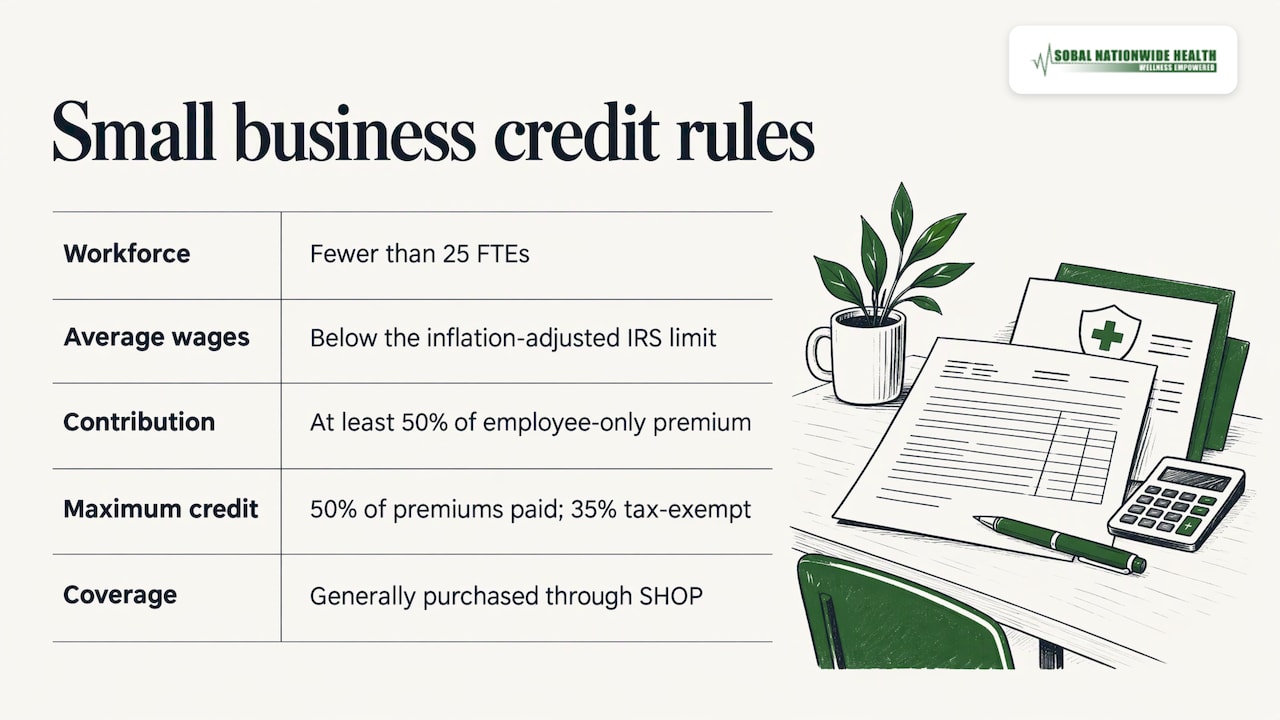
If you have fewer than 25 full-time equivalent employees, average wages below the IRS limit (adjusted for inflation), and you pay a uniform percentage of at least 50% of the employee-only premium, you may qualify for the Small Business Health Care Tax Credit. The maximum credit is 50% of the premiums you pay, and 35% for tax-exempt employers. The IRS generally expects coverage to be purchased through the SHOP Marketplace.
That’s why 50% is such a common floor for small employers: it is the line the credit draws. We break down the mechanics in how the tax credit can cut small business health insurance cost and in our piece on claiming up to 50% for two years. Credit rules and wage limits change, so confirm the current year’s figures with your tax professional.
Fixed-budget options: QSEHRA and CHOICE Arrangements
A group plan isn’t the only way to contribute. Two options let you pick a dollar amount and let employees choose their own coverage:
- QSEHRA. A Qualified Small Employer Health Reimbursement Arrangement lets small employers provide non-taxed reimbursement for certain health expenses, such as premiums, for employees who keep minimum essential coverage.
- CHOICE Arrangements. Formerly known as ICHRAs, these let employers provide tax-free funds for employees to buy their own individual health insurance instead of a traditional group plan.
These can suit a team spread across several states, or a business where one group plan doesn’t fit everyone. Your contribution stays predictable, and each employee shops for the plan that fits their doctors and budget.
Our perspective
After years of helping self-employed people, families, and small owners sort through health insurance, I see the same pattern. Owners worry that a generous contribution will bankrupt them, while employees worry that a skimpy one will leave them with a deductible they can’t meet. Both worries are fair, and both can be solved with good information.
We believe the best contribution is the one you can keep paying in a bad year. Start with your budget, not with the national average. Then ask what plan design stretches those dollars furthest: a PPO with a wider network, a plan with a higher deductible and lower premium, or supplemental coverage like accident or critical illness to fill gaps.
That’s where a broker who isn’t tied to one carrier helps. We advise one-on-one, in English or Spanish, with education first and no sales pressure. We would rather you understand your options and say no than enroll in something you don’t understand.
Bernie S
Choosing a plan that makes your contribution count
Your contribution only buys value if the plan itself works for your people. Three things to compare:
- Premium versus out-of-pocket cost. A lower premium often means a higher deductible. Look at the out-of-pocket maximum, which is the financial safety net if someone has a serious claim.
- Network. A narrow network lowers cost but can send employees away from their doctors. A broad PPO gives more freedom.
- Add-ons. Dental, vision, and supplemental plans are inexpensive ways to make a benefits package feel complete.
For a closer comparison method, see our guide to comparing health insurance plans for small businesses, and for ideas on why the benefit pays you back, 10 benefits of offering small business health insurance.
Get a clear contribution plan with us
We help small business owners compare group and private options across 31 states, run the numbers on different contribution levels, and enroll your team. Our service is built around advice, not pressure, and we can walk you through what each contribution level would look like for your headcount.

Ready to see your options? Visit our business health insurance page or start at sobalhealth.com to talk with a licensed broker. If you’re self-employed or buying for your family, see our personal and family plans.
FAQ
How much does an employer contribute to health insurance per month?
It depends on plan and family status. Using the 2026 KFF averages reported by Stateline, the annual figures work out to about $678 a month for single coverage and about $1,736 a month for family coverage. Small employers often contribute less in dollars because their plans and premiums differ.
Does an employer have to pay part of an employee’s health insurance?
Not for smaller employers. Businesses with 50 or more full-time equivalent employees can face IRS penalties if they don’t offer affordable coverage that meets minimum standards. Smaller businesses can choose whether to offer a plan and how much to pay.
Is the employer’s share of the premium taxable to the employee?
No. Employer-sponsored coverage is not counted as income for federal income tax or payroll tax purposes, according to KFF. The amount is reported on the W-2 for information only.
What if I can’t afford a group plan?
You may be able to use a QSEHRA or a CHOICE Arrangement, which let you set a fixed monthly amount that employees put toward their own coverage. You may also qualify for the small business tax credit if you have fewer than 25 full-time equivalent employees and meet the wage and contribution rules.
Sources
- 2026 Employer Health Benefits Survey, KFF
- Employer-Sponsored Health Insurance 101, KFF
- Cost of employer-sponsored health insurance plans rises again, Stateline
- Family coverage medical care premiums in small firms, U.S. Bureau of Labor Statistics
- Employer shared responsibility provisions, IRS
- Small Business Health Care Tax Credit questions and answers, IRS
- Health Reimbursement Arrangements for small businesses, HealthCare.gov
- Employer Initiatives, CMS
