

To offer group health insurance through the federal SHOP marketplace, a small employer generally needs 1 to 50 full-time equivalent employees. It also needs at least one employee who is not an owner or spouse, and a qualifying business address. Private carriers set their own rules on top of that, most often a minimum number of enrolled employees and a minimum share of eligible staff signing up. If you work for yourself with no employees, you generally can’t buy a true group plan, but you have good options.
I’m a licensed independent broker, and these are the questions I hear most: Do I qualify? How many people do I need? Is a group plan actually better than an individual one? Let’s take them one at a time.
TL;DR
- Group coverage is sponsored by an employer, union, or trade association. Individual coverage is bought directly from an insurer or a Marketplace.
- For SHOP, a small employer generally needs 1 to 50 FTEs and at least one common-law employee who is not an owner or spouse.
- Most carriers and SHOP expect a minimum participation rate, usually 70% in most states, so plan for that before you ask for quotes.
- Federal law does not require every employer to offer coverage. Employers averaging 50 or more full-time employees, including FTEs, generally must.
- Self-employed owners with no employees usually go individual, and may still have private PPO options.
Table of Contents
- What group health insurance is and how it works
- Requirements for the employer
- Requirements for the employee
- Group vs. individual health insurance
- What if you’re self-employed or have no employees?
- How to prepare before you ask for quotes
- Our perspective
- Get a quote that fits your situation
- FAQ
- Sources
What group health insurance is and how it works
A group health plan is a benefit established or maintained by an employer or employee organization, or both, that pays for medical care for participants and their dependents. That is how the U.S. Department of Labor describes group health plans. In plain English: one organization sets up the plan, and the people connected to it join under shared rules.
KFF explains that group coverage is sponsored by an employer, union, or trade association. Individual, or non-group, insurance is bought straight from an insurer or through a Marketplace.
There are two ways an employer can fund the plan. KFF reports that an employer can buy an insured plan from a carrier, or self-fund and pay claims from its own assets, often with stop-loss coverage as a backstop. Small employers who want something in between often look at level-funded plans. We break down the trade-offs in our guide to level funded vs fully insured plans.
Here is the simple version of how it works day to day:
- The employer picks a plan and decides how much of the premium to pay.
- Eligible employees choose whether to join and which dependents to cover.
- Premiums come out of paychecks, usually before tax, with the employer paying its share.
- Everyone eligible gets the same basic benefits, no matter their individual health.
Requirements for the employer
There isn’t one single set of group health insurance requirements. There are federal rules, state rules, SHOP rules, and carrier rules. The eCFR shows that federal rules separate the individual, small-group, and large-group markets, so which bucket you fall into matters.
Size: what counts as a small group
The Department of Labor says the ACA added protections for employment-based group plans. In most states, small group means up to 50 employees. Larger employers fall into the large-group market, which is rated and regulated differently.
Count carefully. SHOP counts full-time equivalents, not just heads. Part-time hours add up to FTEs, which is why a business with a lot of part-timers can land closer to the line than it expects. If that is you, our page on group health insurance before you cross 50 FTEs walks through the counting.
The SHOP checklist
The CMS Employer Guide to SHOP Insurance lays out what a small employer generally needs:
- 1 to 50 full-time equivalent employees
- At least one common-law employee who is not an owner or the owner’s spouse
- A qualifying business address or worksite
- An offer of coverage to full-time employees, meaning those averaging at least 30 hours a week
That third bullet trips people up. A one-person LLC, or a husband-and-wife shop with no other staff, generally does not meet it.
Participation rules
Group plans depend on enough healthy and not-so-healthy people joining together. That is why the minimum participation rate exists. CMS says SHOP employers generally must meet a minimum participation rate, usually 70% in most states, with an exception for enrollment during an annual late-fall window described in the guide. Check the guide for the current dates.
Private carriers have similar rules. The details vary by carrier and state, and they often include a minimum number of enrolled employees. Staff who already have other coverage, such as through a spouse, are sometimes not counted against you. Ask the carrier how it counts waivers before you build your enrollment plan.
Does the employer have to contribute?
HealthCare.gov says SHOP has no general employer contribution requirement. Contribution does matter for one thing, though: the Small Business Health Care Tax Credit. To qualify, you must pay at least 50% of the employee-only premium. The SHOP guide says the credit can reach up to 50% of your contributions, or 35% for tax-exempt employers. If you are in Texas, here is how to avoid losing the SHOP credit.
When an employer must offer coverage
The U.S. does not generally require every employer to provide health insurance. The IRS explains that an employer averaging at least 50 full-time employees, including FTEs, in the prior year is generally an applicable large employer. Under the employer shared responsibility provisions, it must offer affordable, minimum-value coverage to at least 95% of its full-time employees and their dependents, or it may owe a payment. Smaller employers generally are not subject to that federal mandate.
So a 12-person company can offer group coverage as a benefit, but is not forced to.
Requirements for the employee
Eligibility comes from the employer’s plan document. Common rules include:
- Hours worked. Many plans require full-time status, often 30 hours a week or more. Some include part-timers. If you are weighing this, see our guide to health options for part-time workers.
- Waiting period. Plans may wait a set number of days after hire before coverage starts. Ask HR for the exact period.
- Enrollment windows. You usually join when first eligible, during the employer’s annual open enrollment, or after a qualifying life event.
- Dependents. Spouses and children can generally be added, usually with documents and within a deadline. Our page on adding a dependent to a health plan covers what to submit.
KFF reports that 80.4% of adult workers under 65 worked for an employer offering coverage to at least some employees in March 2025. Of those workers, 92.8% were eligible, and roughly three-fourths of all workers were eligible overall. So an offer is common, but not universal.
If you or a spouse is 65 or older, the rules interact with Medicare. The Social Security Administration says employers with 20 or more employees must offer current workers and spouses age 65 or older the same group benefits given to younger employees. For the Medicare side, employer coverage and Medicare timing is worth understanding before you drop either one.
Group vs. individual health insurance
This is the comparison most readers really want. Here is how the two stack up.
| Group plan | Individual plan | |
|---|---|---|
| Who sponsors it | Employer, union, or association | You buy it yourself |
| Who can join | Eligible employees and dependents | Anyone who qualifies to enroll |
| Who pays | Employer often pays part of the premium | You pay all of it, minus any subsidy |
| Plan choice | Limited to what the employer picks | Wide range from carriers and the Marketplace |
| Subsidies | Employer offer can affect your eligibility | Premium tax credits possible by income |
| Portability | Usually ends when you leave the job | Stays with you if you keep paying |
Cost
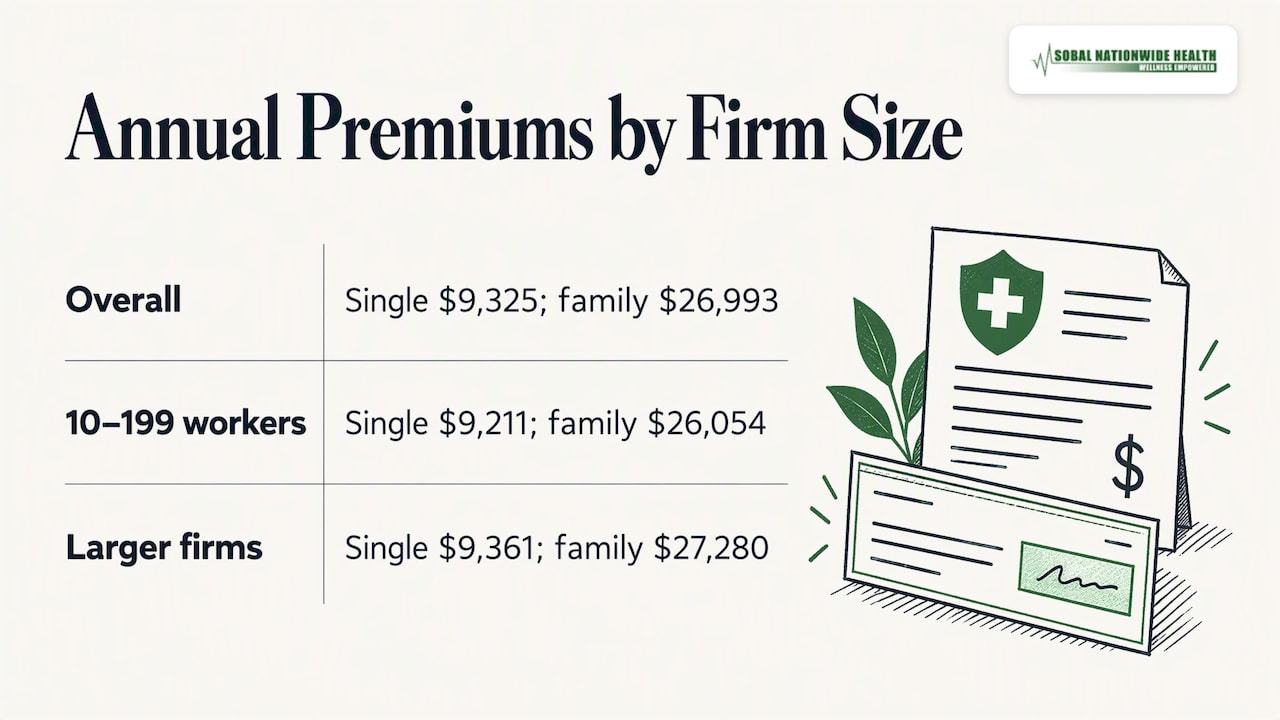
Costs depend on who is covered and who pays. KFF’s 2025 Employer Health Benefits Survey puts average annual employer-sponsored premiums at $9,325 for single coverage and $26,993 for family coverage. Single premiums rose 5% over the prior year, and family premiums rose 6%. The same survey shows average premiums at firms with 10 to 199 workers of $9,211 for single and $26,054 for family coverage, against $9,361 and $27,280 at larger firms.
Those are totals, and employers pay a big share. Your own share is what hits your paycheck.
On a per-person basis, KFF found that in 2024 individual-market premiums averaged $540 per member per month, compared with $587 for fully insured employer coverage. The difference between the two is not as large as many people assume. Group premiums reflect the age and health of the workforce, provider network costs, and how generous the coverage is, as KFF explains.
The premium only gets you in the door. Look at the deductible, copays, and out-of-pocket maximum too. The out-of-pocket maximum is your financial safety net, the most you pay in a year for covered care.
Subsidies
An employer offer can change your Marketplace subsidy picture. HealthCare.gov says an affordable QSEHRA or CHOICE Arrangement can eliminate premium tax credit eligibility, while an unaffordable arrangement may leave an employee eligible, subject to the rules. This is worth running by a licensed professional before you decline an offer.
Coverage and protections
The Department of Labor’s ACA implementation FAQs note that employer plans must offer dependent coverage up to age 26, can’t impose preexisting-condition exclusions, and must give an understandable Summary of Benefits and Coverage. These protections are part of why group coverage is considered solid, but they are not unique to it.
Family vs. individual coverage
The question “family vs. individual” is about who is on the policy. An individual plan covers one person. A family plan covers you plus a spouse and children, usually with a higher premium and often a combined deductible. In a group plan, the employer typically pays more toward employee-only coverage than toward adding family members, so the family tier can feel steep. For a look at what families tend to pay, see how much a family health insurance plan costs.
What if you’re self-employed or have no employees?
This is the part many solo owners miss. A business with no employees other than owners or spouses generally cannot qualify for SHOP. CMS says the owner can instead buy individual Marketplace coverage for themselves and family, and may qualify for premium tax credits. A small employer might also consider a QSEHRA if it meets the conditions.
On the HRA side, HealthCare.gov says a QSEHRA is generally for employers with fewer than 50 employees that do not offer another group plan. A CHOICE Arrangement can be offered by an employer of any size with at least one employee other than certain owners or spouses.
So what are the real paths for a freelancer, 1099 contractor, or solo owner?
- ACA Marketplace plan. Worth pricing, especially if your income lands in subsidy range.
- Private, medically underwritten plan. These are not sold on the Marketplace. Carriers look at your health history, and many offer PPO networks that let you see most doctors and hospitals. Our guide to medically underwritten insurance explains who they fit.
- Hiring a first employee. If you add a qualifying common-law employee, a small-group route may open up. Talk to an accountant about the tax and payroll side first.
If you earn too much for subsidies, option 2 is where I see people save the most.
How to prepare before you ask for quotes
A little homework makes quoting faster and cleaner. Gather these:
- A list of employees with hours worked, hire dates, and who already has other coverage
- Your FTE count, calculated the way SHOP counts it
- The percentage of the premium you would like to pay
- Your business address and state, since rules vary by state
- Whether you want fully insured or level-funded; see our level funded plan checklist
Then compare at least two plan designs side by side: a lower-premium, higher-deductible option and a richer one. Put the employee cost for each tier in front of your team. Plans that look cheap to the owner can look expensive at the family tier.
Our perspective
We talk to self-employed owners, families, and small business teams every day, and the same thing keeps coming up: people assume they must pick between a confusing Marketplace plan and a group plan they can’t qualify for. That is a false choice.
Our view is simple. Group coverage is a strong tool when you have the employees and the participation to support it. When you don’t, a private, medically underwritten PPO can give you the freedom to see almost any doctor, with portable, nationwide coverage designed around you instead of around a subsidy formula.
That is why we do one-on-one advising with no sales pressure. We would rather you understand your premium, deductible, and out-of-pocket maximum than sign something you can’t explain. Our brokers work in English or Spanish, and you can talk to one directly.
Bernie S
Get a quote that fits your situation
Whether you are a business owner thinking about a group plan or a solo professional looking for private coverage, we can sort out which route you qualify for and price your options side by side. We work with self-employed individuals, families, and small businesses across 31 states, and we offer ACA marketplace plans, private medically underwritten plans, dental, vision, and group packages.
If you have employees, start with our business health insurance page. If you are on your own or covering a family, see our personal and family options, or reach out through sobalhealth.com. Have a quick question first? Our health insurance FAQ and calculators are a good place to begin.
FAQ
How many employees do you need for group health insurance?
For SHOP, a small employer generally needs at least one common-law employee who is not an owner or spouse, and up to 50 FTEs. Private carriers may set their own minimums on enrolled employees, so ask each one how it counts waivers.
Can a self-employed person get group health insurance?
Generally not through SHOP if the business has no employees other than owners or spouses. Self-employed owners usually buy individual Marketplace coverage or a private plan instead, and may qualify for premium tax credits on the Marketplace.
Is group health insurance cheaper than individual coverage?
Not always. Employers often pay part of the premium, which lowers what you pay. But KFF’s 2024 data shows individual-market premiums averaged less per member than fully insured employer coverage. Compare your own cost for each option.
Is health insurance required in the U.S.?
Federal law does not generally require every employer to offer coverage. Employers averaging at least 50 full-time employees, including FTEs, generally must offer affordable, minimum-value coverage or may owe a payment. Individual requirements can vary by state.
Sources
- Health Plans and Benefits, U.S. Department of Labor
- Employer-Sponsored Health Insurance 101, KFF
- What Are the Premiums for Employer-Sponsored Health Insurance, KFF
- 2025 Employer Health Benefits Survey, KFF
- How ACA Marketplace Costs Compare to Employer-Sponsored Health Insurance, KFF
- Employer Guide to SHOP Insurance, CMS
- Deciding between group coverage and an HRA, HealthCare.gov
- The Marketplace and Group Insurance Coverage, CMS
- More Info: Group Health Plan, Social Security Administration
- Affordable Care Act Implementation FAQs, U.S. Department of Labor
- 45 CFR Part 144, eCFR
- Employer shared responsibility provisions, IRS
- Employer coverage and Medicare
