






Most Florida realtors are independent contractors, so your brokerage usually won’t hand you a group plan. You buy coverage yourself, either an ACA Marketplace plan (which can come with subsidies) or a private, medically underwritten PPO that healthy agents often find cheaper and more flexible once commissions push income past subsidy limits.
I’m Bernie Sobalvarro, a licensed independent broker (NPN 19189235), and I talk with real estate agents about this every week. Below is how the options really compare, what your Realtor association can and can’t do for you, and how to choose without overpaying. We don’t offer Medicare or Medicaid, so this guide is for agents under 65 who are buying their own coverage.
TL;DR
- Most agents are 1099 contractors, so you shop the individual market yourself: Marketplace (ACA) or private PPO.
- Marketplace savings depend on your estimated income for the year, which is hard to predict on commission.
- Private medically underwritten PPOs ask health questions, but healthy agents can often get broad networks and lower premiums.
- Short-term plans are a bridge, not a replacement: federal rules cap them at four months.
- Self-employed agents may be able to deduct premiums on their federal return. Ask your tax preparer.
Table of Contents
- Why realtors have to shop for their own coverage
- Your main options in Florida
- Private PPO vs. Marketplace: an honest comparison
- What your Realtor association can offer
- How to compare plans like a pro
- Deducting your premiums
- A look at common realtor situations
- Our perspective
- How we help Florida agents
- FAQ
- Sources
Why realtors have to shop for their own coverage
A real estate brokerage is usually not your employer in the tax sense. You’re an independent contractor who pays your own expenses, and that includes health insurance. If you hang your license at a large franchise office, the brokerage probably offers errors and omissions coverage, training and a desk, but not a medical plan.
That’s freeing, because you can shop the whole individual market. It also means nobody is going to remind you about deadlines, and nobody is picking a plan for you. A strong 18-month income stretch can turn into a slow summer, and your health plan has to hold up in both.
The Health Care Marketplace guidance for the self-employed confirms that self-employed people with no employees can enroll in individual coverage through the Marketplace. That’s your baseline option. Private plans are the other main road, and we’ll look at both.
Your main options in Florida
Here’s the short version of each path before we compare them side by side.
ACA Marketplace plans
These are the plans sold on Healthcare.gov in Florida. They must cover a standard set of essential benefits, and savings are based on your estimated household income and household size.
Florida’s insurance regulator reported that 12 companies offered ACA plans on Healthcare.gov for 2027, with an average premium increase of 10.4% before subsidies. That’s why many agents ask whether there’s a better route, especially if they won’t qualify for much help.
Private medically underwritten PPO plans
These plans sit outside the Marketplace. The insurance company reviews your health history before approving you, and in exchange the plan can be priced for healthy people rather than for everyone. Many carry a broad PPO network, so you can see most doctors and hospitals without referrals, and some travel well if you work in more than one part of the state.
We work with these plans through our personal and family insurance options. If you want the full explanation, our guide on how medically underwritten insurance works walks through it step by step.
Short-term plans
Short-term, limited-duration insurance is built to fill a temporary gap. According to CMS, these plans are generally not subject to the federal consumer protections that apply to comprehensive coverage, including limits on pre-existing condition exclusions and on annual or lifetime dollar limits for essential benefits. The same CMS fact sheet explains that for policies sold or issued on or after September 1, 2024, the initial term is limited to three months and the maximum coverage period to four months.
Think of it as a bridge between two real plans, not a place to live.
Supplemental coverage
Accident, critical illness and fixed indemnity plans pay cash benefits and can sit alongside a main plan. They aren’t a substitute for major medical coverage. They can help with the out-of-pocket costs a main plan leaves behind. Our guide to accident insurance for the self-employed explains how to match it to your savings cushion.
Private PPO vs. Marketplace: an honest comparison
Neither one wins for every agent. Here’s how they line up on the points that matter most to someone paid on commission.
| What you’re comparing | ACA Marketplace plan | Private medically underwritten PPO |
|---|---|---|
| Who can enroll | Generally anyone eligible, regardless of health history | Applicants who answer health questions and are approved |
| Subsidies | Premium tax credits based on estimated income and household size | No premium tax credits |
| Pricing | Set for the whole risk pool | Often lower for healthy applicants |
| Network | Varies widely by plan, often narrower | Often a broad PPO, with nationwide access on some plans |
| Benefits | Standard essential health benefits | Plan-specific, so you read the summary closely |
| Income reporting | Must estimate yearly income and reconcile at tax time | Premium doesn’t change with your income |
| Enrollment timing | Open enrollment, or a qualifying life event | Many plans can start year-round when you’re approved |
Two lines in that table drive most of the decisions I see.
Income swings and subsidies
Marketplace premium tax credits are based on Modified Adjusted Gross Income, your AGI plus a few items such as untaxed foreign income, non-taxable Social Security benefits and tax-exempt interest. It’s counted for everyone in your tax household for the coverage year.
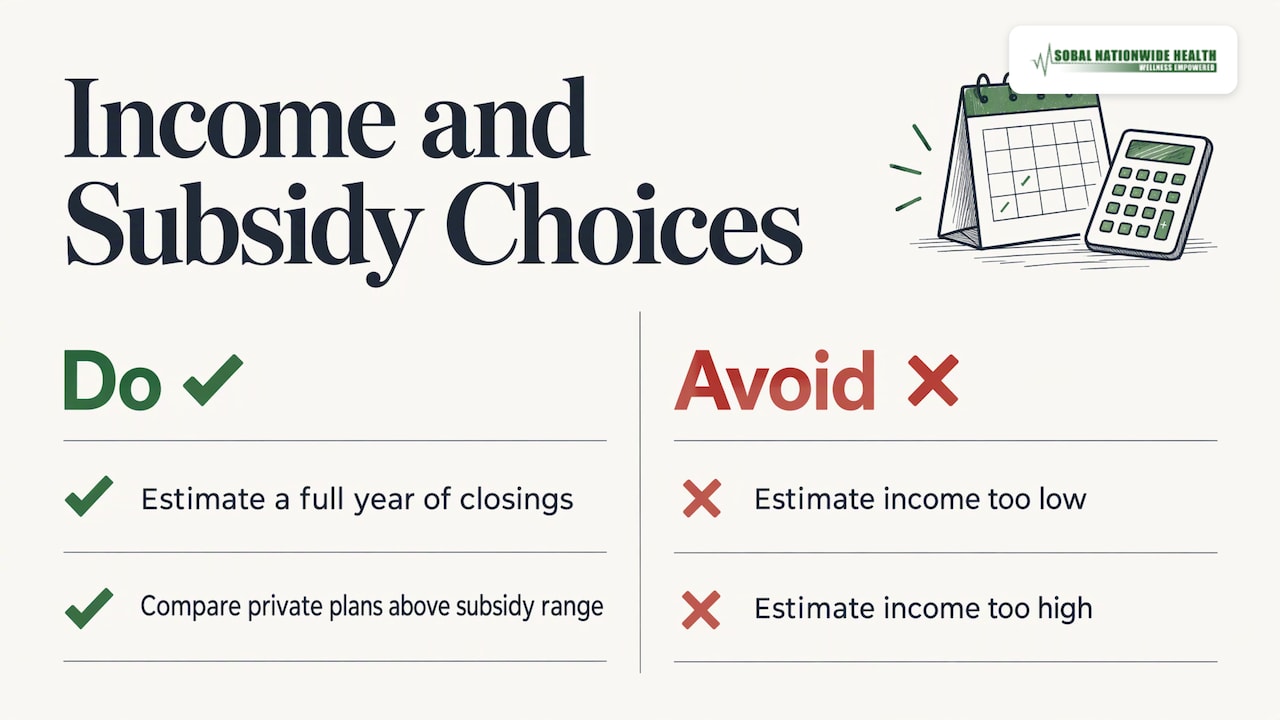
If you’re a realtor, that means you’re estimating a full year of closings in advance. Estimate low and close a few big deals, and you may owe some of the credit back at tax time. Estimate high and you may pay more each month than you needed to. That uncertainty is a real cost of the Marketplace for agents.
If your income is modest and steady, the Marketplace may be the best fit. If your commissions regularly put you above the subsidy range, you’re paying the full price anyway, and that’s when comparing a private plan makes the most sense. Our deeper comparison, private PPO vs. Marketplace in Florida for the self-employed, has more examples.
Health questions and your approval
Private underwritten plans work best for people who are generally healthy: active agents, younger professionals, families with no major ongoing care. You answer questions, the carrier decides, and you find out before you pay. Some pre-existing conditions can still be covered, depending on the carrier and the condition. A broker can tell you which carrier is likely to be a fit before you apply, so you don’t collect needless declines.
What your Realtor association can offer
Membership perks are useful, but it helps to know what they are and aren’t.
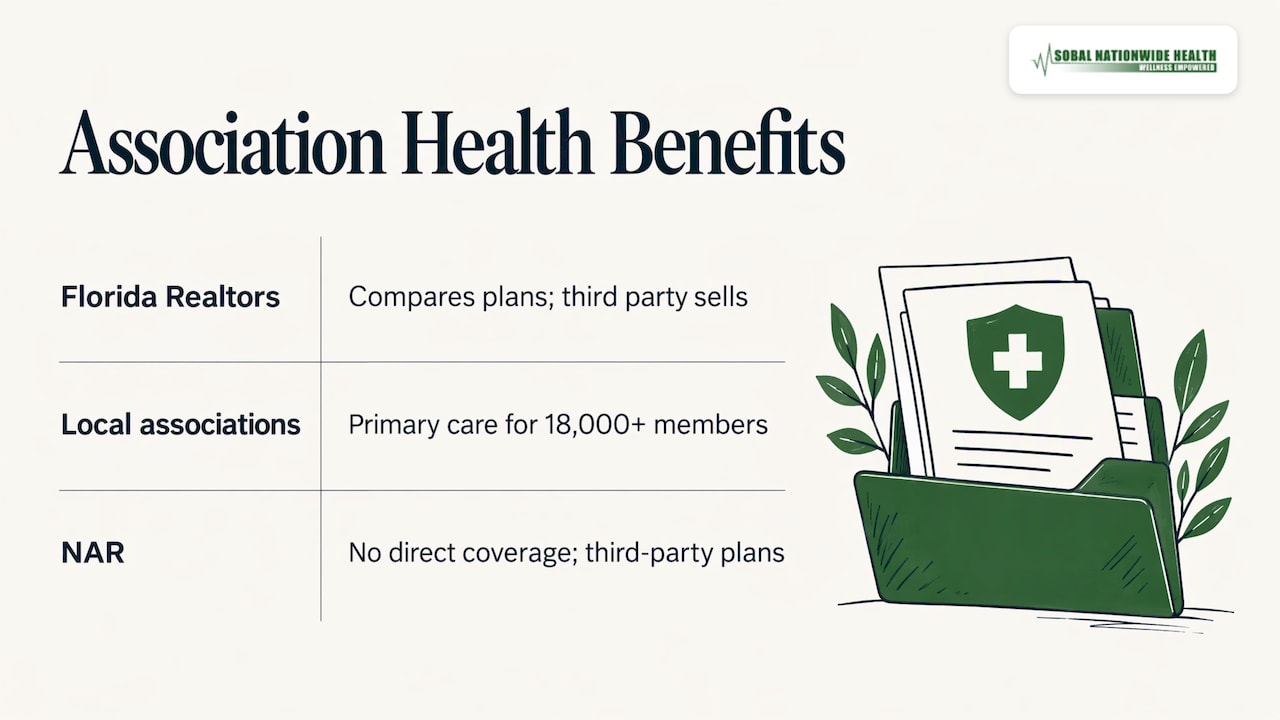
Florida Realtors. The state association announced a health plan comparison service for members that launched in fall 2025. It lets members explore and compare plans across carriers, add family members and sort by plan type, coverage tier and deductible. The association itself isn’t a licensed insurance entity and doesn’t sell the products; an outside company does, and the association may receive non-dues revenue when members buy through the platform.
Local associations. In December 2025, the Orlando Regional REALTOR Association announced a primary care program for its 18,000+ members. It’s a value-based primary care model with unlimited access to doctors, dietitians, pharmacists and mental health experts for a monthly fee. That’s a care arrangement, not a replacement for a plan that protects you from a hospital bill. Many agents pair something like it with major medical coverage. HousingWire reports that associations are increasingly adding health benefits for members beyond the MLS.
NAR. The National Association of Realtors doesn’t offer direct health insurance to members. A member scam alert from a Florida association explains that NAR partners with third-party providers who offer individual plans, not coverage through NAR itself. The same alert warned about health insurance text messages targeting members, so be careful with unsolicited offers and check who is really behind them.
A tool that compares carriers is a good starting point. A one-on-one conversation with a licensed broker is where the plan gets matched to your income pattern, doctors and family. You can use both.
You can also talk with a health insurance broker in Plantation, FL.
How to compare plans like a pro
A monthly premium is only the first number. As I tell clients, the premium gets you in the door; the rest decides what a bad month costs you. Here’s what I’d line up for every plan.
- Premium. What you pay each month to keep the plan active.
- Deductible. What you pay for covered care before the plan starts sharing costs.
- Cost-sharing. Copays and coinsurance after the deductible. These can differ for primary care, specialists, urgent care and the ER.
- Out-of-pocket maximum. Your financial safety net: the most you’d pay in a plan year for covered, in-network care.
- Network. Are your doctors, your hospital and your urgent care in it? Do you travel for work, or show homes across several counties?
- Prescriptions. Check the drug list if you take regular medication.
- Start date and rules. When coverage begins, and what’s needed to stay on it.
Building a quick worked comparison
Take two plans and put them in a simple grid: yearly premium (monthly times 12), plus the deductible, plus the out-of-pocket maximum. The first total is what you’ll pay if you stay healthy. The sum of all three is a rough picture of your worst year. A plan with a lower premium and a higher out-of-pocket maximum is not always better. If your income swings, a plan with a manageable worst case lets you sleep better in a slow quarter.
I don’t quote prices in articles because they depend on your age, ZIP code, tobacco use, health history and the carrier, and they change. A free quote shows real numbers for your situation.
Deducting your premiums
One of the best parts of being self-employed is the tax treatment. Per the IRS instructions for Form 7206, self-employed people may be able to deduct health insurance premiums paid for themselves, a spouse and dependents on Schedule 1 of Form 1040. The plan has to be established under your business, and you can’t be eligible for a subsidized plan through an employer, or through your spouse’s employer.
That last condition matters for realtors with a working spouse. If your spouse’s employer offers a subsidized plan you could join, it may affect the deduction. Whether you qualify, and how much you can deduct, depends on your full return, so confirm the details with your CPA or tax preparer before you rely on it.
A look at common realtor situations
These are patterns, not promises. Your own quote may land differently.
- New agent in your first year. Income is hard to predict, so the Marketplace and its income-based savings may fit well. Estimate carefully and update your application if your income changes.
- Established agent with strong commissions. You may be above the subsidy range, so a private PPO is worth pricing alongside a Marketplace plan.
- Team leader with a few employees. Once you have employees, small group coverage becomes an option. Our page on business health insurance covers it, and so does our guide to what small business health insurance costs in Florida.
- Family priced out of a spouse’s plan. Employer family coverage can be expensive. Compare it against a family PPO for the whole household.
- Between brokerages or leaving COBRA. A private plan can start when you’re approved, which can be useful when you’re between jobs. Short-term coverage can bridge a gap of a few months, within the federal limits above.
- Young adult turning 26. Leaving a parent’s plan is a qualifying moment. Healthy young agents often do well with a private plan.
Our perspective
Realtors are some of the most independent people I work with, and health insurance is often the one thing they’ve put off. I get it. The terms are confusing, the ads are loud, and a closing is more fun than a comparison chart.
Here’s what I’ve seen. A lot of healthy agents are told the Marketplace is the only door. For some it is the right one. For others, especially those who earn too much for subsidies, a private, medically underwritten PPO can offer a broad network and a lower premium. Some of our clients have reported savings of up to $400 a month.
Our job is to explain, not push. We’re a licensed brokerage in 31 states, with brokers who speak English and Spanish, and we’ll walk through both routes with you. If a Marketplace plan is your best move, we’ll tell you so. We also offer dental, vision and supplemental coverage, so you can build one package instead of five.
Bernie S
How we help Florida agents
We’re an independent brokerage, so we can show you private plans and ACA Marketplace plans side by side, then help with the application. You get one-on-one advice, a policy review if you already have a plan, and enrollment support, with no sales pressure.
Start with our personal and family insurance page to see what we offer, or read our Florida guide to self-employed health insurance for more detail. For plain-English explainers on terms and plan types, browse our resources library.
FAQ
Do real estate brokerages provide health insurance in Florida?
Usually not. Most agents work as independent contractors, so the brokerage typically doesn’t offer a medical plan. You shop the individual market yourself, through the Marketplace or a private plan, and some larger brokerages may offer their own perks, so ask your managing broker.
Does my Florida Realtors membership include health insurance?
No. The association offers a tool to explore and compare plans across carriers, but it doesn’t sell insurance itself. Membership can be a useful way to compare, and a licensed broker can help you match a plan to your doctors and budget.
Can I deduct my health insurance as a self-employed realtor?
Many self-employed people can, on Schedule 1 of Form 1040, if the plan is established under their business and they aren’t eligible for a subsidized employer or spouse’s employer plan. Your eligibility and amount depend on your whole return, so check with a tax professional.
Is a short-term plan a good substitute for a regular plan?
It works as a bridge. Federal rules limit new short-term policies to a three-month initial term and four months total, and they generally don’t carry the protections of comprehensive coverage. For ongoing protection, compare a Marketplace plan or a private PPO.
What if my income changes a lot during the year?
On the Marketplace, update your estimated income when it changes, because credits are based on your estimate for the coverage year. A private plan’s premium doesn’t depend on income. A broker can help you compare which handles your commission pattern better.
Sources
- Health Care Insurance Coverage for Self-Employed (HealthCare.gov)
- What’s included as income (HealthCare.gov)
- 2027 Obamacare enrollment begins Sunday (WLRN)
- Short-Term, Limited-Duration Insurance fact sheet (CMS)
- 2026 Instructions for Form 7206 (IRS)
- Florida Realtors member health plan service
- Orlando Regional REALTOR Association announcement (GlobeNewswire)
- Realtor associations add health insurance benefits (HousingWire)
- Scam alert on NAR health insurance texts (FAAR)