






To find a health insurance broker in Florida, verify the license on the Florida Department of Financial Services (DFS) licensee search, ask how many carriers the broker quotes, and confirm who you call after you enroll. Brokers are generally paid by the insurance company, so a good one costs you nothing extra to work with.
I’m Bernie Sobalvarro, a licensed independent broker (NPN 19189235), and this is the checklist I would hand a friend who is self-employed, running a small business or leaving a job plan. If you want to find a health insurance broker you can trust, these five checks take less than an hour.
We don’t offer Medicare or Medicaid. This guide is for people under 65 who want private, PPO-style coverage.
TL;DR
- Check the license first. Search the broker by name or national producer number (NPN) on the Florida DFS licensee search, and cross-check it with the NAIC’s agent search.
- Ask how many carriers the broker quotes and whether the broker has contracts with the companies being offered. Some brokers can only sell plans from companies they represent.
- Broker services are generally free to you because the insurance company pays the commission. If a broker asks for a separate fee, Florida law requires a signed written contract.
- Read Google and Facebook reviews for patterns, not just the star rating.
- Before you enroll, ask who you call about claims, billing and renewals, and whether that person is the broker.
Table of Contents
- Why a broker is worth the effort
- Step 1: Verify the license before anything else
- Step 2: Ask how many carriers they quote
- Step 3: Understand how brokers get paid
- Step 4: Read the reviews the right way
- Step 5: Ask who you call after enrollment
- A one-page checklist
- Who needs which kind of broker help
- What we do, and why it fits this checklist
- Our perspective
- FAQ
- Sources
Why a broker is worth the effort
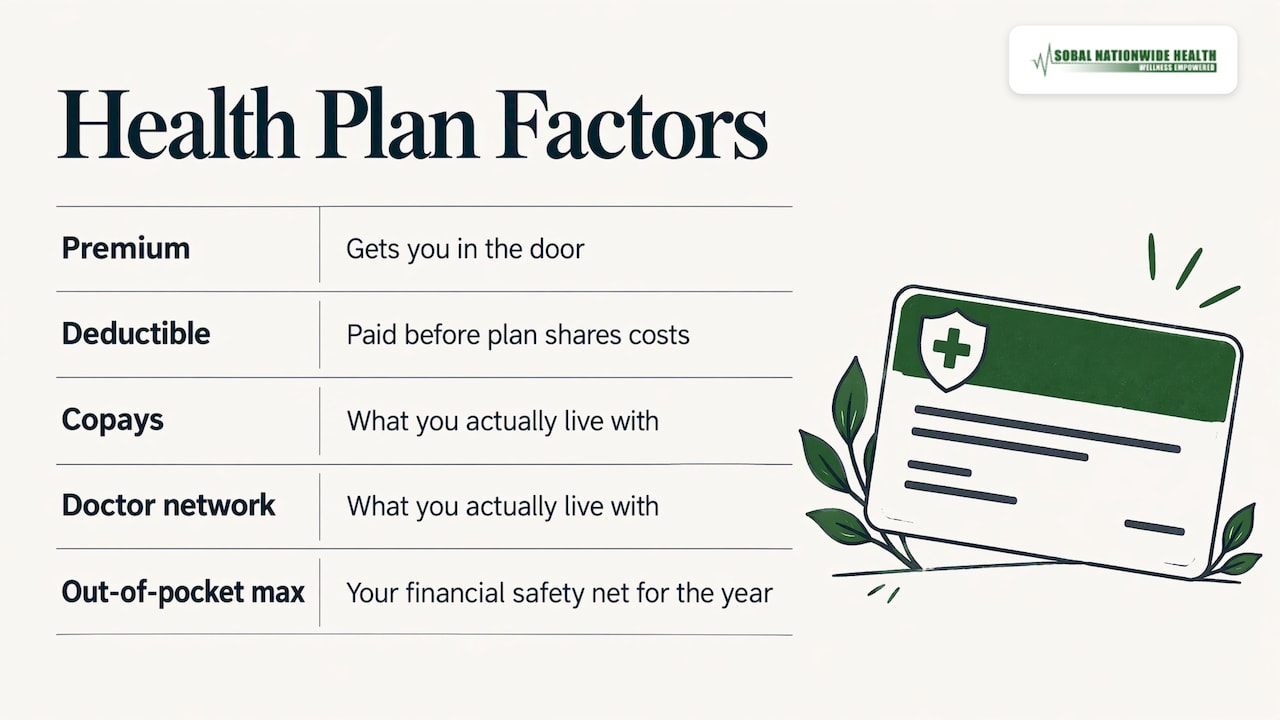
Health insurance is one of the few purchases where the price tag tells you very little. The premium gets you in the door. What you actually live with is the deductible (what you pay before the plan starts sharing costs), the copays, the doctor network and the out-of-pocket maximum, which is your financial safety net for the year.
If you are self-employed, a 1099 contractor, a realtor, an owner-operator trucker or a small business owner with 2 to 30 employees, nobody at an HR department is walking you through those choices. A broker does that job. The right one explains the trade-offs in plain English, compares options side by side and stays reachable after you sign.
The wrong one sells you whatever pays well or whatever they happen to carry. The checklist below is how you tell the difference.
Step 1: Verify the license before anything else
This is the one step you never skip. Florida requires a license to market insurance, and the state gives you a free way to check. The Florida DFS consumer services page on purchasing insurance says to use the Search Licensee tool to confirm that an agent is licensed and has active appointments (formal authorizations) with specific companies. It also notes that marketing insurance without a license is illegal in Florida.
How to run the search
- Go to the DFS Licensee Search.
- Search an individual by first and last name, or an agency by its name. You can also search by license number or national producer number. The DFS licensee search FAQ explains each option and notes that the database holds more than a million records and runs on relatively real-time data.
- Open the record and confirm the license is active, that health insurance is among the lines authorized and that the broker is appointed with the companies they are pitching you.
- Check that the name, address and contact details match what the broker gave you. DFS publishes these as public records.
The NPN is the number the national insurance system assigns to every licensed producer. Any honest broker will give it to you without hesitation. You can look up mine: Bernie Sobalvarro, NPN 19189235.
Cross-check with the national search
The NAIC (the National Association of Insurance Commissioners) runs a free Insurance Agent/Broker Search for consumers. You enter the person’s first name, last name, city and state, and it shows whether the person holds a state license and which kinds of insurance they may sell. If the two searches disagree, that is a reason to stop and ask questions.
Verify the company too
A licensed broker can still be pushing an unlicensed plan, so check the insurer as well. Florida DFS warns that agents who sell unlicensed health plans can face felony charges and discipline, including loss of their license. It also advises making sure the insurer’s name matches the department’s records exactly, because some unlicensed companies use names similar to legitimate ones. You can call the DFS Insurance Consumer Helpline at 1-877-693-5236 with the insurer’s full legal name, as the DFS health insurance guide suggests.
At Sobal Health, we are licensed in 31 states, Florida among them. We would rather you check us on the state’s own database than take our word for it.
Step 2: Ask how many carriers they quote
A carrier is the insurance company that actually issues and pays for your plan. A broker who quotes one carrier gives you one answer. A broker who quotes several gives you a comparison.
Federal guidance is clear that brokers do not all work the same way. CMS notes that agents and brokers other than web-brokers are not required by federal law to display or enroll you in every available plan and may be affiliated with particular insurers. HealthCare.gov adds that some brokers can only sell plans from the companies they represent.
So put these questions to any broker you interview:
- Which carriers do you quote for individuals and families, and which for small groups?
- Do you have a contract with each of those companies?
- What types of plans can you show me: PPO-style plans with nationwide doctor choice, dental, vision, accident, critical illness?
- Will you explain why you recommend one plan over the others?
For self-employed people and families who want to keep their own doctors, this matters a great deal. A broker with access to private, medically underwritten plans can show you PPO-style options that you would not see on a single-carrier menu. Medically underwritten means the insurer reviews your health history when you apply, which is why these plans tend to suit healthy buyers. Our own guide on how medically underwritten insurance works and who it fits goes deeper if that is your situation.
Step 3: Understand how brokers get paid
Most people wonder whether using a broker raises the price. In general it does not. HealthCare.gov says an agent’s or broker’s help is generally free to you because they are usually paid by insurance companies. The commission comes from the carrier when you enroll.
That is why, in a typical case, the premium for a given plan is the same whether you buy through a broker or go straight to the company. I’d ask the broker to confirm it for the specific plan in front of you, and to put anything else in writing.
When a separate fee is allowed
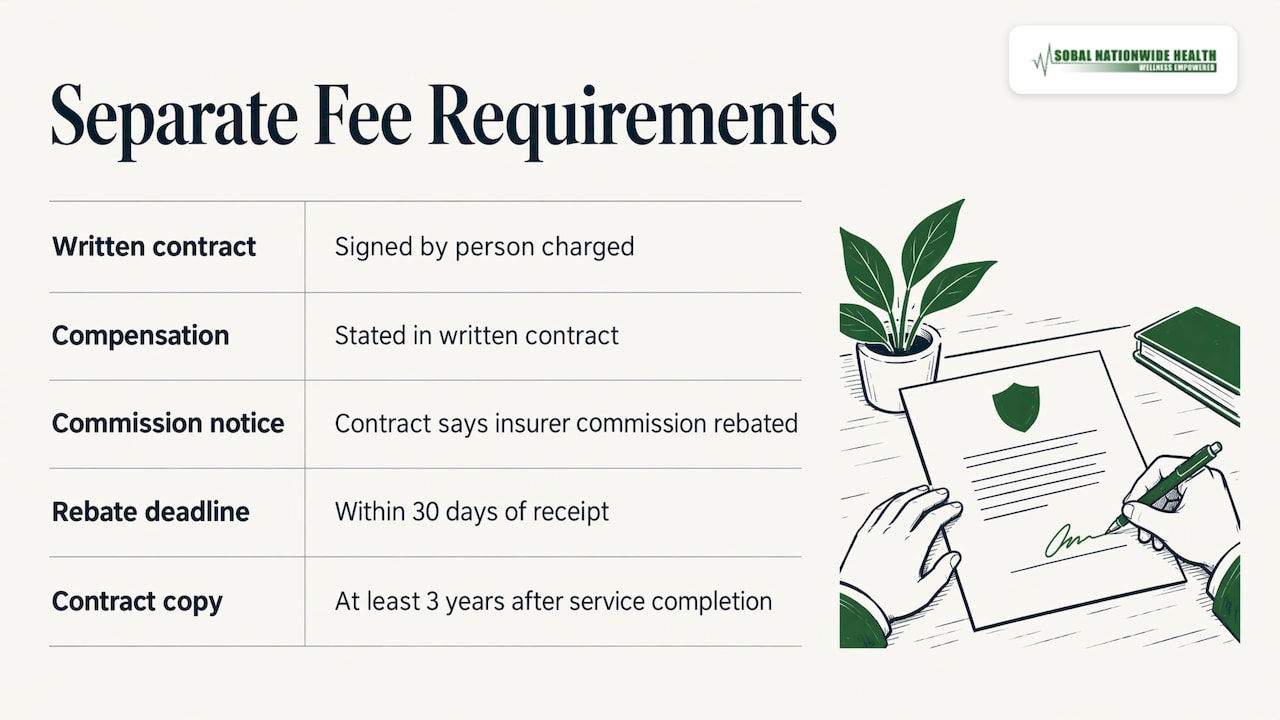
Some brokers charge a fee for advice, for example when a small business wants help beyond placing a policy. Florida regulates this. According to the NABIP Florida resource page, under section 626.593 of the Florida statutes an agent may receive fees for counseling, advising and recommending insurance only under a written contract signed by the person being charged. The contract must state the compensation and tell you that any insurer commission will be rebated. Section 626.572 requires commissions received alongside a separate fee to be rebated to you within 30 days.
The NAIC’s compensation disclosure chart summarizes the same rule and adds that the licensee must keep a copy of the contract for at least three years after the services are fully performed.
What this means for you: if a fee is ever on the table, you should see it on paper before you agree. Our business page lists broker fees for group work at Business Health Insurance, so you can see how we handle them. We have no published price to quote here, so ask us for the specifics on your situation.
A quick way to think about incentives
Because commissions come from carriers, a broker’s recommendation can be shaped by who they are contracted with. That is not a flaw to fear, it is a fact to manage. The best protection is the combination of Steps 1 to 5: a verified license, a broker who quotes several carriers, a plan explained in plain words and someone who stays available. Our guide to questions to ask a health insurance broker gives you wording for the conversation.
Step 4: Read the reviews the right way
Reviews are not proof, but they are useful when you read them for patterns. Look at Google and Facebook, where real customers tend to leave detailed comments. Here is how to read them:
- Look for specifics. A review that mentions a claim that got sorted out, a renewal explained or a question answered the same day tells you more than “great service.”
- Read the middle ratings. Three- and four-star reviews often describe how the broker handles a problem.
- Notice the dates. A broker who is responsive this year matters more than one who was great five years ago.
- Check how the broker replies. A calm, specific reply to a complaint is a good sign.
- Match the reviewer to you. If you are a 1099 contractor, a family or a small business, look for reviews from someone in the same boat.
Some of our clients report meaningful savings after switching to a plan we helped them choose, and we are glad when they say so. Every household is different, and we never promise a particular result. What we do promise is an honest comparison and no sales pressure.
Step 5: Ask who you call after enrollment
This is the question most people forget, and it is the one that decides whether a broker was worth it. Signing up is the easy part. Months later you will have a billing mix-up, a claim question, a doctor who is out of network or a life change such as a new baby, a new job or a child turning 26.
Before you enroll, ask:
- Who do I call with a claim or billing problem, you or the carrier?
- Will I reach you directly, or a call center?
- Do you review my coverage again at renewal?
- What happens if my situation changes mid-year?
- Is help available in the language I’m most comfortable in?
The Florida DFS Purchasing Insurance page advises choosing an agent you feel comfortable with and who will be available to answer your questions. At Sobal Health you get direct access to a broker in English or Spanish, which matters for Spanish-speaking families and business owners who want to ask every question in their own language.
If you ever need a neutral party, the DFS Division of Consumer Services handles this. Florida law gives it the job of receiving consumer inquiries and complaints and providing direct assistance to consumers who ask. The helpline is 1-877-693-5236.
A one-page checklist
| Step | What to do | Green flag | Red flag |
|---|---|---|---|
| 1. License | Search name or NPN on the DFS licensee search and NAIC search | Active license, appointed with the companies offered | No record, or a name that does not match |
| 2. Carriers | Ask how many carriers they quote | Several carriers, clear reasons for the pick | One option, vague answers |
| 3. Pay | Ask how they are paid | Carrier-paid, any fee in a signed contract | Fee requested with nothing in writing |
| 4. Reviews | Read Google and Facebook for patterns | Specific, recent, similar to your situation | Only generic praise, or no replies to complaints |
| 5. After enrollment | Ask who you call for claims and renewals | A named person you can reach directly | “Call the carrier” for everything |
Who needs which kind of broker help
The checklist is the same for everyone, but your priorities shift by situation:
- Self-employed, 1099 and gig workers. You are buying alone, so you want a broker who shows PPO-style options and explains deductibles and out-of-pocket maximums. Realtors and owner-operator truckers often need coverage that travels, so ask about nationwide networks.
- Small business owners with 2 to 30 employees. Ask whether the broker handles group plans and how they support you at renewal.
- People leaving a job plan. If you are between jobs, ask the broker to lay out private options next to your current plan, so you decide with the full picture.
- Families priced out of a spouse’s employer plan. Ask for family quotes that keep your preferred doctors and hospitals.
- Young adults turning 26. Ask about timing so there is no gap when you leave a parent’s plan.
Our pages for personal and family coverage and business health insurance show what we offer each group. For a Florida-specific view on comparing plans, see our guide to factors to consider when comparing health insurance in Florida, and if you are in South Florida, we also have pages for brokers in Miami and Fort Lauderdale.
You can also talk with a health insurance broker in Plantation, FL, by phone or video.
What we do, and why it fits this checklist
Sobal Health is a health insurance brokerage built for self-employed people, families and small businesses. We offer private medically underwritten plans, along with dental, vision, accident, critical illness and group health packages. You get one-on-one advice focused on helping you understand your options, not on pressure to buy, plus policy review and enrollment support.
Holding us to the five steps above is exactly what we hope you do. Look us up on the DFS database, ask which carriers we work with, ask how we are paid and ask who you will call afterward. Then compare our answers with anyone else’s.
If you want help comparing those options, you can find a health insurance broker.
If you are ready to see what a PPO-style plan could look like for your household or your team, start at our personal and family insurance page.
For a small business, the business health insurance page explains group options and the broker fee details.
Our perspective
I became a broker because I kept watching self-employed people and small business owners make a big decision from a confusing screen of premiums. The cheapest number is rarely the best plan, and the premium only gets you in the door.
What I believe is simple. You should be able to ask any question, in English or Spanish, and get a straight answer without feeling pushed. You should see how a private, medically underwritten PPO plan compares with what you have now, including your doctors and your out-of-pocket maximum, before you decide anything.
That is why I tell people to verify me before they trust me. Check my license, ask about carriers, ask how I am paid and ask who picks up the phone after enrollment. A broker who is comfortable with those questions is usually the one worth hiring.
More guides are on our resources page, and I am glad to talk through your own situation any time.
Bernie S
FAQ
Does it cost more to buy health insurance through a broker?
Generally no. HealthCare.gov says brokers’ services are usually free to you because insurance companies pay them. If a broker wants a separate fee, Florida law requires a signed written contract that states the amount.
How do I check that a Florida broker is licensed?
Search the broker’s name, license number or NPN on the Florida DFS licensee search, then cross-check on the NAIC agent search. Confirm that the license is active and that the broker is appointed with the insurers being offered. You can also call the DFS helpline at 1-877-693-5236.
Should I use a local broker or one who works across several states?
What matters is a Florida license and good access to carriers. If you want PPO-style coverage with nationwide doctor choice, a broker licensed in many states can be a good fit, especially if you travel or may move. Sobal Health is licensed in 31 states, including Florida.
What should I ask before I enroll?
Ask which carriers they quote, how they are paid, how the premium, deductible and out-of-pocket maximum compare across your options, and who you call for claims and renewals. Our questions to ask a health insurance broker page has the full list.
Can I switch brokers later?
In many cases yes, but the rules depend on your plan and carrier. Ask your current broker and the carrier how a change works before you make it. A broker who is easy to reach makes this question rarely come up.
Sources
- Purchasing Insurance, Florida DFS Consumer Services
- Licensee Search FAQ, Florida DFS
- Unlicensed Health Plans, Florida DFS
- Health Insurance and Health Maintenance Organizations, Florida DFS consumer guide
- Insurance Agent/Broker Search, NAIC
- Agents and Brokers Guidance for Assisters, CMS
- Agent and broker glossary, HealthCare.gov
- Get contacted by an agent/broker, HealthCare.gov
- NABIP Florida state resources
- Compensation Disclosure Requirements for Producers, NAIC
- Chapter 624, 2026 Florida Statutes
Ready to talk it through? Get a free quote or call (305) 680-0125.