

If you are healthy and self-employed in Florida, a private medically underwritten PPO can give you a wider choice of doctors and hospitals, and sometimes a lower premium, than a Marketplace plan. The Marketplace is still the only place to get premium tax credits, so the better fit depends mostly on your income and how you use care.
I’m Bernie Sobalvarro, a licensed independent broker. Below is the honest side-by-side I walk through with 1099 workers, realtors, truckers, and small business owners every week.
TL;DR
- Marketplace plans (ACA plans) include essential health benefits and are the only plans eligible for premium tax credits, which depend on household income and family size.
- Private PPOs let you see doctors and hospitals in or out of network without referrals. Private medically underwritten plans ask health questions, so they fit best if you are in good health.
- If your income is too high for subsidies, a private plan is often worth pricing next to a Marketplace plan.
- You can compare both with one broker at no cost to you. We don’t offer Medicare or Medicaid.
Table of Contents
- The short version: who each option fits
- How the Marketplace works for self-employed Floridians
- How a private PPO works
- Can a healthy self-employed Floridian get a private PPO?
- Cost: what actually decides the winner
- Doctors, hospitals, and referrals
- When you can enroll
- Quick picks by situation
- A simple way to decide
- Our perspective
- Talk to a broker who offers both
- FAQ
- Sources
The short version: who each option fits
Think of the premium as the price of getting in the door. What matters just as much is what happens once you walk through it: the deductible, the coinsurance, and which doctors you can see.
| ACA Marketplace plan | Private medically underwritten PPO | |
|---|---|---|
| Who can get a subsidy | Qualifying buyers, based on income and household size | Not eligible for Marketplace subsidies |
| Health questions on the application | No | Yes |
| Enrollment window | Open enrollment, or a special enrollment period | Typically offered outside the Marketplace window, depending on the carrier |
| Doctor choice | Depends on the plan’s network design | PPO designs cover in-network and out-of-network care, no referral needed |
| Best fit | Lower to middle incomes who qualify for credits, or anyone who wants ACA benefit standards | Healthy buyers, high earners, and families priced out of other options |
That table is a starting point. Plan details vary by carrier, so the real answer always comes from the plan documents in front of you.
How the Marketplace works for self-employed Floridians
Florida residents use the federal Marketplace. According to the Florida CFO consumer guide, a self-employed person, or a business with only family workers, shops in the individual market.
Three things make Marketplace plans attractive:
- Standard benefits. The ACA requires plans sold on the marketplaces to cover 10 categories of essential health benefits, cover high-value preventive services without cost sharing, and not set annual or lifetime limits on those benefits.
- No health questions. These plans can’t turn you down or charge more because of your health history.
- Financial help. Premium tax credits are available only through the Marketplace. KFF also explains that cost-sharing reductions lower deductibles, copayments, and coinsurance, are generally available between 100% and 250% of the federal poverty level, and require a Silver plan.
Metal tiers are easy to remember. KFF notes that Bronze plans generally have lower premiums but higher deductibles and cost sharing, while Platinum plans flip that. Silver and Gold sit in the middle.
If your self-employment income is modest or uneven, the Marketplace can be a strong choice, because credits shrink the premium. If your income is higher, credits may be small or zero, and the sticker price becomes the real price. That is the point where I recommend pricing a private plan beside it.
How a private PPO works
A PPO (preferred provider organization) is built around choice. Per the Texas Department of Insurance health coverage guide, a PPO covers in-network and out-of-network providers, pays a higher share for in-network care, and doesn’t require a primary care provider or referrals to see a specialist.
The tradeoff is cost sharing when you step outside the network. FAIR Health explains that out-of-network care usually brings a higher deductible and a higher coinsurance percentage, and you may owe the difference between the insurer’s allowed amount and the provider’s actual charge. That difference is called balance billing, and it generally doesn’t count toward your out-of-pocket limit.
In practice, here is how I coach clients to use a PPO well:
- Start with the in-network list. Staying in network keeps your cost sharing lowest.
- Keep out-of-network in your back pocket. It is there when you want a specific surgeon, a specialist out of state, or care while you travel.
- Before a planned procedure, ask the provider’s billing office what they will charge and ask the plan what it allows.
This freedom matters for people who travel for work, like owner-operator truckers, or who split time between cities. Our private plan designs include portable and nationwide PPO options, which means your coverage isn’t tied to one county’s network. The same logic applies to add-ons. If you are thinking about dental work, our dental implants insurance guide shows how provider choice and coverage limits shape what you pay.
Can a healthy self-employed Floridian get a private PPO?
Often, yes. Private medically underwritten plans review your health history before approving you and setting your rate. If you are generally healthy, that review tends to work in your favor, which is why this route fits healthy self-employed people, active families, and young adults aging off a parent’s plan.
Two plain-English notes:
- Health questions are part of the application. You answer them honestly, and the carrier decides on approval and price. Some past conditions can still be covered, depending on the carrier and the details. A broker can tell you before you apply, so you aren’t guessing.
- These plans don’t follow the Marketplace rulebook. Plans that ask about your medical history are not ACA-compliant. KFF lists that as one sign, along with how benefits and limits are structured. So read the benefit summary for the items you care about, such as prescriptions, mental health, maternity, and preventive care. We help you do exactly that.
Our medically underwritten insurance guide goes deeper on how underwriting works and who it fits.
Cost: what actually decides the winner
I don’t quote prices in articles, because rates depend on your age, tobacco use, household, county, and the carrier. What I can show you is how to compare fairly.
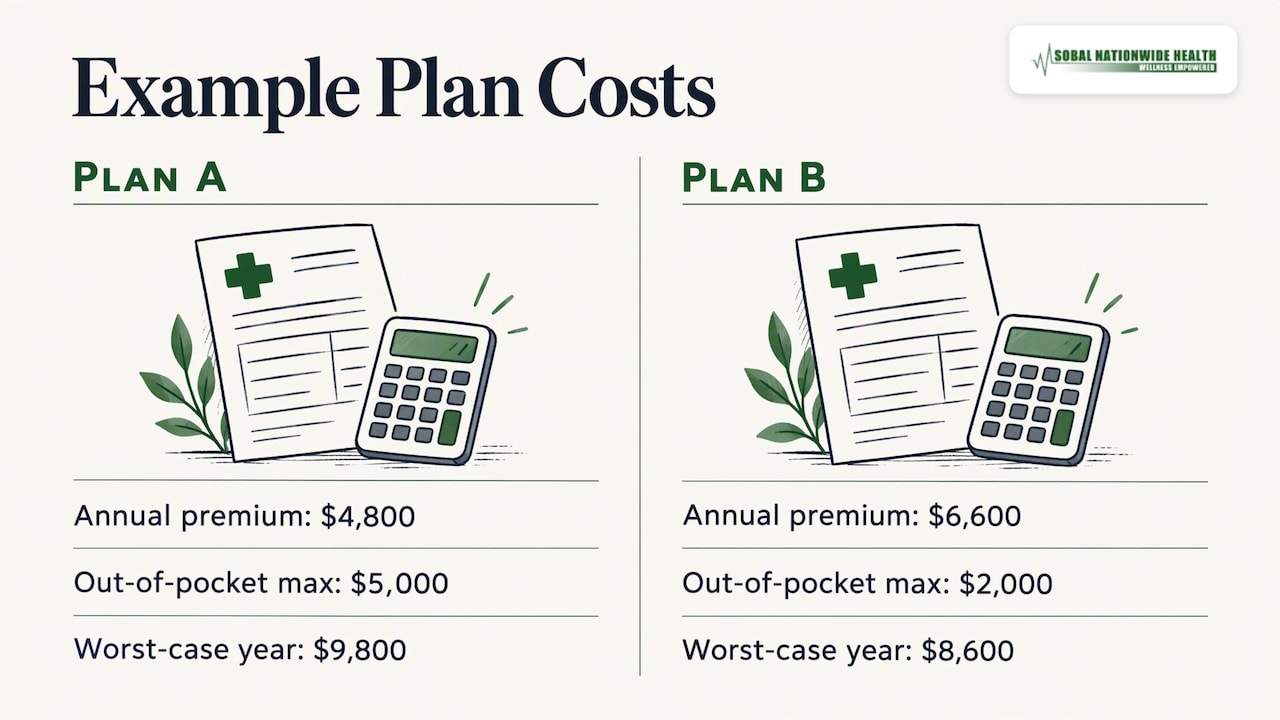
Compare total yearly cost, not only the premium. Add 12 months of premium to the deductible and the out-of-pocket maximum. The out-of-pocket maximum is your financial safety net: the most you would pay in a year for covered in-network care. The premium plus that number is your worst-case year.
Check what subsidies do to your Marketplace number. The Florida CFO guide notes that ACA premium assistance is only available through Marketplace plans, though you can buy directly from an approved insurer or agent without it. If you get a credit, use the post-credit premium in your comparison. If you don’t, use the full price.
Remember your self-employment income can move. A strong year can push you out of subsidy range. A slow year can bring you in. Plan with your realistic income estimate, and talk to your tax professional about whether you can deduct your premiums as a self-employed person.
An example of the method, with made-up round numbers to show the math only: if Plan A has a $400 monthly premium and a $5,000 out-of-pocket maximum, your worst-case year is $4,800 plus $5,000, or $9,800. Plan B at $550 a month with a $2,000 maximum is $6,600 plus $2,000, or $8,600. The cheaper premium doesn’t always win, and a healthy year favors the lower premium. Run your own numbers, and we’ll gladly run them with you.
Readers who have already looked at our Florida guide for incomes above the subsidy range will recognize this: when credits disappear, private plans deserve a real look.
Doctors, hospitals, and referrals
Before you compare premiums, write down your must-haves:
- The primary care doctor or clinic you want to keep.
- Any specialist you see regularly.
- The hospital you would go to in an emergency, and where you’d want planned care.
- Whether you travel or live part of the year in another state.
Marketplace plans come in different network styles, so check the specific plan’s network. With a PPO, the benefit is that you aren’t boxed in: you can see an out-of-network provider without a referral at a higher cost. For a self-employed person who can’t afford a week lost to referral paperwork, that matters.
When you can enroll
The federal Marketplace has a yearly open enrollment window. For 2027 coverage, HealthSherpa’s enrollment guide notes it starts November 1, 2026 and runs into mid-January 2027, and that a qualifying life event can open a special enrollment period. Check HealthCare.gov for the current deadline for your start date.
Outside that window, you may still have options:
- A qualifying event such as losing job coverage, moving, or a household change. See our guide on special enrollment periods in Florida.
- Private plans, which often accept applications outside the Marketplace window, subject to underwriting. Our page on changing health insurance outside open enrollment in Florida explains the steps.
Whoever you are, there’s a good chance one of these fits your timing. Leaving COBRA, turning 26, or finishing a W-2 job are common triggers I see.
Quick picks by situation
- 1099 worker with a high income: Price a private PPO and a Marketplace plan with no credit side by side. Credits may not apply, so the private plan can come out ahead.
- Realtor or commission-based earner with swings in income: Get quotes under a low and a high income estimate. Marketplace credits could change a lot between the two.
- Owner-operator trucker: Prioritize nationwide network access. A portable PPO design is worth a close look.
- Family priced out of a spouse’s employer plan: Compare the family premium on the employer plan with a private family PPO and a Marketplace family plan.
- Young adult turning 26: Healthy and young usually means good underwriting odds. Get a private quote and a Marketplace quote.
- Small business with 2 to 30 employees: Ask about group and private options. Our business health insurance page covers what we arrange.
- Just leaving COBRA: Compare private coverage with the Marketplace before you lock in COBRA’s full-price premium.
For a broader tour of what exists, see our self-employed health insurance options in Florida and our Florida health insurance overview. More explainers live in our resource guide.
A simple way to decide
- Estimate your net income for the coverage year, then check whether you could qualify for credits using KFF’s calculator.
- List your doctors and hospitals and must-have benefits.
- Get your Marketplace price after credits.
- Get your private PPO price, with the benefit summary and the out-of-pocket maximum.
- Compare worst-case year cost and benefits, not just the monthly premium.
- Confirm your start date and enrollment path.
None of that has to be done alone. That is what we are for.
Our perspective
Every week someone tells me they assumed the Marketplace was their only choice, or that a private plan was a gamble. Neither is quite right.
The Marketplace is a good product, especially if credits cut your premium. But if you are healthy, earn too much for subsidies, and want to see any doctor or hospital without referrals, private medically underwritten PPO plans are worth a serious look. They are designed for that kind of buyer, and many of our clients have told us they saved a lot compared with what they were paying before.
Our approach is education first. We show you both options, in English or Spanish, explain the deductible and out-of-pocket maximum in plain words, and let you decide with no sales pressure. If the Marketplace is the better fit for you, we will help you enroll in that too.
Bernie S
Talk to a broker who offers both
Sobal Health helps self-employed people, families, and small businesses compare private medically underwritten plans and ACA Marketplace plans in one conversation. We also arrange dental, vision, and supplemental coverage such as accident and critical illness. You can browse personal and family coverage or go straight to a quote.
We are licensed in 31 states, including Florida, and our brokers speak English and Spanish. We don’t offer Medicare or Medicaid.
FAQ
Is a private PPO cheaper than a Marketplace plan in Florida?
It depends on your income, age, and health. If you qualify for premium tax credits, the Marketplace often wins on monthly cost. If you don’t, a private plan may come in lower, so compare both at the same deductible level.
Do private PPO plans cover pre-existing conditions?
Private medically underwritten plans review your health history, so coverage and pricing are decided case by case. Some conditions can be covered. A broker can check a carrier’s rules before you apply.
Can I see any doctor with a PPO?
Yes, in the sense that a PPO covers in-network and out-of-network providers and doesn’t require referrals. Staying in network costs less, and out-of-network care may bring higher deductibles, higher coinsurance, and balance billing.
Can I buy a Marketplace plan outside open enrollment?
Usually only with a qualifying life event, such as losing other coverage, which opens a special enrollment period. Private plans may accept applications at other times. We can check which route fits your situation.
Does it cost me anything to work with a broker?
We are paid by the insurance carrier when you enroll through us. We can walk you through your options before you decide, and we’ll tell you if any fees apply to your case.
Sources
- Florida CFO: Health Insurance and Health Maintenance Organizations
- KFF Health Insurance Marketplace Calculator
- KFF: Questions About Health Insurance Subsidies
- KFF: Frequently Asked Questions about the ACA Marketplace
- Texas Department of Insurance: 2026 Texas Health Coverage Guide
- FAIR Health: In-Network and Out-of-Network Care
- Banner Aetna: Cost of Out-of-Network Doctors and Hospitals
- Commonwealth Fund: What to Know About Non-ACA-Compliant Health Coverage
- HealthSherpa Help Center: Enrollment periods
- Dental Implants Insurance: What to Expect and How to Pay
