






Medically underwritten insurance is coverage where the insurer reviews your health history before deciding whether to accept you, what to charge, and what to exclude. ACA Marketplace plans are not allowed to do this. Private plans sold outside the Marketplace often are. For a healthy self-employed person who earns too much for subsidies, that difference can mean a lower premium and a wider choice of doctors. For someone with a serious health history, it can mean a decline. Both outcomes are normal, and you should know which one you are walking into.
TL;DR
- Medical underwriting means the insurer looks at your health history and decides to accept you, accept you at a higher rate, or decline you.
- Marketplace plans cannot use it. Private plans outside the Marketplace often can.
- The savings are real for many healthy applicants, but the trade-off is that some benefits may be limited or excluded, depending on the plan type.
- Not every underwritten product is a full major medical plan. Check the plan type before you compare prices.
- Apply for the new plan first and keep your current coverage until you are approved.
Table of Contents
- What medical underwriting actually means
- The three answers you can get
- Underwritten vs. ACA Marketplace: a side-by-side look
- Not all underwritten products are the same
- The honest trade-offs
- Who tends to benefit
- Medical underwriting for employers
- How to apply without regrets
- Where we stand
- Talk it through with a broker
- FAQ
- Sources
What medical underwriting actually means
HealthCare.gov describes medical underwriting as the process insurers use to work out your health status when you apply, so they can decide whether to offer coverage, at what price, and with what exclusions or limits.
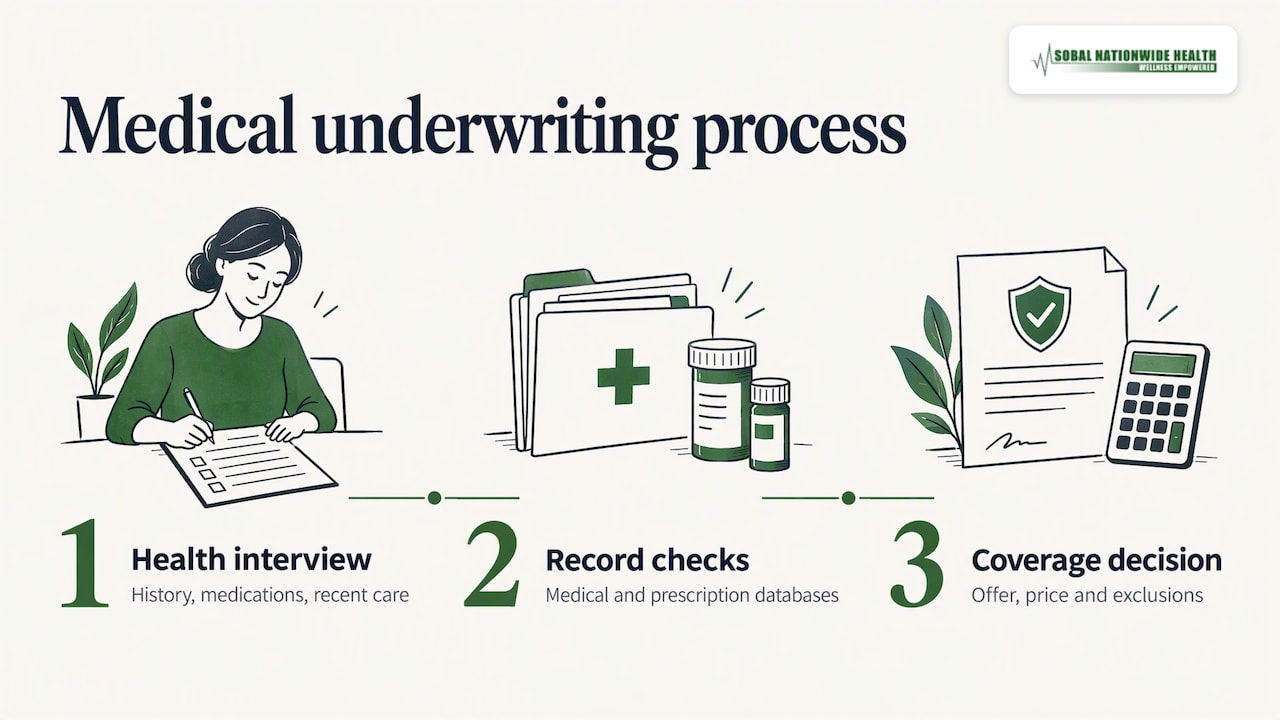
Think of it as a short health interview. You answer questions about your history, medications and recent care. The insurer may also check medical records or prescription databases. Then it decides.
That is the opposite of how Marketplace plans work. Under the ACA, those plans can set premiums using only five factors: age, location, tobacco use, individual versus family enrollment, and plan category. Your health history is not one of them.
So “underwritten” does not mean “bad” and “ACA-compliant” does not mean “best.” They are two different ways of pricing risk, and each one suits different people.
The three answers you can get
When you apply for an underwritten plan, the insurer typically comes back with one of three outcomes:
- Standard rate. You are accepted at the base price for your age and area.
- Rated-up or with exclusions. You are accepted, but at a higher premium, or with a specific condition carved out.
- Decline. The insurer does not offer you a policy.
The HealthCare.gov glossary explains that underwriting can affect price and exclusions, not only whether you are accepted. That is worth remembering: a decline from one carrier does not always mean a decline from every carrier, because each company sets its own standards.
Why the same person gets different answers
Each carrier has its own underwriting guidelines. One may be relaxed about a past knee surgery and strict about blood pressure readings. Another may be the reverse. This is one of the main reasons a broker who can approach several carriers is useful: we can match your history to the carrier most likely to treat it fairly, instead of you submitting application after application and collecting declines.
Underwritten vs. ACA Marketplace: a side-by-side look
| ACA Marketplace plan | Medically underwritten plan | |
|---|---|---|
| Health history reviewed? | No | Yes |
| Can you be declined for health reasons? | No | Yes |
| Pre-existing conditions | Covered from day one | May be excluded or priced in |
| What sets your premium | Age, location, tobacco, family size, plan category | Health profile plus other factors, depending on the carrier |
| Subsidies available? | Yes, if you qualify | No |
| Required to cover essential health benefits? | Yes | Depends on the plan type |
| When can you enroll? | Open enrollment or a qualifying event | Often year-round, subject to approval |
The subsidy line matters most for people with higher incomes. If your income is too high for premium tax credits, you are paying the full Marketplace price, and the one thing you cannot do there is get a discount for being healthy. Underwriting is how a private plan can reward that.
If you are in Florida, we wrote a separate piece on when private plans beat the Marketplace above 400% of the federal poverty level.
Not all underwritten products are the same
This is where people get hurt. “Medically underwritten” describes how you are accepted, not how much the plan covers. Underwritten products range from broad PPO-style major medical to narrow, short-term policies.
The short-term end of the range is the one regulators warn about most. The NAIC notes that short-term, limited-duration plans are often medically underwritten and not required to cover essential health benefits such as maternity care, prescription drugs or mental health care. The same page says federal rules cap their term, though the current administration has suspended enforcement of that rule, so check what your state allows.
KFF has found these plans tend to have lower premiums because they are medically underwritten and exclude pre-existing conditions. Its analysis also says people with conditions such as cancer, obesity or pregnancy are likely to be declined.
Here is how I sort what I see, from the broadest to the narrowest:
- Private major medical (often PPO). Designed as your main coverage, with a broad provider network. Underwritten at application.
- Short-term plans. Designed as a bridge. Narrower benefits, and the coverage ends.
- Supplemental plans. Accident, critical illness and fixed indemnity. These pay cash benefits and sit on top of a main plan. They do not replace one.
For a deeper rundown of the plan categories that still use underwriting, see our guide to plan types that still underwrite U.S. health insurance.
The honest trade-offs
I like these plans for the right client. I also would not be doing my job if I skipped the downsides.
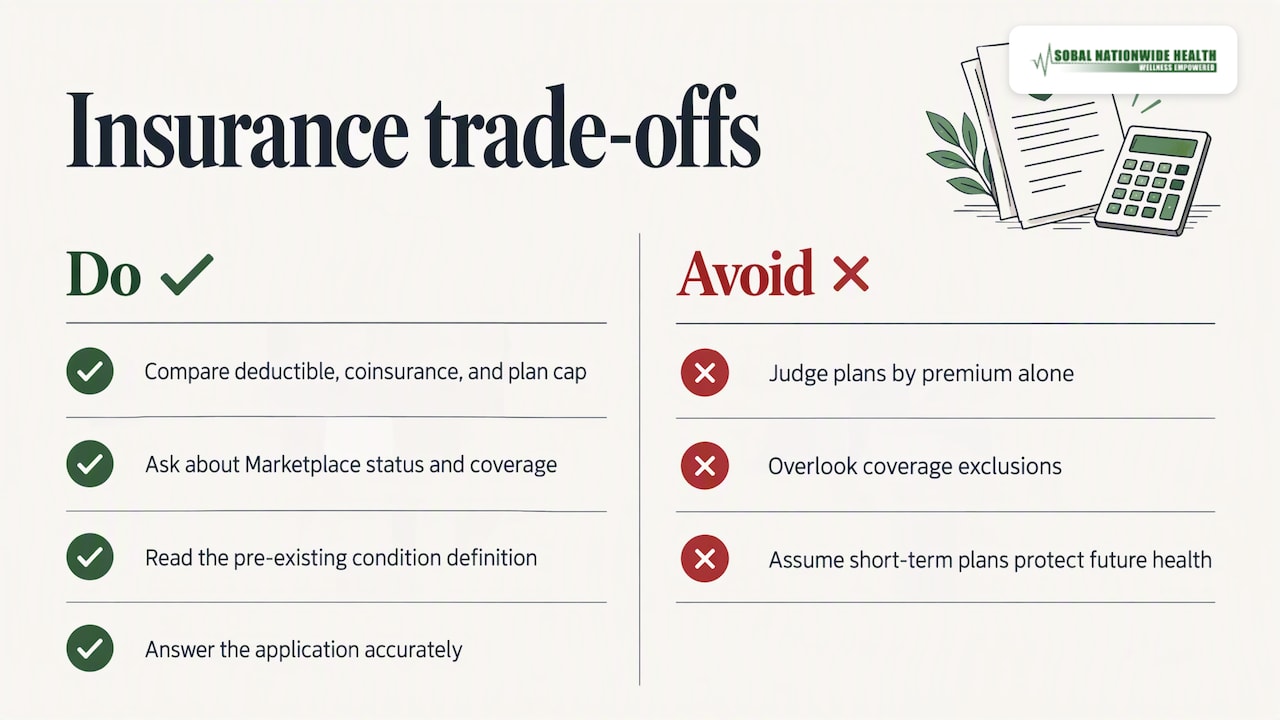
The premium gets you in the door, not the whole way. A lower monthly price is only half of the picture. Look at the deductible, the coinsurance, and the out-of-pocket maximum, which works like a financial safety net: the most you would pay in a covered year before the plan picks up the rest. A cheap premium with a weak safety net is not a bargain.
Exclusions are where surprises hide. NAIC guidance says consumers should ask whether a plan is a Marketplace plan and whether it covers pre-existing conditions before buying. Underwritten and supplemental policies can leave out standard categories such as prescriptions, mental health or maternity, and the NAIC points to the difference between major medical and limited or supplemental coverage as the most important thing to understand. I agree with that completely.
Your future health is not protected the same way. On a short-term plan, KFF notes an insurer may look back through your records if you are diagnosed with something while enrolled, and may argue it was pre-existing. Because of that, I tell clients to read the pre-existing condition definition on any plan before applying, and to be fully accurate on the application. A missed detail now can become a denied claim later.
Getting declined is possible. If you have a significant condition, a Marketplace plan may be the stronger choice, because it must accept you and cover that condition. I would rather tell you that up front than sell you a plan that will not hold up.
Who tends to benefit
In our work with self-employed people, families and small business owners, underwritten private plans most often fit these situations:
- Self-employed professionals and 1099 contractors with income above the subsidy range, who are paying full price on the Marketplace.
- Healthy families who want a PPO that lets them see any doctor or hospital they choose, without being tied to a narrow network.
- Entrepreneurs who travel and want coverage that is portable across state lines.
- People between jobs weighing private coverage against COBRA. Our guide on COBRA versus Marketplace after a job loss walks through the deadlines.
And it is usually not the right fit for someone who is pregnant or planning to be soon, someone with an ongoing condition that needs expensive treatment, or anyone who needs subsidies to afford coverage at all.
Medical underwriting for employers
You will also see this term outside the individual market, so a quick map.
Employer plans. Small and large employer plans can be underwritten as a group, where the insurer prices the whole workforce rather than one person. How a business funds its plan also changes how much health data the employer sees and how risk is shared. If you run a business and are weighing that, this explainer on self-funded versus fully insured plans is a useful background read. For our own small business options, see our business health insurance page.
How to apply without regrets
Here is the order I walk clients through.
- Keep your current coverage. Do not cancel anything until the new plan is approved and active. A decline with no backup is the worst-case scenario.
- Gather your history. List diagnoses, medications, surgeries and doctor visits from the last several years, including the dates. Pull your records if you are unsure.
- Answer every question fully. Underwriters compare your answers to your records. Completeness protects your claims later.
- Check the plan type. Confirm whether it is major medical, short-term or supplemental. Ask whether it covers prescriptions, mental health and maternity.
- Read the pre-existing condition language. Know how the plan defines it and how far back it looks.
- Compare the out-of-pocket maximum, not just the premium. That number is your real worst-case year.
- Ask about the network. If you want any doctor or hospital, confirm that a PPO network reaches the ones you use.
- Compare with the Marketplace. If your income qualifies for subsidies, price those plans too. Our 2026 cost check of private health insurance versus the Marketplace helps with that.
Where we stand
We do not think underwriting is good or bad. It is a tool, and the question is whether it is the right tool for you. Our job is to explain it clearly enough that you can decide for yourself.
We are a licensed brokerage working with self-employed people, families and small businesses across 31 states. We offer access to private, medically underwritten plans that are not available on the public Marketplace, alongside ACA plans, so we are not pushing you toward one option because it is the only one we have. We do not work on sales pressure. We would rather spend an hour on your questions and have you say no than hurry you into a plan that does not fit.
The pattern we see is simple. Healthy people who earn too much for subsidies are often overpaying for Marketplace plans, and many have not been told that another route exists. Some clients tell us they save as much as $400 a month, though what you save depends on your age, state, health and plan design, and we cannot promise a number before we see your situation. And sometimes, after a conversation, the honest answer is that the Marketplace is better for you. We will say so.
If you want to prepare, our list of 10 questions to ask a broker when buying private insurance as a self-employed person is a good place to start.
— Bernie S
Talk it through with a broker
If you would like a plain-English look at what you would likely be offered, we can review your options with you one on one, in English or Spanish. We compare private medically underwritten plans with ACA plans, and can add dental, vision, accident and critical illness coverage. Start at our personal and family insurance page, or reach us through the Sobal Health home page. Our FAQ and cost calculators are there if you would rather explore first.
FAQ
Is medically underwritten insurance legal?
Yes. The ACA bans medical underwriting for Marketplace plans, but it does not apply the same ban to every product. Short-term plans, for example, were exempted from those rules, and states set their own limits on what can be sold. Availability and rules vary by state, so check yours.
Can I be denied for a pre-existing condition?
On an underwritten plan, yes. The insurer can decline you, charge more, or exclude the condition. On a Marketplace plan, no insurer can reject you or charge more for a condition you had before coverage started. That is why anyone with an ongoing condition should price Marketplace plans first.
Is medically underwritten insurance cheaper?
Often, for healthy applicants, but not always. KFF explains that short-term plans cost less partly because they screen applicants and exclude pre-existing conditions, and that benefits are often thinner. Compare the deductible and out-of-pocket maximum alongside the premium, and the price of a quote for your own health profile is the only number that counts.
Sources
- Medical underwriting glossary, HealthCare.gov
- How Marketplace plans set your premiums, HealthCare.gov
- Marketplace plans cover pre-existing conditions, HealthCare.gov
- Short-term limited-duration health plans, NAIC
- Consumer guidance on cancer insurance and coverage questions, NAIC
- Examining short-term limited-duration health plans, KFF
- Understanding short-term limited duration health insurance, KFF
- Why short-term plans have lower premiums than ACA plans, KFF
How Insurers Actually Check Your Health History
Understanding the mechanics of underwriting takes the mystery out of it. Insurers follow a fairly consistent sequence, whether they’re underwriting a short-term health plan or a life insurance policy.
-
The application questionnaire comes first. You’ll answer yes/no and detail questions about diagnoses, medications, surgeries, hospitalizations, and sometimes family history. Watch for phrasing like “have you ever been diagnosed with, treated for, or advised to seek treatment for” — that phrasing is intentionally broad, and it’s designed to capture conditions you might not think to mention, including ones a doctor merely suggested watching.
-
Prescription and claims databases get checked next. Pharmacy benefit managers and specialized data vendors maintain records that insurers can query, often instantly. If you’ve filled a prescription for a blood pressure medication, a statin, or an antidepressant in the past few years, the underwriter likely already knows before you finish the application.
-
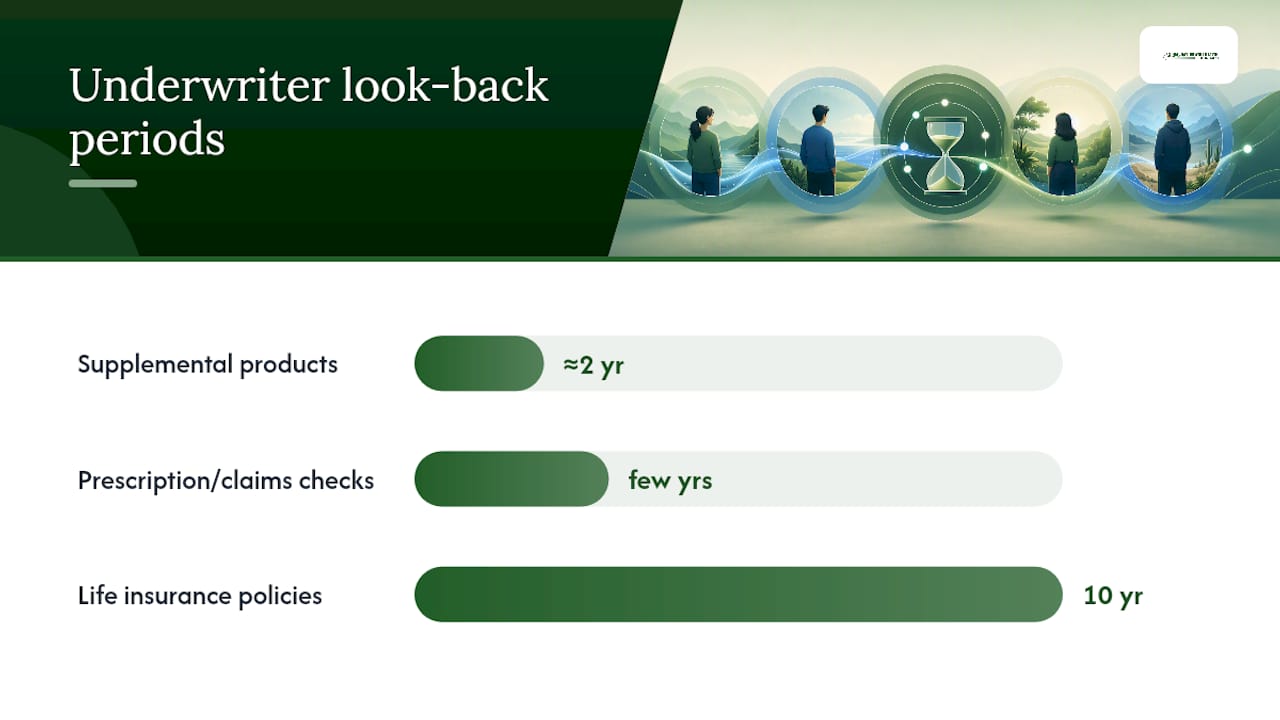
Medical records requests follow for larger policies or flagged applications. The underwriter’s look-back period, the span of history they review, ranges from a couple of years for smaller supplemental products to a full decade for substantial life insurance policies. Investopedia’s explainer on full medical underwriting describes this as a comprehensive review that can involve directly contacting your prior providers.
-
A medical exam may be ordered, particularly for life insurance above a certain coverage amount. The insurer typically pays for and schedules this exam, using its own network of paramedical companies. You show up, they draw blood, check blood pressure, and sometimes run an EKG. You generally don’t pay out of pocket for an insurer-requested exam tied to an application in progress.
-
Post-claims underwriting happens after the fact, and this is the step that catches people off guard. Rather than fully verifying your health history before issuing the policy, some insurers, particularly in the short-term and supplemental markets, issue coverage quickly and only pull medical records once you file a significant claim. If that records pull reveals an undisclosed condition, even one you genuinely forgot to mention, the insurer can rescind the policy and deny the claim.
Pro Tip: Request your own prescription history and medical records report before you apply for anything medically underwritten. Errors in these files are common, and catching one before an insurer does can be the difference between an approval and a denial.
Rescission is legally constrained in ways many applicants don’t realize. Under the ACA, rescission of ACA-compliant plans is prohibited except in cases of fraud or intentional misrepresentation. But that protection doesn’t extend to the exempt categories covered above, which is exactly why post-claims underwriting remains a live risk if you buy a short-term or supplemental plan without fully disclosing your history.
What an Underwriting Decision Costs You
Once underwriting is complete, you’ll land in one of four outcomes, and each carries different financial and coverage consequences worth understanding before you sign anything.
Premium loading is the most common outcome for applicants with manageable health conditions. An insurer might rate you up by a percentage over the standard premium because your BMI, blood pressure, or cholesterol readings fall outside preferred ranges. This isn’t arbitrary. It reflects the insurer’s actuarial tables translating your specific risk profile into dollars.
Exclusion riders and waiting periods target a specific condition rather than the whole application. A common scenario: you have a history of lower back issues, so the insurer issues the policy but attaches a rider excluding any back-related claims for a set period, or permanently. Waiting periods work similarly, delaying coverage for a particular condition category, often cardiac or maternity related, for a defined stretch after the policy takes effect.
Outright denial happens when an insurer decides your risk profile falls outside what it’s willing to cover at any price. This is more common in the short-term and supplemental markets than most applicants expect, particularly for anyone with a recent cancer diagnosis, uncontrolled diabetes, or a chronic condition requiring expensive ongoing treatment.
Rescission after a claim is the outcome nobody plans for. It happens when post-claims underwriting uncovers something the insurer believes should have been disclosed, and it can leave you responsible for medical bills you assumed were covered.
A meaningful share of adults carry a condition that pre-ACA underwriting standards would have flagged for a denial or a rate-up, according to KFF’s tracking of pre-existing condition prevalence. That’s the scale of the population still exposed whenever they shop outside ACA-protected plan categories.
If you receive an unfavorable underwriting decision, you have real options:
- Request the specific reason for the denial or rate-up in writing.
- File an appeal directly with the insurer, following the timeline listed in your denial letter.
- Contact your state insurance commissioner if you suspect the decision violated state regulations.
- Keep copies of every document you submitted, every communication you received, and dated notes of every phone call.
That documentation habit matters more than most applicants realize. Getting your own records and prescription history before you apply tends to produce better appeal outcomes and lowers your rescission risk down the line, because you’re not relying on the insurer’s version of your history being complete or accurate.
Recommended
- What Is Health Insurance and How Does It Work?
- 5 Plan Types That Still Underwrite U.S. Health Insurance: What to Check



Pingback: LPFSA vs FSA: Which Account Fits Your Health Plan?
Pingback: Group Health Insurance Requirements: Who Qualifies and How It Compares
Pingback: PPO Health Insurance for Self-Employed & 1099 | Sobal Health
Pingback: Private Health Insurance Broker: How to Choose One
Pingback: Private PPO vs Marketplace in Florida for Self-Employed
Pingback: COBRA Alternatives in Texas: Options When You Leave a Job
Pingback: Questions to Ask a Health Insurance Broker | Sobal Health
Pingback: Private Health Insurance for High Earners in Florida
Pingback: When Is Open Enrollment for Health Insurance 2027?
Pingback: Dental Implants Insurance Coverage: What Plans Really Pay
Pingback: Health Insurance for Realtors in Florida: 2026 Options
Pingback: Owner-Operator Truck Driver Health Insurance in Texas
Pingback: Special Enrollment After Job Loss in Texas: 60-Day Guide
Pingback: How to Find a Health Insurance Broker in Florida
Pingback: Open Enrollment for the Self-Employed: 2027 Plan Guide
Pingback: No Subsidy Health Insurance: Your Options and Real Costs
Pingback: Preventive Care Coverage: What's Free and What Isn't