

Most ACA-compliant health plans cover a set list of preventive services at no cost to you. That means no copay, no coinsurance and no deductible to meet first, as long as you see an in-network provider. Think annual checkups, vaccines, and screenings such as mammograms and colonoscopies. The catch is in the details: the same visit can be free or billed depending on why you went, who you saw and what kind of plan you hold.
This guide walks through what counts as preventive care, how the rules work, and the situations where people get an unexpected bill. We’ll also cover self-employed and between-jobs readers, who often buy coverage on their own and can’t assume every plan treats preventive care the same way.
TL;DR
- Under the Affordable Care Act, most non-grandfathered plans, including every Marketplace plan, must cover listed preventive services with no copay or coinsurance when you use an in-network provider.
- Preventive means you have no symptoms. If you go in because something hurts or feels wrong, the visit is usually diagnostic and normal cost-sharing applies.
- Short-term plans and other non-ACA products often skip routine preventive care, so read the benefits document before you count on a free checkup.
- The covered list is updated over time, so check the current version and confirm details with your insurer before booking an expensive screening.
Table of Contents
- What counts as preventive care
- How the “free” part works
- Five places a “free” visit turns into a bill
- Preventive care on different kinds of plans
- Which vaccines and screenings are on the list
- Things that sound preventive but may not be
- Will the list change?
- A short checklist before you book
- Where preventive care fits when you’re buying on your own
- Our perspective
- Talk it through with a licensed broker
- FAQ
- Sources
What counts as preventive care
Preventive care is care meant to keep you well or catch a problem early, before you notice any signs of it. The federal rules rest on three groups of recommendations, according to HealthCare.gov’s adult list and CMS guidance:
- The U.S. Preventive Services Task Force (USPSTF): services it rates “A” or “B.”
- The CDC’s Advisory Committee on Immunization Practices (ACIP): routine vaccines.
- The Health Resources and Services Administration (HRSA): guidelines for women and children, including contraception and well-child visits.
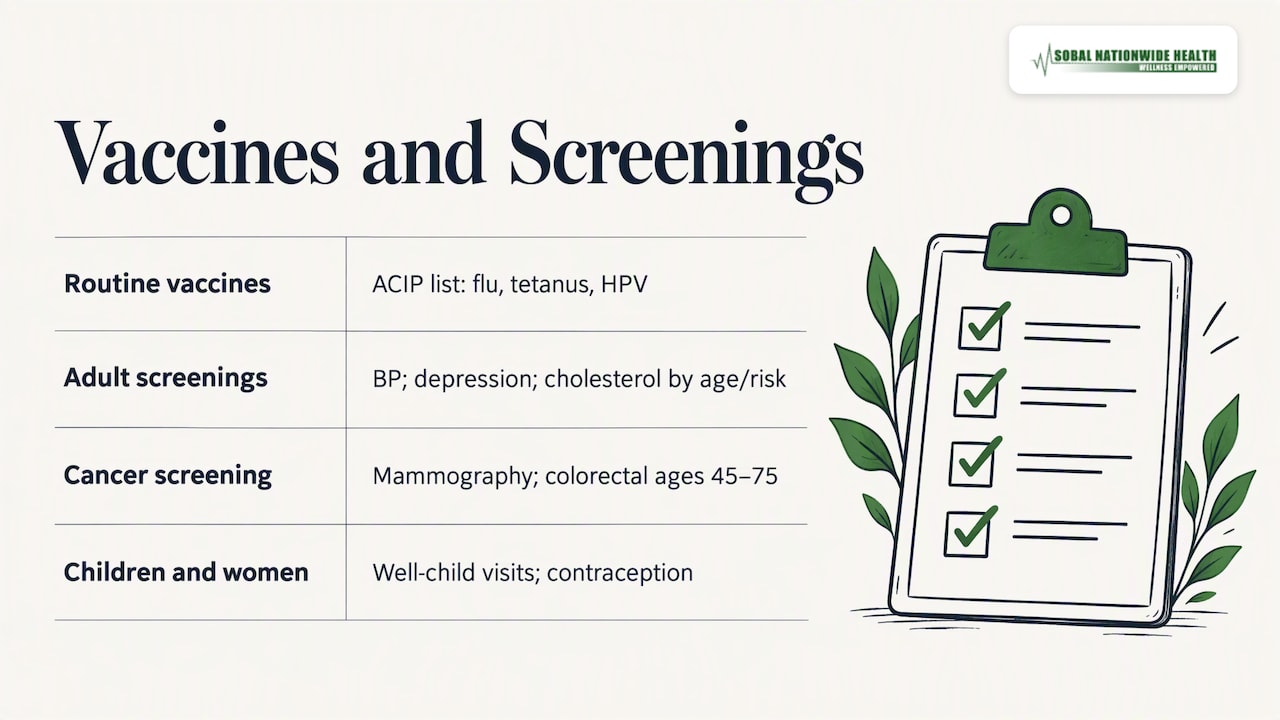
In plain English, that covers a lot of ground. Services on the adult list include blood pressure screening, depression screening, cholesterol screening for certain ages and risk groups, flu, tetanus and HPV vaccines, mammograms for women, and colorectal cancer screening for adults aged 45 to 75. The exact list changes by age, sex and risk factors, so the official pages for adults are the place to check your own situation.
Here is how that looks in everyday terms:
| Usually preventive | Usually not preventive |
|---|---|
| Annual wellness or well-child visit | A visit for a cough, rash or back pain |
| Flu shot and other recommended vaccines | Treatment of a condition found during a screening |
| Mammogram or colorectal screening at a recommended age | A follow-up scan to look at a problem you already have |
| Blood pressure and depression screening | Ongoing care for a chronic condition |
| Contraception and well-woman visits (per HRSA guidelines) | Cosmetic or elective procedures |
The line between the two columns is the single most useful thing to understand. We come back to it below.
How the “free” part works
Think of your premium as the price of getting in the door. Preventive care is one of the things the door opens to without a second charge. Under the ACA, covered preventive services come with no copayment or coinsurance, and the deductible doesn’t have to be met first. The rule applies to all Marketplace plans and many other plans, though HealthCare.gov is careful to say that coverage may vary and $0 isn’t guaranteed in every case.
Some other terms you’ll see on your plan documents:
- Premium: what you pay each month to keep the plan active.
- Deductible: what you pay for most care before the plan starts sharing costs. Preventive care is the big exception.
- Coinsurance and copay: your share of a bill after you meet the deductible, as a percentage or a flat fee. If you want the full picture, our guide on coinsurance vs. copay shows how a 20% share can turn into real money.
- Out-of-pocket maximum: the financial safety net. Once you hit it, the plan pays covered in-network care for the rest of the year.
Preventive care sits outside the deductible, which is why a healthy person on a high-deductible plan can still get a checkup and a flu shot without paying.
Five places a “free” visit turns into a bill
In our experience as a broker, the surprise rarely comes from the rule itself. It comes from one of these five situations.
1. You went because of a symptom
The ACA mandate is built for people without signs or symptoms. The Task Force explains this in its overview of how it works. If you book a physical and mention a nagging pain, the doctor may bill part of the visit as diagnostic. Your usual deductible and copay then apply to that part.
A practical habit: when you schedule, say it’s a preventive or wellness visit. If you have a separate concern, ask whether it will be billed separately and what that might cost.
2. The provider is out of network
The no-cost benefit generally applies when you use an in-network provider. If you see an out-of-network doctor or lab, you can be billed even for a service that is on the covered list. Check the network status of the specific doctor, and also of the lab or imaging center they send you to.
3. A screening turns into treatment
A routine colonoscopy is a good example. The screening itself is covered, but if the doctor finds and removes a polyp, some plans treat that as a different kind of service, so cost-sharing can show up. Ask your insurer in advance how they handle that situation. Federal guidance on this has changed over the years, so a quick call before the procedure is worth your time.
4. The plan sets its own methods
When a recommendation doesn’t spell out a specific test, brand or setting, insurers may use “reasonable medical management” to decide what is covered at no cost. That can mean one type of test is free and another isn’t. Before you schedule an expensive screening, ask your insurer which method and location are covered at $0.
5. Your plan isn’t ACA-compliant
This is the big one for people who buy on their own. Short-term, limited-duration plans aren’t subject to ACA requirements, and many people wrongly assume they include the same preventive benefits. A national consumer survey from the insurance regulators’ association (NAIC) asked whether short-term plans must cover preventive care such as wellness visits or vaccinations, which shows how common the confusion is. Such plans often leave routine care out entirely, so you could pay the full price for a service that would be free on a Marketplace plan.
The same caution applies to supplemental products like accident, critical illness and fixed indemnity plans. They pay cash or benefits for specific events. They aren’t a substitute for major medical coverage and aren’t built to deliver a free annual checkup.
Preventive care on different kinds of plans
The right question isn’t “does my plan have preventive care?” It’s “which rules does my plan follow?” Here’s a simple way to sort it.
| Plan type | Preventive care | What to check |
|---|---|---|
| ACA Marketplace plan | Required list covered at $0 in network | Network, plus the exact provider and lab |
| Employer or group plan (non-grandfathered) | Generally the same federal requirement | Plan year changes, network |
| Grandfathered plan | Exempt from the mandate | Ask whether the plan is grandfathered |
| Short-term plan | Often limited or excluded | Read the exclusions before enrolling |
| Private medically underwritten plan | Varies by carrier and design | Read the benefit schedule; ask us to walk you through it |
| Dental, vision, accident, fixed indemnity | Separate products, not major medical | Don’t expect checkups to be included |
A word on that fifth row. Private medically underwritten plans can be a smart fit for self-employed people who earn too much for subsidies, because they can be priced differently from Marketplace plans. Their preventive benefits are written by the carrier, though, and they don’t all look alike. That’s why we read the benefit schedule with you before you enroll. Our guide to how medically underwritten insurance works explains who they fit and what trade-offs come with them.
Which vaccines and screenings are on the list
Vaccines are the easiest place to see how the system works. Routine immunizations that ACIP recommends are part of the required list, including flu, tetanus and HPV shots. That’s also why vaccine rules can be quite specific: even a single vaccine product can matter when a form requires it. For example, a clinic that handles immigration medical exams explains how meningococcal vaccine rules affect green card paperwork. That is a separate process from insurance coverage, but it shows why you should confirm exactly which vaccine your doctor plans to give.
For screenings, the covered services depend on your age, sex and risk. To give a few examples from the federal adult list: blood pressure checks, cholesterol screening for certain ages and risk groups, depression screening, and cancer screenings such as mammography and colorectal screening for adults aged 45 to 75. Children and women have their own lists, including well-child visits and contraception.
One more thing to keep in mind: the Task Force describes its recommendations as a starting point for a conversation with your doctor. Not every service is right for every person, even with an A or B grade. The Task Force fact sheet puts the focus on shared decision-making that takes your health history and preferences into account.
Things that sound preventive but may not be
Some care is wellness-minded but isn’t on the federal list. Chiropractic visits, massage, many nutrition services and gym memberships are common examples. Some plans cover a few of them, usually with a copay or visit limit. If you’re curious how insurers typically treat one of these, this explainer on whether insurance covers chiropractic care is a reasonable starting point, then confirm with your own plan.
Will the list change?
Yes, it can. In June 2025 the Supreme Court ruled 6-3 in Kennedy v. Braidwood that the ACA preventive services requirement stands. KFF’s analysis notes, though, that the story isn’t over: the administration has influence over who sits on the Task Force, which can affect how quickly and in what direction recommendations are updated.
What does that mean for you? Treat the list as a living document. Before each plan year, and before any big screening, check the current federal pages or ask your insurer or broker. Don’t rely on what a friend had covered three years ago.
A short checklist before you book
- Confirm your plan type. ACA-compliant, grandfathered, short-term or something else?
- Check the network for the doctor, the lab and the imaging center.
- Say “preventive” when you book, and ask how a concern raised during the visit would be billed.
- Ask which test or method is covered at $0 if there’s more than one option.
- Get the answer in writing or note the call reference, especially for costly screenings.
Where preventive care fits when you’re buying on your own
If you’re self-employed, between jobs, or a business owner with a small team, you’re choosing among a few paths, and preventive care is one thing to weigh. Marketplace plans guarantee the federal list. Whether you get premium tax credits depends on household income and size, not on your job status, according to KFF’s ACA overview. Our guide to ACA subsidy income limits shows where you might land.
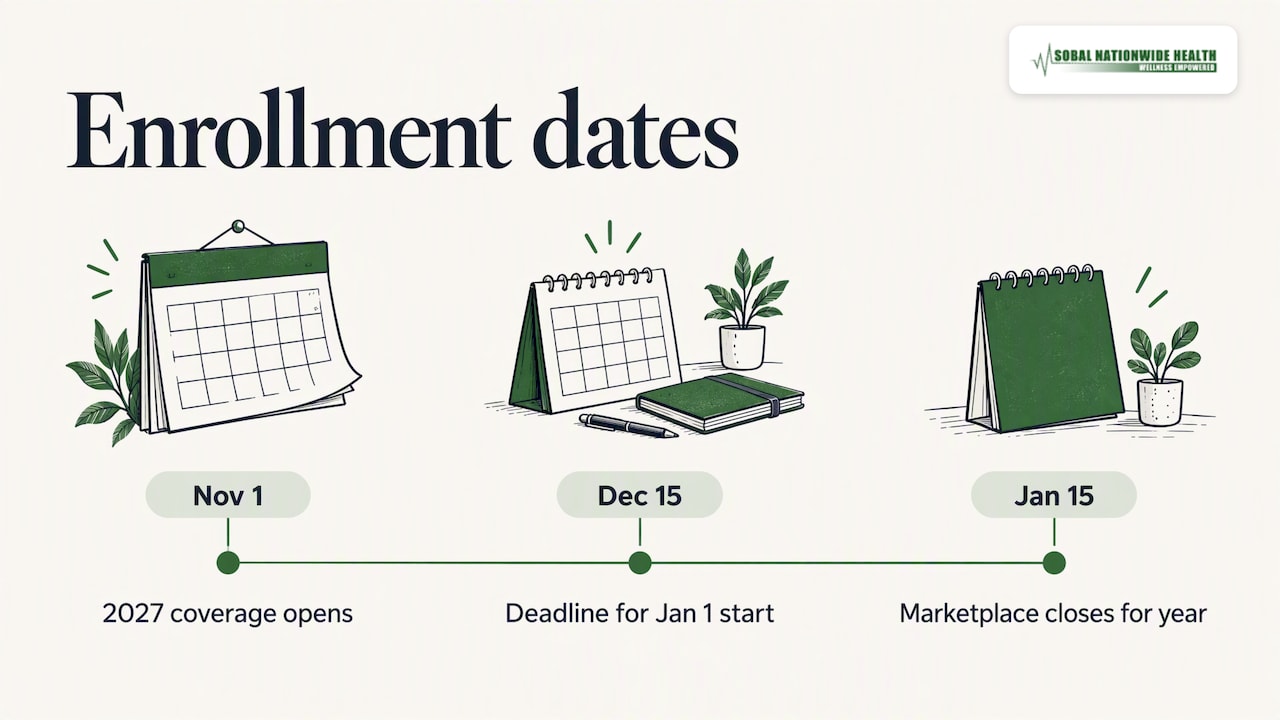
If your income is above the subsidy range, a private plan may be worth a look. Our Marketplace vs. private plan cost check lays out the comparison, and the same trade-off comes up for Floridians in our piece on what happens above 400% of the poverty level. Open enrollment for 2027 coverage starts November 1, and December 15 is the deadline for a January 1 start. The Marketplace closes January 15 for the year.
Our perspective
We talk to people every week who bought a plan for its low premium and later learned, in the doctor’s office, that “covered” didn’t mean what they thought. Preventive care is where that gap shows up most. It’s the one benefit almost everyone uses, and it’s the one most often assumed.
Our approach is simple. We don’t think the right plan is the cheapest or the fanciest. It’s the one whose rules you understand before you need it. For some of our self-employed clients, that’s an ACA plan with a subsidy. For others who earn too much for help, a private PPO with a wide network works better, and some have saved a good deal compared to what they were paying. We say what each option does and doesn’t cover, including preventive care, before anyone signs.
If a plan doesn’t cover your annual checkup the way you’d expect, we’d rather you hear it from us now than from a bill later.
— Bernie S
Talk it through with a licensed broker
If you’d like a second pair of eyes on a plan’s preventive benefits, or you’re comparing Marketplace and private options, we can help in English or Spanish, with no sales pressure. We work across 31 states and cover personal and family plans as well as business health insurance. Browse our resource guide for more plain-English explainers, or start at sobalhealth.com to request a conversation.
FAQ
Is a yearly physical always free?
Not always. On an ACA-compliant plan, a preventive wellness visit with an in-network doctor is generally covered at no cost. If you bring up a symptom or a new problem, part of the visit may be billed as diagnostic. Plans that aren’t ACA-compliant may not cover a physical at all.
Do I have to meet my deductible before preventive care is covered?
No, not for the listed services on a plan that follows the ACA rule. Covered preventive services come without a copay or coinsurance, even if you haven’t met your yearly deductible. The service must come from an in-network provider in most cases.
Does preventive care coverage apply to self-employed people?
Yes, if your plan is an ACA-compliant one, whether you bought it on the Marketplace or through another route. The rule follows the plan, not your job status. If you hold a short-term or private non-ACA plan, check the benefit schedule, because the preventive coverage may differ.
What if my screening finds a problem?
The screening itself is the preventive part. Follow-up tests and treatment are usually billed as diagnostic or treatment care, with your normal deductible and coinsurance. Ask your insurer how it handles that before a large procedure like a colonoscopy.
Sources
- Preventive health services, HealthCare.gov
- Preventive care benefits for adults, HealthCare.gov
- When can you get health insurance?, HealthCare.gov
- FAQs about Affordable Care Act Implementation Part 68, CMS
- July 2020 Health Insurance Knowledge Survey, NAIC
- Understanding how the USPSTF works
- USPSTF overview fact sheet
- Kennedy v. Braidwood, KFF
- Health Policy 101: The Affordable Care Act, KFF
