

A general-purpose health FSA pays for a broad range of medical, prescription, dental and vision costs. A limited purpose FSA (LPFSA) pays only for dental and vision care, and that narrower job is exactly what lets you keep it alongside a health savings account (HSA). If you have an HSA, you can have an LPFSA but not a general FSA. If you don’t have an HSA, the general FSA usually gives you more room to spend.
I’m a licensed independent health insurance broker, and this is one of the most common mix-ups I untangle for clients. The names are close, the rules are different, and a wrong pick can cost you tax savings. Let’s sort it out step by step.
TL;DR
- A general-purpose FSA reimburses eligible medical, prescription, dental and vision expenses. An LPFSA covers dental and vision (plus preventive care in many plans).
- If you contribute to an HSA, you can pair it with an LPFSA. A general-purpose FSA generally makes you ineligible to contribute to an HSA.
- Neither account is health insurance. Both are tax-advantaged accounts that reimburse out-of-pocket costs, and both usually come through an employer.
- Self-employed people generally cannot open an FSA of either kind. An HSA with a qualifying high deductible plan is the usual route instead.
- Unused money is generally lost at the end of the plan year, unless your employer offers a grace period or a limited carryover.
Table of Contents
- The short version: what each account does
- LPFSA vs FSA side by side
- What an LPFSA can pay for
- Can you have an LPFSA and an HSA at the same time?
- How contributions and tax savings work
- Use it or lose it: what happens to leftover money
- Is an LPFSA the same as health insurance?
- If you’re self-employed, here’s the catch
- Our perspective: pick the plan first, the account second
- Want help matching the plan to the account?
- Quick checklist before open enrollment
- FAQ
- Sources
The short version: what each account does
Think of an FSA as a pre-tax spending envelope for health costs. You decide in advance how much to put in, the money comes out of your paycheck before taxes, and you use it to pay for eligible care. Both account types work this way. The difference is what the envelope is allowed to pay for.
According to a summary of IRS rules from a university benefits office, a general-purpose health FSA reimburses eligible medical, prescription, dental and vision expenses, while an LPFSA reimburses dental and vision care. The same summary notes that people with an HSA may enroll in an LPFSA but not in a general-purpose health FSA.
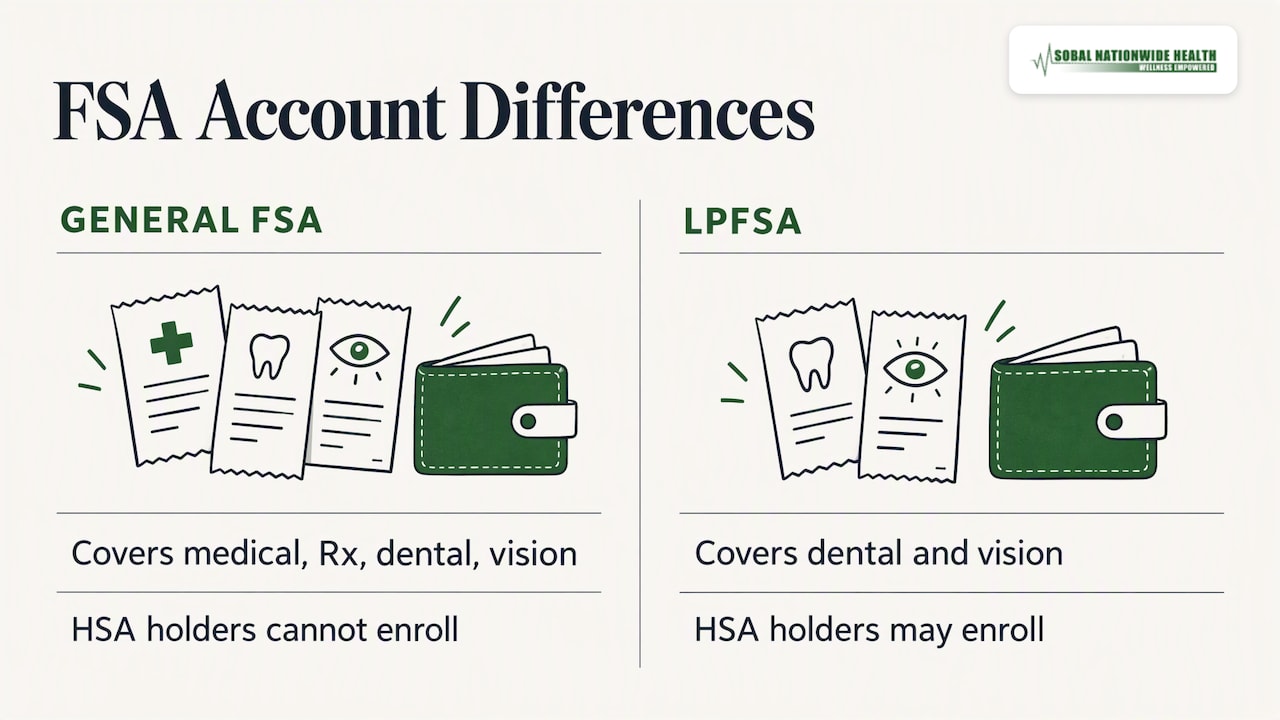
That last point is the whole reason the LPFSA exists. It’s a restricted version built to sit next to an HSA without breaking the HSA’s rules.
LPFSA vs FSA side by side
Here is how the two compare on the points readers ask about most.
| Feature | General-purpose health FSA | Limited purpose FSA (LPFSA) |
|---|---|---|
| What it pays for | Eligible medical, prescription, dental and vision costs | Dental and vision costs, and often preventive care |
| Can you also contribute to an HSA? | Generally no | Yes, if you’re covered by a qualifying high deductible health plan |
| Typical exam, cleaning or glasses purchase | Covered | Covered |
| Doctor visit copays and deductibles | Covered | Not covered |
| Prescriptions and over-the-counter medicine | Covered when eligible | Not covered |
| Funded by | Pre-tax payroll deductions | Pre-tax payroll deductions |
| Who can have one | Employees whose employer offers it | Employees whose employer offers it |
| Is it insurance? | No | No |
The table tells you most of what you need. If your employer offers both and you are not using an HSA, the general-purpose account is the more flexible tool. If you are using an HSA, the LPFSA is the only FSA that fits.
What an LPFSA can pay for
An LPFSA is built around two categories: dental and vision. The IRS-based summary lists examples such as exams, cleanings, orthodontia and glasses. It also says an LPFSA does not cover medical expenses, prescription or over-the-counter medicines, or medical equipment.
Some common examples of what that means in daily life:
- Your six-month cleaning and any fillings.
- Braces or other orthodontic treatment. (We cover this in more detail in our guide to using HSA and FSA money for orthodontic costs.)
- An eye exam, prescription glasses and contact lenses. Our page on contact lens coverage and HSA strategies walks through the details.
- Your share of dental costs that your plan doesn’t pay, such as coinsurance after a deductible.
What it won’t pay for: a specialist visit, a prescription copay, or a bottle of ibuprofen. Those belong to a general-purpose FSA or to your HSA.
Preventive care can be included
There’s one more door that many people miss. IRS guidance in Revenue Ruling 2004-45 says a limited-purpose health FSA may reimburse preventive care as well as the permitted dental and vision coverage. Whether your own plan does depends on how your employer wrote the plan document, so check the summary plan description before you count on it.
The date of service rule
FSA expenses count when the care is provided, not when the bill arrives or when you pay it. The IRS-based summary says the date of service must fall within the plan year. So if you get a crown in December and pay the bill in February, it belongs to the December plan year.
Can you have an LPFSA and an HSA at the same time?
Yes, and this is where the LPFSA earns its keep. The IRS rule in Revenue Ruling 2004-45 says you may contribute to an HSA while covered by a high deductible health plan (HDHP) and a limited-purpose FSA that reimburses permitted coverage, including dental and vision care, and preventive care. The same ruling says a general-purpose FSA that reimburses medical expenses generally makes you ineligible to contribute to an HSA.
So the choice often isn’t really LPFSA vs FSA at all. It’s about which side of the HSA line you’re standing on.
A simple way to decide
- You have an HDHP and want an HSA. Pair it with an LPFSA if your employer offers one. Use the HSA for medical costs and the LPFSA for dental and vision.
- You have a traditional plan with copays and want predictable pre-tax savings. A general-purpose FSA is usually the better fit.
- You’re not sure. Look at your expected costs. If you expect heavy dental or orthodontic spending, the LPFSA can be a good partner to an HSA. If you expect regular prescriptions and doctor visits under a non-HSA plan, the general FSA does more.
If you’re weighing a high deductible plan, our HDHP guide explains the deductible rules in plain English. For the bigger HSA picture, see our HSA vs FSA comparison.
You can’t be reimbursed twice
Here’s a rule that trips people up. According to a Congressional Research Service comparison of tax-advantaged accounts, an expense reimbursed under an LPFSA cannot also be reimbursed under another plan or program, including an HSA. In practice, that means you pick one account for each dental or vision bill and keep the receipt. The same logic applies when you submit claims for care your insurer treats as out of network: if you’re already getting money back through one route, such as out-of-network therapy reimbursement, the same dollars can’t be claimed again from a second account.
How contributions and tax savings work
The tax benefit is the main attraction. The Congressional Research Service explains that FSA contributions are excluded from employee wages and aren’t subject to federal income or payroll taxes. Employer contributions are excluded too. It also notes that your full annual election amount is available at the start of the plan year, even though you fund it a paycheck at a time.
That last feature is a real perk. Say you elect $1,200 for the year and need $1,200 of orthodontic work in your first month. You can generally be reimbursed up to your full election even though you’ve only contributed a fraction through payroll.
The annual limit
For plan years beginning in 2026, IRS Publication 15-B sets the maximum employee salary-reduction contribution to a health FSA under a cafeteria plan at $3,400. Your employer can set a lower cap, so look at your own benefits guide. The IRS adjusts the figure each year, so check the current number when you enroll.
If you’re also funding an HSA, those limits are separate. Our guide to HSA contribution limits covers them.
Use it or lose it: what happens to leftover money
This is the part I want you to take seriously. According to HealthCare.gov, FSAs generally must be used within the plan year. Employers may offer either a grace period of up to 2½ months or a carryover of up to $660 per year, but not both. Anything left after that is lost.
A few habits keep you from donating money back to your employer:
- Estimate conservatively. Count only the care you know is coming, such as a scheduled cleaning, new glasses or an orthodontist’s payment plan.
- Check your plan’s rule. Find out whether you have a grace period, a carryover, or neither.
- Book care before the year ends. Remember that the date of service is what counts.
- Keep your receipts. Reimbursement usually needs documentation.
If you’re planning a big dental purchase, it also helps to know what your insurance pays first. Our pages on dental implant coverage and dental plans with no waiting period can help you plan what you’ll owe out of pocket.
Is an LPFSA the same as health insurance?
No. The Congressional Research Service describes these accounts as tax-advantaged ways to pay for out-of-pocket health expenses, not coverage. An LPFSA doesn’t protect you from a hospital bill. It only lets you pay for certain costs with pre-tax dollars.
Think of it this way. Your health plan is the safety net. The FSA is the wallet you use to pay for the smaller, predictable things the net doesn’t cover.
If you’re self-employed, here’s the catch
Many of the people who read our guides are freelancers, 1099 contractors and small business owners, so this is the most important section for you.
The Congressional Research Service notes that FSAs are generally available only to current employees of organizations that offer the benefit, and that self-employed individuals are ineligible to establish or contribute to them. If you work for yourself, neither an LPFSA nor a general FSA is open to you in the usual way.
That doesn’t leave you without options:
- An HSA. If you’re covered by a qualifying high deductible plan, you can generally open and fund an HSA on your own. Read our guide to the HSA for the self-employed for eligibility, limits and setup.
- A private plan that fits your life. Some self-employed people earn too much for marketplace subsidies and find private coverage a better value. Our explainer on medically underwritten insurance shows how those plans work and who they fit.
- A group plan, if you have employees. Once you have staff, you may be able to offer benefits. See our guide to group health insurance for employers and our overview of level funded plans.
If you run a business with employees, you may be the one deciding whether to offer an LPFSA. A good benefits advisor can walk you through how it fits with the rest of your package.
Our perspective: pick the plan first, the account second
We see people choose an FSA or an HSA first and then hunt for a health plan that fits it. We think that’s backwards. Start with the coverage, because that decides which account you’re even allowed to use.
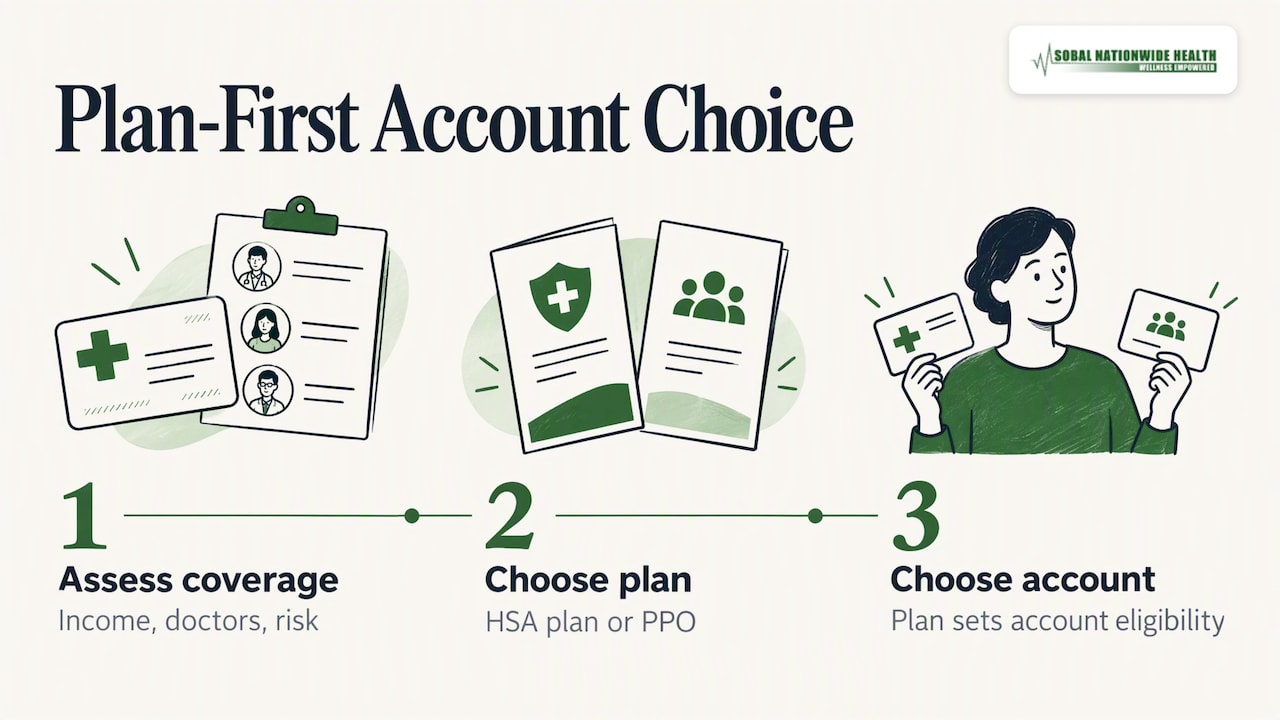
Here’s what that looks like in our daily work. A self-employed client comes to us confused about marketplace premiums and deductibles. We look at how much they earn, who needs coverage, which doctors they want and how much risk they can handle. Only then do we talk about whether a high deductible plan with an HSA makes sense, or whether a PPO with predictable copays is a better fit. Often the account question answers itself once the plan is chosen.
We also like to be honest about the limits of tax accounts. They are helpful, but they don’t replace good coverage. A pre-tax dollar is nice. A plan that lets you see the doctor you want without a surprise bill is better. That is why we focus on educating you first, with no sales pressure, and on making sure you understand your cost-sharing before you enroll. If you’d like a second pair of eyes on a plan or a benefits package, we’re happy to look.
— Bernie S
Want help matching the plan to the account?
If you’re self-employed, between jobs or running a small business, we can help you compare private medically underwritten plans, ACA marketplace plans, and dental and vision coverage in one conversation. You can speak with a broker in English or Spanish, and we explain each option in plain terms so you can decide for yourself.
Start with our personal and family insurance page, or if you have employees, see our business health insurance options. You can also browse our resource guide for more plain-English explainers.
Quick checklist before open enrollment
- Confirm whether your health plan is a qualifying HDHP. If it is and you want an HSA, ask for the LPFSA, not the general FSA.
- Read your plan’s rule on grace period or carryover.
- Add up your expected dental and vision costs, including orthodontia.
- Decide which account you’ll use for each bill so you never claim the same expense twice.
- Check your employer’s own contribution cap, which may be below the IRS maximum.
- Remember when coverage begins. Our guide to health insurance effective dates explains why applying alone doesn’t start coverage.
FAQ
What is the main difference between an LPFSA and a general FSA?
A general-purpose FSA covers eligible medical, prescription, dental and vision costs. An LPFSA covers only dental and vision, and in many plans preventive care. The restriction is what allows you to keep an HSA alongside it.
Can I have both an LPFSA and a general FSA?
Typically you’d be offered one or the other, not both. Having a general-purpose FSA generally makes you ineligible to contribute to an HSA. Ask your benefits administrator what your employer offers and how the plan document is written.
Is an LPFSA worth it?
It can be if you have an HSA and expect real dental or vision costs, like orthodontia or new glasses. Contributions are free of federal income and payroll tax. The risk is overestimating, since unused money is generally lost unless your plan has a grace period or a carryover.
Can a self-employed person get an LPFSA?
Generally no. FSAs are tied to employer-sponsored benefit plans, and self-employed individuals are not able to establish or contribute to them. An HSA paired with a qualifying high deductible plan is the usual alternative.
What happens to my LPFSA money at the end of the year?
It depends on your employer’s plan. According to HealthCare.gov, an employer may allow a grace period of up to 2½ months or a carryover of up to $660, but not both. Without either, leftover funds are forfeited.
Sources
- General-purpose vs. limited-purpose health FSA (IRS rules summary)
- IRS Revenue Ruling 2004-45, Section 223 HSAs: interaction with FSAs
- Congressional Research Service: A Comparison of Tax-Advantaged Accounts for Health Care
- IRS Publication 15-B (2026)
- HealthCare.gov: Using a Flexible Spending Account
