






What you pay for self-employed health insurance in Florida depends mostly on your age, where you live, who is on the plan and how much cost-sharing you take on. Private, medically underwritten PPO-style plans can be priced differently than what you may have seen elsewhere, and we can show you the real numbers for your household by phone or webinar screen share.
I’m Bernie, a licensed independent broker (NPN 19189235). Most Florida freelancers, 1099 contractors, realtors and owner-operators I talk to ask the same thing first: “What should I expect to pay each month?” The honest answer is a range, and the monthly premium is only one part of it. This guide shows you what drives the range and how to compare plans on what you will really spend in a year.
TL;DR
- Your premium is shaped by age, location, how many people are covered, tobacco use and the plan design you choose.
- A lower premium usually means you carry more cost-sharing (deductible, copays, coinsurance), so compare total yearly exposure, not just the monthly bill.
- Private PPO-style plans are built for people who want to choose their own doctors and hospitals, including outside Florida.
- Our quote form asks only for your zip code and birthdates. We never ask health questions on the form.
- We don’t offer Medicare or Medicaid.
Table of Contents
- What “cost” really means when you buy for yourself
- What moves your Florida premium
- Why the cheapest premium is not always the cheapest plan
- Costs that don’t show up in the premium
- What this means for different self-employed readers
- How to get a real number for your household
- Private plans: why many Floridians price them
- Who we help, and who we don’t
- Talk it through with a licensed broker
- FAQ
- Sources
What “cost” really means when you buy for yourself
When you work for yourself, nobody else pays part of the bill. The whole premium comes out of your business or personal account every month. That is why the sticker price feels so large, and why it is worth understanding every piece of it.
There are four numbers to keep straight:
- Premium: the monthly amount you pay to keep the plan active. Think of it as the price to get in the door.
- Deductible: what you pay for covered care before the plan starts sharing costs on many services.
- Copays and coinsurance: your share once the plan is paying. A copay is a flat fee per visit. Coinsurance is a percentage of the bill.
- Out-of-pocket maximum: the most you can owe in a plan year for covered in-network care. It works like a financial safety net.
Two plans with the same premium can cost very different amounts in a year of real use. And two plans with very different premiums can cost about the same once you add up what you actually use. That is the core of comparing fairly.
What moves your Florida premium
The Florida Chief Financial Officer’s consumer guide explains that for individual coverage, the rating factors that set a premium include the ages of the people covered, geographic location, whether the plan covers one person or a family, and tobacco use (Florida CFO health insurance consumer guide). The same guide describes broader pressures that push prices up over time, such as medical-cost inflation and how much care people use.
Here is how each one plays out for a typical self-employed household.
Age
Premiums rise as you get older. A 28-year-old graphic designer and a 58-year-old contractor looking at the same plan design will see different monthly prices. If you have a child about to turn 26 and leave your plan, or you are a young adult who just did, your own age bracket is a big part of the quote.
Where you live in Florida
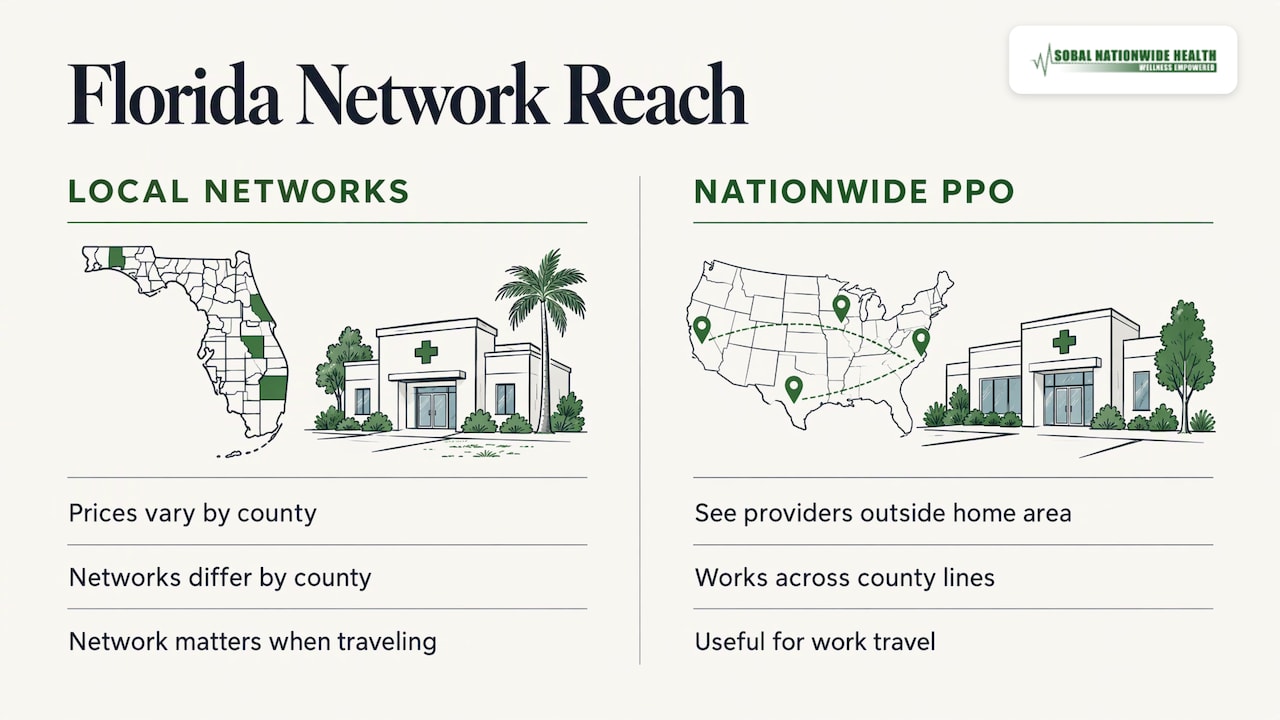
Prices differ by county and by which networks operate there. Miami-Dade, Broward, Palm Beach, Hillsborough and rural counties do not look the same. If you split time between cities or travel for work, the network matters as much as the price. A nationwide PPO network lets you see providers outside your home area, which matters for truckers on the road and realtors who work across county lines. You can read more about nationwide PPO health insurance on our site.
Who is covered
Covering just yourself costs less than adding a spouse and children. Families that are priced out of a spouse’s employer plan often find that the family tier of that plan is the expensive part. Quoting your household separately and as a group lets you see where the real cost sits.
Tobacco use
Tobacco use is a standard pricing factor. It is one of the few details that can change a quote noticeably, so be straightforward about it when your broker asks.
Plan design
This is the factor you control most. A higher deductible generally lowers the monthly premium, while a lower deductible and richer copays generally raise it. Choosing between them is about your cash flow and how much surprise you can absorb. That is where a conversation with a broker helps most: an agent can walk you through all the options for your situation.
Why the cheapest premium is not always the cheapest plan
It is tempting to sort quotes from lowest to highest and pick the top one. That works only if you never use your coverage. Here is a simple way to think about it, using made-up round numbers just to show the arithmetic.
Say Plan A has a lower premium and a $7,000 out-of-pocket maximum. Plan B has a higher premium and a $3,000 out-of-pocket maximum. If the premium difference is $150 a month, Plan B costs $1,800 more over twelve months. In a healthy year, Plan A wins by that amount. In a year with a surgery or an accident, Plan A could cost up to $4,000 more in cost-sharing, so Plan B comes out ahead. You are choosing which risk you would rather carry.
When you compare, line up:
- Twelve months of premiums.
- The deductible.
- Copays for the visits you expect (primary care, specialists, urgent care).
- The out-of-pocket maximum.
- Which doctors and hospitals are in the network.
The annual premium plus the out-of-pocket maximum gives you the worst-case yearly cost for covered in-network care. The annual premium alone gives you the best case. Your real year usually lands somewhere between.
The same logic applies to everyday expenses. Imaging, for example, can be a surprise line item when it is not covered the way you assumed, which is why people look up what a DEXA scan costs with or without insurance before deciding how much cost-sharing they are comfortable with.
Costs that don’t show up in the premium
Budget for these before you commit:
- Your deductible, in cash. If you could not write a check for it tomorrow, a lower-deductible design may suit your cash flow better.
- Prescriptions. Check how a plan treats the medications you take regularly.
- Out-of-network care. A PPO gives you the freedom to see providers outside the network, but you usually pay more when you do. Know which doctors you want and confirm them.
- Dental and vision. These are often separate. If your family needs orthodontia or implants, ask about them early. We also help with dental implants insurance coverage questions.
- Income protection. A health plan pays medical bills, not your lost income. Self-employed people often add accident or disability income coverage so that a few weeks off work does not hit the business. Our page on accident insurance for the self-employed explains how it fits with cash flow.
What this means for different self-employed readers
Everyone in this group is paying the full cost, but the pressure points differ.
Freelancers, gig workers and 1099 contractors
Income comes in lumps, so a predictable monthly premium and a deductible you can fund matter. If your income is high enough that you want strong coverage and broad doctor choice, a private PPO-style design is often what people are looking for. Our 1099 contractor health insurance page covers the specifics for contractors.
Realtors
You are in the car all day, working across several counties. Doctor choice and a network that travels with you can matter more than a few dollars on the premium.
Owner-operator truckers
You may be home in Florida only part of the month. A nationwide network lets you see providers when you are in Georgia, Texas or anywhere your route goes, and that is a cost question too, because out-of-network care is where bills climb.
Small business owners with 2 to 30 employees
Costs for a group depend on the number of people enrolled, their ages and the plan design you offer. I keep business advice general here: a broker can walk you through all of your options. Start with our Florida small business health insurance cost page or the business health insurance page.
People leaving COBRA and young adults turning 26
COBRA, the continuation of your old employer’s plan, usually has you paying the full premium yourself, so many people compare it with private options once they see the bill. If you are turning 26 and leaving a parent’s plan, you have a defined window of change, so start comparing a little before your birthday rather than after.
Families priced out of a spouse’s employer plan
If the employee-only price is manageable but the family price is not, quote your household as a separate private plan and compare the full-year picture. Our guide to comparing family health insurance plans in Florida walks through what to line up side by side.
How to get a real number for your household
A published average cannot tell you what you will pay. A quote can. Here is the routine I follow with clients:
- Share a zip code and birthdates. That is all our quote form needs. We never ask for health information on the form.
- Decide what matters most. Lowest monthly bill, lowest yearly exposure, or the widest doctor choice. Most people want a mix.
- Look at several plan designs side by side. Compare the annual premium, deductible, out-of-pocket maximum and network for each.
- Check your doctors and hospitals. Make sure the ones you rely on are in the network.
- Ask about add-ons. Dental, vision, accident and disability income are priced separately.
- Decide with the full year in mind. Choose the plan whose worst case you can live with and whose best case you are happy to pay for.
You are welcome to look through our resources library for plain-English explainers before you talk to anyone. If you want a deeper Florida breakdown, see how much individual health insurance costs in Florida and our self-employed health insurance in Florida guide. For private networks specifically, we cover private PPO health insurance in Florida as well.
Private plans: why many Floridians price them
Private, medically underwritten plans are reviewed by the insurance company based on the applicant’s health history, and the plan is priced accordingly. For healthy buyers who can qualify, that can open up PPO-style designs with nationwide doctor choice. Some pre-existing conditions can be covered, and the underwriting review is done at application, not on our quote form.
The point is not that one plan type wins for everyone. The point is that you should see these designs next to everything else you are considering, with the total yearly cost in front of you. Our page on medically underwritten insurance explains how that process works and who it tends to fit.
Who we help, and who we don’t
We work with adults ages 18 to 64: self-employed people, families and small business owners who want private, PPO-style coverage. We don’t offer Medicare or Medicaid.
Perspective
When someone tells me health insurance is too expensive, I ask one question first: “Expensive compared to what?” Often they have only looked at one number, the monthly premium, and never at the whole year.
Our approach is built around education before enrollment. We are an independent brokerage, so we can show you private, medically underwritten plans next to each other, explain every cost-sharing term in plain English, and let you decide at your own pace. There is no sales pressure, and you can talk with a broker directly in English or Spanish.
What I’d tell a friend who is self-employed in Florida is this: decide how much surprise your business can absorb, then choose the plan design that fits that number. Do it with a licensed broker who will show you the full year, not just the first month.
Bernie S
Talk it through with a licensed broker
We help self-employed individuals, families and small businesses across 31 states, including Florida, with private plans, dental, vision, accident and critical illness coverage and group health packages. Our brokers handle enrollment support and policy review, and consultations are by phone or webinar screen share. See the full range on our personal and family insurance page, or learn more about our Florida broker team.
If you would rather start with who you will be speaking to, you can find a health insurance broker on our site.
FAQ
How much does self-employed health insurance cost in Florida?
It depends on your age, county, household size, tobacco use and plan design, so there is no single number. Two people in the same city can see very different quotes. A quote based on your zip code and birthdates is the fastest way to see your range.
Why is health insurance so expensive for self-employed people?
You pay the entire premium yourself, with no employer share. The price also reflects broader medical costs and how much care people use, as the Florida CFO’s consumer guide describes. Comparing plan designs is the best way to bring your own cost down.
Is a higher deductible worth it to lower my premium?
It can be, if you can comfortably fund the deductible and out-of-pocket maximum. The trade-off is that you carry more cost when you use care. We can walk you through several designs side by side.
Do I need to answer health questions to get a quote?
No. Our quote form asks only for your zip code and birthdates. Health questions come later, with your broker, only if you decide to apply for a private underwritten plan.
Can I keep my own doctors with a private PPO-style plan?
These plans are designed to give you broad doctor and hospital choice, including outside Florida on a nationwide network. Confirm that your specific providers are in the network before you enroll. We don’t offer Medicare or Medicaid.
Sources
Get a free quote at sobalhealth.com/#quote or call (305) 680-0125.