






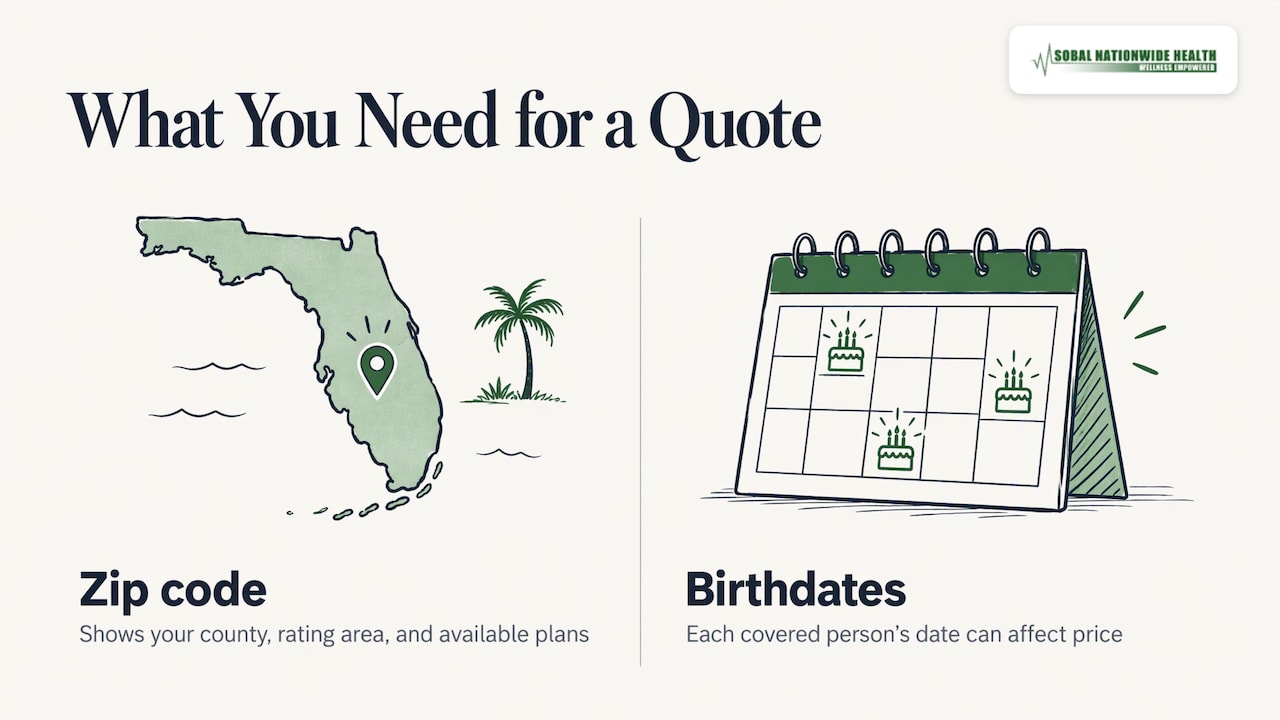
To get an accurate Florida health insurance quote, you only need two things: your zip code and the birthdates of everyone who would be covered. You do not need to answer health questions to start, and you do not need paperwork in front of you.
The rest of this guide explains why those two details drive the price, what to look at once the quote arrives, and how to read it so the number you see is the number that matters. It is written for self-employed people, 1099 contractors, families and small business owners ages 18-64 who want private, PPO-style coverage. We don’t offer Medicare or Medicaid.
TL;DR
- A zip code and birthdates are all our quote form asks for. No health questions.
- Zip code sets your rating area and the plans you can see. Age is the other big pricing input.
- Compare the whole yearly picture, not just the monthly premium: deductible, copays, coinsurance and the out-of-pocket maximum.
- Ask for the plan’s Summary of Benefits and Coverage so you can compare plans side by side.
- A quote is a starting point. A licensed broker can walk you through every option before you decide.
Table of Contents
- The two things you actually need: zip code and birthdates
- Why those two details move the price
- What you do not need to bring to the first quote
- Who this fits: a few common situations
- How to read your quote once it arrives
- Doctors, hospitals and the network question
- Check what Florida’s regulator publishes
- Waiting periods and start dates
- A short checklist before you request a quote
- What our team offers in Florida
- Our perspective
- FAQ
- Sources
The two things you actually need: zip code and birthdates
I’m Bernie, a licensed broker, and I get asked all the time what people should gather before they ask for a quote. People imagine tax returns, medical records and a stack of forms. For the first quote, the answer is much simpler.
Your zip code. Florida is a big state, and where you live changes which plans are offered to you and how they are priced. A zip code tells us your county and area, which is how we know what is available where you actually live and work.
Birthdates for everyone who needs coverage. Age is one of the main inputs into what a plan costs, so we need the date of birth of each person: you, a spouse or partner, and any children. Birthdates, not just ages, because a birthday coming up soon can change the number.
That is it. When you request a quote from us, you will never be asked a health question on the form. You get a starting point built on the two facts that most directly shape price, and from there we talk through what fits.
Why those two details move the price
Premium rules differ by plan type, but zip code and age show up again and again. Federal law, for example, says that in the individual and small group markets a premium may vary only by whether the plan covers an individual or a family, rating area, age and tobacco use, and for adults the age difference is capped at a ratio of 3 to 1. In plain English: where you live and how old you are are legitimate reasons for two quotes to differ, and they are the reason we start there.
Two more details can also come up as the conversation moves along:
- Who is covered. An individual plan and a family plan are priced differently, so we need to know whether you are getting coverage for yourself or for your household.
- Tobacco use. It can affect pricing on some plans. We will talk about it with you by phone, not on the quote form.
Here is how the two starting details work in practice:
| What you give us | What it tells us | Why it matters |
|---|---|---|
| Zip code | Your county and rating area | Plans offered and prices can differ by area |
| Birthdates | Each person’s age | Age is a main driver of premium |
| Who is on the plan | Individual or family | Family coverage is priced differently |
What you do not need to bring to the first quote
A lot of people delay getting a quote because they think they have to be “ready.” You can skip all of this at the start:
- Medical records or a list of past visits
- Prescription lists
- Tax returns or income statements
- Your current policy (helpful later, but not required)
- Doctor names (we will ask about these when we talk, because they matter for choosing a network)
If you want to compare against what you have now, a current policy summary is useful, but it is a nice extra, not a requirement.
Who this fits: a few common situations
The form is the same for everyone, but the reasons people come to us differ. Here are the situations we hear about most.
Self-employed people and 1099 contractors
If you work for yourself, there is no HR department picking a plan for you. You pick, you pay, and you want to know the real number. Your zip code and birthdates are enough to start. If you are a freelancer or gig worker, our page on 1099 contractor health insurance covers the situation in more detail.
Realtors and owner-operator truckers
Realtors and truckers share one thing: your work moves you around. A trucker may be in a different state every week, and a realtor may show homes in several counties. That is why doctor and hospital choice across the country matters, and why the network question gets its own section below. If a nationwide network matters to you, take a look at how nationwide PPO health insurance works.
People leaving COBRA or a job
COBRA lets you keep a former employer’s plan for a limited time, but you usually pay the full cost. Many people want to see what a private plan would cost before they commit. You need the same two details: zip code and birthdates.
Families priced out of a spouse’s employer plan
Sometimes the employee-only price at work is fine and the family add-on is not. Give us birthdates for everyone you want covered, and we can show you what a private family plan looks like next to it. Our guide on how to choose family health insurance in Florida goes deeper.
Young adults turning 26
Federal rules let young adults stay on a parent’s plan until they turn 26, under 45 CFR § 147.120. After that you need your own coverage. If you are approaching the birthday, start looking a bit before it so you have time to compare. All we need is your birthdate and zip code.
Small business owners with 2-30 employees
For a group quote, we start with your business zip code and the birthdates of the people who would be covered. Our small business health insurance page explains what we offer. An agent can walk you through all the options, so you do not have to figure out the setup alone.
How to read your quote once it arrives
The monthly premium is the number everyone looks at first. I like to say the premium gets you in the door. What happens after you are inside is decided by cost-sharing, which is simply how you and the plan split the bill.
Here is what to line up for each plan you compare:
- Premium: what you pay each month to keep the plan active.
- Deductible: what you pay for covered care before the plan starts paying its share.
- Copays and coinsurance: a copay is a flat fee for a visit or prescription. Coinsurance is a percentage of the bill you pay after the deductible.
- Out-of-pocket maximum: your financial safety net. It is the most you pay in a year for covered services.
A simple way to compare: multiply the monthly premium by 12, then add the deductible and think about how much care you expect to use. HealthCare.gov’s guidance on estimating total yearly costs uses this same logic: premium times 12, plus deductible, copays, coinsurance and the out-of-pocket maximum. It is written for another type of coverage, but the arithmetic works for any plan.
Worked example with made-up round numbers, only to show the method: Plan A has a $300 monthly premium and a $3,000 deductible. Plan B has a $400 monthly premium and a $1,000 deductible. Plan A costs $3,600 in premiums for the year, and Plan B costs $4,800. If you only see a doctor for a checkup, Plan A is cheaper. If you have a year with real medical needs, Plan B could come out ahead. Neither number tells the story alone. Our page on deductibles, copays and out-of-pocket maximums in Florida walks through this in more depth.
Ask for the Summary of Benefits and Coverage
Federal rules require plans to provide a short, standardized document called the Summary of Benefits and Coverage. According to CMS’s job aid, it covers deductibles, out-of-pocket limits, in-network and out-of-network coverage, excluded services and standardized coverage examples, such as having a baby. Because every plan uses the same layout, you can put two side by side and compare them line by line.
Look past the premium for what is covered
Every plan has its own list of covered services, and everyday items like contraception are worth checking in the benefits summary rather than assuming. For one example of how that kind of coverage is described, see this explainer on birth control coverage and what to verify. Then compare the same items across each quote you hold.
Doctors, hospitals and the network question
A quote tells you the price of the plan. It does not tell you whether your doctor is part of it. That is the part of the process I would never skip.
A network is the group of doctors and hospitals a plan has agreements with. Staying in network usually costs less. Many of the people we work with want a PPO-style plan, where you can see a wide range of providers without a referral. Before you commit, bring your list of doctors and hospitals to the conversation and ask whether each one is in the plan’s network.
Can a Florida plan cover care in another state? It depends on the plan and its network, so this is something to confirm for the specific plan you are considering, not assume. This matters a lot if you travel for work, have family elsewhere, or want the option to see a specialist out of state. Our page on private PPO health insurance in Florida explains how we approach network choice.
Check what Florida’s regulator publishes
Florida’s Office of Insurance Regulation runs a tool called CHOICES. According to the instructions for the CHOICES tool, it lets you view premium information based on rates insurers have filed with the Office, and the results show the plan name, coverage level, monthly and annual premium, deductible and out-of-pocket maximum. The Office notes that it does not guarantee a company will sell at the stated premium, so treat it as a reference point for filed rates, not a final price.
It is a useful way to get familiar with the vocabulary before you talk to anyone. The terms in that results table are the same ones you will see on your own quote.
Waiting periods and start dates
Two timing questions come up often: when does coverage begin, and is there a waiting period?
For group plans, such as those offered by employers, federal rules say a plan must not impose a waiting period longer than 90 days, and every calendar day counts, including weekends and holidays. That rule is in 45 CFR § 147.116. If you are a small business owner thinking about group coverage for your team, this is the rule behind the “90 day rule” people ask about.
For your own quote, ask two plain questions: what is the effective date, and are there any waiting periods for specific benefits? Florida law also requires a policy to state when coverage takes effect and ends, and to print its exceptions and reductions plainly, under Florida Statute 627.602. Read that part of the policy before you sign.
A short checklist before you request a quote
- Decide who needs coverage: just you, you and a spouse, or the whole household.
- Write down each person’s date of birth.
- Have your Florida zip code ready (home or business).
- Jot down the doctors and hospitals you want to keep.
- Think about how much care you expect to use this year, from a light year to a heavy one.
Steps 1 to 3 are all the form needs. Steps 4 and 5 make the follow-up conversation faster and more useful, and we handle that by phone or webinar screen share.
What our team offers in Florida
Sobal Health is a licensed health insurance brokerage covering 31 states, including Florida. We help self-employed people, families and small businesses find private, medically underwritten plans, along with dental, vision and supplemental coverage. You get one-on-one advice focused on education, not sales pressure, with brokers who speak English or Spanish.
If you want to see what we offer for individuals and households, start with our personal and family insurance page. For a deeper look at how we work in your state, visit our Florida health insurance broker page. You can also browse our free resources library for guides on costs, comparisons and plan types.
When you are ready to compare, an agent can walk you through all the options and answer your questions in plain English.
Our perspective
The biggest mistake I see is people waiting to start because they believe getting a quote is a big job. It isn’t. Two facts, your zip code and your birthdates, are enough to begin.
The second mistake is stopping at the monthly premium. A low premium feels good on day one, but the deductible, the copays and the network are what you live with all year. When I sit down with someone, I want them to leave understanding why a plan fits them, not just what it costs.
That is the reason we focus on education first. Self-employed people, truckers, realtors, families leaving COBRA, young adults turning 26 and small business owners all have different schedules and different priorities, and a private PPO-style plan with wide doctor choice can fit many of them. Our job is to help you see your options clearly and make the decision yourself.
Bernie S
FAQ
What do I need to get a Florida health insurance quote?
You need your Florida zip code and the birthdates of everyone who would be covered. Our quote form does not ask health questions. After the quote, a broker can talk through plan details with you by phone or webinar screen share.
Why does my zip code change my quote?
Where you live determines the plans offered in your area and how they are priced. Federal law lists geography, or rating area, among the few factors that may change a premium in the individual and small group markets, alongside age, tobacco use and individual versus family coverage.
Is the quote I get the final price?
A quote is a starting estimate built on the details you give. Even Florida’s regulator notes, in its CHOICES tool instructions, that filed rates are not a guarantee a company will sell at that premium. Confirm the final price, effective date and benefits with the broker before you enroll.
Can a Florida plan cover doctors in another state?
It depends on the plan and its network. Ask whether your specific doctors and hospitals are in the network, and how care outside Florida is handled, before you choose. This matters most for people who travel for work.
Does the 90-day rule apply to me?
The 90-day limit applies to group health plans, such as an employer’s plan, and it caps how long a new eligible person can wait for coverage to begin. If you are a business owner considering group coverage, ask about the effective date upfront.
Ready to see your options? Get a free quote at sobalhealth.com/#quote or call (305) 680-0125.
Sources
- CHOICES instructions, Florida Office of Insurance Regulation
- 42 U.S.C. § 300gg: Fair health insurance premiums
- Your total costs for health care, HealthCare.gov
- Summary of Benefits and Coverage (SBC) Job Aid, CMS
- 45 CFR § 147.116, waiting periods
- 45 CFR Part 147, eCFR
- Florida Statute 627.602 (2025)
- Birth control insurance coverage explainer
Recommended
- How Much Should You Budget for Health Insurance in Florida?
- Factors to Consider When Comparing Florida Family Health Insurance Plans
- Tips for Securing Best Individual Health Insurance Plan in Florida
- Factors to Consider When Comparing Health Insurance in Florida (2026)
Related official guides