

An HSA usually wins for long-term savers on a high-deductible health plan who want their money to roll over and grow. An FSA usually wins if you don’t qualify for an HSA or you want guaranteed pretax dollars for expenses you already know are coming. New 2026 IRS guidance also expands who can even qualify for an HSA in the first place, so the rules just shifted for some readers.
TL;DR:
- Eligible for an HSA depends on enrollment in a qualifying HDHP, with new 2026 rules expanding plan options to include certain bronze and catastrophic plans.
- Unused HSA funds roll over indefinitely and can be invested, unlike FSAs, which typically have use-it-or-lose-it restrictions unless specific carryover options exist.
- Having a general-purpose FSA disqualifies you from HSA eligibility, but limited-purpose or dependent-care FSAs do not affect it, making plan coordination crucial.
- Employer contributions and plan design, including carryover and grace periods, significantly influence eligibility, so verify plan details in writing before open enrollment.
- Moving from an FSA to an HSA requires spending down current FSA balances beforehand, and eligibility rules should be checked annually due to frequent changes in plan and coverage status.
Table of Contents
- HSA vs FSA: What Each Account Actually Is
- HSA vs FSA Comparison: Portability, Rollover, Taxes, and Eligibility
- Who Qualifies for an HSA and Who Qualifies for an FSA?
- 2026 Contribution Limits and HDHP Thresholds
- Qualified Expenses and What Happens to Leftover Funds
- Can You Have Both an HSA and an FSA at the Same Time?
- Real-World Scenarios: Matching Your Situation to the Right Account
- How to Choose: Questions to Ask HR Before Open Enrollment Ends
- Self-Employed and Small Business Considerations
- The Bottom Line on HSA vs FSA
- What Employers and Employees Both Get Wrong About This Choice
- How Sobal Nationwide Health Can Help You Compare Plans
- Sources
- FAQ
HSA vs FSA: What Each Account Actually Is
Let’s clear up the confusion right away, because I hear the same mix-up from clients constantly: people think HSA and FSA are just two names for the same pretax account. They’re not, and the difference in ownership alone changes how you should think about your money.
A Health Savings Account (HSA) is a tax-advantaged trust or custodial account that’s yours, tied to enrollment in a High Deductible Health Plan (HDHP). You contribute pretax dollars (or deduct them if you contribute post-tax), and withdrawals stay tax-free as long as you spend them on qualified medical expenses. According to IRS Publication 969, the HSA belongs to you individually, not your employer, and it follows you if you change jobs or leave the workforce entirely.
A Flexible Spending Account (FSA) is different in a way that matters a lot come December. It’s an employer-established pretax account that lives inside what’s called a cafeteria plan, meaning your employer sets the rules and, in most cases, you lose unused funds at year’s end unless the plan says otherwise.
Here’s the ownership breakdown in plain terms:
- HSA: You own it. The account moves with you, and either you, your employer, or both can contribute.
- FSA: Your employer owns the plan structure. You get access to the money through payroll deduction, but plan design (including whether funds carry over) is entirely up to your employer.
The premium gets you access to a plan. The HSA or FSA determines how much of your own money you keep in the process.
HSA vs FSA Comparison: Portability, Rollover, Taxes, and Eligibility
Once you understand ownership, the rest of the HSA vs FSA comparison falls into place fairly fast. Four axes drive almost every real-world decision: who controls the account, what happens to leftover money, who’s even eligible, and how the tax benefits actually play out.
Portability is the clearest split. Your HSA is portable. It stays with you through job changes, career breaks, or retirement, and no employer can take it back. Your FSA generally is not. Leave your job mid-year, and in most cases the unused balance stays behind with your former employer’s plan.
Rollover and investment potential is where the HSA pulls further ahead over time. HSA balances roll over indefinitely; nothing expires. Many HSA providers also let you invest funds above a minimum cash threshold, similar to a retirement account, which means your health savings can actually grow in the market over a decade or two. FSAs, by contrast, are subject to “use-it-or-lose-it” unless your employer opts into a limited carryover or grace period, and even then the amount you can protect is capped.
Eligibility works in opposite directions for the two accounts. HSA eligibility depends on your health coverage, specifically enrollment in an HDHP, not your employer’s generosity. FSA eligibility depends almost entirely on whether your employer offers one; there’s no HDHP requirement at all.
Tax outcomes are similar on the front end (both reduce taxable income) but diverge on the back end. HSA withdrawals for qualified expenses are permanently tax-free, and unlike FSAs, you can hold the account long after you’ve left the job that gave you access to it.
Pro Tip: Before assuming your FSA “resets” every January, check your employer’s plan documents. Some plans allow a $680 carryover for 2026 per Rev. Proc. 2025-19, while others use a grace period instead, and a few offer neither.
Here’s the side-by-side that clients ask me to text them before enrollment meetings:
| Factor | HSA | FSA |
|---|---|---|
| Ownership | Individual, portable for life | Employer plan, typically forfeited if you leave |
| Rollover | Unlimited, every year | Capped carryover or grace period only, if offered |
| Investment option | Yes, many providers allow it | No |
| Eligibility requirement | Must be enrolled in a qualifying HDHP | Employer must offer it; no HDHP required |
| Contribution sources | Employee, employer, or both | Employee, sometimes with employer match |
The number worth committing to memory: a general-purpose FSA with even a small carryover can quietly block your HSA eligibility for a full year if you’re not paying attention, a trap covered in the eligibility section below.
Who Qualifies for an HSA and Who Qualifies for an FSA?
HSA eligibility gets checked monthly, not once a year, and that trips up more people than you’d expect. According to Publication 969, you’re HSA-eligible for a given month only if all of the following are true:
- You’re covered by a qualifying HDHP on the first day of that month.
- You have no disqualifying coverage, meaning no general-purpose FSA, no non-HDHP plan, and typically no coverage through a spouse’s general FSA either.
- You’re not enrolled in Medicare.
- No one else can claim you as a tax dependent.
FSA availability, on the other hand, has nothing to do with HDHP status. It comes down entirely to whether your employer’s benefits package includes one. Most employees offered a general-purpose or dependent-care FSA can enroll regardless of what health plan they’re on.
The edge cases are where things get messy. If your spouse has a general-purpose FSA through their own employer, and you’re on their plan, it can knock you out of HSA eligibility even though the FSA isn’t technically yours. A limited-purpose FSA (covering only dental and vision) or a post-deductible FSA (covering expenses only after you’ve met the HDHP deductible) can both coexist safely with an HSA. Carryover balances and grace periods on a general FSA can also extend disqualification well past January 1, sometimes for the entire following plan year.
2026 Contribution Limits and HDHP Thresholds
The 2026 numbers matter because they’re higher across the board, and one of them comes with a broader eligibility change attached.
Per Rev. Proc. 2025-19, the 2026 HSA contribution limits are:
- $4,400 for self-only coverage
- $8,750 for family coverage
- $1,000 catch-up contribution for anyone 55 or older, on top of either limit
To even qualify for those limits, your plan has to meet the IRS definition of an HDHP for 2026, which sets a minimum deductible of $1,700 for self-only coverage and a maximum out-of-pocket limit of $8,500. Family HDHP deductible minimums and out-of-pocket maximums are higher and specified in the same revenue procedure, so it’s worth confirming your specific plan against those figures rather than assuming.
On the FSA side, the 2026 contribution limit and maximum carryover vary by plan; some plans allow a carryover up to $680, while others use a grace period or offer neither — check your plan details.
The bigger structural shift for 2026 comes from Notice 2026-05, where the Treasury and IRS expanded HSA eligibility to include certain bronze and catastrophic plans purchased through an Exchange, plus some Direct Primary Care (DPC) arrangements, starting January 1, 2026. If you’ve been buying a bronze plan on the marketplace and assumed HSA contributions were off the table, that assumption may no longer hold. It’s worth checking your specific plan against the new guidance before you write off the HSA option.

Qualified Expenses and What Happens to Leftover Funds
Both accounts cover a similar core list: deductibles, copays, prescriptions, dental work, and vision care. IRS Publication 502 lays out the full list of qualified medical expenses, and it’s the same reference point whether you’re spending HSA or FSA dollars.
The real difference shows up after the money goes unspent. Here’s the practical contrast:
- HSA: Nothing expires. Funds can sit invested for years and get spent tax-free on a qualified expense decades from now, even after retirement.
- FSA: Use-it-or-lose-it applies by default. Some employers soften this with a $680 carryover for 2026 or a grace period of up to two and a half months, but plan design varies, so check your summary plan description rather than assuming either exists.
Pro Tip: If you’re planning to move from a general-purpose FSA to an HSA next plan year, spend down your FSA balance before your current plan year ends. Carrying even a small amount forward can make you HSA-ineligible for months, sometimes the entire following year, depending on how your employer structured the carryover.
Can You Have Both an HSA and an FSA at the Same Time?
The short answer: it depends entirely on what kind of FSA you’re looking at.
- A general-purpose health FSA disqualifies you from HSA contributions. This is the rule that catches the most people off guard during open enrollment, and it applies even if the FSA balance is tiny.
- A limited-purpose FSA (dental and vision only), a dependent-care FSA, or a post-deductible FSA can all coexist with an HSA. These don’t count as “other coverage” under Congressional Research Service guidance on HSAs, so you can run either alongside an HSA without losing eligibility.
- A carryover or grace period on a general FSA can extend disqualification into the next plan year, even if you intend to switch to an HSA-compatible plan on January 1.
If you contribute to an HSA while technically ineligible, the IRS treats the excess as taxable income and applies a 6% excise tax on top of it. Before you enroll in anything, confirm your FSA type in writing with HR. It’s a five-minute email that can save you a tax headache later.
Real-World Scenarios: Matching Your Situation to the Right Account
Numbers aside, most people land on the right account once they see their own situation reflected back at them. A few patterns show up over and over in enrollment conversations:
- The young, healthy saver: Rarely visits the doctor, values low premiums, and wants the HSA’s investment feature to build a long-term medical fund. HSA is usually the stronger fit here.
- The family with predictable annual costs: Braces, regular prescriptions, routine pediatric visits. Knowing the exact spend in advance makes the FSA’s guaranteed pretax dollars genuinely useful, assuming they don’t also want an HDHP for other reasons.
- The near-retiree focused on tax-advantaged growth: Wants to stack HSA contributions now to cover Medicare-era expenses later, since HSA funds never expire and can even reimburse Medicare premiums down the road.
- The lower-wage worker prioritizing cash flow: May prefer the FSA’s immediate payroll deduction over the HSA’s higher-deductible tradeoff, especially if the employer doesn’t contribute to either account.
Employer plan design often decides this before the employee does. An employer that funds part of the HSA changes the math substantially, and that single detail deserves its own line item in your comparison.
How to Choose: Questions to Ask HR Before Open Enrollment Ends
Getting this right takes less time than most people assume, as long as you ask the right questions in the right order.
- Ask if your FSA option is general-purpose or limited-purpose. This single answer determines whether you can pair it with an HSA at all.
- Ask whether there’s a carryover or grace period, and get the amount in writing. Verbal answers from open enrollment meetings are notoriously unreliable once tax season arrives.
- Ask whether your employer contributes to the HSA, and how much, since employer contributions count toward your annual limit.
- Confirm your medical plan actually meets the IRS definition of an HDHP for 2026. Not every plan marketed as “high deductible” clears the Healthcare.
- If switching from FSA to HSA, verify your FSA balance and spend it down before the plan year ends, or open a limited-purpose FSA instead if a full switch isn’t possible mid-year.
Pro Tip: Request your Summary Plan Description directly from HR rather than relying on the open enrollment portal’s summary page. Get written confirmation of carryover and grace period terms before you sign anything.
Self-Employed and Small Business Considerations
Self-employed workers face this decision differently, since there’s no HR department making the call for you. One example that comes up often: a self-employed worker chooses an HDHP specifically to lower monthly premiums, then funnels the savings straight into HSA contributions to build a cushion for future care, effectively converting a cost-cutting move into a long-term savings plan. Reviewing self-employed health insurance options alongside HDHP eligibility is worth doing before locking in a plan for the year.
Small business owners face a parallel decision: offer HSA-compatible HDHPs, traditional FSAs, or both. Sobal Nationwide Health works with self-employed individuals and small businesses across 31 states, and this exact HSA-versus-FSA tradeoff comes up constantly during plan selection conversations. For a deeper look at self-employed coverage tradeoffs, this guide to claiming self-employed health insurance and HSA deductions covers the tax mechanics in more detail.
The Bottom Line on HSA vs FSA
If you’re on an HDHP and want your savings to grow untouched for years, the HSA is almost always the better long-term move. If you’re not on an HDHP, or you know exactly what you’ll spend this year, the FSA still earns its place.
Three steps to take this week: confirm whether your medical plan actually meets the 2026 HDHP thresholds, ask HR in writing whether your FSA carries a carryover or grace period, and if you’re eligible, open an HSA trustee account before your first paycheck of the new plan year.
What Employers and Employees Both Get Wrong About This Choice
The conventional advice treats HSA versus FSA as a math problem: compare contribution limits, pick the bigger number, done. That framing misses the part that actually costs people money, which is plan design, not the account type itself. I’ve seen employees pick an HSA-compatible HDHP during enrollment, only to discover months later that their spouse’s leftover general FSA balance from a previous employer quietly disqualified them the entire time.
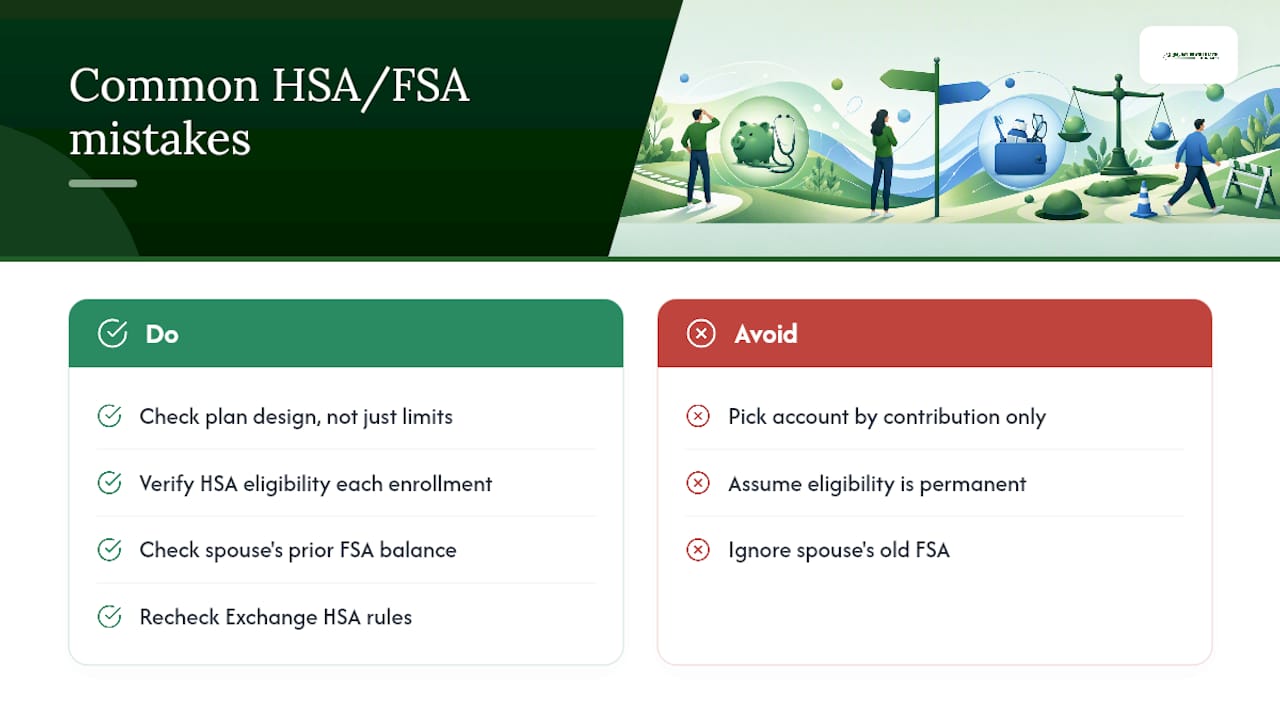
The 2026 changes make this more urgent, not less. Notice 2026-05 just opened HSA eligibility to bronze and catastrophic Exchange plans that were previously excluded, which means a lot of self-employed people and gig workers who assumed the HSA door was closed should look again. That’s the real story this year, more than the modest bump in contribution limits.
My honest take: stop treating this as a one-time enrollment decision and start treating it as an annual eligibility check. Coverage changes, spousal plans change, and now the IRS has changed the rules on Exchange plans. Verify your status every open enrollment season, not just the year you first sign up.
— Bernie S
How Sobal Nationwide Health Can Help You Compare Plans
Figuring out whether your specific plan even qualifies as an HDHP, or whether your spouse’s FSA is quietly blocking your HSA eligibility, isn’t something a benefits portal explains well. We work one-on-one with self-employed individuals, families, and small businesses to help sort through plan-design details, without sales pressure.

If you’re weighing a private medically underwritten plan against an ACA marketplace HDHP, or trying to figure out whether switching plans this year affects your HSA eligibility, a licensed broker can walk through the specifics with you directly. Start by learning how health insurance actually works and how plan choice ties into HSA eligibility, then reach out through Sobal Nationwide Health to get a personalized comparison for your situation before open enrollment closes.
Sources
The contribution limits, eligibility rules, and 2026 updates referenced throughout this article come directly from federal guidance:
This article is general information, not a substitute for advice from a qualified financial advisor. Consult a qualified financial professional about your own circumstances before acting on anything here.
FAQ
Why would anyone use an FSA instead of an HSA?
An FSA makes sense if you don’t qualify for an HSA, don’t have an HDHP, or know your exact medical spending for the year and want guaranteed pretax dollars without waiting to accumulate a balance.
Do I need both an FSA and an HSA?
No. Most people only need one, and pairing a general-purpose FSA with an HSA isn’t allowed; if you want both, choose a limited-purpose, post-deductible, or dependent-care FSA instead, per IRS Publication 969.
Which is stricter, HSA or FSA eligibility?
HSA eligibility is stricter because it’s checked monthly and depends on HDHP enrollment, disqualifying coverage, and Medicare status, while FSA eligibility depends only on whether your employer offers one.
What is the downside of an HSA?
The main downside is the HDHP requirement itself: higher deductibles mean more out-of-pocket cost before insurance kicks in, and not everyone can absorb that risk even with the long-term tax benefits.
Can I switch from an FSA to an HSA mid-year?
Generally no, since most FSA plans run on a fixed plan year, so the practical move is to spend down your FSA balance before it ends and enroll in an HSA-eligible HDHP for the following plan year.
