

Yes, you can have a health savings account (HSA) when you work for yourself. You need a qualifying high deductible health plan (HDHP), no other disqualifying coverage, and no Medicare. You don’t need an employer to open one. For 2026 you can put in up to $4,400 with self-only coverage or $8,750 with family coverage, and you get to choose your own account provider.
That last part matters more than most people realize. Below, we walk through how an HSA works, which plans qualify, how the tax break shows up on your return, and where self-employed people tend to trip up.
TL;DR
- Self-employed people can open and fund an HSA if they’re covered by an HSA-eligible HDHP and have no disqualifying coverage.
- The 2026 contribution limits are $4,400 (self-only) and $8,750 (family), plus $1,000 if you’re 55 or older.
- Contributions are deducted on your tax return, growth is tax-free, and withdrawals for qualified medical costs are tax-free.
- You pick the HSA provider yourself, so compare fees and investment options before you open one.
- An HSA is only as good as the plan underneath it. A high deductible suits some households and strains others, so check your numbers first.
Table of Contents
- How an HSA works when you have no employer
- Who qualifies as self-employed for HSA purposes
- What counts as an HSA-eligible health plan
- 2026 contribution limits
- The tax deduction for the self-employed
- Pros and cons for self-employed people
- Choosing an HSA provider: where fees hide
- Perspective: why the plan matters more than the account
- When your situation changes: Medicare, job changes and COBRA
- A simple setup checklist
- How we can help
- FAQ
- Sources
How an HSA works when you have no employer
Think of an HSA as a medical savings account that belongs to you, not to a job. You pair it with a qualifying health plan, put pre-tax money in, and spend it on qualified medical costs. If you don’t spend it, it stays there and keeps growing.
HealthCare.gov describes what many people call the triple tax advantage: contributions are tax-deductible, growth is tax-free, and withdrawals for qualified medical expenses are tax-free. Those expenses include deductibles, copayments, coinsurance, dental and vision care.
One thing surprises people. You can’t use HSA money to pay your health insurance premiums, according to HealthCare.gov. The premium gets you in the door. The HSA helps with what you pay once you’re inside.
If you’ve worked for an employer before, you may remember the account arriving pre-selected. As a self-employed person, you’re the one choosing, and that’s an advantage.
Who qualifies as self-employed for HSA purposes
Sole proprietors, freelancers, 1099 contractors and other self-employed people can all qualify. The requirements are the same ones everyone faces:
- You’re covered by an HSA-eligible HDHP.
- You have no other health coverage that disqualifies you (a general-purpose health FSA or a spouse’s non-HDHP plan can be a problem).
- You’re not enrolled in Medicare.
- No one else claims you as a dependent.
The last two or three are where people get caught, so confirm them with a tax professional if your household situation is complicated. If you’re not sure whether a spouse’s flexible spending account counts against you, our HSA vs FSA guide walks through how the two interact.
What counts as an HSA-eligible health plan
The IRS sets the rules each year. For 2026, the IRS inflation-adjusted figures are:
| 2026 HDHP requirement | Self-only | Family |
|---|---|---|
| Minimum annual deductible | $1,700 | $3,400 |
| Maximum out-of-pocket (excluding premiums) | $8,500 | $17,000 |
Two practical points.
The plan must be labeled HSA-eligible. A high deductible alone doesn’t make a plan qualify. It has to meet the federal definition, and the carrier or marketplace will say whether it does.
Marketplace plans can qualify. HealthCare.gov says all Bronze and Catastrophic plans work with HSAs, along with some plans in other categories. The IRS has also issued guidance on expanded HSA availability under the One, Big, Beautiful Bill Act, so it’s worth checking the current rules for your specific plan before you assume anything.
For a deeper look at how deductibles, out-of-pocket maximums and HSA rules fit together, see our HDHP guide.
2026 contribution limits
The IRS 2026 limits are:
| Coverage | Annual limit | With age 55+ catch-up |
|---|---|---|
| Self-only | $4,400 | $5,400 |
| Family | $8,750 | $9,750 |
The $1,000 catch-up applies if you’re 55 or older by the end of the tax year. Contributions from anyone count toward the limit, so if a relative gifts money to your account, it uses up part of your room. We break down proration, mid-year enrollment and the last-month rule on our HSA contribution limits page.
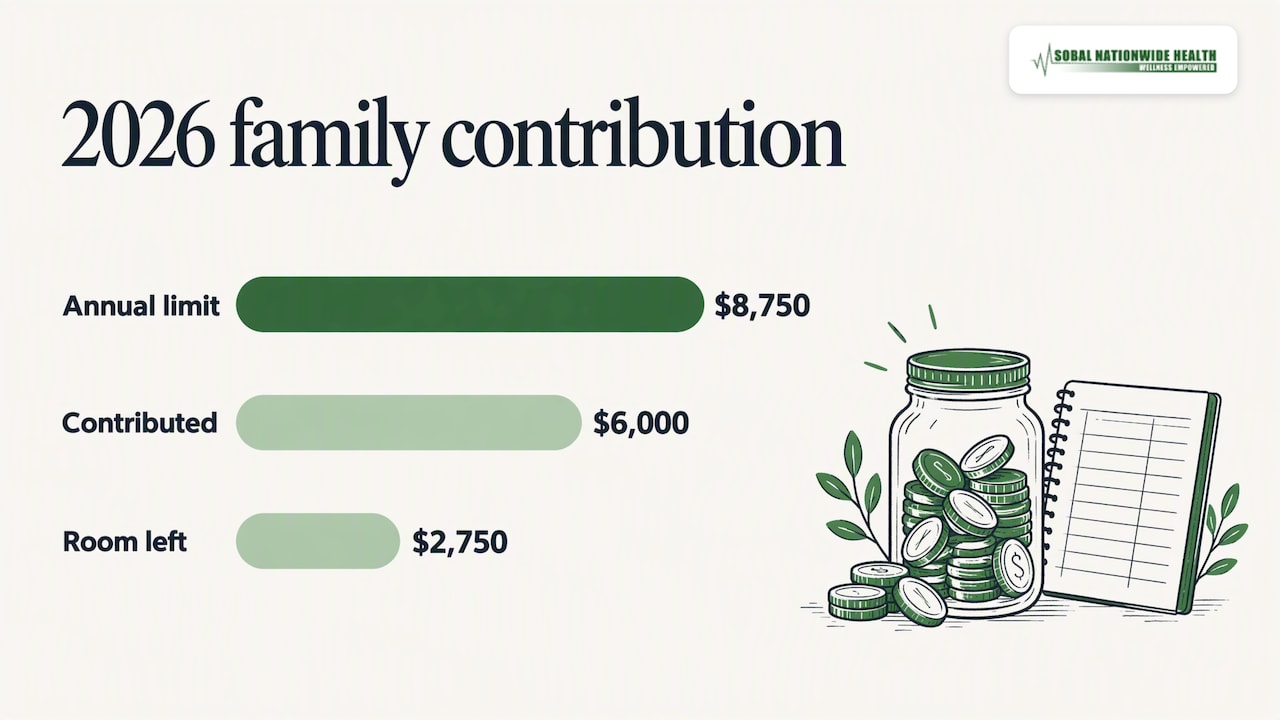
A quick example. Say you’re a 42-year-old freelance designer with family HDHP coverage all year. You can contribute up to $8,750 for 2026. Put in $500 a month and you’ve used $6,000, leaving $2,750 of room.
The tax deduction for the self-employed
This is where working for yourself can feel different. You don’t have a payroll department running contributions through a cafeteria plan. Instead, you deduct your own contributions directly on your return. You figure the deduction on Form 8889, and the IRS instructions for Form 8889 explain how to report contributions, figure your HSA deduction and report distributions.
Two habits save headaches:
- Track contributions by tax year. You can generally contribute for a given year until the tax filing deadline, so label each deposit with the year it belongs to.
- Keep receipts for every withdrawal. If you ever need to prove a withdrawal was for a qualified expense, you’ll want the paperwork. Some people deliberately pay medical bills out of pocket now, let the account grow, and reimburse themselves years later. That works only if you’ve kept the receipts.
HSA contributions are separate from the self-employed health insurance deduction, which covers your premiums. If you’re deducting premiums too, our guide to the self-employed health insurance deduction covers Form 7206 and Schedule 1 step by step. For sole proprietors in particular, see our page on sole proprietor health coverage.
Pros and cons for self-employed people
An HSA isn’t right for every household. Here’s an honest look.
Pros
- You get a tax deduction on money you’d spend on health care anyway.
- The balance rolls over every year and stays with you if you change plans, clients or careers.
- You control the account, including where the money is held or invested.
- Irregular income can be easier to manage when you can build a medical cushion in strong months.
Cons
- You have to carry the plan’s deductible, and a deductible of $1,700 or $3,400 or more can hurt in a lean year.
- You can only contribute while you’re covered by an HSA-eligible plan.
- Non-qualified withdrawals are taxed, and an extra tax can apply, so it isn’t a flexible emergency fund.
- Account fees and low interest can chip away at the savings if you don’t shop around.
A simple test: could you cover your plan’s full out-of-pocket maximum from savings if a bad year hit? If yes, an HDHP with an HSA may suit you well. If no, a plan with a lower deductible might be safer, even if you lose the HSA.
Choosing an HSA provider: where fees hide
Most people never pick their HSA provider. An employer or insurer does it for them. The Consumer Financial Protection Bureau (CFPB) has said that consumers often have no say in the provider, and that switching can bring obstacles and fees.
You have no such constraint. The CFPB’s 2024 findings point to monthly maintenance fees, paper statement fees, and outbound transfer and closure fees. Its issue spotlight notes closure charges of up to $25 at some large providers, and interest rates are often below 1%. A small monthly fee on a small balance can eat much of the growth.
When you compare providers, check:
- Monthly or annual maintenance fee, and whether a minimum balance waives it.
- Closing and transfer fees. Ask what it costs to leave before you join.
- Interest rate on cash, and the balance at which investing becomes available.
- Investment options and their costs, if you plan to hold the money long term.
- Debit card, app and reimbursement tools you’ll actually use at tax time.
The CFPB’s guide to comparing financial providers suggests talking to more than one provider and shopping around. Treat it like choosing a bank. Many banks, credit unions and brokerages offer HSAs, and you can transfer an existing account later.
Perspective: why the plan matters more than the account
We talk with self-employed people every week, and the HSA question usually arrives second. The first question is: “Why is my premium so high?”
Here’s what we see. Many freelancers and 1099 workers earn too much for marketplace subsidies, so they pay full price for a plan with a deductible and a narrow network. Then someone tells them to open an HSA to save on taxes, and the HSA gets bolted onto a plan that was never a good fit.
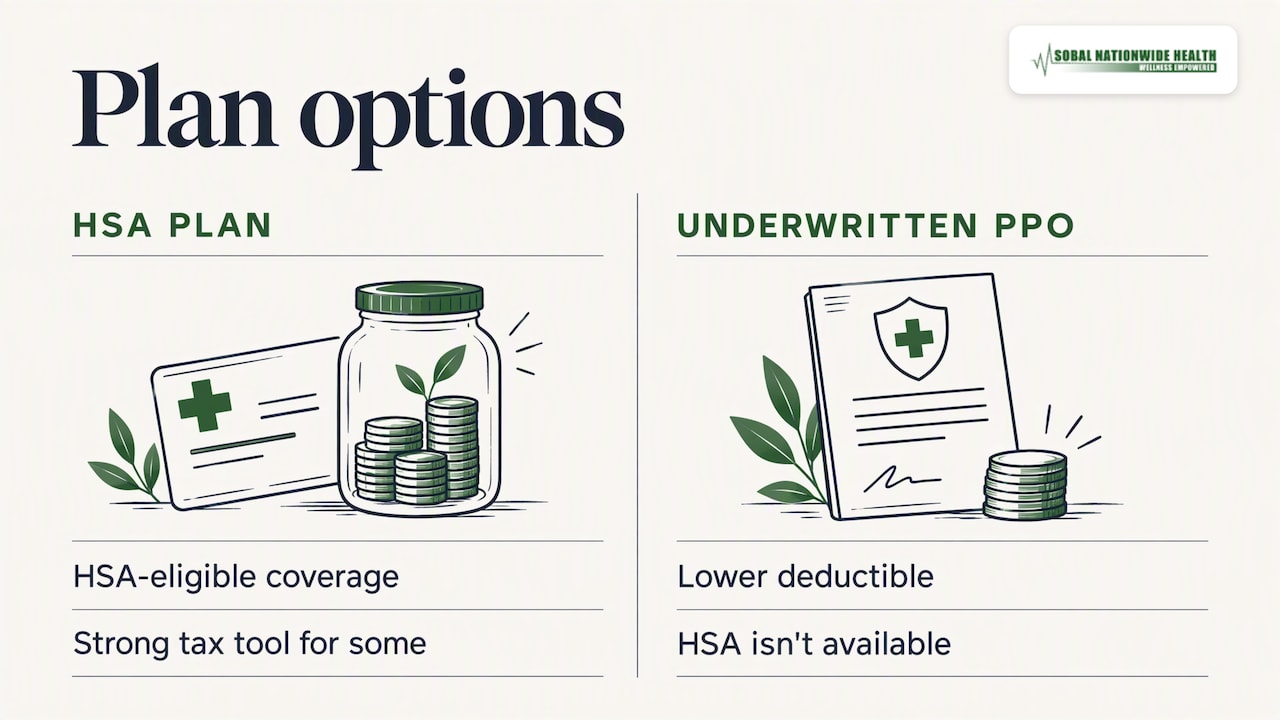
We’d flip that order. Start by asking what coverage you actually need: which doctors and hospitals you want to see, what you can afford if something goes wrong, and whether you’re traveling or living in more than one state. Then ask whether an HSA-eligible plan fits. For some of our clients it does, and the HSA becomes a strong tax tool. For others, a private, medically underwritten PPO with a lower deductible is the better answer, and an HSA isn’t on the table.
That’s the benefit of working with an independent broker. We aren’t selling you one answer. We’ll lay out both paths, show the real numbers, and let you decide without pressure. Some clients have told us they cut their monthly costs by as much as $400 after comparing their options, though results depend on your age, health, state and plan.
— Bernie S
When your situation changes: Medicare, job changes and COBRA
Your HSA goes with you. If you take a W-2 job, close your business or move between jobs, the money stays yours.
There are two things to know.
You can only contribute while you’re eligible. If you’re between jobs and covered by a plan that isn’t HSA-eligible, you can’t add new money for those months. HealthCare.gov explains that you can still use the existing balance tax-free on qualified expenses, including COBRA continuation premiums and Medicare Part B premiums.
Medicare has a timing trap. You need to stop contributing six months before you enroll in Medicare or retire and start benefits, because Medicare coverage can be retroactive. If you’re approaching 65, this explainer on HSA and Medicare timing covers how to avoid an excise tax from over-contributing.
If you’re between jobs and weighing COBRA against a private plan, talk to a broker before you decide. The right answer depends on your health, your budget and how long the gap will be.
A simple setup checklist
- Choose a plan. Confirm it’s HSA-eligible, and check the deductible and out-of-pocket maximum against your savings.
- Confirm you’re eligible. No Medicare, no disqualifying second coverage, not a dependent on someone else’s return.
- Compare HSA providers. Look at fees, interest, investment options and exit costs.
- Open the account and fund it. Set up an automatic transfer on a schedule that matches your cash flow, such as a fixed percentage of each client payment.
- Keep records. Save receipts, statements and the year each contribution belongs to.
- Report it at tax time. File Form 8889 with your return, or hand the records to your tax preparer.
One extra tip: if you have vision or dental costs, such as contacts or orthodontics, an HSA can help pay for them. Our guides on contact lens coverage and orthodontic costs show how families put the account to use.
How we can help
Sobal Health is an independent brokerage serving self-employed individuals, families and small businesses in 31 states. We can compare HSA-eligible plans, ACA marketplace plans and private medically underwritten plans side by side, in English or Spanish. We also offer dental, vision, accident and critical illness coverage, so you can see the whole picture in one conversation.
If you’re a 1099 worker, see how we approach contractor health insurance, or visit our personal and family coverage page to start a conversation. If you run a business with employees, our business health insurance page is the place to begin.
FAQ
Can a sole proprietor open an HSA without a business?
Yes. You don’t need an entity or an employer. You need an HSA-eligible health plan and to meet the standard eligibility rules, and then you can open an account with any bank, credit union or other qualified provider.
Can I pay my health insurance premiums from my HSA?
Generally no. HealthCare.gov states that HSA funds can’t pay premiums, though they can cover deductibles, copayments, coinsurance, dental and vision. There are limited exceptions, such as COBRA and Medicare Part B premiums.
How much can I contribute for 2026?
Up to $4,400 with self-only coverage or $8,750 with family coverage, per the IRS. If you’re 55 or older, you can add $1,000. Your contributions count toward the limit no matter who makes them.
Do I lose my HSA if I stop being self-employed?
No. The account is yours, and the balance stays tax-free for qualified expenses. You just can’t add new contributions in months when you aren’t covered by an HSA-eligible plan.
Is an HSA worth it if I have irregular income?
It can be, if you can handle the deductible in a slow year. Contributions are flexible, so you can put in more during strong months and less during weak ones. If a large deductible would put you at risk, compare other plan types first.
Sources
- IRS Internal Revenue Bulletin 2025-21
- IRS Notice 2026-05: expanded HSA availability
- IRS instructions for Form 8889
- HealthCare.gov: HSA options
- HealthCare.gov: How HSA-eligible plans work
- CFPB: Statement of Director Rohit Chopra on medical financial products
- CFPB: Hidden costs of health savings accounts
- CFPB: Health Savings Account Issue Spotlight
- CFPB: Comparing financial service providers
