

For many plans, your deductible resets on January 1. But that’s a common pattern, not a rule. Some employer plans reset on a different date, and your own policy documents decide the answer. This guide shows you how to find your exact reset date in about ten minutes. It also covers what happens when you switch plans, and how to avoid paying a new deductible before you have to.
I’m a licensed independent broker, and “when does my deductible start over?” is one of the questions I hear most from self-employed clients and families. It usually comes up in November or December, right when a surprise bill would hurt most.
TL;DR
- Individual and family Marketplace plans normally run on a calendar year, so the deductible commonly resets January 1, even if your coverage started mid-year.
- Employer (group) plans can use a plan year that starts on another date, and some still reset deductibles on January 1. Check the plan documents.
- Your Summary of Benefits and Coverage (SBC) lists your coverage period and deductible details. Start there.
- Switching plans usually means starting a new deductible. Don’t assume credit carries over unless the new insurer confirms it in writing.
- A reset also restarts your out-of-pocket maximum, which is your real financial safety net for the year.
Table of Contents
- Calendar year vs. plan year: the difference that decides your date
- What if your coverage started mid-year?
- How to find your deductible reset date
- The employer plan trap: plan year is not always deductible year
- What happens to your deductible when you switch plans?
- Do you owe 100% until you meet the deductible?
- Out of pocket vs. premium: how the pieces work together
- Our perspective: the reset date matters more than most people realize
- Plan around your reset date
- Not sure which plan fits your year? Talk to us
- FAQ
- Sources
Calendar year vs. plan year: the difference that decides your date
The deductible is the amount you pay for covered care each year before your plan starts sharing costs. (If you want the basics first, our guide on what a deductible is in health insurance covers them.) The word “each year” is where confusion starts, because insurers count a year in two different ways.
| Type | When it starts | When your deductible resets | Where you usually see it |
|---|---|---|---|
| Calendar year | January 1 | January 1 | Individual and family plans, many employer plans |
| Plan year (or policy year) | The renewal date set by the plan | The renewal date, in many plans | Some employer plans |
| Benefit year that differs from plan year | Varies | Often January 1, even when the plan year begins elsewhere | Some group plans |
HealthCare.gov defines a group plan’s plan year as a 12-month period of benefits coverage that may not match the calendar year. It tells you to check your plan documents or ask your employer to find out when yours begins.
For an individual Marketplace plan, the benefit year normally runs January 1 through December 31, even if your coverage begins later. So you don’t get a fresh 12 months of deductible from your start date. The clock was already running.
What if your coverage started mid-year?
This is the case that trips up the most people, and it’s common among self-employed folks who enroll after losing other coverage or after a life change.
Say your plan starts September 1. On a calendar-year plan, your benefits period ends December 31, and a brand-new deductible begins January 1. You get four months to meet one deductible, then you start over. That’s why I tell clients to ask before they enroll, not after, whether the deductible runs on the calendar year.
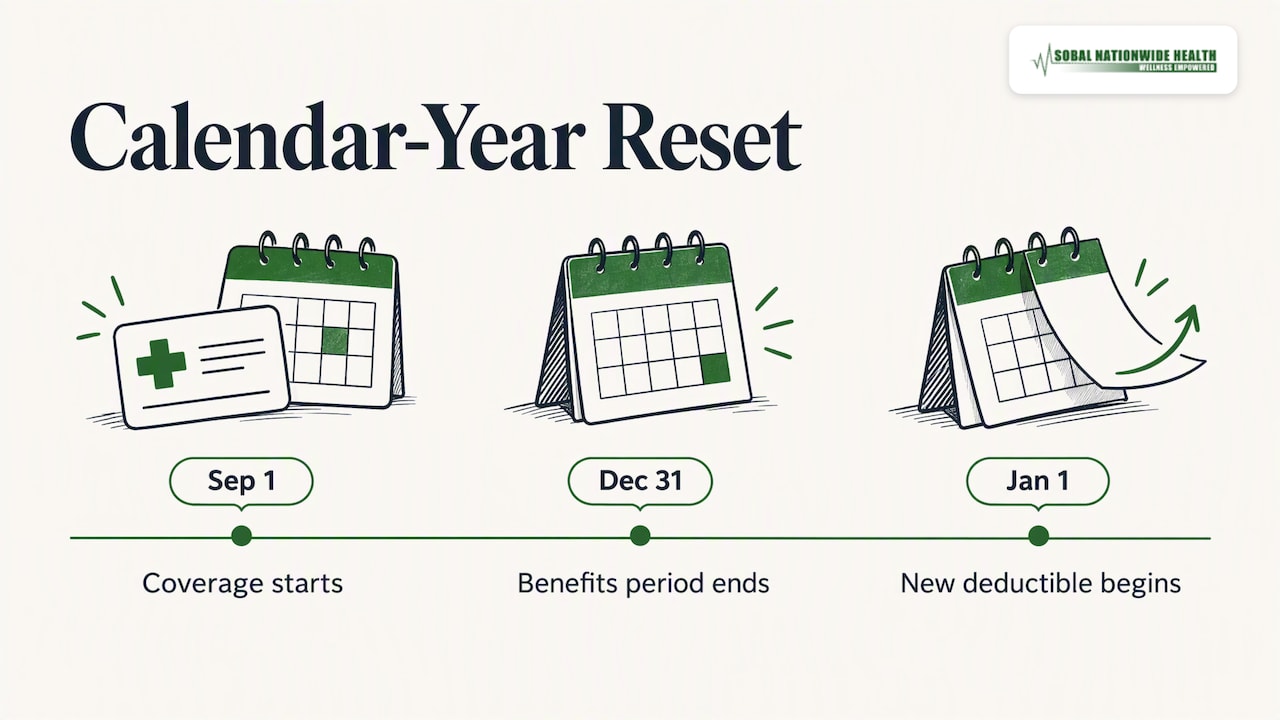
Individual policies sometimes call this period a “policy year” instead, so confirm the wording on your specific policy. If you’re still deciding when to start, our page on health insurance effective dates explains why applying alone doesn’t start coverage.
How to find your deductible reset date
You don’t need to guess. Here’s the order I’d follow.
- Find your Summary of Benefits and Coverage. Every plan has one. The federal SBC template has a spot for the coverage period and asks about the deductible and any separate deductibles for specific services. Look at the top right of page one for the dates.
- Read the dates. If the range reads January 1 to December 31, your deductible resets January 1. If it reads, say, July 1 to June 30, you’re likely on a plan year. One caution: the SBC instructions note that the dates may reflect the plan or policy as a whole, not each person’s own period, so a calendar-year plan can show an individual’s dates differently.
- Check your policy or plan document. Confirm the effective dates there and look at the deductible wording.
- Ask in writing. Email your insurer or your employer’s benefits administrator: “Is my deductible based on the calendar year, plan year, policy year, or another benefit period?” Keep the answer.
- Check your member portal. Many portals show how much of your deductible you’ve met so far. Compare that number with your last explanation of benefits.
If you’re on an employer plan, there’s one more step worth taking.
The employer plan trap: plan year is not always deductible year
It’s natural to assume that if your company’s plan renews October 1, your deductible resets October 1. Often it does. But not always.
Federal SBC instructions for group health plans explicitly contemplate a plan beginning October 1 while deductibles and out-of-pocket limits reset on January 1. So don’t infer your date from the renewal anniversary alone.
The better document is your Summary Plan Description (SPD). The Department of Labor says the SPD is the primary document explaining how a plan works, including deductibles, cost-sharing, networks and appeals. You can ask your employer’s plan administrator for it. Don’t rely only on the date printed on your insurance card.
Owners of small businesses have a related decision. If you choose a group plan for your team, you can ask the carrier how the deductible period works before you sign. Our business health insurance page explains how we help with that.
What happens to your deductible when you switch plans?
Short answer: plan on starting over.
A new plan generally applies its own cost-sharing period and its own deductible. Money you’ve already spent toward the old deductible usually doesn’t follow you. That’s true whether you move from one individual plan to another, leave a job, or go from group coverage to private coverage.
A few practical points:
- Marketplace changes have timing rules. Changing plans outside Open Enrollment generally requires a qualifying Special Enrollment Period. HealthCare.gov also advises comparing the new plan’s deductibles and total yearly costs.
- Ask about carryover. Some plans offer a deductible credit, sometimes called an accumulator carryover. It is plan-specific, so get it confirmed in writing. Don’t budget as if prior spending counts unless the new policy says so.
- Time big care carefully. If you’ve nearly met your deductible and you’re switching on January 1 anyway, scheduling a planned procedure before the change may save you money. Check that your provider is in your network and ask your insurer first.
If you’re between jobs and weighing private coverage, our guide to private health insurance vs. the Marketplace lays out how the two compare on cost.
Do you owe 100% until you meet the deductible?
This is the other half of the question people type, and the honest answer is “often, but not always.”
For covered, in-network services that are subject to the deductible, you generally pay the plan’s allowed amount until you meet it. HealthCare.gov walks through this in its explanation of your total costs. But there are exceptions:
- Preventive services may be covered before you meet the deductible.
- Some plans use copays for certain visits before the deductible applies.
- Separate deductibles can exist, for example one for medical care and another for prescriptions.
- Out-of-network care and noncovered services follow different rules, and may not count at all.
CMS gives a simple example in its guide to health insurance terms. If you haven’t paid your deductible yet, you pay the full allowed amount, for instance $100 for a service, or whatever balance remains on your deductible. After that, cost-sharing may shift to a copay or coinsurance.
So the useful question isn’t just “what is my deductible?” It’s “which services are subject to it, and when does the counting period end?”
Out of pocket vs. premium: how the pieces work together
Here’s how I explain it to clients. The premium gets you in the door. It’s what you pay every month to keep the plan active, whether you see a doctor or not. The deductible, copays and coinsurance are what you pay when you actually use care. The out-of-pocket maximum is your financial safety net, the cap on what you pay for covered care in a coverage period.
| Cost | What it is | Resets with the deductible? |
|---|---|---|
| Premium | Monthly price to keep coverage | No, you pay it all year |
| Deductible | What you pay before the plan starts sharing costs | Yes |
| Copay | A flat fee for a specific service | Depends on the plan |
| Coinsurance | Your percentage share after the deductible | Applies after the deductible is met |
| Out-of-pocket maximum | The most you pay for covered care in the coverage period | Yes |
The maximum applies during a coverage period that usually lasts one year, and plan documents can exclude certain items. Premiums, noncovered care and balance-billed amounts generally don’t count toward it. If you’d like a plain-English explanation of what maximum out-of-pocket means, that page breaks down which expenses count. For how percentages translate into real money, see our piece on coinsurance vs. copay.
A worked example
HealthCare.gov’s example uses a $1,500 deductible, 20% coinsurance and a $5,000 out-of-pocket maximum. Let’s run a hypothetical covered, in-network hospital bill with an allowed amount of $10,000, and assume nothing has been paid yet this year:
- You pay the first $1,500 (the deductible).
- On the remaining $8,500, you pay 20%, which is $1,700.
- Your total for the bill is $3,200, under the $5,000 cap.
- Your plan pays the rest, and once you reach $5,000 for the year it pays 100% of covered services through the coverage period.
Now imagine the same surgery lands in early January instead of late December. In December, you’d have likely met the deductible already through earlier care, and January would restart the counter. That’s the reset in real dollars.
Our perspective: the reset date matters more than most people realize
We see the same pattern across the self-employed individuals, families and small business owners we work with. People shop on the monthly premium, because it’s the number they see first. Then the deductible resets and they feel the real cost of the plan.
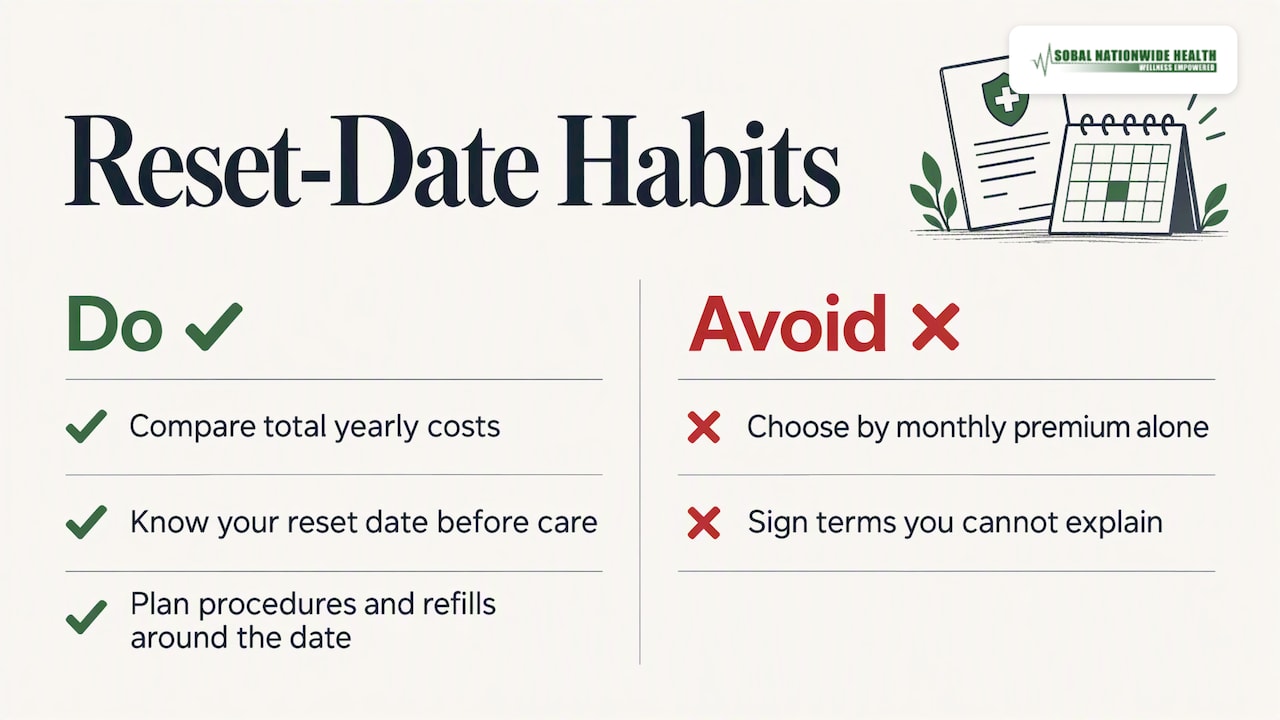
HealthCare.gov’s own guidance says to compare total yearly costs, not premiums alone. We agree, and we’d add a second habit: know your reset date before you need care. That date tells you when to schedule a procedure, when to refill a long-term prescription, and when a low-premium, high-deductible plan will cost you more than it seems.
There’s also a bigger choice. If you earn too much for Marketplace subsidies, a private, medically underwritten plan may offer different deductibles, networks and pricing than a Marketplace plan. Whether it fits depends on your health history and the policy’s terms, and we’ll walk through both options with you. Our look at open enrollment and private plans vs. Marketplace goes deeper on that choice. We never push a plan, and we’d rather you understand the fine print than sign something you can’t explain.
— Bernie S
Plan around your reset date
Once you know your date, a few simple habits can save real money.
Before the reset
- Check your portal for how much of the deductible you’ve met.
- If you’ve met it and have care you were already planning, look at scheduling it before the reset, with your doctor’s input.
- Refill and organize paperwork so you know which claims fall in which year.
After the reset
- Expect to pay more at the start of the year for deductible-subject care.
- Build a small cash cushion for January and February, which is especially important if your income swings from month to month.
- Look up whether your preventive visits are covered before the deductible.
At enrollment time
- Ask whether the deductible is calendar year or plan year.
- Ask whether there are separate deductibles for drugs or specific services.
- Compare total yearly costs under a healthy year and a bad year.
If you want to compare numbers by state, our guide to deductibles, copays and out-of-pocket maximums in Florida is a good example of how to read the pieces together. For more questions, the health insurance FAQ and cost calculators can help.
Not sure which plan fits your year? Talk to us
We’re a health insurance brokerage helping self-employed people, families and small businesses in 31 states. We offer private medically underwritten plans, ACA Marketplace plans, dental, vision and supplemental coverage, with advisors who speak English or Spanish. We’ll review your current policy, point out when your deductible resets, and explain the trade-offs without sales pressure.
See our personal and family insurance options or visit sobalhealth.com to book a conversation.
FAQ
Does my deductible reset on January 1?
On most individual and family Marketplace plans, yes. Many employer plans also use a calendar year, but some use a plan year that starts on another date. Check your SBC and plan documents rather than assuming.
How do I see when my deductible resets?
Open your Summary of Benefits and Coverage and look at the coverage period at the top of the first page. Then confirm in your policy or Summary Plan Description, or ask your insurer or benefits administrator in writing whether the deductible runs on a calendar, plan or policy year.
When you switch insurance, does your deductible reset?
Usually, yes. A new plan generally applies its own deductible and cost-sharing period. Some plans offer a deductible credit, but it’s plan-specific, so get it in writing before you count on it.
Do I owe 100% until I reach my deductible?
Often, for covered in-network services that are subject to the deductible. Preventive care may be covered earlier, some plans use copays before the deductible, and separate medical or drug deductibles can apply. Premiums and noncovered care don’t count toward the deductible or out-of-pocket maximum.
Sources
- Plan year, HealthCare.gov glossary
- Your total costs for health care, HealthCare.gov
- Changing plans outside Open Enrollment, HealthCare.gov
- Summary of Benefits and Coverage template, CMS
- No Surprises: Health insurance terms you should know, CMS
- SBC instructions for group health plans, U.S. Department of Labor
- Workers’ right to health plan information, U.S. Department of Labor
