

Your health insurance effective date is the day your coverage actually begins, usually the first of a month, and it’s set by when you select a plan, not when you apply. There are a few notable exceptions, like retroactive coverage for a new baby, and in nearly every case you still need to pay your first premium before that coverage is usable. Federal guidance from Healthcare and CMS spells out the rules, and we walk you through them below.
TL;DR:
- Federal Marketplace enrollment by December 15 starts January 1; enrollment from December 16 through January 15 starts February 1, while state exchanges may set different deadlines.
- After losing coverage, moving, marrying, or having a child, enroll within 60 days to use a Special Enrollment Period; coverage usually starts the following month.
- Birth and adoption can qualify a child for coverage from the event date, even after later enrollment, but premiums apply retroactively.
- An assigned effective date does not make coverage usable: insurers need the first premium, commonly within 30 days, though some set earlier deadlines.
- Most employer group plan waiting periods cannot exceed 90 days; ask HR for your hire date, waiting period, and paperwork deadline.
Table of Contents
- What the effective date actually means
- Open Enrollment deadlines and how they set your start date
- Special Enrollment Periods: qualifying events and the 60-day window
- Employer coverage, waiting periods, and the 90-day cap
- Effectuation: the payment step that actually turns on coverage
- Newborns, adoption, and other retroactive coverage rules
- How broker support helps you avoid an effective-date gap
- Get help confirming your effective date today
- FAQ
- Sources
What the effective date actually means
We hear this mix-up constantly: people assume their coverage starts the moment they hit submit on an application. It doesn’t. There are three separate dates worth knowing, and confusing them is how coverage gaps happen.
- Application date: when you submit your information to the Marketplace or carrier.
- Plan selection date: when you actually choose and confirm a specific plan.
- Effective date: the day the insurer’s coverage actually kicks in, which is almost always the first day of a month.
Insurers use “first of the month” logic for administrative simplicity. It lets them batch enrollments, update records, and sync billing cycles instead of tracking coverage that starts on random days.
This is why timing matters more than people expect. If you select a plan on January 28 instead of January 25, you might miss a processing cutoff and get pushed to a March 1 start date instead of February 1. A few days’ delay in plan selection, not application, can cost you a full month of coverage.
Open Enrollment deadlines and how they set your start date
Open Enrollment on the federal Marketplace runs November 1 through January 15, and your enrollment date within that window determines your coverage start date. The rule is straightforward once you see it laid out:
- Enroll by December 15 and coverage begins January 1.
- Enroll between December 16 and January 15 and coverage begins February 1.
Open Enrollment runs November 1 to January 15 on the federal Marketplace, with the two-tier deadline system above determining whether you start the new year covered or wait an extra month.
If you already have Marketplace coverage, you likely don’t need to lift a finger. Most plans auto-renew, which is why many people stay covered on January 1 without actively reelecting anything. That said, auto-renewal can also roll you into a plan with different costs or network terms than you’d choose on purpose, so it’s worth a quick review each year rather than letting it happen passively.
One more wrinkle: not every state uses the federal deadlines. State-run exchanges can set their own Open Enrollment windows and cutoff dates, so if you’re shopping through a state marketplace rather than HealthCare.gov, check that state’s site directly before assuming the December 15 and January 15 dates apply to you.
Special Enrollment Periods: qualifying events and the 60-day window
Life doesn’t wait for Open Enrollment, which is why Special Enrollment Periods (SEPs) exist. A qualifying event opens a 60-day window to enroll outside the normal calendar, and understanding the timing rules here prevents a lot of unnecessary stress.
- Identify your qualifying event: losing other coverage, moving to a new area, getting married, or having a baby or adopting a child are the most common triggers.
- Enroll within 60 days of the event to use the SEP; miss the window and you’ll generally wait for the next Open Enrollment.
- Expect a first-of-next-month start date in most cases. Under 45 CFR 155.420, Marketplace coverage from an SEP typically begins the first day of the month after you select a plan.
- Check for retroactive options: birth and adoption are exceptions, letting coverage start on the actual date of the event rather than waiting for the following month.
- Ask about effective-date choice: some loss-of-coverage SEPs let you pick between effective-date calculation methods, which can help you avoid a gap between your old plan ending and the new one starting.
Travel nurses and other workers with variable contracts face this timing pressure often; our guide on acting within 60 days to avoid coverage gaps walks through the specifics.
Employer coverage, waiting periods, and the 90-day cap
If you’re starting a new job, your effective date depends on your employer’s waiting period, which is the stretch of time between your hire date and when you become eligible to enroll in the group plan. Employers set their own waiting periods, but they’re not unlimited.
- Federal rules under the Public Health Service Act, enforced through Department of Labor guidance, cap most group plan waiting periods at 90 days.
- Many employers align enrollment with payroll periods, so your actual start date might land on the first of a pay period rather than your exact hire date.
- Ask HR for three things when you’re hired: your official hire date, the length of the waiting period, and any enrollment paperwork deadlines. Those three answers let you project your effective date accurately.
Effectuation: the payment step that actually turns on coverage
Here’s the part people miss most often: having an effective date assigned doesn’t mean your coverage is usable yet. You still need to pay your first premium, known as the binder payment, to effectuate the policy.
CMS guidance on coverage effectuation confirms that insurers commonly allow up to 30 days from your effective date to receive that first payment, though some carriers set earlier deadlines. Until that payment posts, providers may not be able to verify your coverage at all, even on paper your policy looks active.
- Pay your binder premium as soon as you can after enrolling, not at the deadline.
- Keep a receipt or payment confirmation in case of a billing dispute later.
- Get written confirmation of your effective date directly from the insurer.
- Follow up with both the insurer and the Marketplace if confirmation doesn’t arrive within a few days.
Pro Tip: Call your insurer a week after paying your binder premium to confirm the payment posted and your effective date is locked in, don’t wait for a bill to find out something went wrong.
Newborns, adoption, and other retroactive coverage rules
A few situations override the standard first-of-month rule entirely. Birth and adoption are the clearest examples: coverage can start on the actual date of the event, even if you formally enroll the baby or child weeks later, though you’re generally responsible for premiums covering that retroactive period.
- Newborns and newly adopted children typically get a window to be added with coverage backdated to the event date; our guide on 30 and 60 day deadlines for adding a newborn covers the documentation involved.
- COBRA continuation coverage interacts with Marketplace SEP timelines, so losing a job and COBRA eligibility both matter for your enrollment window, as detailed in our piece on comparing COBRA vs Marketplace coverage.
- Loss-of-coverage SEPs sometimes let you choose which effective-date calculation applies, which can close the gap between an old plan ending and a new one starting.
How broker support helps you avoid an effective-date gap
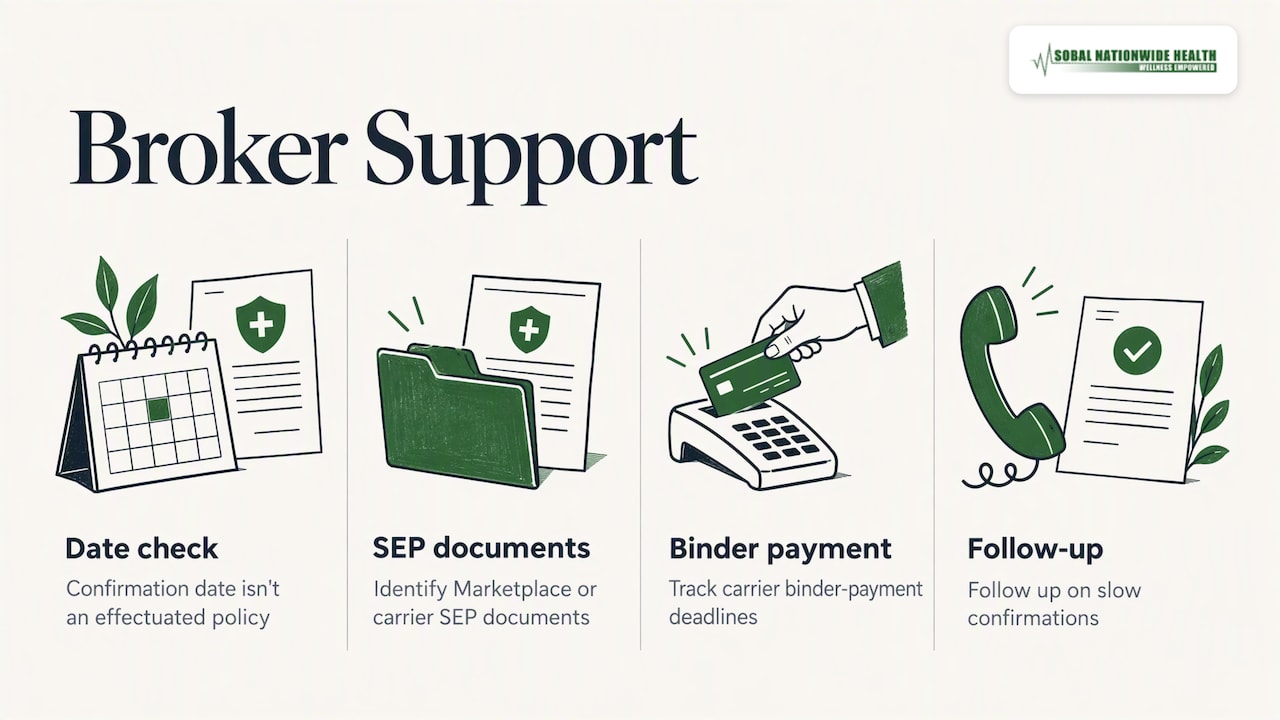
We spend a good portion of our day confirming effective dates for clients, because an assigned date on a Marketplace confirmation screen isn’t the same as a verified, effectuated policy—learn more about the how to switch therapists without losing coverage process to avoid gaps. When a client has a qualifying event, we help identify which documents the Marketplace or carrier will require to confirm SEP eligibility under HealthCare.gov’s verification process, so coverage doesn’t stall after an effective date is already on the books.
We also track binder payment deadlines directly with carriers and follow up when confirmation is slow to arrive. Our brokers work in English and Spanish, and we’ve guided many clients through exactly this kind of SEP timing. If you want a second set of eyes on your projected start date, our SEP eligibility guide for Florida is a good place to start.
Get help confirming your effective date today
We built our brokerage around exactly this kind of timing question: self-employed individuals, families, and small business owners who need someone to confirm a start date, check a deadline, and make sure the first premium actually posts before they show up at a doctor’s office assuming they’re covered.

- We review your enrollment or SEP documentation and flag anything a carrier might reject.
- We confirm your projected effective date in writing before you pay your first premium.
- We follow up with the insurer if effectuation confirmation is delayed.
Working with a broker costs you nothing extra since we’re paid by the carrier, not by you. Visit Sobal Health to connect with a licensed broker and get your effective date confirmed before it becomes a problem.
FAQ
What does effective date mean for health insurance?
Your effective date is the specific day your insurance policy actually begins covering you, separate from the day you applied or selected a plan. It’s typically the first day of a month, though exceptions exist for birth and adoption that allow retroactive start dates.
How do I know my insurance effective date?
Your Marketplace or carrier confirmation should state the effective date directly, but it’s worth calling to verify it in writing rather than relying on a portal screen alone. If you enrolled through HealthCare.gov, your account dashboard will also display the date once processing is complete.
Can I use my insurance on the effective date?
Only if your first premium payment has posted. CMS guidance confirms that coverage must be effectuated through binder payment before claims can be paid, even if the effective date has technically arrived.
How soon does health insurance go into effect?
For Open Enrollment, coverage generally starts January 1 or February 1 depending on when you enroll, per the December 15 and January 15 deadlines. For Special Enrollment Periods, coverage usually starts the first of the month after you select a plan, with birth and adoption as the main exceptions allowing an earlier start.
Sources
- Healthcare
- 45 CFR 155.420 — Special enrollment periods and effective dates
- Understanding Your Health Plan Coverage: Effectuations, Reporting Changes, and Ending Enrollment — CMS
- DOL technical release on 90-day waiting period limitation
