

If you lose job-based coverage in Texas, your main alternatives to COBRA are a Marketplace plan, a spouse’s or parent’s plan, or a private medically underwritten PPO. Marketplace plans have a 60-day enrollment window, so the clock starts the day your coverage ends.
I’m Bernie, a licensed independent broker, and I talk with people in this spot every week: self-employed workers, 1099 contractors, small business owners, young adults turning 26 and families leaving a spouse’s employer plan. This guide walks through each option in plain English, compares a private PPO with the Marketplace honestly, and shows you what to do first.
TL;DR
- COBRA keeps your exact old plan, but you pay the full premium plus a small fee. That is often the costliest route.
- You generally have 60 days from losing coverage to pick a Marketplace plan. A spouse’s or parent’s plan has a shorter window, 30 days.
- Texas also has state continuation, which can extend coverage after COBRA ends or apply when COBRA does not.
- If you are healthy and earn too much for subsidies, a private medically underwritten PPO can be worth pricing. We work with these plans in Texas.
- Don’t cancel COBRA early until your new coverage has a confirmed start date.
Table of Contents
- Why COBRA feels so expensive
- Your main COBRA alternatives in Texas
- Private PPO vs. Marketplace: an honest comparison
- When keeping COBRA makes sense
- Know the deadlines before you decide
- Don’t forget dental and vision
- Special situations in Texas
- A note on Medicare and Medicaid
- Perspective
- How to choose in five steps
- Get both options priced
- FAQ
- Sources
Why COBRA feels so expensive
COBRA lets you keep the plan you had at work. The catch is the bill. According to the Texas Department of Insurance 2026 Health Coverage Guide, you pay 100% of the premium, including the share your employer used to cover, plus a small administrative fee.
For a sense of scale, the Texas Employees Retirement System lists its Plan Year 2026 COBRA rates (including a 2% administrative fee) at $639.95 to $685.85 a month for you alone, and $1,845.06 to $2,002.70 a month for a family. That is one state program, not a quote for your employer’s plan. Your own COBRA notice will show your actual number.
The premium is the price of getting in the door. What you also care about is the deductible, the network and what you could owe in a bad year. So the real question is not only “what does COBRA cost?” but “what else could I buy for that money?”
Your main COBRA alternatives in Texas
The Texas Department of Insurance lists several routes on its health insurance options page: Marketplace plans, state continuation, group plans through associations, churches or colleges, and coverage through a spouse or parent. Here is how they look for the people I work with.
Marketplace (ACA) plans
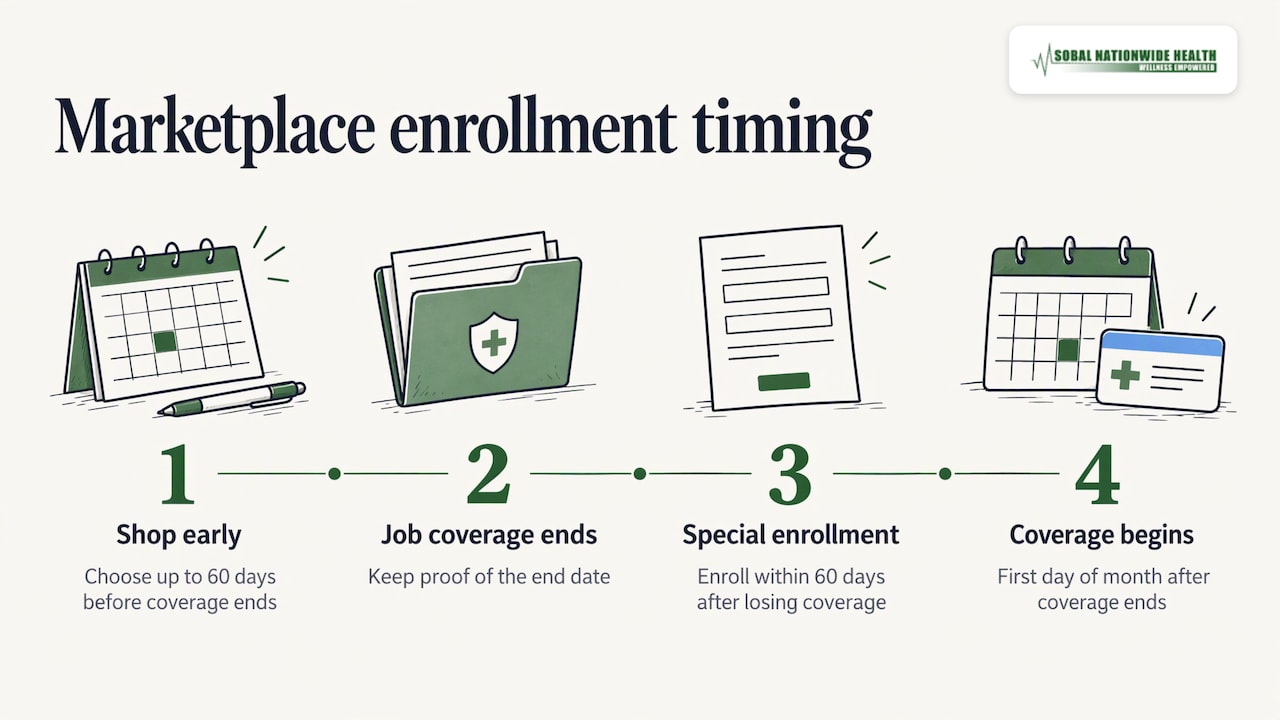
If you leave your job for any reason, even if you quit or were let go, HealthCare.gov says you can enroll in a Marketplace plan within 60 days of losing job-based coverage. Coverage can start the first day of the month after your job-based coverage ends.
You can also shop early. The CMS guide to losing job-based coverage notes you can pick a plan up to 60 days before your coverage ends, so there is no gap. Keep proof of your coverage end date, because you may need it for the special enrollment application.
Marketplace plans may come with premium tax credits, which lower the monthly bill. The Texas Department of Insurance notes that if you lost your job and don’t know when you’ll find another, a Marketplace plan with a tax credit may be the best affordable choice. Whether you qualify depends on your income.
A spouse’s or parent’s plan
If your spouse or parent has job-based coverage, you may be able to join it. The U.S. Department of Labor’s COBRA FAQs say the special enrollment right lasts 30 days from losing your job-based plan. That window is half as long as the Marketplace’s, so check it first.
Two groups I see often:
- Young adults turning 26. Aging off a parent’s plan is a loss of coverage, so you have a window to move to your own plan. Don’t wait for the last day.
- Families priced out of a spouse’s family plan. The employee-only price may look fine, while adding the family makes the premium jump. It is worth comparing that family premium with an individual plan for each person.
Texas state continuation
Texas adds its own layer. The Texas Department of Insurance explains that federal COBRA runs up to 18 months, and Texas law requires some group plans to let you keep your plan for six more months after COBRA ends. If you aren’t eligible for COBRA, you might still qualify for state continuation. You pay the premium either way.
The 2026 Texas Health Coverage Guide adds the details. Federal COBRA applies to employers with 20 or more employees. Texas state continuation, sometimes called mini-COBRA, covers employers with 2 to 19 employees. It can last up to 9 months, and it applies only to fully insured plans, not self-funded ones. Ask your former employer’s HR team which one applies to you.
Group plans through associations, churches or colleges
Some membership associations and churches offer group plans to members, and colleges often offer plans to students. The Texas Department of Insurance points out that group plans spread costs across more people, so they are usually less expensive than buying directly. Check the benefits and network before you rely on one.
A private medically underwritten PPO
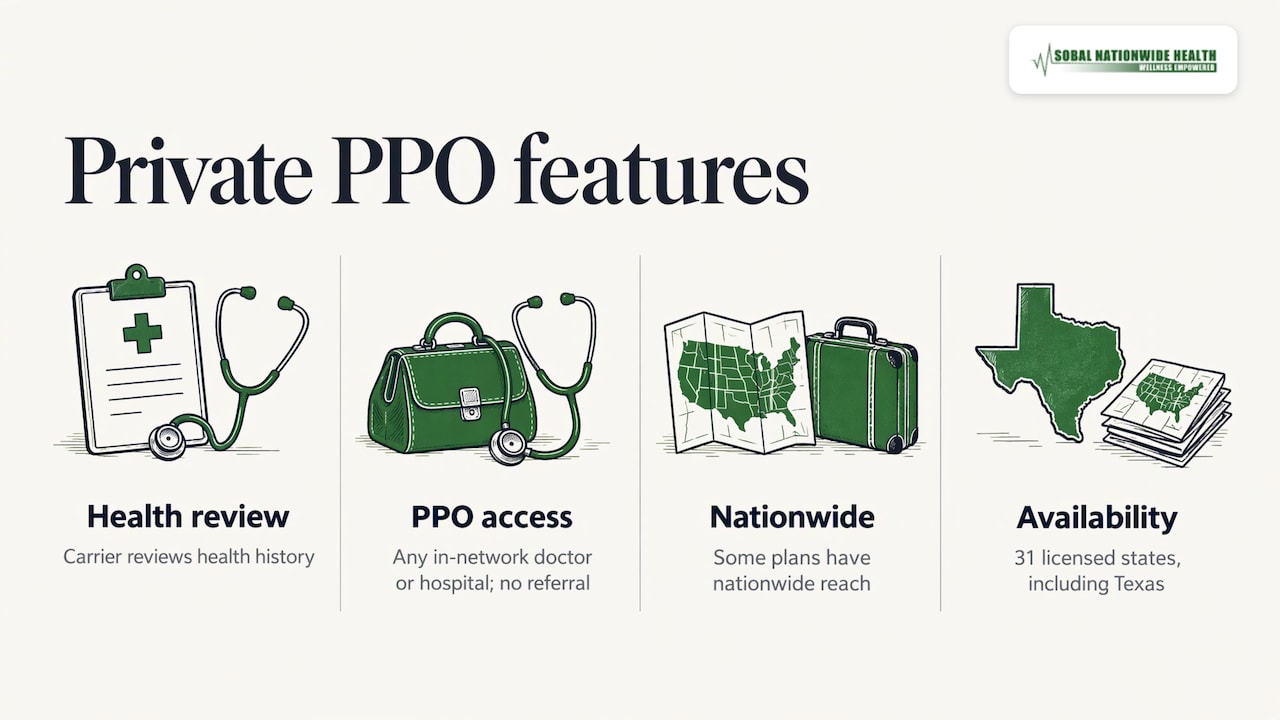
This is the option most people have never heard of. Private medically underwritten plans are not sold on the public Marketplace. The carrier looks at your health history when you apply, which is why they can be a strong fit for healthy people. It is also why we focus them on healthy buyers: healthy self-employed workers, active families and young adults.
Many of these plans are PPOs, which means you can see any doctor or hospital in a broad network without a referral, and some have nationwide reach. That matters if you travel for work, like our owner-operator truckers, or if you want to keep your current doctors. Some pre-existing conditions can be covered, but approval and terms depend on the carrier, so the application is where you find out.
We offer access to these plans in all 31 states where we are licensed, Texas included. You can read more on our page about medically underwritten health insurance.
Private PPO vs. Marketplace: an honest comparison
Neither is better for everyone. Here is how I walk clients through it.
| What you’re weighing | Marketplace (ACA) plan | Private medically underwritten PPO |
|---|---|---|
| Approval | Open to everyone who qualifies to enroll, no health questions | Carrier reviews your health history, so best for healthy applicants |
| Premium help | Tax credits may lower the premium, depending on income | No premium tax credits |
| Best fit | People whose income qualifies for meaningful credits | Higher earners who don’t get subsidies and want broad choice |
| Doctor choice | Depends on the plan’s network | Often a broad PPO, any doctor or hospital, some nationwide |
| Enrollment timing | Open Enrollment or a special enrollment period, such as the 60 days after losing job coverage | Application is reviewed by the carrier, so apply as early as you can |
| Standardized benefits | Plans follow ACA benefit rules | Benefits vary by plan, so a side-by-side review matters |
Here is the honest summary. If your income is low enough that tax credits cut your premium sharply, the Marketplace is usually where the math lands. If you earn too much for credits, a full-price Marketplace plan can feel steep for what you get, and that is where a private PPO is worth a quote. Some of our clients’ reviews report savings of up to $400 a month, though what you save depends on your age, health, location and the plan you choose.
We also offer ACA Marketplace plans. So when you talk to us, you get both sides priced, not one sales pitch.
When keeping COBRA makes sense
I don’t tell everyone to drop COBRA. The 2026 Texas Health Coverage Guide points out that COBRA may be your best option if you need specialized care that switching plans could complicate, since it gives you the exact same coverage you had before.
Common reasons to keep it, at least for a while:
- You are mid-treatment or mid-pregnancy and your doctors are in your old network.
- You have already met most of this year’s deductible and don’t want to start over.
- You expect a new job with benefits within a few months.
In those cases, price the alternatives anyway, so you know what you are paying for.
Know the deadlines before you decide
Timing is where people get hurt, so here are the dates that matter.
- 60 days to elect COBRA. The Department of Labor says this runs from when your coverage ends or when your election notice is provided, whichever is later. After you elect, you have 45 days to make the first payment.
- 60 days to pick a Marketplace plan. This runs from the loss of job-based coverage.
- 30 days to join a spouse’s or parent’s plan.
- Don’t cancel COBRA on a whim. HealthCare.gov says that if you drop COBRA early on your own, it doesn’t count as a loss of coverage for a special enrollment period. A CMS Q&A on COBRA adds that if you elect COBRA first, you can still use the Marketplace window until your original 60 days run out.
That last point is a useful safety net. You can elect COBRA to protect yourself while you shop, and still move to a Marketplace plan inside the 60-day window. If you want a deeper walk-through, our guide for U.S. workers comparing COBRA and the Marketplace lays out the steps.
Don’t forget dental and vision
COBRA can include dental and vision, and when you leave it, those benefits go too. Standalone dental and vision plans are separate purchases, and the rules around waiting periods and what a plan pays for bigger work vary a lot. If you are thinking about something like implants, read up on dental implants insurance before you pick a plan. You can also look at our guide to dental plans with no waiting period.
Special situations in Texas
Self-employed, 1099 and gig workers
You have no employer plan to fall back on, so the choice is between the Marketplace and private coverage. Realtors and truckers often work irregular income, which makes the tax-credit estimate harder to predict. A quote for both routes shows you the true spread. Our Texas affordable health insurance guide goes deeper, and if an accident would hurt your cash flow, see accident insurance for self-employed workers.
Small business owners with 2 to 30 employees
If your group is small, you may be both the person leaving a plan and the person choosing one for staff. Group options for small employers are different from individual plans, and Texas has its own rules, including the SHOP credit. See our page on Texas small business health insurance or our business health insurance overview.
Hablamos español
Nuestros agentes también atienden en español, directamente y sin presión de ventas.
A note on Medicare and Medicaid
We don’t offer Medicare or Medicaid. If you are 65 or older, or your income is low, we can’t help with those programs, and your best next step is to contact the official program for your situation.
Perspective
When someone calls me after a layoff, the first thing I hear is worry, not a question about premiums. People think they have to decide in a day. You don’t. You have a window, and inside it you can compare calmly.
What I’ve learned from years of sitting with Texas families is that COBRA is the default, not the best answer for everyone. It is easy because it is familiar, and many people pay for that comfort without ever seeing what else is out there.
At Sobal Health, we believe in education before enrollment. We show you the Marketplace and the private medically underwritten PPO side by side, in English or Spanish, and you choose. Because we are a brokerage, our service doesn’t cost you extra on top of the plan, and there’s no pressure. If a plan isn’t right for you, we’ll say so.
Bernie S
How to choose in five steps
- Find your dates. Write down the day your coverage ends, your COBRA election deadline and your Marketplace deadline.
- Get your COBRA price. It is on your election notice. Then check whether state continuation applies to your employer.
- Estimate your income. This tells you whether Marketplace tax credits are likely to matter.
- Look at your health honestly. If you are generally healthy, a private PPO may be an option. If you rely on current treatment, weigh keeping COBRA for continuity.
- Compare in one sitting. Put the monthly premium, deductible, out-of-pocket maximum and doctor network side by side. The out-of-pocket maximum is your financial safety net, so look at it, not just the premium.
Need extra reading? Our resource library explains these terms in plain language.
Get both options priced
Sobal Health helps self-employed people, families and small businesses in Texas and 30 other states compare private medically underwritten plans, ACA Marketplace plans, dental, vision and supplemental coverage. You talk to a licensed broker directly, with no sales pressure.

If you want to see what is available beyond COBRA, explore our personal and family coverage or talk with us about your situation. We don’t publish plan prices, because they depend on your age, health, location and plan design, so a quote is the way to see real numbers.
FAQ
Is COBRA required to be cheaper than other options?
No. COBRA is often the most expensive route because you pay the full premium plus a small fee. It is not automatically worse, though, since it keeps your exact plan and network. Compare it with at least a Marketplace quote and, if you’re healthy, a private PPO quote.
How long do I have to leave COBRA for the Marketplace?
You have 60 days from losing your job-based coverage, and you can elect COBRA and still use that window. If you drop COBRA voluntarily after the 60 days pass, you generally wait until the next Open Enrollment unless you qualify for another special enrollment period. When COBRA runs out, you get a new 60-day window.
What is Texas state continuation?
It is Texas law that lets some people keep group coverage after leaving a job or after COBRA ends. For employers with 2 to 19 employees, it can last up to 9 months, and it applies to fully insured plans only. You pay the premium yourself.
Can I get a private PPO if I’m self-employed?
Yes, if you qualify. Private medically underwritten plans review your health history, so they tend to suit healthy self-employed people, active families and young adults. We can show you which carriers are available in Texas and what they ask for.
Do you offer Medicare or Medicaid?
No. We don’t offer Medicare or Medicaid. We help with private medically underwritten plans, ACA Marketplace plans, dental, vision, supplemental accident and critical illness coverage, and group plans for small businesses.
Sources
- Texas Department of Insurance: Need health insurance? How to find a new health plan now
- Texas Department of Insurance: 2026 Texas Health Coverage Guide
- Texas Employees Retirement System: COBRA for employees
- HealthCare.gov: See your options if you lose job-based health insurance
- HealthCare.gov: Getting health coverage outside Open Enrollment
- CMS: Losing Job-based Coverage
- CMS: Understanding COBRA webinar Q&A
- U.S. Department of Labor: FAQs on COBRA Continuation Health Coverage for Workers
- Dental implants insurance: what to expect and how to pay
