






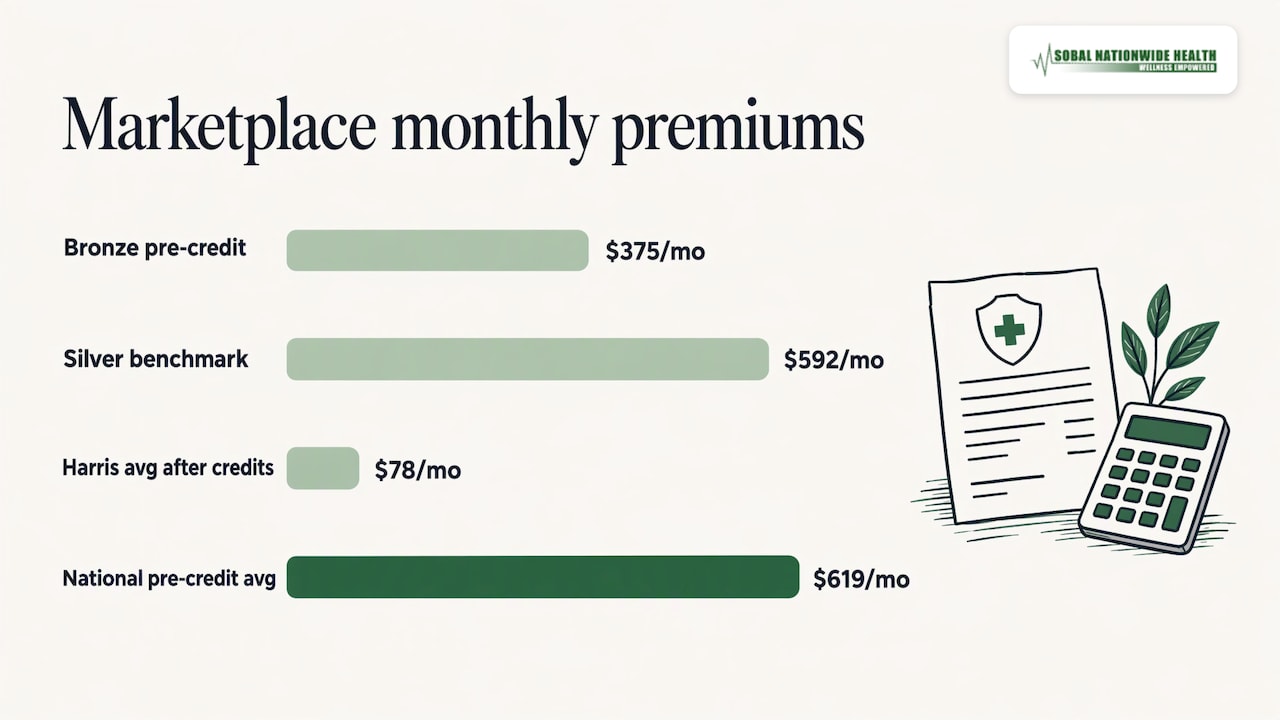
In Harris County, the 2026 benchmark Silver plan on the ACA Marketplace costs a 40-year-old about $592 a month before tax credits, and the cheapest Bronze plan about $375. Private PPO-style plans are priced on your own application, so the number depends on your age, your household and the network you pick, and the fastest way to see yours is a quote with a licensed broker.
I’m Bernie Sobalvarro, a licensed broker, and I talk with Houston freelancers, 1099 contractors, small business owners and families about this every week. This guide gives you the real price points, explains what moves them, and shows how to compare plans on total cost instead of the monthly bill alone.
TL;DR
- Before tax credits, Harris County Marketplace plans start around $375 a month for a 40-year-old on the cheapest Bronze plan, with the benchmark Silver at $592.
- Age, location, tobacco use, household size and plan category drive Marketplace premiums. Private plans are priced through an application, so your quote is your own.
- The premium is only the price of getting in the door. Deductible, coinsurance and the out-of-pocket maximum decide what a bad year costs.
- Self-employed people, 1099 contractors, families leaving COBRA and young adults turning 26 each have a different cost picture, covered below.
- We don’t offer Medicare or Medicaid.
Table of Contents
- What health insurance costs in Houston in 2026
- What moves your premium
- The premium is only the price of getting in the door
- Houston self-employed and 1099 workers
- Private plans compared with Marketplace plans
- Other Houston situations
- How to compare Houston plans in five steps
- Get a Houston quote from a licensed broker
- Our view from the broker’s chair
- FAQ
- Sources
What health insurance costs in Houston in 2026
Start with the public numbers, because they give you a reference point. According to a 2026 Harris County price summary, 119 Marketplace plans from 7 insurers are sold in the county. For a 40-year-old, before any tax credits, the cheapest Bronze plan runs $375 a month and the benchmark Silver plan runs $592.
Those are list prices. Nationally, the Centers for Medicare & Medicaid Services reports that the average Marketplace premium for 2026 was $619 a month before tax credits and $178 after. Harris County enrollees who received credits paid an average of $78 a month after them.
Here is why I lay out both numbers. The list price is what you pay if you earn too much for help, and many of the people I work with do. Self-employed professionals, realtors with a strong year and owner-operators with solid income often land above the subsidy range, so the “after credits” figures are not their reality.
A quick reference table
| Figure | Amount | Applies to |
|---|---|---|
| Cheapest Bronze, before credits | $375 a month | Age 40, Harris County, 2026 |
| Benchmark Silver, before credits | $592 a month | Age 40, Harris County, 2026 |
| Average after credits | $78 a month | Harris County enrollees, 2026 |
| National average before credits | $619 a month | All 2026 Marketplace enrollees |
| Employer family coverage, full premium | $26,281 a year | U.S. average per enrolled employee, 2025 |
| Employer single coverage, full premium | $9,025 a year | U.S. average per enrolled employee, 2025 |
The employer figures come from federal survey data compiled by KFF. Of the $26,281 family total, employees paid $7,314 and employers paid the rest. That gap is why a family priced out of a spouse’s plan often finds the employer’s family tier expensive: the employee share can be large even when the employer covers most of the total.
These are published figures for one period. Premiums are reset each year, so use them as a yardstick and not as your quote.
What moves your premium
In the Marketplace, federal rules limit what an insurer can look at. HealthCare.gov explains that premiums can vary by only five things: age, location, tobacco use, individual or family enrollment, and plan category. Older enrollees can be charged up to 3 times as much as younger ones, and tobacco users up to 50% more.
Here is how I explain each one to Houston clients.
- Age. The biggest lever. A 27-year-old and a 58-year-old in the same zip code see very different prices.
- Location. Harris County is one rating area, but a move to a neighboring county can change which insurers and prices you see.
- Household size. Adding a spouse and children raises the premium, and so does the number of people on the application.
- Plan category. Bronze, Silver and Gold trade monthly premium against what you pay when you use care.
- Network type. This one is not in the five factors, but it changes the price and your experience.
Networks: why PPO-style coverage costs what it does
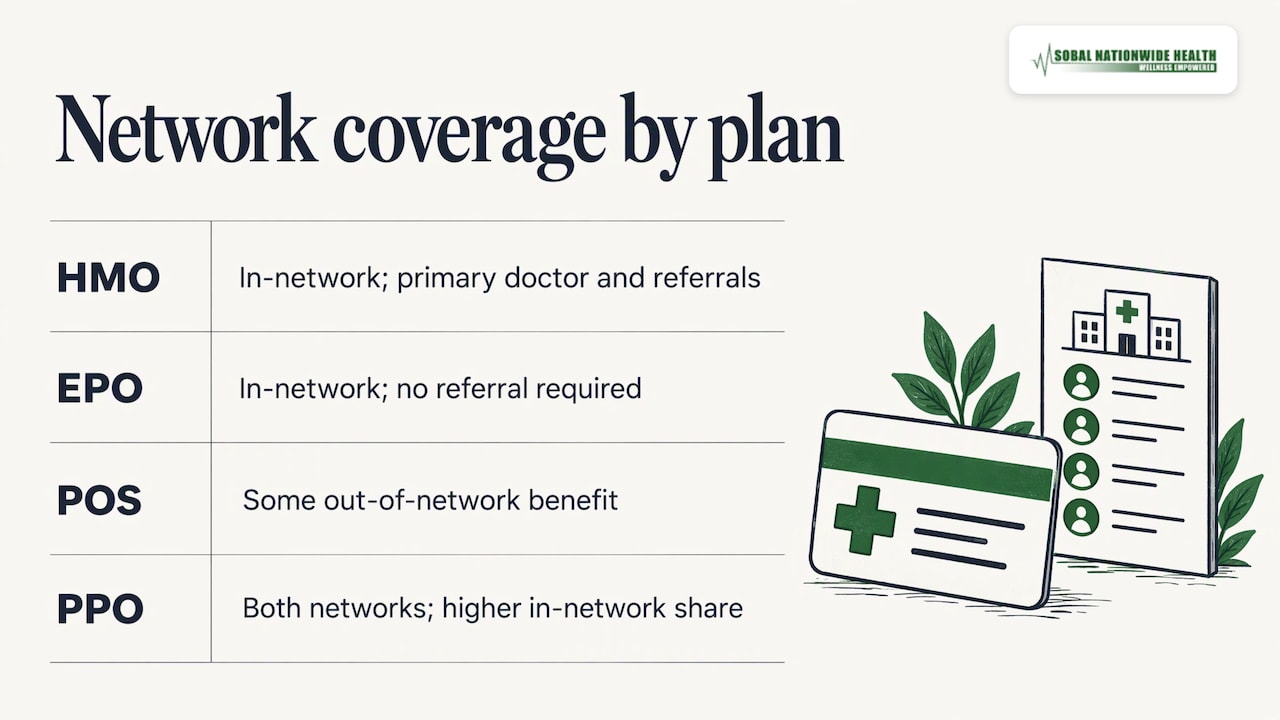
The Texas Department of Insurance explains the network types in its 2026 Texas Health Coverage Guide. HMOs cover in-network care only, except emergencies, and require a primary care doctor and referrals. EPOs also stay in network but skip the referral rule. POS plans add some out-of-network benefit. PPOs cover both in- and out-of-network care, paying a higher share when you stay in network.
Many of the people I help want PPO-style choice: the freedom to see the specialist they want at the hospital they prefer, including when they travel. That flexibility is a reason people look at private plans, and it is a pricing factor too, so compare it deliberately. If nationwide doctor choice is your priority, our page on nationwide PPO health insurance explains what to look for.
The premium is only the price of getting in the door
I like to say the premium gets you in the door. It does not tell you what happens once you are inside. Four terms decide that:
- Premium: what you pay every month to keep the plan active.
- Deductible: what you pay for covered care before the plan starts sharing costs.
- Coinsurance: your percentage of the bill after the deductible is met.
- Out-of-pocket maximum: your financial safety net, the most you pay in a plan year for covered in-network care.
The Texas Department of Insurance advises shoppers to look at both premium and out-of-pocket costs, noting that lower-premium plans often carry higher cost-sharing. In its guide, it also notes that ACA-compliant plans cover preventive services without cost-sharing, even before the deductible is met.
A worked example
Imagine two plans for the same Houston household. Plan A has a lower monthly premium and a high deductible. Plan B costs more each month but has a lower deductible and a PPO network that includes your pediatrician and your orthopedist. If your family rarely uses care, Plan A may cost less over the year. If someone needs an MRI and a procedure, Plan B may cost less in total. The way to decide is to add twelve months of premiums to your realistic share of costs, then compare the totals. These are illustrative figures, not quotes.
It also helps to know what routine services cost before you pick a deductible. For example, imaging prices vary a lot; this breakdown of what a DEXA scan costs with and without insurance shows how much the same service can differ depending on coverage.
Houston self-employed and 1099 workers
If you are self-employed or work 1099, you buy as an individual, and your income can change month to month. That makes the cost question sharper: you are paying the full list price, or something close to it, whenever your income is above the subsidy range.
The subsidy range is real, so here is how it works. KFF’s subsidy calculator explains that premium tax credits go to people with family incomes between 100% and 400% of the federal poverty level, who pay between 2.15% and 10.22% of income for the benchmark Silver plan. The enhanced credits that were in place through 2025 expired at the end of 2025, per the CMS 2026 enrollment report. Which rules apply to you depends on your income, so please check with a tax professional. This is not tax advice.
What I can tell you from the broker side is where people in this group often land:
- Realtors and real estate agents: income is commission-driven, so a strong quarter can move you above subsidy limits. A private PPO-style plan with nationwide doctor choice is worth pricing next to a Marketplace plan.
- Owner-operator truckers: you are on the road, so a network that works outside Houston matters as much as the premium.
- Freelancers and gig workers: a plan you can keep as your client list changes is more useful than one tied to a single job.
Our 1099 contractor health insurance page and our guide to self-employed health insurance in Texas go deeper on each of these.
Private plans compared with Marketplace plans
Marketplace plans are priced by the five factors above. Private, medically underwritten plans work differently: the insurer reviews your application before it sets your coverage and rate. For healthy buyers, that can lead to a different price and a broader network than the public list shows. We offer access to private plans that are not available on the public Marketplace, and our private PPO health insurance in Texas page explains how they fit.
I don’t publish private plan prices, because they depend on your age, household and the plan you choose, and I won’t guess at them. What I can say is that we’ve seen client reviews report savings of up to $400 a month, on the client’s own site. Your result will differ, and I can’t promise coverage or savings. Underwriting means an insurer decides whether to offer you a plan, so approval is not guaranteed.
To get started, we only need your zip code and birthdates. We don’t ask health questions on the quote form. If you want a side-by-side of your own numbers, see our cost check of private health insurance versus the Marketplace.
Other Houston situations
Leaving a job and weighing COBRA
COBRA lets you keep your employer’s plan for a time after you leave, but you typically pay the full premium plus an administrative fee, so the monthly cost can surprise you. Compare that bill with other private options before you elect. Our guide to COBRA alternatives in Texas walks through the choices.
Families priced out of a spouse’s plan
Employer coverage looks cheap for one person and costly for a family. With U.S. employer family premiums averaging $26,281 a year in 2025, the employee share can be a big bill. If your household earns above subsidy limits, it is worth pricing a private PPO-style family plan as well. Our page on private family health insurance for higher earners in Texas covers that case.
Turning 26
If you are leaving a parent’s plan, you are a single adult buyer, and age is a mild factor in your favor: rating by age means younger adults pay less than older ones. Start looking before your coverage ends so you have time to compare.
Small business owners with 2 to 30 employees
Group coverage, level-funded arrangements and individual plans each have rules about eligibility and contributions. I’m not able to set up a plan for you in an article, and an agent can walk you through all the options. Our small business health insurance options page and the Texas small business health insurance guide are good starting points, and the business page shows what we handle.
How to compare Houston plans in five steps
- Write down your must-haves. List the doctors, hospitals and prescriptions you use, and whether you travel.
- Pick a network type. Decide if PPO-style flexibility is worth a higher premium to you.
- Price the full year. Add twelve premiums to your likely cost-sharing, then check the out-of-pocket maximum for the worst case.
- Check your income against the subsidy range. A tax professional can confirm where you stand.
- Ask for quotes on more than one kind of plan. Compare private and Marketplace options on the same household.
If you’d like help, we do consultations by phone or webinar screen share, in English or Spanish, with no sales pressure. You can also browse our resource library for plain-English explainers, or read our broader Texas health insurance cost guide.
Get a Houston quote from a licensed broker
We help self-employed people, families and small businesses compare private plans and Marketplace plans across 31 states, and we have a page for Houston health insurance brokers. Personal and family coverage, including dental and vision, is on our personal and family insurance page.

We don’t offer Medicare or Medicaid. Our focus is adults ages 18 to 64 who want private, PPO-style coverage with nationwide doctor choice.
Our view from the broker’s chair
Most people who ask me what health insurance costs in Houston are really asking two questions: what will I pay every month, and what will I pay when something goes wrong? The public price lists answer the first one. They rarely answer the second.
We built our practice around the person the standard lists forget: the self-employed professional who earns too much for help, the family squeezed by an employer’s family tier, the freelancer between jobs. For those readers, we think private, medically underwritten plans with PPO-style networks deserve a place in the comparison, because they can change both the premium and your choice of doctors.
Our approach is education before enrollment. We walk through the premium, deductible, coinsurance and out-of-pocket maximum with you, by phone or webinar screen share, in English or Spanish, so the decision is yours and you feel confident making it. We don’t promise coverage or savings, because the plan has to fit you and the insurer has to approve you.
If you take one thing from this page, let it be this: compare the whole year, not just the monthly bill.
Bernie S
FAQ
How much is health insurance per month in Houston?
In 2026, the benchmark Silver Marketplace plan in Harris County costs a 40-year-old about $592 a month before tax credits, and the cheapest Bronze about $375, per a county price summary. Private plan prices depend on your application, so a quote is the only reliable number.
Is $200 a month expensive for health insurance?
It depends on the plan and your household. A low premium can come with a high deductible, so compare the premium plus the cost-sharing you could face in a year. Houston prices before tax credits for one adult are often higher than $200, so the figure depends on your age and plan.
What makes my Houston premium different from a neighbor’s?
Age, tobacco use, household size and plan category are the main Marketplace factors, per HealthCare.gov. Network type and deductible also change what you pay.
Can I get a private PPO plan if I earn too much for subsidies?
Many self-employed and high-earning buyers look at private PPO-style plans. They are medically underwritten, so approval depends on the insurer’s review of your application. A broker can show you what is available for your age and household.
Do you help with Medicare or Medicaid?
No. We don’t offer Medicare or Medicaid. We work with adults ages 18 to 64 who want private coverage.
Sources
- Harris County, TX Health Insurance Plans & Prices (2026)
- How Health Insurance Marketplace Plans Set Your Premiums, HealthCare.gov
- 2026 Texas Health Coverage Guide, Texas Department of Insurance
- Health Insurance Exchanges 2026 Open Enrollment Report, CMS
- Health Insurance Marketplace Calculator, KFF
- Average Annual Family Premium per Enrolled Employee, KFF
- DEXA Scan Cost in 2026: With or Without Insurance
Ready to see your own numbers? Get a free quote at https://sobalhealth.com/#quote or call (305) 680-0125.
Recommended
- How Much Is Health Insurance in Texas? 2026 Monthly Costs
- Self-Employed Health Insurance in Texas (2026 Guide)
- How to Find Affordable Health Insurance in Texas
- Private Family Health Insurance in Texas for Higher Earners
Related official guides