






In Miami-Dade County, the 2026 average benchmark premium for a family of four was $2,579 a month before any subsidy, and what an individual pays depends mostly on age, plan tier and income. If you earn too much for subsidies or you buy on your own, a private PPO-style plan can be priced very differently, and a licensed broker can show you both side by side.
I’m Bernie Sobalvarro, a licensed broker (NPN 19189235). Below I’ll walk you through the real numbers published for Miami, what moves your price up or down, and how to compare your options without guessing. We don’t offer Medicare or Medicaid, so this guide is for adults ages 18 to 64 shopping for their own coverage.
TL;DR
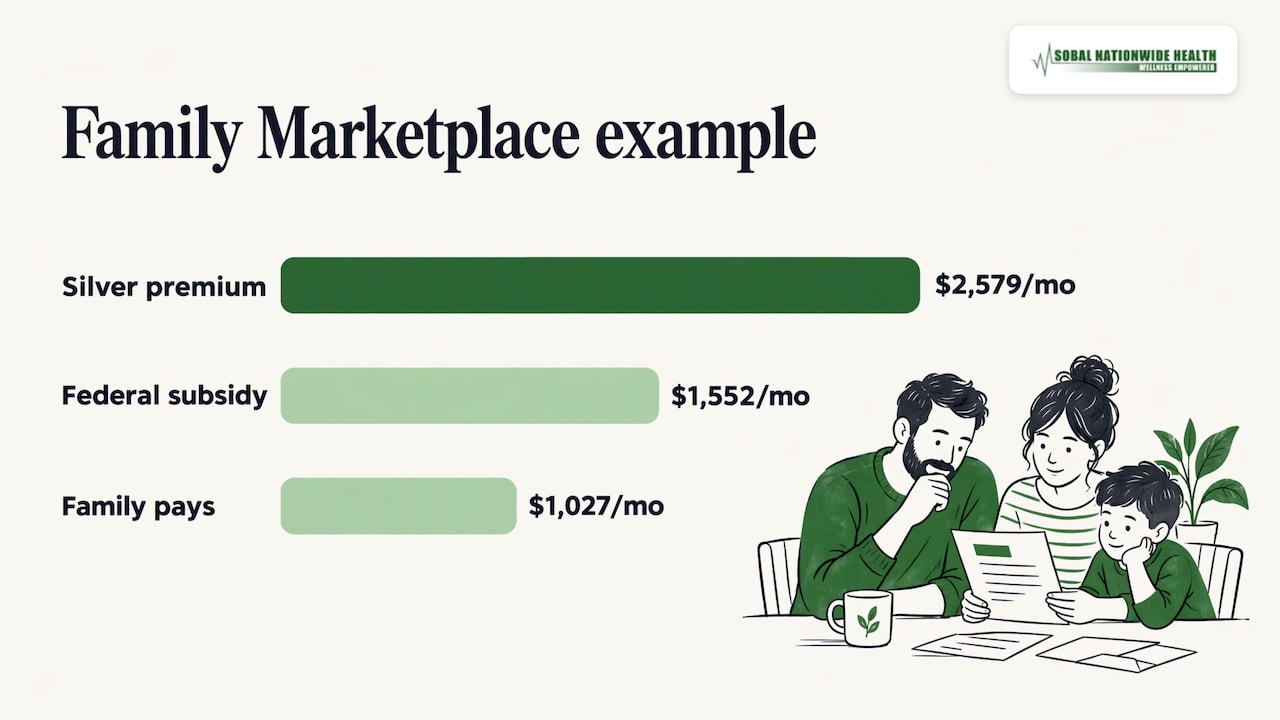
- Florida’s insurance regulator published a 2026 example for Miami-Dade: an average Silver family of four paid $2,579 a month in premiums before a subsidy, and $1,027 after one at an $85,000 household income.
- Marketplace insurers may set premiums using only five factors: location, age, tobacco use, individual vs. family enrollment, and plan category.
- The enhanced premium tax credits expired after tax year 2025, so many households contribute a larger share of income in 2026 than they did in 2025.
- Private, medically underwritten plans are priced differently from Marketplace plans, so people above the subsidy line often compare both before they decide.
- A free quote needs only your zip code and birthdates. We never ask health questions on the form.
Table of Contents
- What the published Miami numbers actually say
- What sets your premium: five factors
- Why the 2026 subsidy change matters in Miami
- Self-employed, 1099 and freelance: where the money goes
- Leaving COBRA, turning 26 or priced out of a spouse’s plan
- Small business owners with 2 to 30 employees
- How to get a Miami number that’s actually yours
- Our view: the sticker price is only half the story
- Get your Miami quote
- FAQ
- Sources
What the published Miami numbers actually say
There is no single “Miami price,” and anyone who gives you one number is guessing. What we do have is public data. The Florida Office of Insurance Regulation (OIR) publishes county-level examples every plan year. For 2026, its table shows the average Silver individual-market premium for a family of four in Miami-Dade County at $2,579 a month. That family was two 40-year-old adults and two 10-year-old children. In the same example, a household earning $85,000 received a $1,552 monthly federal subsidy, leaving $1,027 a month for the family to pay.
Two things to keep in mind when you read that example:
- It is an illustration, not a quote. OIR says the county examples are based on the Silver plans filed in each county and tells consumers to check healthcare.gov for actual premium and subsidy amounts.
- It is a Marketplace example. It describes one type of plan. Private, medically underwritten plans are a separate market with their own pricing.
If you want to see the raw material, HealthCare.gov publishes plan-level premium data going back to 2018 for adults of various ages, couples and families with children. It also notes that those prices don’t reflect the subsidies that tax credits apply automatically. The data is detailed but heavy, which is one reason many people ask a broker to pull the right rows for them.
For a broader look at the whole state, our guide to how much individual health insurance costs in Florida covers the same ground beyond Miami.
What sets your premium: five factors
The premium is the monthly amount that gets you in the door. You pay it whether or not you see a doctor that month. Everything else, the deductible, copays and coinsurance, is what you pay when you actually use care.
HealthCare.gov explains that Marketplace insurers may use only five factors to set premiums:
| Factor | How it affects your price |
|---|---|
| Location | Plans and prices are set by area, so Miami-Dade rates differ from other Florida counties. |
| Age | Older enrollees can be charged up to 3 times more than younger ones. |
| Tobacco use | Can add up to 50% more. |
| Individual vs. family | Covering more people raises the total. |
| Plan category | Bronze through Platinum: lower premiums usually come with higher out-of-pocket costs. |
That same page confirms that Marketplace insurers can’t use health status, medical history or sex. That’s the Marketplace rulebook. Private plans follow their own underwriting rules, which is why a quote comparison matters.
Premium, deductible and out-of-pocket maximum
Three terms drive most of the confusion, so here they are in plain English. The Florida state health encyclopedia, FloridaHealthFinder, describes them like this: you pay the premium whether or not you use services, out-of-pocket costs include copays, deductibles (which reset every year) and coinsurance, and the out-of-pocket maximum caps what you spend in a year. Costs are also lower when you use providers in your plan’s network.
Think of the out-of-pocket maximum as your financial safety net. The premium gets you in the door, the deductible is what you cover first, and the maximum is the ceiling.
Why the 2026 subsidy change matters in Miami
If you shop on the Marketplace, your cost depends on a tax credit. The Congressional Research Service explains that the credit is based on the second-lowest-cost Silver plan in your area. It also explains that the enhanced credits expired after tax year 2025. The 400% federal poverty level income cap is back, and the percentage of income households are expected to contribute went up. In its example, a household at 200% of the poverty level that paid 2% of income in 2025 must contribute 6.6% in 2026.
This is not tax advice. For how a premium tax credit affects your return, talk to a tax professional.
What does this mean in practice? Self-employed Miami professionals with solid income, realtors with a strong year, owner-operators and 1099 contractors can land above the subsidy line. When that happens, the Marketplace premium is the full sticker price. That is the moment to look at private plans. Our article on when private plans beat the Marketplace in Florida explains the comparison in detail.
OIR also tracks how much average premiums moved from year to year. Its tables carry a caution worth repeating: the percentages are based on enrollment across a whole carrier’s book, so they don’t represent the change for one policyholder. Your own renewal can look different from any average.
Self-employed, 1099 and freelance: where the money goes
If you work for yourself in Miami, you are buying coverage with no employer sharing the bill. That is true whether you’re a realtor, a freelancer, a gig worker or an owner-operator trucker running routes out of South Florida. Your decision usually comes down to three questions:
- Do you qualify for a subsidy at your income? If yes, the Marketplace number may look very different from the sticker price. If no, you pay the full premium.
- How important is doctor choice? Many self-employed people want a PPO-style network so they can see the doctor or hospital they prefer, including when they travel. If that’s you, look at our page on nationwide PPO health insurance.
- Do you want coverage that moves with you? Work that crosses state lines, such as trucking, is a good reason to ask about portable coverage.
Our self-employed health insurance page for Florida and our guide for 1099 contractors go deeper on each of these. For Florida PPO-style options specifically, see private PPO health insurance in Florida.
Leaving COBRA, turning 26 or priced out of a spouse’s plan
Some Miami readers are not self-employed at all. They are in a transition, and the price of the old plan is what’s pushing them to look.
Leaving COBRA or losing job coverage. COBRA lets you keep a former employer’s plan, but you generally pay the whole premium yourself. Comparing that number with a private plan quote is a normal step when you’re between jobs.
Turning 26. You leave a parent’s plan and need your own. A young adult’s premium is driven by age and plan tier, which is the lower end of the age scale described above.
Priced out of a spouse’s employer plan. Employer plans look cheap when the company pays most of the bill, but family coverage is a different story. KFF’s 2026 Employer Health Benefits Survey found average annual family premiums of $28,303, with workers contributing 27%, or $7,471 a year. If adding a spouse and kids to the plan costs more than you expected, a separate family quote is worth seeing. Our personal and family insurance page explains what we offer, and our guide to comparing family health insurance plans in Florida covers what to line up side by side.
Small business owners with 2 to 30 employees
If you run a small Miami business, you carry two numbers: the cost of the plan and the share you ask your team to carry. This part of the article stays general on purpose. An agent can walk you through all the options.
Here is what Florida’s regulator publishes. OIR’s 2027 small-group tables show the weighted-average monthly premium per person rising from $813 in 2026 to $920 in 2027, a 12.9% increase. That is the average across carriers in the PPACA small-group market, so individual plans fall above and below it.
KFF adds the employee side. In its 2026 survey, workers at small firms (10 to 199 employees) contributed 37% of family premiums, against 25% at large firms. How much of the premium a business covers shapes both your budget and how competitive your offer looks to people you want to hire.
For Florida specifics, read how much small business health insurance costs in Florida, or see our business health insurance page.
How to get a Miami number that’s actually yours
Published averages tell you the range. Your own price depends on your ages, your zip code and the plan design you pick. Here is the routine I walk clients through.
- Write down who needs coverage. List each person and birthdate. Age is one of the biggest levers on a premium.
- Decide what you can afford each month and in a bad year. Look at the premium and the out-of-pocket maximum together. A cheap premium with a high ceiling can cost more than you think.
- Decide how much doctor choice matters. If you want any doctor or hospital, say so up front. That shapes which plan designs are worth quoting.
- Compare Marketplace and private quotes together. Ask for both on the same page, with the same people and the same budget.
- Ask what’s not covered. Read the plan’s exclusions as carefully as the benefits.
Where do we fit? We take the comparison off your plate. On our end it’s a one-on-one conversation by phone or webinar screen share, with no sales pressure, and you can speak with a broker in English or Spanish. The quote form asks only for your zip code and birthdates. It never asks health questions.
For Miami-specific help, see our Miami health insurance broker page or our wider Florida team page. If you’d rather learn first, our resources library explains terms like deductible, coinsurance and network in plain language. And if you want a broker in your own area, you can find a health insurance broker through us.
Our view: the sticker price is only half the story
I talk with Miami families, realtors, truckers and small business owners every week, and the first question is almost always the same: what will this cost me? It’s a fair question, but I’d like to widen it.
The monthly premium is one line. The questions that matter just as much are which doctors you can see, what you’ll pay before the plan kicks in, and what the most you could pay in a year is. A low premium that locks you into a narrow network can feel like a bargain until you need a specialist.
That’s why we focus on private, medically underwritten plans for people who want PPO-style coverage with nationwide doctor choice. For many self-employed people who earn too much for subsidies, it is worth putting those plans next to a Marketplace quote and seeing the whole picture. Our approach is one-on-one education first. You decide, and you get an advisor who explains each piece.
Not everyone will want a private plan, and that’s fine. What I’d like is for you to make the choice with real numbers, not a headline.
Bernie S
Get your Miami quote
We help self-employed people, families and small businesses compare private plans and Marketplace options, along with dental, vision and supplemental coverage such as accident and critical illness insurance. Everything starts with a short conversation about what you need. Our personal and family page shows the types of coverage we offer, and our business page covers group options.

You don’t need to share health information to get started. Zip code and birthdates are enough.
FAQ
What is the average cost of health insurance in Miami?
It depends on age, plan tier, household size and income. Florida’s insurance regulator published a 2026 example for Miami-Dade showing an average Silver plan for a family of four at $2,579 a month before a subsidy. Individuals and couples pay less, and your own quote will differ from any average.
Why is my premium different from my neighbor’s?
Marketplace premiums are set using location, age, tobacco use, individual or family enrollment and plan category. Two neighbors with different ages or plan tiers can pay very different amounts. Subsidies add another layer, because they depend on household income.
Do I need a subsidy to afford coverage in Miami?
Not necessarily. Subsidies depend on income, and after the enhanced credits expired for 2026, the income cap and contribution percentages changed. People above that line often compare private PPO-style plans with Marketplace plans. This is not tax advice, so check with a tax professional about how credits affect your return.
How much does small-business group coverage cost in Miami?
Florida’s regulator shows the weighted-average small-group premium rising from $813 to $920 per person per month between 2026 and 2027. Your actual cost depends on your employees’ ages and the plan design. An agent can walk you through all the options for a team of 2 to 30.
What do I need to get a quote?
Just your zip code and the birthdates of everyone who needs coverage. We don’t ask health questions on the quote form. We don’t offer Medicare or Medicaid.
Sources
- Florida OIR, 2026 plan year family-of-four subsidy tables
- Florida OIR, 2027 plan year small-group tables
- HealthCare.gov, health plan research information
- HealthCare.gov, how plans set your premiums
- FloridaHealthFinder, how to choose a health plan
- Congressional Research Service, enhanced premium tax credit and 2026 premiums
- KFF, 2026 Employer Health Benefits Survey
Ready to see your own numbers? Get a free quote at sobalhealth.com/#quote or call (305) 680-0125.
Recommended
- How Much Should You Budget for Health Insurance in Florida?
- How to Lower Health Insurance Costs in Florida (2026)
- Health Insurance Broker in Miami, FL
- How to Find Affordable Health Insurance in Florida (2026)
Related official guides