






A Florida family of four can choose among four main plan types: HMO, PPO, EPO and POS. They differ mainly in how much freedom you have to pick doctors and hospitals. If you want to keep nationwide doctor choice without referrals, a private PPO-style plan is usually the closest fit, and we can walk you through the options.
I’m Bernie Sobalvarro, a licensed broker (NPN 19189235). This guide explains each plan type in plain English, shows what moves the cost for four people, and gives you a short checklist for comparing plans. It is written for ages 18 to 64: self-employed and 1099 workers, small business owners, people leaving COBRA, families priced out of a spouse’s employer plan, and young adults turning 26. We don’t offer Medicare or Medicaid.
TL;DR
- HMO and EPO plans keep you in a network. PPO and POS plans give more room to go out of network, at a higher cost.
- A PPO lets you see specialists without a referral. A POS plan generally asks for a primary care referral first.
- Florida’s 2026 average Silver premium for a family of four ranged widely by county, so your county matters as much as your plan type.
- Compare total yearly cost, not just the monthly premium: premiums plus likely out-of-pocket spending, up to the plan’s maximum.
- Check your doctors, hospitals and prescriptions before you choose.
Table of Contents
- The four plan types, side by side
- What a family of four actually pays in Florida
- Which plan type fits which family
- How to compare plans in five steps
- Marketplace plans and private plans
- Why network limits matter to your wallet
- Our perspective
- Talk to a broker about your family
- FAQ
- Sources
The four plan types, side by side
Think of the network as the list of doctors, hospitals and labs a plan has agreements with. Using them usually costs you less. The plan type decides what happens when you step outside that list.
| Plan type | Out-of-network care | Referral to see a specialist | Typical trade-off |
|---|---|---|---|
| HMO | Generally only emergencies | Usually through a primary care doctor | Lower premiums, least flexibility |
| EPO | Generally only emergencies | Not required | Network only, but no referral step |
| POS | Costs more, referral needed | Referral needed | Middle ground |
| PPO | Allowed at a higher cost | Not required | Most choice, higher premiums |
These definitions follow HealthCare.gov’s plan type guide, and the premium comparisons match UF Health’s overview of insurance plans.
HMO
An HMO (health maintenance organization) generally covers care only inside its network, except in emergencies. You pick a primary care doctor who coordinates your care and refers you to specialists. Premiums tend to be lower. For a busy family, the referral step can mean one more appointment before a child sees an allergist.
EPO
An EPO (exclusive provider organization) also covers only in-network care outside of emergencies. The difference is that you generally don’t need a referral to see a specialist. It suits families whose doctors are already in the network.
POS
A POS (point of service) plan sits between an HMO and a PPO. In-network care costs less and usually needs a primary care referral for specialists. Going out of network is possible, but Florida’s consumer site notes the plan may pay only 50 to 80 percent of expenses, leaving you with the deductible and coinsurance.
PPO
A PPO (preferred provider organization) costs less in network but lets you use out-of-network providers without a referral, for an additional cost. Premiums are typically higher than an HMO’s. The extra is the price of flexibility. For families who travel, split time between states, or want a specific children’s hospital, that flexibility is often the whole point.
What a family of four actually pays in Florida
Plan type is only one lever. Florida’s Office of Insurance Regulation publishes a 2026 table for a family of four (two 40-year-old adults and two 10-year-olds). It shows average Silver premiums before subsidies running from $2,100 a month in Sumter County to $4,067 a month in Monroe County. The same table notes the figures are illustrative and subject to final federal review.
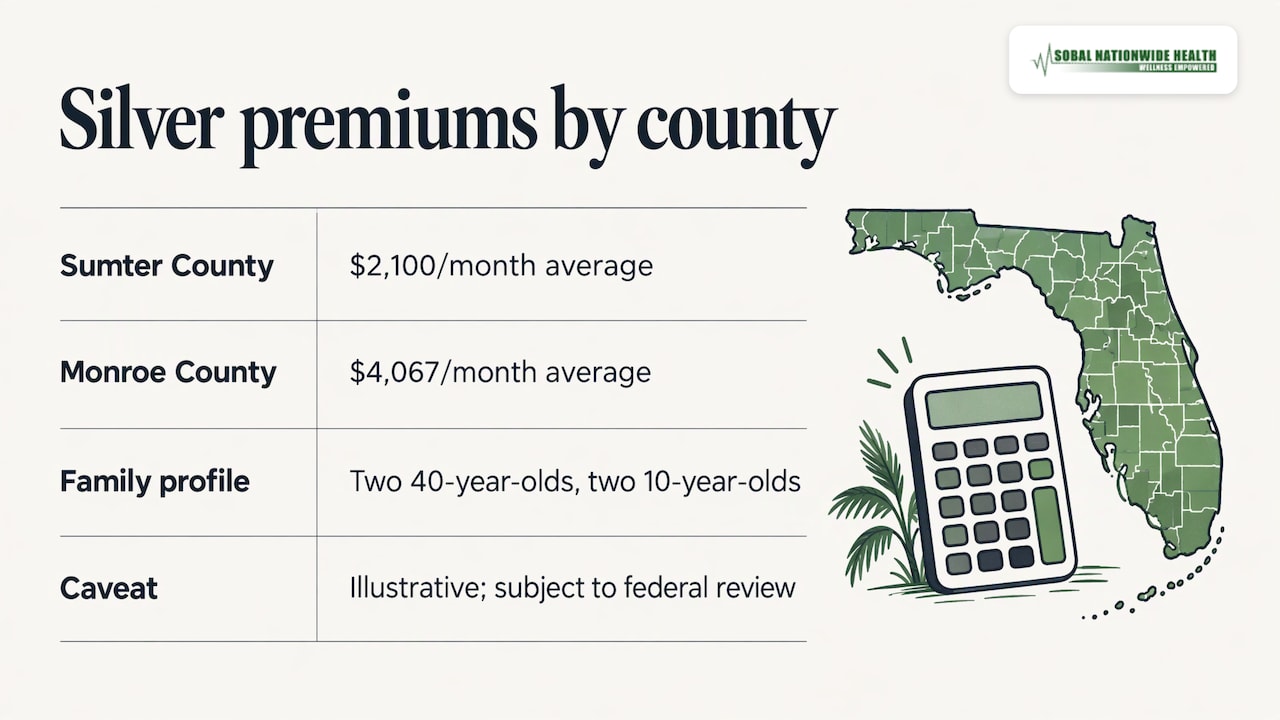
That spread is a reminder that where you live in Florida changes the price a lot. Ages, tobacco use, the plan’s metal level and the network all play a part too.
Premium, deductible and out-of-pocket maximum
- Premium: what you pay monthly. It gets you in the door.
- Deductible: what you pay for covered care before the plan starts sharing costs.
- Copay and coinsurance: your flat fee or percentage share once coverage kicks in.
- Out-of-pocket maximum: the financial safety net, the most you pay in a year for covered in-network care.
Florida’s consumer health site suggests adding up annual premiums, estimating out-of-pocket costs against each plan’s maximum, and checking providers, hospitals, referral rules and prescription coverage. A low premium with a high deductible can cost more over a year than a mid-priced plan, if your kids see doctors regularly.
A simple worked example
Say you’re comparing two plans. Plan A has a lower premium but a high deductible. Plan B costs more each month and pays sooner. Multiply each premium by 12, then add the amount you expect to spend on checkups, prescriptions and the odd urgent care visit, never above that plan’s out-of-pocket maximum. The lower total is the better fit for your year, not necessarily the lower premium.
Which plan type fits which family
Self-employed and 1099 families. You manage your own coverage, so the network matters. If your family wants any doctor or hospital, a PPO-style plan is worth a look. Our page for 1099 contractor health insurance and the self-employed Florida guide go deeper.
Realtors and truckers. If you’re on the road or showing homes across counties, a network that stays local may not follow you. A nationwide PPO network is built for that. See our nationwide PPO page.
People leaving COBRA or a job plan. COBRA keeps your old plan, often at full cost. Many families compare it with private plans before deciding.
Families priced out of a spouse’s employer plan. Adding dependents to an employer plan can be expensive. A separate private plan for the family is one option to price.
Young adults turning 26. Coverage on a parent’s plan ends at 26, so it’s worth lining up your own plan before then.
Small business owners with 2 to 30 employees. Group options exist, and our business health insurance page covers them. An agent can walk you through all the options.
How to compare plans in five steps
- List your doctors and hospitals. Write down every provider your four people see, including pediatricians and any specialist.
- Note referral rules. Decide whether a primary care referral step works for your schedule.
- Add up the year. Premiums plus estimated out-of-pocket spending, using the plan maximum as the ceiling.
- Check prescriptions. Confirm the medications your family takes are covered, and at what cost.
- Look at extras. Dental and vision are often separate. Ask whether they’re included.
Our own guides, how to choose family health insurance in Florida and tips for comparing family plans, walk through the same ground in more detail. For more learning material, see our resources library.
Marketplace plans and private plans
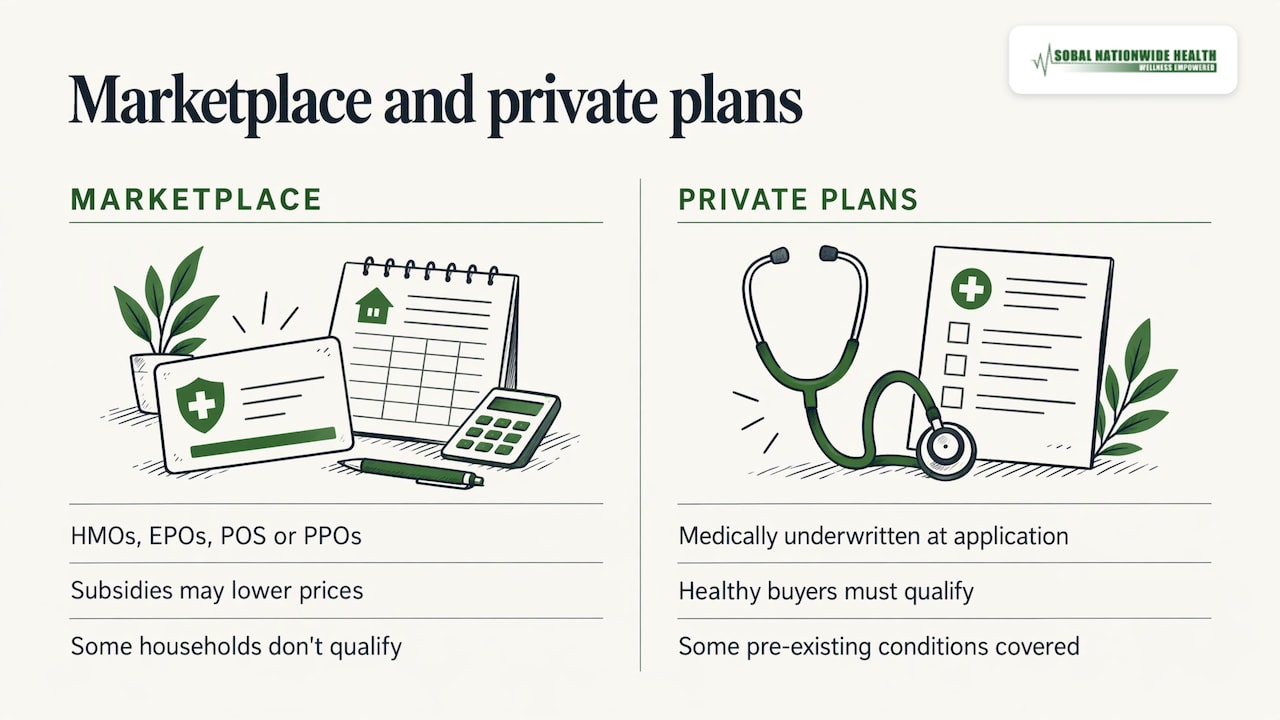
Marketplace plans can be HMOs, EPOs, POS plans or PPOs at each metal level, according to HealthCare.gov, depending on what’s offered in your area. Subsidies can lower the price for some households, but many self-employed professionals and high earners find they don’t qualify.
Private plans are an alternative worth knowing about. Private plans are medically underwritten, meaning the carrier reviews health information when you apply, so they suit healthy buyers who can qualify. Some pre-existing conditions can be covered. Our page on how medically underwritten insurance works explains it, and our Florida private PPO page shows how these plans are built. For budgeting, see what individual health insurance costs in Florida.
When you request a quote with us, we only need your zip code and birthdates. We never ask health questions on the form.
Why network limits matter to your wallet
Florida’s Department of Financial Services notes that managed-care networks limit your choice of doctors and hospitals, and that members usually pay less when they stay in network. The practical lesson: a cheaper plan helps only if the providers you actually use are inside it.
Our perspective
When families come to me, the first question is rarely about plan acronyms. It’s “Can my kids keep their doctor?” and “What happens if we need care out of state?” Those two questions point straight to the network.
That’s why we focus on private plans and PPO networks for families who want broad doctor and hospital choice. We offer medically underwritten plans that aren’t available on the public marketplace, and we spend our time explaining each option rather than pushing one.
You can talk with a broker in English or Spanish, by phone or webinar screen share. Bring your doctor list, and we’ll go through it together.
Bernie S
Talk to a broker about your family
Sobal Health helps self-employed people, families and small businesses in 31 states compare private medically underwritten plans, along with dental, vision and supplemental coverage. Browse our personal and family insurance options, or read about our Florida broker team. You can also find a health insurance broker on our site.
We don’t promise coverage or savings, since both depend on your family and your county. We’ll show you what’s available.
FAQ
Which plan type is best for a family of four?
It depends on how much doctor choice you want. HMOs and EPOs usually cost less but keep you in a network. PPOs cost more and allow out-of-network care without referrals. A broker can compare options with your doctor list.
Do I need a referral to see a specialist?
In an HMO or POS plan, you generally need a referral from your primary care doctor. With a PPO or EPO you generally don’t, according to HealthCare.gov.
Is a PPO always more expensive?
PPO premiums are typically higher than HMO premiums, per UF Health. Total yearly cost also depends on the deductible, copays and how much care your family uses.
What if my family lives in different counties or travels often?
A broader network matters more in that case. A nationwide PPO network is designed for families who need care in more than one area.
Do you offer Medicare or Medicaid?
No. We don’t offer Medicare or Medicaid. We work with ages 18 to 64 who want private, PPO-style coverage.
Ready to compare? Get a free quote at sobalhealth.com/#quote or call (305) 680-0125.
Sources
- HealthCare.gov: Health insurance plan and network types
- FloridaHealthFinder: Health plan glossary
- FloridaHealthFinder: How to choose a health plan
- UF Health: Understanding health insurance plans
- Florida Office of Insurance Regulation: 2026 family subsidy table
- Florida DFS: Health insurance and HMO overview