
Dental insurance can cover implants, but many plans don’t, and the ones that do usually pay only part of the bill. Expect about half of the cost, up to a yearly cap that is often between $1,000 and $2,000, and sometimes after a waiting period. The rest of this guide shows you how to find out what your own plan will pay before you book anything.
I’m a licensed independent health insurance broker, and this is one of the most common surprises I hear about. Someone has a dental plan for years, needs an implant, and finds a line in the policy that says otherwise. Let’s walk through it so you don’t get that surprise.
TL;DR
- Many plans exclude implants or treat them as cosmetic. Plans that include them typically pay about 50% of the cost, up to the annual maximum.
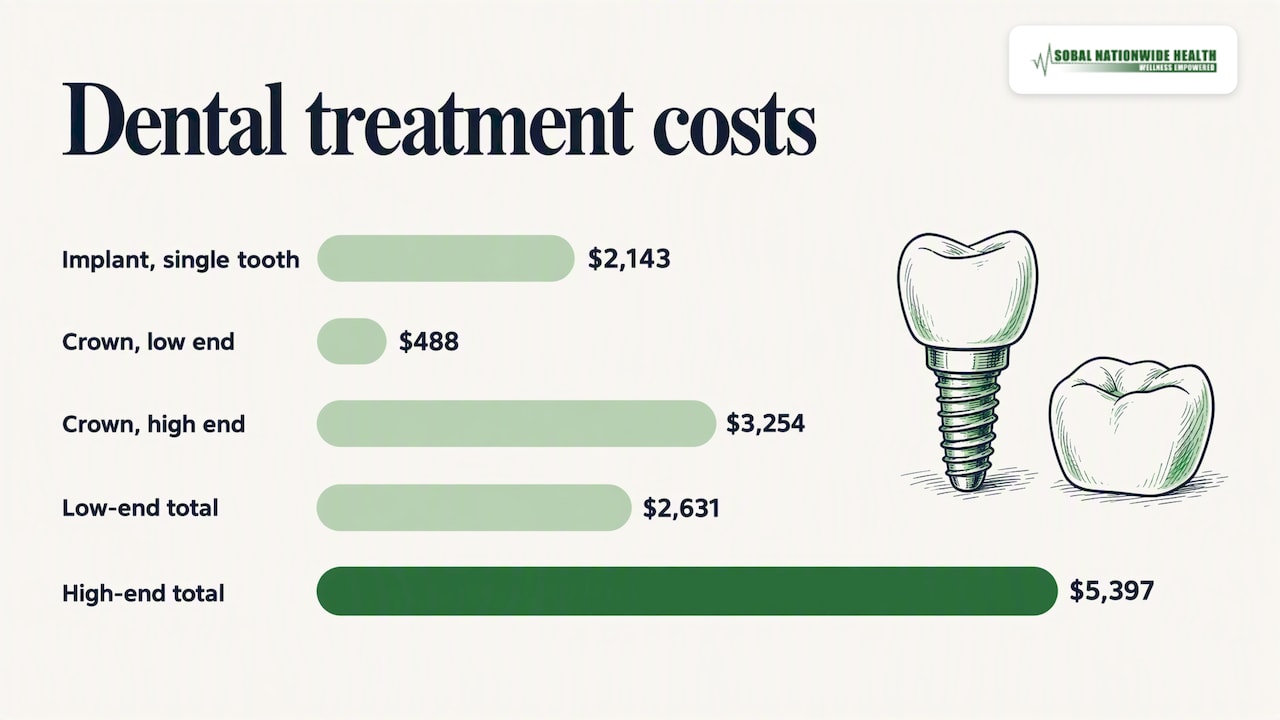
- A single implant averages $2,143, plus $488 to $3,254 for the crown, and bone grafting can add $550 to over $5,000.
- Waiting periods, annual maximums, and fee schedules lower than your dentist’s charges are what shrink the payout.
- Original Medicare almost never covers implants. Medicaid adult dental benefits depend on your state. HSA and FSA dollars can help with the out-of-pocket part.
- Ask your dentist to submit a pre-treatment estimate (predetermination) before you commit.
Table of Contents
- Does dental insurance cover implants?
- How much will a plan actually pay?
- The limits that shrink your payout
- Can medical insurance pay for an implant?
- Medicare and Medicaid
- Using an HSA or FSA for implants
- How to check your benefits before you commit
- Perspective: what we tell people who need an implant
- Where Sobal Health fits in
- FAQ
- Sources
Does dental insurance cover implants?
Sometimes. Dental insurance can cover implants, but it often does not. Some policies exclude them outright or label them cosmetic, even though they may cover other parts of the care, such as an extraction or an exam.
There’s no rule that forces every insurer to include them. The American Dental Association recommends that comprehensive plans cover fixed prosthetics and implants so people can chew, speak, and smile. But that is a design recommendation for plan builders, not a requirement.
Adult dental coverage is also uneven because adult dental care is not an ACA essential health benefit. The ADA Health Policy Institute’s chief economist has pointed out that adult dental coverage varies widely across Medicaid, Medicare, and private plans. So the plan in your hand is the only answer that matters.
How much will a plan actually pay?
Think of the premium as getting you in the door. What happens inside depends on cost-sharing: your deductible, your coinsurance, and your annual maximum.
Implants fall in the “major services” bucket. Major procedures are commonly covered at 50% coinsurance in plans that include them. Annual maximums commonly run from $1,000 to $2,000, and that cap covers all your dental work for the year, not just the implant.
Here is a simple example using the averages below.
| Item | Cost |
|---|---|
| Implant (average, single tooth) | $2,143 |
| Crown on top (low end of range) | $488 |
| Total before any extras | $2,631 |
| Plan pays 50%, but capped at a $1,500 maximum | $1,315 |
| Your share | $1,316 |
The figures for the implant and crown come from published averages. The $1,500 maximum is an illustration, not a quote from any plan. If your dentist’s crown costs closer to the high end of $3,254, the total is $5,397, and a $1,500 cap would leave you with about $3,900.
That is before bone grafting. Grafting is needed for more than half of implants and can add anywhere from $550 to over $5,000. Ask whether your plan treats the graft, the implant, and the crown as separate services, because each can have its own rules.
If coinsurance versus copay still feels fuzzy, our guide on coinsurance and what 20% can mean in real dollars uses the same logic. For a refresher on how the deductible plays in, see what a deductible is.
The limits that shrink your payout
Two plans can both say they cover implants and still pay very differently. These are the details to look for.
Waiting periods
Many plans make you wait before major services are paid. One 2026 marketplace plan in the federal benefits data lists major adult dental care at 50% coinsurance, a $1,100 annual maximum, and a 12-month exclusion period. That is one plan in one state, but it shows how the pieces stack up. If you need treatment soon, look at dental plans with no waiting period first.
Annual maximums
Once the plan has paid its yearly cap, you pay everything else. Some people split treatment across two benefit years to use two maximums. That only works when your dentist agrees it is clinically sound to stage the work, so ask.
Frequency and lifetime limits
Some plans limit certain services to once in a lifetime, and crowns may be limited to once every five to seven years. The National Association of Dental Plans notes that frequency limits are common even among carriers that offer implant coverage.
Missing-tooth exclusions
This one catches people. Plans can carry preexisting-condition exclusions for missing teeth, which may be reduced if you had prior creditable coverage. If the tooth was lost before your policy began, the plan may refuse to pay for replacing it.
Fee schedules
Many plans pay based on a Usual, Customary, and Reasonable (UCR) fee schedule. According to the ADA, that figure may be lower than your dentist’s actual fee. Your 50% is calculated on the plan’s number, not the number on the bill. An in-network dentist has usually agreed to the plan’s fees, which can narrow that gap.
Can medical insurance pay for an implant?
Sometimes, but it is the exception. Medical plans generally treat dental care as separate. Cases where a medical plan steps in tend to involve a larger medical event, such as jaw reconstruction after an accident or cancer treatment. Your insurer will want records showing the implant is a necessary part of treating a medical condition, not only a replacement for a missing tooth.
If your dentist thinks your case qualifies, ask the office to send clinical notes, X-rays, and a letter of medical necessity to the medical insurer, and request a written decision before treatment. Expect a denial in many cases, and know that you can appeal.
Medicare and Medicaid
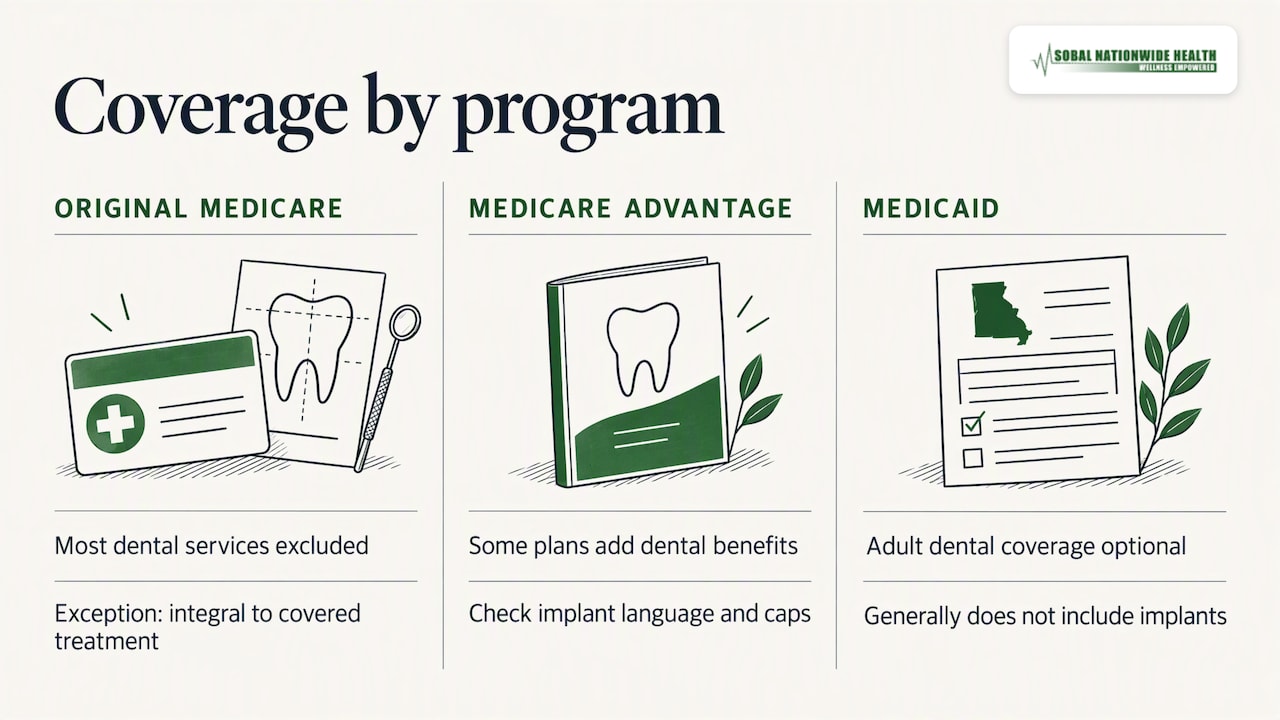
Original Medicare does not cover most dental services, implants included. The narrow exceptions involve dental work tied to another covered treatment, such as a heart valve replacement or an organ transplant.
Even then, the bar is high. CMS guidance says the dental service must be integral to the success of a covered medical service, not just medically useful. An extra implant or crown that isn’t immediately needed before surgery generally isn’t payable. If you are working through this, how Medicare treats dental implants is worth a read. Some Medicare Advantage plans add dental benefits, so check the plan’s evidence of coverage for implant language and caps.
If you carry two plans, such as Medicare plus a separate dental policy, coordination of benefits decides which one pays first.
Medicaid is a state decision. Adult dental coverage is optional for states, and it generally does not include implants, though exceptions may exist for medically necessary cases. Your state Medicaid office can tell you what applies where you live.
Using an HSA or FSA for implants
Even when insurance pays little, pre-tax money can soften the rest. IRS Publication 502 treats amounts paid for the prevention and alleviation of dental disease as medical expenses. In practice, replacing a missing tooth for function usually qualifies, while purely cosmetic work does not. If the line is blurry, ask your dentist for a letter explaining the clinical reason, and check with your plan administrator.
Two practical tips:
- Pay the out-of-pocket portion from the account after your plan’s payment is posted, so you don’t spend funds on amounts insurance will reimburse.
- Keep itemized receipts and the explanation of benefits for your records.
The same approach applies to other big dental bills. Our guide on HSA/FSA use and predetermination for orthodontics walks through it for braces.
How to check your benefits before you commit
This is the step that saves the most money. Here is the order I’d follow.
- Read your summary of benefits. Look for the words implant, major services, waiting period, and annual maximum. Check the exclusions list too.
- Call the insurer. Ask: Are implants covered, and at what percentage? Is the crown covered separately? Is there a waiting period? How much of this year’s maximum is left? Is there a missing-tooth clause? Write down the date, the representative’s name, and a reference number.
- Ask your dentist for a predetermination. Also called a pre-treatment estimate, it asks the insurer to review the planned treatment before it happens. The ADA explains that these are processes payers make available to dentists, and that the estimate is tempered by what benefits are available at the time of service. In other words, it is a useful guide and not a guarantee.
- Get a written treatment plan with codes. Include the implant, abutment, crown, extraction, and any graft or sinus work, each with its fee.
- Compare in-network and out-of-network fees. The same plan can pay very differently depending on the dentist.
- Plan the timing. If you’re close to a new benefit year or the end of a waiting period, ask your dentist whether waiting is safe.
If you’re shopping for a new plan, remember that coverage doesn’t begin the day you apply. Check the effective date before you schedule surgery.
Perspective: what we tell people who need an implant
We work with self-employed people, families, and small business owners, and dental questions come up constantly. Most of them are on a plan chosen mainly for its price, and the implant clause was never part of the decision.
Our advice is to treat dental coverage as its own purchase. Read the maximum, the waiting period, and the exclusions before you look at the monthly cost. A plan that costs a few dollars less but pays nothing toward major work can be the more expensive choice if you need an implant.
We also try to keep expectations honest. Even good plans will leave a real share for you to pay, so build a cash plan alongside the insurance plan, with an HSA or FSA if you have one. And if you’re between jobs, self-employed, or earn too much for marketplace subsidies, your options for medical and dental coverage are different from an employee’s. We walk through them one-on-one, in English or Spanish, without sales pressure.
— Bernie S
Where Sobal Health fits in
As an independent brokerage, we help self-employed people, families, and small businesses compare coverage in 31 states. That includes private medically underwritten plans, dental, vision, and supplemental coverage, and group options through our business health insurance page. If you want to understand how underwriting changes what a plan can exclude, start with how medically underwritten insurance works. Reach out through sobalhealth.com and we’ll review your current policy with you, including how it treats major dental work.
FAQ
Will dental implants ever be covered by insurance?
Yes, some dental plans cover them, usually as a major service at about 50% up to the annual maximum. Others exclude them entirely. Medical insurance may pay only when the implant is part of treating a covered medical condition.
How much is one tooth implant out of pocket?
Published averages put a single implant at $2,143, with a crown adding $488 to $3,254. Bone grafting can add more. What you pay depends on your plan’s percentage, its maximum, and your dentist’s fees.
Does Medicare cover dental implants?
Original Medicare generally does not. The exceptions are rare and tie to other covered medical care, like heart valve surgery or an organ transplant. Some Medicare Advantage plans offer dental benefits with their own limits.
Can I use my HSA or FSA for an implant?
Usually yes, when the implant treats or prevents dental disease or restores function. Cosmetic-only work generally doesn’t qualify. Ask your dentist for a short letter on the clinical need and confirm with your plan administrator.
How do I get my insurance to pay for an implant?
Confirm that the plan covers implants, ask your dentist to submit a predetermination with the full treatment plan, and use in-network providers where you can. If a claim is denied, you can appeal and ask for the plan’s reasoning in writing.
Sources
- Does dental insurance cover implants? (HealthInsurance.org)
- Dental Benefit Plan Design (American Dental Association)
- Adult dental coverage testimony (ADA Health Policy Institute)
- How Does Dental Insurance Work? (Cleveland Clinic)
- Benefits and Cost Sharing PUF, PY2026 (Data.Healthcare.gov)
- Dental Plan Benefits and Limitations (American Dental Association)
- Pre-Authorizations (American Dental Association)
- Dental service coverage (Medicare.gov)
- CMS Medicare dental policy guidance
- IRS Publication 502 (2021)
- Medicare and dental implants
