

Yes, you can find dental insurance with no waiting period, but the fastest coverage usually comes from DHMO-style plans, employer or group policies, and a handful of PPOs marketed for immediate use. Dental discount plans work even quicker since they aren’t insurance at all. Before you enroll anywhere, pull up the plan’s effective date and its Summary of Benefits & Coverage. That document tells you, in writing, exactly when your coverage actually starts.
TL;DR:
- DHMO plans and employer group policies most reliably offer true day-one coverage, especially for preventive and basic procedures, but often limit out-of-network care.
- Major dental procedures like crowns and implants typically have a waiting period of six to twelve months, even on plans claiming no waiting period overall.
- Always verify the plan’s effective date and review the full policy schedule to confirm which services are truly covered without delay.
- Prior coverage proof and direct carrier confirmation are crucial to obtain a waiver of waiting periods for specific services.
- Comparing premiums to the expected cost of needed procedures helps determine if a no-wait plan offers cost-effective coverage or if alternative options like discount plans are better.
Table of Contents
- What Does “No Waiting Period” Actually Mean for Dental Coverage?
- Which Plan Types Skip the Waiting Period Most Often?
- What Gets Covered Right Away, and What Still Makes You Wait?
- How Do You Confirm the Waiting-Period Language Before You Enroll?
- How Do You Shop for a No-Wait Plan Without Wasting Days?
- Is a No-Wait Plan Actually Worth the Higher Premium?
- How Sobal Health Helps You Sort Through the Fine Print
- Why Most Advice on This Topic Misses the Point
- Ready to Confirm Your Coverage? Here’s How Sobal Health Helps
- Where to Verify Plan Details and Explore Alternatives
- Sources
What Does “No Waiting Period” Actually Mean for Dental Coverage?
Two terms get confused constantly, and mixing them up leads to real disappointment at the dentist’s chair. Your effective date is the calendar day your policy legally begins. A waiting period is a separate clock, one that some plans layer on top of the effective date before they’ll pay for certain services, even though you’re technically covered.
“No waiting period” means that second clock doesn’t exist for the services in question. It doesn’t mean coverage appears the instant you click “submit” on an application. Immediate coverage plans still depend on that effective date, plus a short administrative window while the carrier loads your information into its provider network.
Watch for this fine print when you’re comparing plans:
- “Immediate coverage” or “day-one benefits” language, which usually applies to preventive and sometimes basic care only
- Fine print separating “no waiting period” claims by service category rather than the whole plan
- Phrases like “coverage begins on your effective date” without confirming waits are actually waived
- Any mention of a “pre-existing condition” clause, which can limit what counts as newly covered
Which Plan Types Skip the Waiting Period Most Often?
Not every plan type plays by the same rules, and knowing the category tells you what tradeoff you’re signing up for.
- DHMO and DHMO-like plans. These are the most reliable source of true day-one coverage, and full coverage with no waiting period is most common in DHMO plans. The catch: you’re locked into a network of contracted dentists, and out-of-network care usually isn’t reimbursed at all.
- Employer and group plans. Group underwriting spreads risk across many enrollees, so insurers often drop waits entirely, especially for preventive and basic services. Association-based small business plans frequently follow the same logic.
- Select PPOs and specialty “immediate coverage” products. A smaller number of PPOs advertise no-wait access to preventive, basic, and even major services starting on the plan’s effective date, though premiums run higher and availability shifts by state and carrier.
If you’re weighing a DHMO against a PPO for reasons beyond dental, our breakdown of HMO versus PPO plan structures walks through the network tradeoffs in more detail.
What Gets Covered Right Away, and What Still Makes You Wait?
Even a genuinely “no wait” plan rarely treats every procedure the same way. Coverage tends to sort into four practical tiers.
- Preventive care (cleanings, exams, X-rays) is almost always covered starting day one, even on otherwise conservative plans.
- Basic care (fillings, simple extractions) often gets immediate coverage too, but always confirm the specific plan language rather than assuming.
- Major care (crowns, bridges, implants, orthodontics) is where waits show up most. When a wait applies at all, it typically runs six to twelve months.
- Cosmetic procedures are commonly excluded outright or pushed past a long delay, regardless of how the plan markets itself.
If you need a crown or an implant this month, a plan’s “no waiting period” headline can be misleading unless it explicitly names major services in that promise.
How Do You Confirm the Waiting-Period Language Before You Enroll?
Don’t take a sales page’s word for it. Get the paperwork and ask pointed questions before you sign anything.
Request these documents:
- The Summary of Benefits & Coverage (SBC), which lays out covered services in plain terms
- The full policy schedule, including any waiting-period or exclusion riders
- A list of the CPT or service codes explicitly covered versus excluded
Then call the carrier directly and ask:
- What is my exact effective date, and does it match today’s enrollment date?
- Is there a wait on any specific service category, even if the plan overall says “no wait”?
- Do you offer prior-coverage credit, and what counts as valid proof?
- How long before your system shows me as active to my dentist’s office?
On that last point, most carriers need one to three business days to load new members into provider networks after the effective date, even when no waiting period applies. Build that buffer into your planning.
If you’re switching plans specifically to avoid a wait, proof of continuous prior coverage is often the key to a waiver. Carriers typically want an employer benefits letter or an official letter from your prior insurer listing policy dates. A screenshot of an old insurance card usually isn’t enough.
Pro Tip: Call the carrier before you enroll, not after. Ask them to email you written confirmation of your waiver eligibility. Verbal promises from a sales rep don’t hold up if a claim gets denied later.
How Do You Shop for a No-Wait Plan Without Wasting Days?
Speed matters when you’ve got a toothache today, not next month. Work through this in order.
- Search with the right filters. Use carrier websites, the ACA marketplace, and broker platforms, filtering specifically for “no waiting period” or “immediate coverage” rather than generic “dental plans.”
- Rank plans by three things first: explicit no-wait language for the service you need, the listed effective date, and the annual maximum. Everything else is secondary.
- Choose your effective date deliberately. Some carriers let you pick a start date within a short window. Pick the earliest one that still gives you time for the provider system to activate your record.
- Call instead of clicking when your situation is complicated. Anything involving a prior-coverage waiver, or a major procedure you need soon, usually goes faster with a human on the phone than through an online application.
If you’re comparing this decision against broader plan shopping, our guide to choosing the right family health insurance plan covers similar comparison habits worth applying here too.
Is a No-Wait Plan Actually Worth the Higher Premium?
Insurers price no-wait plans higher because removing the waiting period increases what actuaries call adverse selection. People are more likely to enroll in a no-wait plan right when they know they need expensive work, so the insurer compensates with a higher premium, a lower annual maximum, or a tighter network.
Roughly six months to a year is the typical wait window insurers use to protect against this risk when a wait exists at all, which tells you how much pricing weight that gap carries.
Run the math before you commit. Estimate the cost of the procedure you actually need, add your expected out-of-pocket share after any deductible, and compare that total to a full year of the no-wait plan’s premium. Factor in the annual maximum too. If your procedure costs more than the plan’s yearly cap, the “immediate coverage” won’t fully protect you anyway.
Consider these alternatives before assuming insurance is the only path:
- A dental discount plan, which isn’t insurance but often activates faster and offers negotiated rates at participating dentists
- Community health clinics offering sliding-scale dental care
- A payment plan negotiated directly with your dentist’s office
Discount plans won’t count toward an annual maximum since they don’t function like insurance coverage, but for a single needed procedure, the savings can beat a new policy’s first-year premium. For a general sense of how premium costs stack up across plan types, our cost breakdown is a useful companion to this math.
How Sobal Health Helps You Sort Through the Fine Print
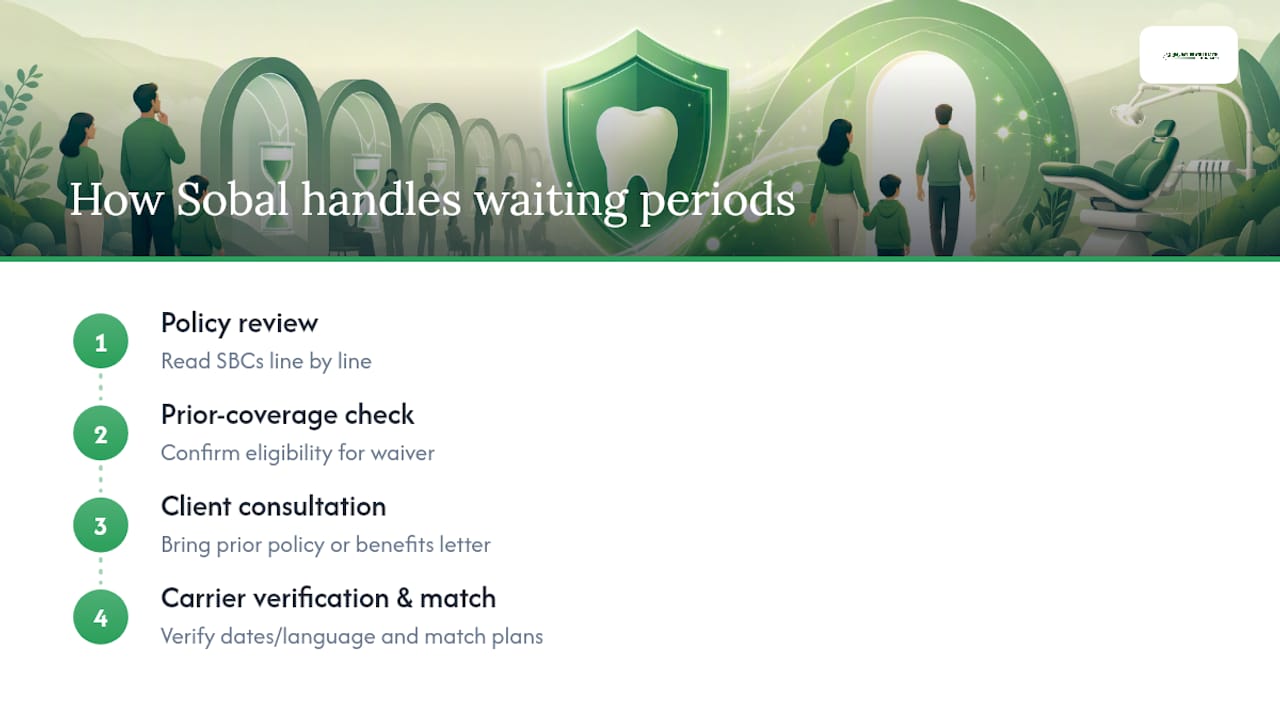
Reading ten different SBCs to find the one plan that actually covers your crown next week isn’t a great use of your afternoon. That’s the part Sobal Nationwide Health handles directly. We review policy language line by line, check whether your prior coverage qualifies for a waiver, and match you to plans that fit your actual timeline, not just a marketing headline.
A consultation is straightforward. Bring your prior policy statements or benefits letter, and a rough idea of the procedure you need, if you know it already. From there, we verify effective dates and waiting-period language directly with carriers, so you’re comparing real numbers instead of ad copy.
Why Most Advice on This Topic Misses the Point
Most coverage of no-wait dental plans treats it as a simple checklist: find the plan, confirm no waits, enroll, done. That framing skips the part that actually determines whether the plan helps you, which is whether the specific service you need is the one that’s actually wait-free.
A plan can legitimately advertise “no waiting period” while still making you wait a year for the implant that brought you to the search in the first place. The conventional advice rarely separates preventive language from major-service language, and that gap is where people get burned.
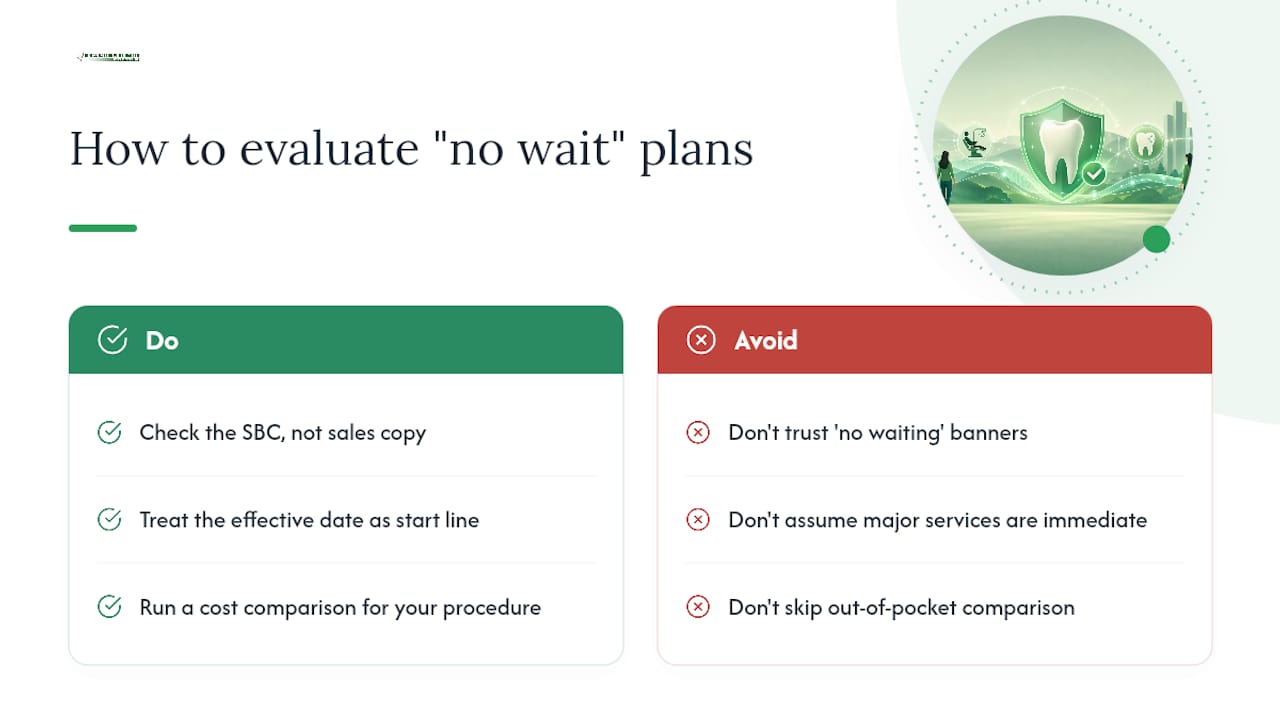
My honest read: prioritize the SBC over the sales page every time, and treat the effective date as the real start line, not the day you applied. If you need major work soon, run the cost comparison before you assume insurance beats paying out-of-pocket or using a discount plan. Sometimes it does. Often, for a single procedure, it doesn’t. The plan that wins isn’t the one with the flashiest “immediate coverage” banner. It’s the one whose fine print actually matches your timeline.
— Bernie S
Ready to Confirm Your Coverage? Here’s How Sobal Health Helps
Sobal Nationwide Health is the alternative to guessing your way through carrier fine print. We review the actual policy language behind “no waiting period” claims and tell you, in plain terms, whether a plan covers what you need when you need it, at no cost to you for the consultation.

Here’s what that involves:
- A side-by-side review of plan effective dates, waiting-period exclusions, and annual maximums
- A check on whether your prior coverage qualifies you for a waiting-period waiver
- Enrollment support so you’re not navigating carrier portals alone
Before you reach out, have your prior policy details (or a benefits letter) and a general idea of the dental work you’re anticipating. From there, visit Sobal Health to request a personalized quote, or explore how health insurance mechanics work if you’re still sorting out the basics of effective dates and premiums. Either way, you’ll walk away knowing exactly what your plan covers and when.
Where to Verify Plan Details and Explore Alternatives
For deeper reading on how carriers structure these terms, DentalInsurance.com’s guide to no-wait plans lists state-by-state examples. Forbes Advisor’s comparison of no-wait dental options breaks down the cost tradeoffs further, and policyhop’s explainer on insurer waiting periods offers useful context on why insurers build these clocks into coverage in the first place. Always request the SBC and full policy schedule directly from any carrier before enrolling.
This article is general information, not a substitute for advice from a qualified doctor. Consult a qualified healthcare professional about your own circumstances before acting on anything here.
