

You have two real options after losing job-based coverage: enroll in a Marketplace plan through a Special Enrollment Period, or elect COBRA to keep your old plan. Both run on the same clock. Confirm your exact coverage end date in writing, then act within 60 days. Medicaid, a spouse’s plan, or a licensed broker like Sobal Nationwide Health can also help you sort through the numbers.
TL;DR:
- Comparing COBRA and Marketplace plans requires calculating total costs, deductible progress, and provider network coverage, as the cheaper option varies case by case.
- The 60-day enrollment window starts on your coverage end date, with deadlines strict and non-negotiable, making prompt documentation collection critical.
- Eligibility for Medicaid or a spouse’s plan may offer better or cheaper coverage depending on income, with shorter enrollment windows for some options like HIPAA rules.
- ACA plans, whether Marketplace or COBRA, cannot deny coverage or increase costs due to pre-existing conditions, unlike short-term plans that bypass these protections.
- Professionals like brokers or health services can help you compare options quickly, potentially saving hundreds of dollars by switching from COBRA to a subsidized Marketplace plan.
Table of Contents
- Quick Action Checklist: Steps to Take in the First Week
- COBRA Explained: Election Timing, Cost, and When It’s the Right Choice
- How Does the Marketplace Special Enrollment Period Work?
- What Other Coverage Options Exist Besides COBRA and the Marketplace?
- How Do You Decide Between COBRA and a Marketplace Plan?
- How Sobal Nationwide Health Helps People in This Situation
- Impact of Pre-Existing Conditions During Coverage Transitions
- How to Navigate Appeals or Disputes with Insurers After Job Loss
- Mental Health Coverage Considerations After Losing Job-Based Insurance
- Resources for Financial Assistance or Free Clinics During Uninsured Periods
- How to Apply: Documents to Collect Before You Start
- A Broker’s Top Recommendation
- Get Help Choosing the Right Plan Fast
- Sources
Quick Action Checklist: Steps to Take in the First Week
The moment you know your job is ending, the calendar starts working against you. Here’s what protects your options.
- Get your coverage end date in writing. Ask HR or your benefits administrator for the exact date, not an estimate.
- Watch your mail for the COBRA election notice, and mark its deadline the day it arrives.
- Create a Marketplace account at Healthcare and run a quick eligibility check.
- Estimate your household’s yearly income (MAGI) so you know roughly what subsidy tier you fall into.
- Start a folder, physical or digital, for every notice, letter, and confirmation email you receive.
None of this takes more than an hour, but skipping it is how people end up with an accidental gap in coverage.
COBRA Explained: Election Timing, Cost, and When It’s the Right Choice
COBRA lets you keep your exact former employer plan, same network, same deductible, same doctors, for a limited stretch after your job ends. You typically qualify if your employer had 20 or more employees and offered group health coverage.
You get 60 days from whichever is later, the date your coverage ends or the date you receive the election notice, to decide. Once you elect it, coverage usually runs for up to 18 months, though certain qualifying events can extend that.
The catch is cost. You now pay the full premium your employer used to help cover, plus an administrative fee of up to 2%. If your employer was quietly covering 70% of your premium, that gap becomes very real on your first COBRA invoice.
- COBRA keeps your provider network and deductible intact
- You pay 100% of the group premium plus the admin fee
- Election and payment deadlines are strict and non-negotiable
Pro Tip: If you’ve already burned through most of your deductible this year on the old plan, COBRA can actually save you money for the rest of the calendar year since a new Marketplace plan resets your deductible to zero.
How Does the Marketplace Special Enrollment Period Work?
Losing job-based coverage counts as a qualifying life event, which opens a 60-day Special Enrollment Period to buy a Marketplace plan. That clock starts on your coverage end date, not the day you lose your job or your last paycheck.
Your subsidy eligibility, both premium tax credits and cost-sharing reductions, depends on your household’s modified adjusted gross income (MAGI) for the year, not your old salary. Many people who never qualified for help while employed suddenly do once their income drops.
A key number to remember: 60. That’s the number of days you have from your coverage end date to enroll, and it doesn’t extend for holidays, confusion, or forgetting.
Coverage typically starts the first of the month after you enroll, sometimes sooner if you act quickly. To apply, you can:
- Enroll directly through HealthCare.gov or your state’s exchange
- Call the Marketplace call center for phone-based enrollment
- Work with a free, certified enrollment assister
- Go through a licensed broker who can also check subsidy math and provider networks
Have your termination date, household income estimate, and family size ready before you start.
What Other Coverage Options Exist Besides COBRA and the Marketplace?
COBRA and Marketplace plans aren’t the only doors open to you. A few other paths matter depending on your income and family situation.
- Medicaid: In states that expanded it, adults with income up to 138% of the federal poverty level may qualify, often with no premium at all.
- A spouse’s employer plan: Under HIPAA special enrollment rules, you usually have 30 days from losing your old coverage to join a spouse’s plan, a tighter window than the Marketplace’s 60 days.
- CHIP for kids: Children often qualify for the Children’s Health Insurance Program even when parents don’t qualify for Medicaid.
- Turning 26 health insurance rule: If you’re a young adult who was on a parent’s plan, you can generally stay covered there until you turn 26, regardless of your own job status.
Short-term health plans show up in a lot of searches for coverage after job loss, and they’re worth understanding before you buy one. They aren’t required to follow ACA rules, which means they can deny coverage for pre-existing conditions and cap what they’ll pay out. Treat them as a bridge for a narrow gap, not a real substitute for ACA-compliant coverage.
How Do You Decide Between COBRA and a Marketplace Plan?
Run the actual numbers before you decide anything. This isn’t a gut call, it’s arithmetic.
- Compare total monthly cost. Add up your full COBRA premium plus the 2% fee, then compare it against your Marketplace premium after subsidies.
- Check your deductible progress. If you’ve already paid down most of this year’s deductible, switching plans resets it to zero, which can erase months of progress overnight.
- Confirm your providers and prescriptions are covered. A cheaper premium means nothing if your specialist or medication isn’t in-network.
Ask your former employer for the precise coverage end date, and ask a Marketplace representative or broker for a real subsidy estimate based on your projected income. Comparing a deductible reset against ongoing prescription costs is exactly the kind of math a broker can run for you in minutes.
Pro Tip: Don’t assume COBRA is automatically the “safe” choice just because it feels familiar. For many people, a subsidized Marketplace plan ends up cheaper with a comparable network.
How Sobal Nationwide Health Helps People in This Situation
This is exactly the moment Sobal Nationwide Health exists for. We help you compare COBRA against Marketplace plans and private medically underwritten options side by side, across 31 states, without a sales pitch attached.
You’ll get a no-pressure assessment of your situation, help gathering the right documents, and a real quote you can compare against your COBRA notice. Some clients we’ve worked with have found savings of up to $400 a month by switching away from COBRA into a better-fitting plan. We walk you through the enrollment itself, not just the recommendation, so nothing falls through during your 60-day window.
Impact of Pre-Existing Conditions During Coverage Transitions
Here’s some genuinely good news buried in an otherwise stressful process: ACA-compliant plans, whether Marketplace or COBRA, cannot deny you coverage or charge you more because of a pre-existing condition. Diabetes, a past cancer diagnosis, pregnancy, mental health history, none of it affects your premium or your eligibility on a compliant plan.
That protection disappears the moment you step outside ACA-compliant coverage. Short-term plans routinely use medical underwriting, which means they can exclude your condition entirely or deny your application outright. If you have an ongoing prescription, a scheduled surgery, or a chronic condition you’re actively managing, a short-term plan is one of the riskiest choices you could make right now.
The bigger risk isn’t denial, it’s a coverage gap that interrupts treatment. If you’re mid-course on a medication or between appointments with a specialist, any lapse in coverage can delay refills or push back a procedure. This is where COBRA has a real edge: it keeps your existing plan, deductible, and provider relationships intact with zero underwriting risk, since you’re just continuing what you already had.
If you choose the Marketplace instead, double check that your specific medications are on the new plan’s formulary before you enroll. A plan can be ACA-compliant and still place your specific drug on a higher cost tier, which matters even though it can’t deny you outright.
How to Navigate Appeals or Disputes with Insurers After Job Loss
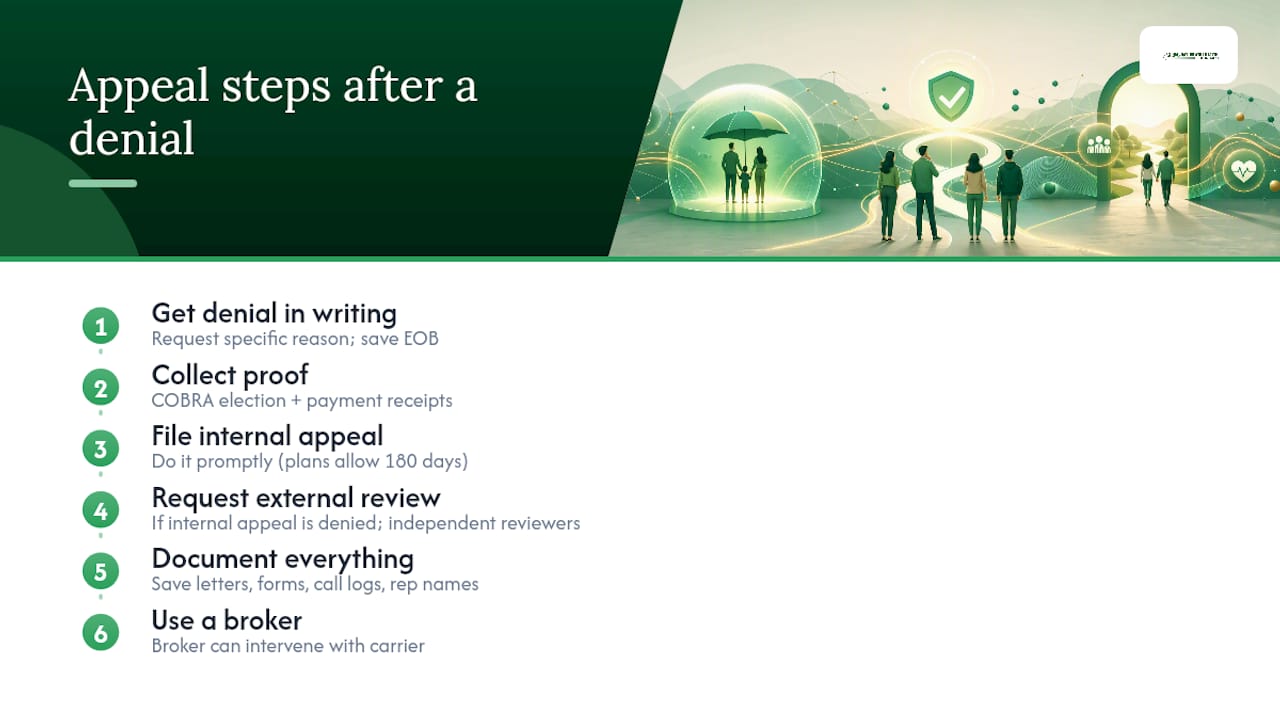
Claims problems tend to spike during coverage transitions, partly because paperwork gets crossed between your old plan and your new one. If a claim gets denied, don’t assume it’s final. Every ACA-compliant plan is required to offer an internal appeal process, and if that fails, an external review by an independent third party.
Start by requesting the denial explanation in writing. Insurers must tell you the specific reason a claim was denied, and vague answers like “not medically necessary” should come with more detail if you ask. Your explanation of benefits (EOB) document is your starting point for building an appeal.
A common dispute during job transitions involves timing: a claim gets denied because the insurer’s records show your old coverage ended before the date of service, even though you were actually covered under COBRA continuation retroactively. COBRA coverage is retroactive to your original coverage end date once you elect it and pay the premium, so keep your election confirmation and payment receipts handy for exactly this scenario.
File your internal appeal promptly, most plans give you 180 days, but don’t wait that long if you can help it. If the internal appeal fails, you have the right to request an external review, which is decided by reviewers outside the insurance company entirely. Keep copies of every letter, claim form, and phone call log with dates and representative names. If you enrolled through a broker, they can often intervene directly with the carrier on your behalf, which sometimes moves faster than going it alone.
Mental Health Coverage Considerations After Losing Job-Based Insurance
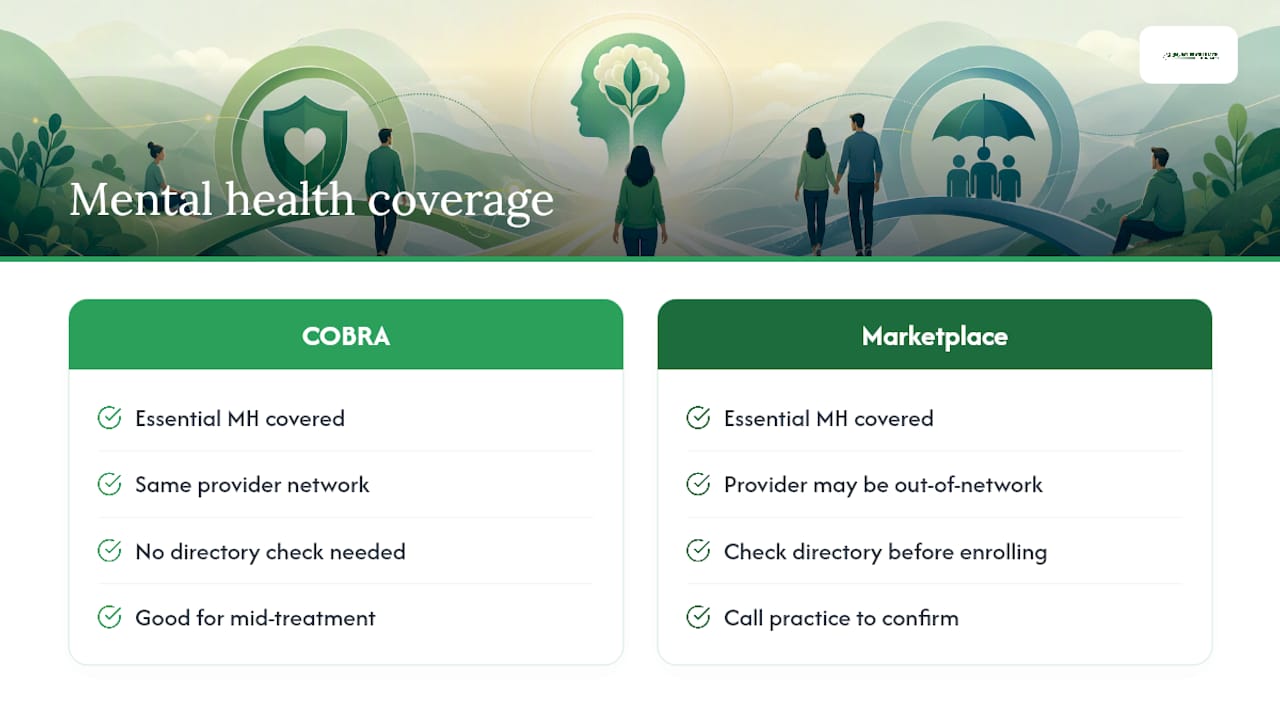
Losing your job is stressful enough without also losing access to a therapist or psychiatrist you’ve been seeing regularly. The good news: mental health and substance use treatment are considered essential health benefits under the ACA, meaning every Marketplace plan and every COBRA continuation must cover them.
The practical question isn’t whether you’ll have mental health coverage, it’s whether your specific provider stays in-network. If you switch to a new Marketplace plan, your therapist may not be in that insurer’s network even if they accepted your old employer plan. This is one of the strongest arguments for COBRA if you’re mid-treatment with a provider you don’t want to lose, since COBRA keeps your existing network completely intact.
If you do move to a Marketplace plan, check the provider directory before you enroll, not after. Call the practice directly to confirm they’re still accepting that specific plan, since online directories are notoriously outdated.
For anyone who needs support during the gap itself, before coverage kicks in, community mental health centers and university-affiliated clinics often offer sliding-scale fees based on income. The 988 Suicide and Crisis Lifeline is free and available regardless of your insurance status, and many therapists offer telehealth sessions at reduced rates for patients between plans. Losing insurance shouldn’t mean pausing care entirely, even for the few weeks it takes to get your new coverage active.
Resources for Financial Assistance or Free Clinics During Uninsured Periods
If you’re in the gap between job loss and new coverage kicking in, or you simply can’t afford any option right now, you still have real resources available.
Federally Qualified Health Centers (FQHCs) provide care on a sliding fee scale based on your income, sometimes charging just a few dollars per visit for basic care. You can search for one near you through the Health Resources and Services Administration’s clinic finder. Many hospitals also have financial assistance or charity care programs for uninsured patients, though you typically have to apply for that assistance directly through the hospital’s billing office, not the emergency room.
Prescription assistance programs run directly by pharmaceutical manufacturers can significantly cut medication costs for people without coverage, particularly for chronic conditions like diabetes or high blood pressure. GoodRx and similar discount programs also help at the pharmacy counter even without insurance.
If your gap is temporary, a matter of weeks while your Marketplace or COBRA coverage processes, prioritize any ongoing prescriptions and urgent care needs first. Free and community clinics generally aren’t equipped for major procedures, but they cover the basics well. None of this replaces real coverage, but it can carry you through the transition without skipping care entirely.
How to Apply: Documents to Collect Before You Start
Enrollment moves faster when you’re not scrambling for paperwork mid-application. Gather these before you sit down to apply anywhere.
From your employer or plan administrator, request the exact date your coverage ends, in writing, along with your COBRA election notice if one hasn’t arrived yet. That notice should list your COBRA premium amount, election deadline, and payment instructions.
For a Marketplace application, you’ll need Social Security numbers for everyone in your household, estimated annual income for the year (not last year’s tax return), employer and income information if you’re still doing any freelance or part-time work, and immigration documents if applicable.
For COBRA specifically, keep your election form, first payment confirmation, and any correspondence with the plan administrator in one place. Since COBRA coverage applies retroactively once elected, these documents matter later if a claim gets questioned.
If you’re applying through a broker rather than directly, they’ll typically ask for the same information, plus a short conversation about your current providers and prescriptions, so they can check network coverage before recommending a specific plan. Having everything ready before that first call can shave days off the process, days that matter when you’re working inside a 60-day window.
A Broker’s Top Recommendation
Everyone assumes COBRA is the “safe” default because it’s familiar. That assumption costs people money. Before you elect anything, gather your documents and run a real side-by-side: total monthly cost, deductible progress, and whether your providers are covered.
I’ve seen people stick with COBRA out of habit and pay hundreds more than a comparable Marketplace plan would have cost them. Run the numbers first.
— Bernie S
Get Help Choosing the Right Plan Fast
You’ve got 60 days, and running the COBRA-versus-Marketplace math alone while also job hunting is a lot to carry. Sobal Nationwide Health gives you a faster path: one conversation with a licensed broker who checks your subsidy eligibility, confirms your providers are covered, and compares private medically underwritten plans against Marketplace options, all without a sales pitch attached.

Here’s what happens when you reach out: we ask about your coverage end date, your household income estimate, and any ongoing prescriptions or providers you want to keep. Then we show you actual numbers, not just plan names, so you can see what COBRA would cost against a subsidized Marketplace plan side by side. If you want a sense of what family coverage typically runs before you even call, our family plan cost breakdown is a good starting point.
Start by visiting Sobal Nationwide Health to set up a consultation before your 60-day window closes.
This article is general information, not a substitute for advice from a qualified financial advisor. Consult a qualified financial professional about your own circumstances before acting on anything here.
Sources
- Healthcare
- Workers and families: Protecting retirement and health benefits after job loss | U.S. Department of Labor
- Healthcare
- Healthinsurance
