

A prior authorization is your insurance company’s sign off, required before your plan will pay for a specific service, drug, or test. Skip that step and your insurer can deny the claim, leaving you on the hook for the full bill. Your provider’s office usually files the request, and if it gets denied, you have real appeal rights, both inside your plan and through an outside reviewer.
TL;DR:
- Prior authorization is required for high-cost drugs, imaging, non-emergency surgeries, and some medical equipment, but emergency care usually bypasses this need.
- The process is initiated by your provider or pharmacy, with submission times of around 15 days for standard requests and 72 hours for urgent cases.
- Confirm whether a prior authorization is needed before scheduling procedures and ensure your provider submits complete, timely documentation to avoid delays.
- A mismatch between your plan and your medications or providers increases the risk of denials, making personalized plan reviews valuable in preventing coverage issues.
Table of Contents
- What Prior Authorization Means and Why Insurers Use It
- When Prior Authorization Usually Applies
- Who Files the Prior Authorization, and What You Need to Do
- The Prior Authorization Process, Step by Step
- When a Prior Authorization Is Denied: How to Appeal
- How to Avoid Delays and Improve Your Approval Odds
- How Sobal Nationwide Health Helps You Avoid PA Surprises
- A Broker’s Take on Fixing Prior Authorization Without Losing Access to Care
- Get a Personalized Plan Review Before Prior Authorization Becomes a Problem
- Where This Information Comes From
- Sources
- FAQ
What Prior Authorization Means and Why Insurers Use It
Prior authorization goes by a few names. You’ll hear “prior auth,” “preauthorization,” and “precertification” tossed around interchangeably, and they all mean the same thing: your health plan wants to sign off on certain care before it happens, not after.
Insurers built this system for a few practical reasons:
- Medical necessity checks — confirming a treatment fits your diagnosis before the plan commits to paying for it.
- Utilization management — steering care toward options the insurer considers proven and cost-effective.
- Formulary control — pharmacy benefit managers use PAs to push patients toward preferred drugs on the plan’s formulary.
Here’s the part that trips people up: PA rules aren’t standardized across the industry. Requirements vary significantly between insurers, and even between plans from the same insurer (https://content.naic.org/article/what-prior-authorization), and formularies can change without much warning. Always confirm requirements with your specific plan before you assume anything.
When Prior Authorization Usually Applies
Certain categories of care trigger a PA request far more often than others. Knowing the pattern helps you plan ahead instead of getting blindsided at the pharmacy counter or the imaging center.
Common triggers include:
- Specialty medications, especially high-cost biologics or drugs with step-therapy rules attached.
- Advanced imaging like MRIs and CT scans.
- Planned, non-emergency surgeries.
- Durable medical equipment, such as wheelchairs, CPAP machines, or insulin pumps.
There’s a newer wrinkle worth watching. Some plans have started requiring PA for lower-cost medications too, not just the expensive specialty drugs, so check your formulary even for routine prescriptions. One consistent bright spot: emergency care is almost never subject to prior authorization. Insurers generally can’t require a PA before treating a true emergency, since the whole point of an ER visit is that it can’t wait.
Who Files the Prior Authorization, and What You Need to Do
Your doctor’s office or your pharmacy typically submits the prior authorization request, not you. For prescriptions, that request often routes through a pharmacy benefit manager, or PBM, which handles formulary decisions on the insurer’s behalf.
That said, you’re not just a bystander. A few things you can do to keep the process moving:
- Confirm with your provider’s office that a PA is actually required for your specific service or drug.
- Ask who is submitting the request and get a name and direct contact if possible.
- Provide any outside medical records the office might not already have, especially if you’ve switched providers recently.
- Track submission dates, reference numbers, and follow-up calls in one place, even a simple notes app works.
- If your situation is urgent, ask your provider to explicitly request an expedited review. This has to come from the provider, and it will not happen automatically just because you’re worried.
The Prior Authorization Process, Step by Step
The mechanics are fairly consistent even though the paperwork differs by plan. Your provider submits the request with clinical documentation, the insurer reviews it, sometimes asks for more information, then issues a decision and notifies both you and your provider.
Timelines are where things get concrete, and where federal rules actually give you leverage:
- Standard pre-service decisions: CMS guidance points to timeframes like 15 calendar days for many standard pre-service requests, though your specific plan and state may set their own deadlines.
- Urgent or expedited requests: Federal rules allow for dramatically faster turnaround, with some urgent decisions required within 72 hours.
- Incomplete submissions: Missing records or vague clinical notes are the single biggest cause of delay, since the insurer’s clock often pauses while it waits for more information.
Pro Tip: Ask your provider’s office to submit clinical notes, prior treatment history, and a clear diagnosis code all at once, rather than piecemeal. Complete submissions get faster decisions because the insurer has no excuse to pause the clock waiting on paperwork.
That 15 day standard versus 72 hour urgent gap is the single most useful number in this whole process. If your situation genuinely can’t wait two weeks, say so, loudly, to your provider.
When a Prior Authorization Is Denied: How to Appeal
Getting denied is not the end of the road, and it’s more common than you might think. Roughly a quarter of prior authorizations are denied initially, though many get overturned once a provider adds the right documentation.
There are two main appeal paths, and they typically run in sequence:
- Internal appeal — you or your provider ask the insurer to formally reconsider its own decision, usually within a set number of days after the denial notice.
- External review — if the internal appeal fails, an independent third party outside the insurer takes a fresh look. Federal rules through HHS establish external review rights and timelines, and some states run their own independent review organizations, or IROs, with similar protections.
The evidence you attach matters enormously. Appeals succeed more often when providers document that other treatments were already tried and failed, or that the requested therapy follows established clinical guidelines. A well-organized health insurance claim denial appeal usually includes a letter of medical necessity, a timeline of prior treatments, and any relevant peer-reviewed guidance backing the request.
Pro Tip: Ask your doctor’s office for a copy of the actual denial letter, not just a phone summary. It usually states the exact reason for denial, which tells you precisely what evidence your appeal needs to counter.

How to Avoid Delays and Improve Your Approval Odds
None of this has to feel like a mystery. A handful of habits, done early, dramatically cut your risk of a denial or a frustrating delay.
- Call your insurer’s member services line, or the PBM for medications, before you schedule anything that sounds expensive or unusual.
- Confirm both whether a PA is required and exactly who is responsible for filing it.
- Ask your provider to document step-therapy history and include a letter of medical necessity up front, rather than waiting for a denial to request one.
- Check your PA’s expiration window. Some plans require renewal every refill cycle for certain drugs, while others approve coverage for a set number of months, so start renewal paperwork well before that date.
- If your health situation genuinely can’t wait, ask explicitly for an expedited review rather than assuming the standard timeline will work out.
Pro Tip: Set a calendar reminder 30 days before any known PA expiration date for an ongoing medication. Renewal requests submitted early rarely cause a gap in your prescription; last-minute ones frequently do.
How Sobal Nationwide Health Helps You Avoid PA Surprises
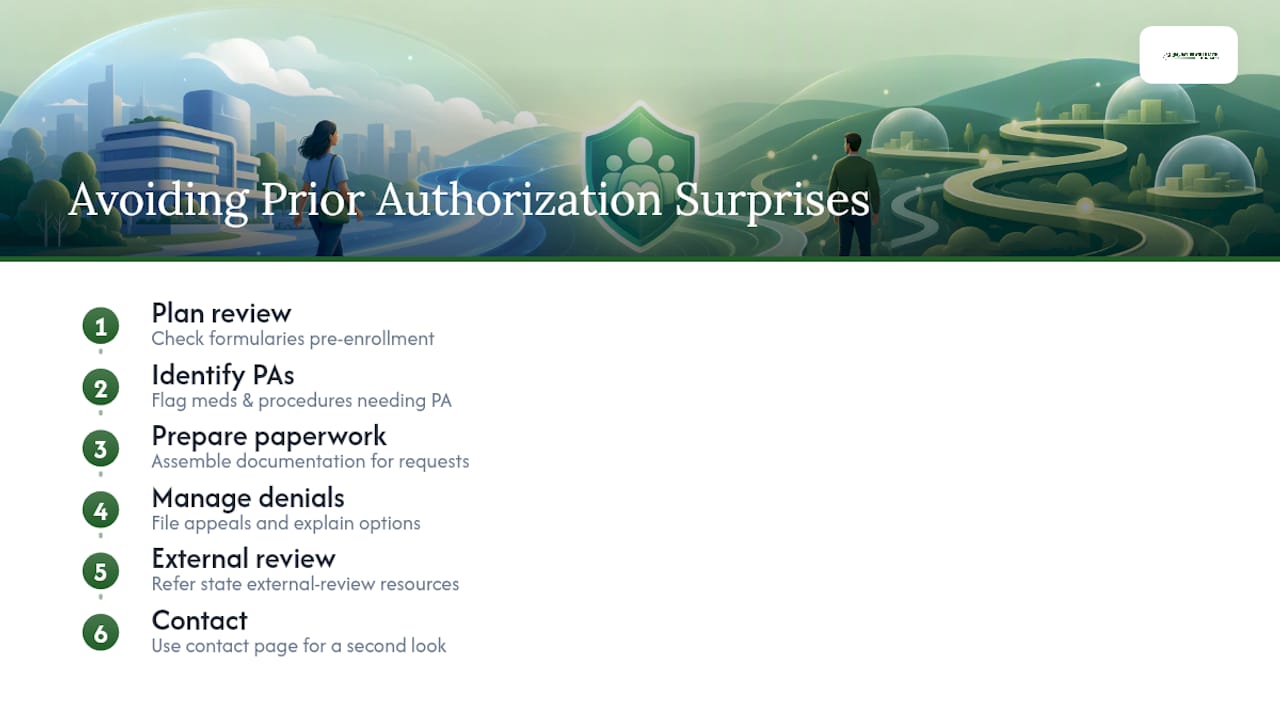
This is exactly where a broker earns their keep. We review plan formularies with clients before enrollment, so you know upfront which of your regular medications or expected procedures are likely to require prior authorization, instead of finding out at the pharmacy counter.
We also help you prepare documentation and understand your appeal options if a request gets denied, and we can point you toward your state’s external review resources when an internal appeal doesn’t resolve things. If you want to understand how your plan actually works before you’re locked into it for a year, that conversation is exactly what we’re here for. Reach out through our contact page any time you want a second set of eyes on a plan’s PA rules.
A Broker’s Take on Fixing Prior Authorization Without Losing Access to Care
Prior authorization exists for a real reason, insurers do need some check on runaway costs and unproven treatments, but the AMA’s own data on physician time lost to paperwork tells you the system leans too hard on providers to prove the obvious. The fix isn’t eliminating PA. It’s faster, more transparent reviews, and more patients actually using the appeal rights they already have. Most denials aren’t final verdicts. They’re an invitation to submit better documentation, and that invitation is worth taking seriously before you assume the answer is no.
— Bernie S
Get a Personalized Plan Review Before Prior Authorization Becomes a Problem
Prior authorization headaches almost always trace back to one thing: a plan that wasn’t matched to your actual medications and providers in the first place. Sobal Nationwide Health exists to fix that mismatch before it costs you a denied claim. We offer personalized plan reviews for individuals and families, bilingual brokers who walk you through formulary details in English or Spanish, and enrollment support that flags likely PA exposure before you sign anything.

Reach out if you’re on a chronic medication, if you’ve been denied more than once, or if your current plan’s coverage rules just feel impossible to pin down. Compare your options and explore personal and family coverage with a broker who will walk you through the fine print instead of leaving you to guess. Start with a conversation on our contact page, and we’ll help you find a plan built around the care you actually need.
Where This Information Comes From
The rules and timelines in this article draw from federal guidance and established medical organizations, not marketing copy. For deeper reading, check the NAIC’s consumer guide, CMS’s appeals process overview, the AMA’s prior authorization research, and explainers from Cleveland Clinic and Harvard Health. For durable medical equipment specifically, this guide on device approval breaks down documentation for CGMs and insulin pumps.
This article is general information, not a substitute for advice from a qualified doctor. Consult a qualified healthcare professional about your own circumstances before acting on anything here.
Sources
- What Is Prior Authorization? — NAIC
- Prior authorization: What is it, when might you need it, and how do you get it? — Harvard Health
- Prior Authorization — Cleveland Clinic
- What is prior authorization? — American Medical Association
- Internal claims, appeals and external review process overview — CMS
FAQ
How do you explain prior authorization to a patient?
Tell them it’s your insurance company’s advance approval, required before certain care gets covered, and that your provider’s office typically files the paperwork on your behalf. Without it, the plan may not pay and you could be billed directly for the full cost.
Why do doctors hate prior authorization?
Physicians report substantial time lost to paperwork and phone calls that delay patient care, according to AMA survey data on administrative burden. The frustration centers on delays for treatments doctors already consider medically necessary.
Do prior authorizations usually get approved?
Most eventually go through, but initial denials are common. Roughly a quarter of PAs are denied at first, with many overturned on appeal once a provider adds stronger documentation.
What are three drugs that require prior authorization?
Specialty drugs, biologics used for autoimmune conditions, and certain brand-name medications with cheaper generic alternatives commonly require PA. Requirements vary by plan and formulary, so always confirm with your specific insurer rather than assuming.
How long does a prior authorization decision take?
Standard decisions often fall within a 15 calendar day window under federal guidance, while urgent cases can require a decision within 72 hours. Your provider must request the expedited timeline; it doesn’t happen automatically.
