

Medically underwritten health insurance is coverage that insurers price, limit, or deny based on your health history, and it still shows up more often than most people expect. If you’re shopping short-term plans, adding Medigap after your first six months on Medicare, buying supplemental accident or critical illness coverage, or applying for life or disability insurance, your medical history is likely part of the decision. Check the plan type and your enrollment timing before you apply.
TL;DR:
- Short-term plans, Medigap outside the initial enrollment window, and supplemental policies routinely involve full medical underwriting, including detailed health questionnaires and record checks.
- Insurers use application responses, prescription database checks, and sometimes medical record requests or medical exams to assess risk, which can lead to rate-ups, exclusions, or denials.
- Outcomes of underwriting can include premium increases, specific condition exclusions, outright denials, or policy rescissions after claims, especially in markets outside ACA protections.
- Knowing key terms like look-back periods, exclusion riders, and post-claims underwriting helps applicants better understand and navigate the process.
- Proper preparation, including ordering records, disclosing all conditions, and asking detailed questions upfront, can reduce the risk of unfavorable underwriting decisions or policy rescission.
Table of Contents
- What Medical Underwriting Actually Means
- Which Plans Still Ask About Your Health
- How Insurers Actually Check Your Health History
- What an Underwriting Decision Costs You
- Your Step-by-Step Underwriting Checklist
- Who’s Behind This Guide, and How Sobal Health Fits In
- Where This Information Comes From
- Why the Real Risk Isn’t Where Most People Look
- Get a Plan Review Before You Sign Anything
- Sources
- FAQ
What Medical Underwriting Actually Means
Medical underwriting is the process an insurer uses to evaluate your health status before deciding whether to offer you coverage, what to charge you, and which conditions to exclude. That’s the plain definition, and it’s worth sitting with for a second, because it explains almost everything confusing about buying insurance outside the ACA marketplace. The insurer isn’t just checking a box. It’s calculating risk, the same way a lender checks your credit before setting your mortgage rate.
I’ve sat across from clients who assumed every health plan worked the same way. It doesn’t. Two people with identical ages, incomes, and zip codes can get completely different offers from the same insurer, purely because one has a clean medical file and the other has a history of, say, treated high blood pressure. That’s underwriting doing its job.
The insurer’s actual goal in underwriting is straightforward: match the price of the policy to the statistical cost of covering you. If you’re a higher predicted cost, the insurer either charges more, excludes the condition that’s driving the risk, or declines coverage outright. This is standard actuarial practice, and it predates the Affordable Care Act by decades.
How the ACA changed the rules, but not everywhere
The Affordable Care Act fundamentally rewrote the rules for individual and small-group major medical plans. Under the ACA, insurers selling ACA-compliant plans cannot use your health status to deny coverage or charge you more. This is called guaranteed issue, paired with community rating, which means your premium is based on factors like age, location, and tobacco use, never your diagnosis history.
That protection is why most people under 65 who buy marketplace coverage during open enrollment never fill out a health questionnaire. But guaranteed issue and community rating apply narrowly. They cover ACA-compliant individual and small-group plans. They do not extend to short-term plans, most supplemental products, Medigap outside its enrollment window, or life and disability insurance. Those markets never stopped underwriting.
You’ll run into a specific vocabulary once you start comparing medically underwritten plans:
- Pre-existing condition: any health issue you had, or were treated for, before your coverage started.
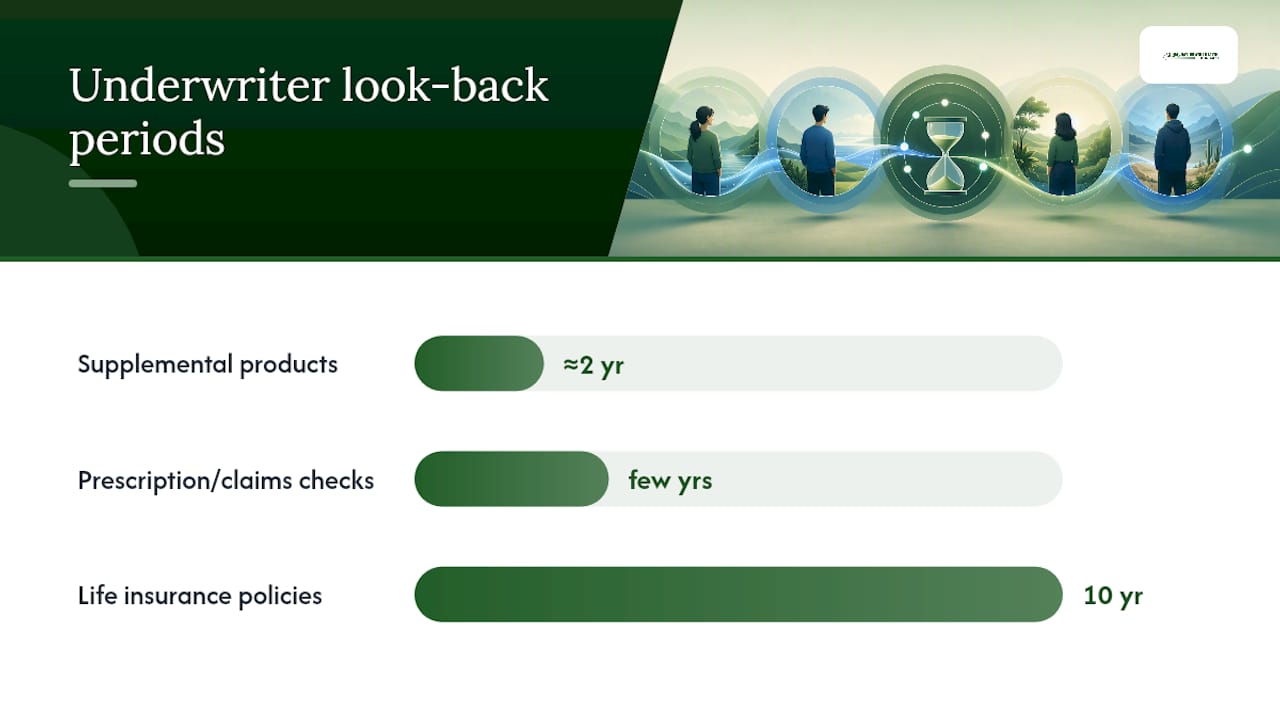
- Look-back period: the window of medical history an insurer reviews, often ranging from a few years to a full decade depending on the product.
- Exclusion rider: a clause that removes coverage for a specific condition, sometimes permanently.
- Rate-up or premium loading: a higher premium charged because of your health profile.
- Rescission: the insurer’s cancellation of a policy after discovering undisclosed information, sometimes applied retroactively.
- Post-claims underwriting: a records review triggered after you file a claim, rather than before you enroll.
Learning this vocabulary before you apply for anything is probably the single highest-leverage thing you can do. Insurers aren’t hiding these terms, but they’re buried in dense policy language most people skim past. Once you can spot them, you read every application differently. Our overview of how health insurance actually works breaks down the broader plan landscape if you want the fuller picture before diving into underwriting specifics.
Which Plans Still Ask About Your Health
Five categories of coverage routinely use medical underwriting, and knowing which bucket you’re shopping in tells you almost everything about what to expect.
Short-term limited-duration plans are the clearest example. These plans were designed as temporary bridge coverage, and because they fall outside ACA-compliant major medical rules, insurers can and usually do run full medical underwriting on every applicant. Expect a detailed health questionnaire, common exclusions for pre-existing conditions, and no guarantee of renewal if your health changes mid-term.
Medigap, or Medicare Supplement insurance, has a narrow guarantee built in. You get a six-month guaranteed-issue window that starts when you first enroll in Medicare Part B. Apply inside that window, and insurers generally can’t turn you down or charge you more for health reasons. Miss it, and most states allow insurers to fully underwrite Medigap applications, meaning a stroke, cancer history, or even ongoing physical therapy can lead to a denial or a rate-up.
Excepted benefits and supplemental policies make up a broad and often misunderstood category. This includes dental plans, vision plans, fixed-indemnity policies, and critical illness or accident coverage. These products are explicitly carved out of ACA protections because they’re not considered comprehensive major medical coverage. Underwriting practices vary widely here. Some dental plans barely ask anything. Fixed-indemnity and critical illness policies, on the other hand, often ask detailed questions about cardiac history, cancer, and diabetes, because those are precisely the conditions the policy is designed to pay out for.
Individual life and disability insurance almost always involve underwriting, and it tends to be the most thorough kind. Insurers routinely request:
- Full prescription drug histories
- Attending physician statements
- Blood and urine samples for larger policies
- Family health history in some cases
Association health plans and other niche products round out the list. These plans, sold through trade groups or membership organizations, sometimes use medical underwriting depending on how they’re structured and which state regulates them. The rules vary enough by state that it’s worth confirming directly with the plan administrator rather than assuming.
The common thread across all five categories: if a plan sits outside the ACA’s major medical framework, assume medical underwriting is in play until you confirm otherwise. KFF’s research on pre-existing condition prevalence estimates that a meaningful share of adults have a health condition that would have triggered a denial or rate-up under pre-ACA underwriting standards, which gives you a sense of just how many people these exempt categories can still affect.
How Insurers Actually Check Your Health History
Understanding the mechanics of underwriting takes the mystery out of it. Insurers follow a fairly consistent sequence, whether they’re underwriting a short-term health plan or a life insurance policy.
-
The application questionnaire comes first. You’ll answer yes/no and detail questions about diagnoses, medications, surgeries, hospitalizations, and sometimes family history. Watch for phrasing like “have you ever been diagnosed with, treated for, or advised to seek treatment for” — that phrasing is intentionally broad, and it’s designed to capture conditions you might not think to mention, including ones a doctor merely suggested watching.
-
Prescription and claims databases get checked next. Pharmacy benefit managers and specialized data vendors maintain records that insurers can query, often instantly. If you’ve filled a prescription for a blood pressure medication, a statin, or an antidepressant in the past few years, the underwriter likely already knows before you finish the application.
-
Medical records requests follow for larger policies or flagged applications. The underwriter’s look-back period, the span of history they review, ranges from a couple of years for smaller supplemental products to a full decade for substantial life insurance policies. Investopedia’s explainer on full medical underwriting describes this as a comprehensive review that can involve directly contacting your prior providers.
-
A medical exam may be ordered, particularly for life insurance above a certain coverage amount. The insurer typically pays for and schedules this exam, using its own network of paramedical companies. You show up, they draw blood, check blood pressure, and sometimes run an EKG. You generally don’t pay out of pocket for an insurer-requested exam tied to an application in progress.
-
Post-claims underwriting happens after the fact, and this is the step that catches people off guard. Rather than fully verifying your health history before issuing the policy, some insurers, particularly in the short-term and supplemental markets, issue coverage quickly and only pull medical records once you file a significant claim. If that records pull reveals an undisclosed condition, even one you genuinely forgot to mention, the insurer can rescind the policy and deny the claim.
Pro Tip: Request your own prescription history and medical records report before you apply for anything medically underwritten. Errors in these files are common, and catching one before an insurer does can be the difference between an approval and a denial.
Rescission is legally constrained in ways many applicants don’t realize. Under the ACA, rescission of ACA-compliant plans is prohibited except in cases of fraud or intentional misrepresentation. But that protection doesn’t extend to the exempt categories covered above, which is exactly why post-claims underwriting remains a live risk if you buy a short-term or supplemental plan without fully disclosing your history.
What an Underwriting Decision Costs You
Once underwriting is complete, you’ll land in one of four outcomes, and each carries different financial and coverage consequences worth understanding before you sign anything.
Premium loading is the most common outcome for applicants with manageable health conditions. An insurer might rate you up by a percentage over the standard premium because your BMI, blood pressure, or cholesterol readings fall outside preferred ranges. This isn’t arbitrary. It reflects the insurer’s actuarial tables translating your specific risk profile into dollars.
Exclusion riders and waiting periods target a specific condition rather than the whole application. A common scenario: you have a history of lower back issues, so the insurer issues the policy but attaches a rider excluding any back-related claims for a set period, or permanently. Waiting periods work similarly, delaying coverage for a particular condition category, often cardiac or maternity related, for a defined stretch after the policy takes effect.
Outright denial happens when an insurer decides your risk profile falls outside what it’s willing to cover at any price. This is more common in the short-term and supplemental markets than most applicants expect, particularly for anyone with a recent cancer diagnosis, uncontrolled diabetes, or a chronic condition requiring expensive ongoing treatment.
Rescission after a claim is the outcome nobody plans for. It happens when post-claims underwriting uncovers something the insurer believes should have been disclosed, and it can leave you responsible for medical bills you assumed were covered.
A meaningful share of adults carry a condition that pre-ACA underwriting standards would have flagged for a denial or a rate-up, according to KFF’s tracking of pre-existing condition prevalence. That’s the scale of the population still exposed whenever they shop outside ACA-protected plan categories.
If you receive an unfavorable underwriting decision, you have real options:
- Request the specific reason for the denial or rate-up in writing.
- File an appeal directly with the insurer, following the timeline listed in your denial letter.
- Contact your state insurance commissioner if you suspect the decision violated state regulations.
- For Medicare-related issues, reach out through CMS and HHS consumer resources, which maintain guidance on enrollment rights and complaint processes.
- Keep copies of every document you submitted, every communication you received, and dated notes of every phone call.
That documentation habit matters more than most applicants realize. Getting your own records and prescription history before you apply tends to produce better appeal outcomes and lowers your rescission risk down the line, because you’re not relying on the insurer’s version of your history being complete or accurate.
Your Step-by-Step Underwriting Checklist
You can’t control whether a plan uses medical underwriting, but you can control how prepared you are for it. Here’s the sequence I walk clients through before they apply for anything that isn’t ACA-guaranteed-issue.
-
Confirm the plan type first. Look for language like “short-term,” “limited benefit,” “fixed indemnity,” or “supplemental” in the plan name or marketing material. These are near-certain signs of medical underwriting. If the brochure emphasizes fast approval or same-day coverage, that’s often a signal the insurer is relying on post-claims review rather than upfront verification, which shifts risk onto you.
-
Order your own medical records and prescription history. Request these directly from your providers and pharmacy before you fill out any application. Review them line by line for errors. Misfiled diagnoses and outdated medication lists are more common than people expect, and they can trigger a rate-up or denial for something that isn’t even accurate.
-
Correct any errors you find, in writing, with dated documentation. Send corrections to the provider or pharmacy that generated the record, and keep copies of your correction requests along with their responses.
-
Disclose everything the application asks about, even conditions that feel minor or resolved. If a doctor ever suggested monitoring something, mention it. Underwriters interpret vague or incomplete answers as a red flag, and an undisclosed condition discovered later is the single biggest driver of post-claims rescission.
-
Document your disclosure. Keep a copy of your completed application, ideally with a timestamp, before you submit it. If you’re applying through a broker, ask for written confirmation of what was submitted on your behalf.
-
Ask direct questions before you sign, including: What’s the look-back period for this policy? Are pre-existing conditions excluded permanently or for a defined period? Does this plan use post-claims underwriting? What’s the appeal process if I’m denied?
-
Watch for policy red flags, including broad pre-existing condition exclusions with vague language, lifetime or annual benefit caps well below typical treatment costs, and any look-back period that isn’t clearly stated in plain numbers.
Pro Tip: If a broker or carrier can’t clearly answer how long the plan’s look-back period is, treat that as a warning sign, not an oversight. A legitimate underwriter always knows the exact window they’re reviewing.
If you’re weighing a lower-premium option against something more comprehensive, it’s worth reading through the trade-offs in our breakdown of low-premium health insurance, since many of the same underwriting exposures show up there in disguised form.
Who’s Behind This Guide, and How Sobal Health Fits In
The company specializes in personalized health insurance advisory with experience in private, medically underwritten markets beyond what most marketplace shoppers encounter. That specialization matters here specifically because underwriting is where generic advice runs out and personalized guidance starts paying off.
Here’s what that specialization looks like in practice:
- Direct broker access in multiple languages helps clients understand underwriting questions clearly.
- One-on-one advisory focused on education rather than a sales script provides personalized guidance during complex health insurance decisions.
- Access to private medically underwritten plans beyond the public marketplace, alongside standard ACA options, allows clients to compare a variety of choices.
- Portable PPO plan designs are available for individuals who move across states or travel frequently.
This guide comes from Bernie S, drawing on the regulatory research and underwriting mechanics covered throughout this piece. Client feedback includes reports of savings after switching to properly matched plans, although individual savings vary based on personal health and coverage. If you want a second opinion on whether a plan you’re considering will underwrite you fairly, reach out for a policy review before you sign anything.
Where This Information Comes From
The regulatory and statistical claims in this guide draw from a small set of primary sources worth bookmarking if you want to dig further on your own.
- Healthcare defines medical underwriting in plain regulatory language.
- CMS marketplace oversight resources explain ACA guaranteed-issue and community rating rules.
- KFF’s pre-existing condition research quantifies how many people underwriting exemptions still affect.
- Investopedia’s underwriting explainer walks through full medical underwriting mechanics with practical examples.
Why the Real Risk Isn’t Where Most People Look
Most consumer advice on this topic obsesses over the ACA marketplace, where guaranteed issue already solved the underwriting problem for the majority of applicants. That’s misplaced energy. The actual risk lives in the categories people don’t think to question: the short-term plan bought as a stopgap, the Medigap application filed eight months after turning 65, the fixed-indemnity policy sold as a cheap add-on.
Conventional advice tells people to “read the fine print.” That’s true but useless without knowing which specific words to hunt for. Look-back period, post-claims underwriting, exclusion rider. Those three phrases predict more real-world financial exposure than an entire brochure of marketing language.
If I had to rank priorities, disclosure comes first, documentation comes second, and price comparison comes a distant third. A cheap premium on a plan that rescinds coverage after your first major claim isn’t cheap at all. Get your own records before an insurer gets theirs, answer every question fully, and treat the enrollment window rules, especially Medigap’s six months, as immovable deadlines rather than suggestions.
— Bernie S
Get a Plan Review Before You Sign Anything
A licensed broker can provide personalized review of your health history against a range of private and public health insurance plan options.

This approach is especially relevant for self-employed individuals and small business owners considering plans subject to underwriting risks. Rather than navigating exclusion criteria or look-back periods on your own, personalized broker support can clarify your options without sales pressure. Explore medically underwritten plans and supplemental coverage built for exactly this kind of decision, or contact Sobal Nationwide Health directly to request a policy review before you submit any application that could put your history on the record.
This article is general information, not a substitute for advice from a qualified financial advisor. Consult a qualified financial professional about your own circumstances before acting on anything here.
Sources
- Medical underwriting – Glossary
- CMS marketplace oversight
- KFF — Pre-existing condition prevalence for individuals and families
- Medical underwriting — Investopedia
- Health insurance underwriting: What it is and how it works – LegalClarity
FAQ
What Does Full Medical Underwriting Mean for Health Insurance?
Full medical underwriting means the insurer conducts a comprehensive review of your medical history, including records, prescriptions, and sometimes direct contact with your prior providers, before deciding whether to offer coverage. Investopedia describes this process as the most thorough form of underwriting, and it typically results in one of four outcomes: standard approval, a rated-up premium, an exclusion rider, or denial.
Who Pays for Medical Exams During Underwriting?
The insurer typically pays for and schedules any medical exam it requires during the underwriting process, usually through its own network of paramedical exam companies. This applies most often to life insurance applications above a certain coverage amount, rather than to most short-term or supplemental health plans.
What Does a Medical Insurance Underwriter Do?
An underwriter evaluates your application, medical records, and prescription history to determine whether to offer coverage and at what price. The Bureau of Labor Statistics describes underwriters broadly as risk assessment professionals who balance an applicant’s health profile against the insurer’s pricing models.
How Is Medical Underwriting Done?
Medical underwriting starts with an application questionnaire, followed by checks against prescription and claims databases, and, for larger policies, a request for full medical records covering a defined look-back period. Some insurers also use post-claims underwriting, pulling records only after a significant claim is filed rather than before issuing the policy.
Does Medicare Supplement Insurance Always Use Medical Underwriting?
No. Medigap offers a six-month guaranteed-issue window starting with your Medicare Part B enrollment, during which insurers generally cannot deny you or charge more for health reasons. Apply outside that window, and most states allow full medical underwriting on Medigap applications.
Can Sobal Nationwide Health Help Me Find a Medically Underwritten Plan?
Yes. Sobal Nationwide Health provides access to private medically underwritten plans alongside standard ACA options, with personalized broker advisory for self-employed individuals, families, and small businesses in multiple states. Current plan details and pricing are available directly through Sobal Nationwide Health’s website.
