

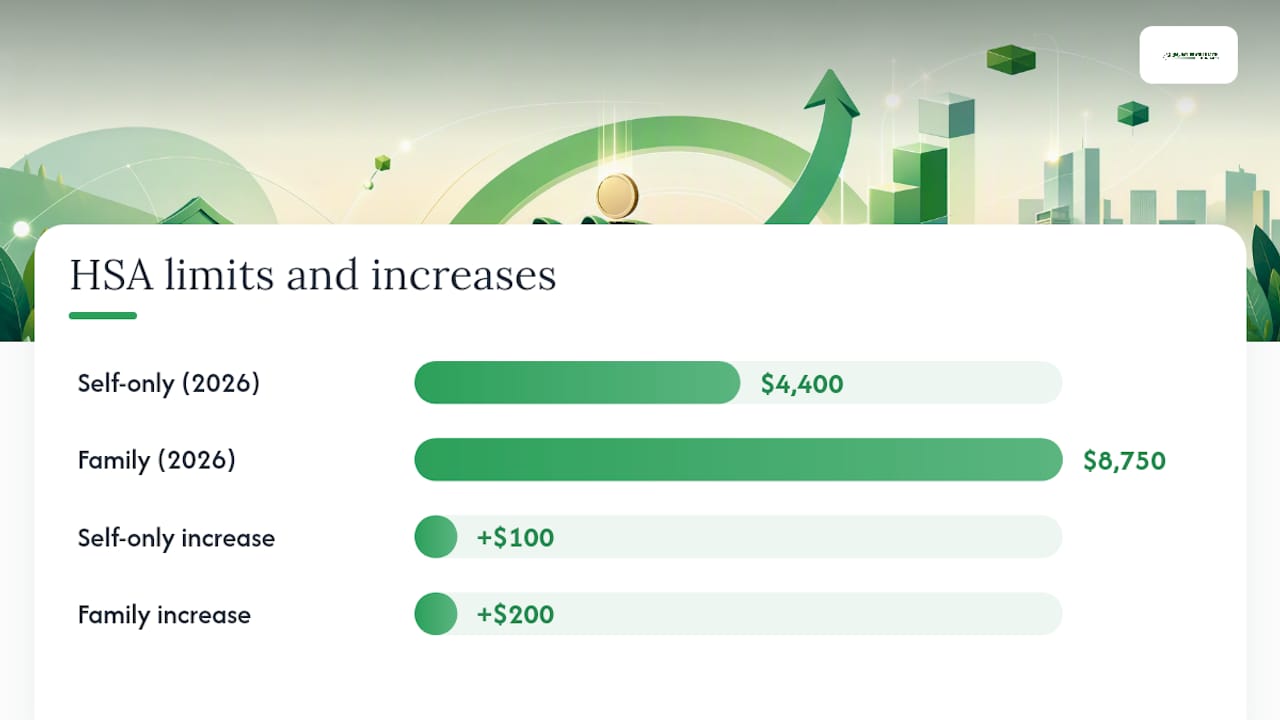
For 2026, the IRS caps HSA contributions at $4,400 for self-only coverage and $8,750 for family coverage, and if you’re 55 or older, you can tuck away an extra $1,000 on top of that. Those numbers only apply if you’re enrolled in a qualifying high-deductible health plan for the months you’re claiming, and every dollar has to land in your account by the tax filing deadline. The eligibility rules and the deadline math matter just as much as the headline figures.
TL;DR:
- Your total contributions, including employer deposits, cannot exceed the prorated annual limit for the months you are eligible, or you risk penalties.
- If you enroll in Medicare or switch from family to individual coverage mid-year, your HSA eligibility ceases immediately, reducing future contribution room.
- Contributions made after the tax year ends are allowed until the tax filing deadline, but excess contributions before that must be corrected to avoid a 6% annual excise tax.
- Properly structured HDHP plans must meet specific deductible and out-of-pocket thresholds in 2026; plans falling short disqualify you from HSA contributions.
- The $1,000 catch-up contribution for those 55+ remains unchanged, but it is not inflation-adjusted and can be split if both spouses are eligible for catch-up contributions.
Table of Contents
- HSA Contribution Limits 2026: The Official Numbers and Where They Come From
- HSA Eligibility and 2026 HDHP Requirements
- How to Calculate Your Personal 2026 HSA Limit
- Employer Contributions Count Toward Your Limit Too
- Medicare, COBRA, and Other Situations That Change Your Eligibility
- Deadlines, Excess Contributions, and How to Fix a Mistake
- Getting the Most Out of Your HSA in 2026
- Why Self-Employed Workers Need to Think About This Differently
- Finding an HSA-Eligible HDHP That Actually Fits Your Budget
- Primary Sources for 2026 HSA Rules
- Sources
HSA Contribution Limits 2026: The Official Numbers and Where They Come From
The IRS doesn’t pull these figures out of thin air. Every year, the agency runs the numbers through an inflation formula written into the tax code, then publishes the results in a revenue procedure months before the plan year begins. For 2026, that document is Rev. Proc. 2025-19, and it sets the self-only contribution limit at $4,400 and the family limit at $8,750.
Comparing to 2025, the self-only coverage limit increased slightly to $4,400, and the family coverage limit increased to $8,750. That’s the usual pattern with HSA limits. They rarely jump dramatically in a single year because the IRS rounds adjustments to the nearest $50, which smooths out the kind of wild swings you might see in other inflation-linked figures.
Thomson Reuters reported that the IRS released these 2026 figures back in May 2025, giving employers, brokers, and benefits administrators nearly eight months to update payroll systems and enrollment materials before the new plan year started. If you’ve ever wondered why open enrollment materials in the fall already reflect next year’s HSA numbers, that’s the answer. The IRS front-loads this information specifically so nobody gets caught guessing.
Here’s the side-by-side comparison:
| Category | 2025 Limit | 2026 Limit | Change |
|---|---|---|---|
| Self-only coverage | $4,400 | $4,400 | +$100 |
| Family coverage | $8,750 | $8,750 | +$200 |
| Catch-up contribution (55+) | $1,000 | $1,000 | No change |
Notice that catch-up figure staying flat. Unlike the base limits, the $1,000 catch-up contribution for people 55 and older isn’t indexed for inflation at all. Congress set that number by statute, and it’s stayed at $1,000 since it was introduced. That means its real-dollar value has quietly eroded every year the base limits have climbed, a detail Dartmouth’s benefits guidance confirms explicitly for 2026.
Think of the base limit as the size of your savings bucket and the catch-up as a fixed-size scoop you get to add once you hit 55. The bucket keeps growing a little each year. The scoop stays exactly the same size it’s always been.
One nuance worth flagging if you’re married and both spouses are HSA-eligible: each spouse can open and fund an individual HSA, but the combined contributions across both accounts still can’t exceed the family limit for the year, a point the Congressional Research Service’s HSA report lays out clearly. If you’re both 55 or older, though, each spouse can add their own separate $1,000 catch-up, since catch-up contributions must go into the account of the person who qualifies for them and can’t be pooled.
If your household is weighing whether a high-deductible plan is the right fit financially, it helps to understand how deductibles actually work before you commit to a plan built around one.
HSA Eligibility and 2026 HDHP Requirements
Having access to an HSA isn’t automatic just because you want one. You need to be enrolled in a health plan that meets the IRS definition of a high-deductible health plan, and that definition has specific dollar thresholds attached to it every year.
For 2026, a plan qualifies as an HSA-eligible HDHP if it meets these minimums and maximums, as set out in Rev. Proc. 2025-19:
- Minimum annual deductible: $1,700 for self-only coverage, $3,400 for family coverage
- Maximum out-of-pocket limit: $8,500 for self-only coverage, $17,000 for family coverage
- The deductible has to be at least that high before the plan starts paying for most services (preventive care is typically exempt from this rule)
- The out-of-pocket maximum caps what you’d pay in a worst-case year, including deductible, copays, and coinsurance combined
That out-of-pocket ceiling is worth sitting with for a second. It’s not the deductible. It’s the absolute most you’d owe in a single year even if you had a serious medical event. Think of it as the plan’s safety net; once your spending hits that number, the insurance company picks up 100% of covered costs for the rest of the year.
Meeting the deductible thresholds doesn’t automatically make you eligible to contribute, though. A handful of common situations disqualify people who otherwise think they’re in the clear:
- Medicare enrollment in any part (A, B, or D) immediately ends your HSA eligibility, even if you’re still working and covered by an HDHP through your employer
- Being claimed as a dependent on someone else’s tax return disqualifies you, regardless of what coverage you have
- Enrollment in a general-purpose health FSA through a spouse’s employer can disqualify you, since that coverage counts as “other health coverage” under IRS rules
- TRICARE coverage or certain VA benefits used within the prior three months can also create eligibility conflicts
If you’re self-employed and shopping for a plan specifically to unlock HSA eligibility, the safest move is to ask the carrier or your broker directly whether the plan is designated as HSA-qualified. Marketplace listings usually flag this, but the deductible and out-of-pocket structure has to match the IRS thresholds exactly, not approximately. A plan with a $1,600 deductible for self-only coverage, for example, misses the 2026 minimum by $100 and simply doesn’t qualify, no matter how the insurer markets it. Sobal Nationwide Health’s own guidance on lowering health insurance costs walks through how HDHP selection interacts with your broader premium and deductible strategy.
How to Calculate Your Personal 2026 HSA Limit
The $4,400 and $8,750 figures assume you’re eligible for the entire calendar year. Most people aren’t, whether because they started a new job in June, switched from individual to family coverage, or aged into Medicare partway through the year. When your eligibility changes mid-year, you have to prorate.
Here’s the formula the IRS uses, and it’s simpler than it sounds:
- Divide the annual limit by 12 to get your monthly contribution allowance for the coverage tier you had that month
- Count the months you were HSA-eligible as of the first day of each month, since eligibility is determined on the 1st, not on a daily basis
- Multiply your monthly allowance by the number of eligible months to find your prorated annual limit
- Add your catch-up contribution, prorated the same way if you turned 55 mid-year, or in full if you were 55 for the entire eligibility window
Let’s run two real examples.
Example one: Partial-year self-only coverage. Say you started a new job with an HSA-eligible HDHP on April 1, 2026, and had self-only coverage the rest of the year. You were eligible for 9 months (April through December). Your monthly allowance is $4,400 divided by 12, or about $366.67. Multiply that by 9, and your prorated limit for 2026 is $3,300.
Example two: Family coverage transition. Now imagine you had self-only HDHP coverage from January through June, then got married and switched to a family HDHP plan starting July 1. For January through June, your allowance is based on the self-only limit: $4,400 divided by 12, times 6 months, equals $2,200. For July through December, you use the family limit: $8,750 divided by 12, times 6 months, equals $4,375. Add those together, and your total 2026 limit is $6,575.
There’s a shortcut that can override all of this math, though. It’s called the last-month rule, and it says that if you’re HSA-eligible on December 1 of the tax year, you’re treated as if you’d been eligible the entire year, meaning you could contribute the full $4,400 or $8,750 even if you only had coverage for a few months. The catch, as explained in the CRS report on HSAs, is the 12-month testing period that comes with it. You must remain HSA-eligible for the entire following calendar year (through December of the next year), or the extra amount you contributed under the shortcut gets reclassified as taxable income, plus a 10% additional tax in most cases.
Because that testing period is unforgiving, some taxpayers deliberately skip the last-month rule and stick with straight prorating instead, even when they’d qualify for the bigger contribution, simply to avoid the risk of a coverage change blowing up their tax return the following year.
Pro Tip: Keep a simple calendar note or spreadsheet marking the exact date your HDHP coverage started or changed each year. When you’re prorating contributions or defending a last-month rule claim on an audit, “I think it was around March” doesn’t cut it. A dated screenshot of your enrollment confirmation is worth more than your memory.
Employer Contributions Count Toward Your Limit Too

Here’s a detail that trips up a lot of people who feel like accountants for a day every April: your $4,400 or $8,750 limit isn’t just about what comes out of your own paycheck. It’s the combined total of everything deposited into your HSA, from any source, in that calendar year.
If your employer kicks in $1,000 to your HSA as part of your benefits package, that $1,000 counts against your annual limit exactly the same as if you’d deposited it yourself. This applies whether the employer contribution comes as a lump sum, a wellness incentive, or matched pre-tax payroll deferrals you elected during open enrollment.
According to IRS Publication 969, that combined ceiling applies no matter how many different sources are feeding the account, which makes reconciliation an actual necessity rather than a nice-to-have. Before you assume you have room to contribute more, check these sources:
- Your most recent pay stub, which should itemize year-to-date HSA payroll deductions separately from other benefits
- Form W-2, box 12 with code W, which reports combined employer and employee pre-tax HSA contributions for the year
- Your HDHP plan documents or benefits portal, which often list any employer wellness contributions or matching funds
- Form 5498-SA, sent by your HSA custodian, which reports total contributions received into the account regardless of source
A surprising number of people forget to factor in employer deposits when they’re calculating how much more they can personally add before year-end, which is exactly the kind of oversight that leads to an excess contribution nobody meant to make. Reconciling all four of those documents before the filing deadline takes maybe twenty minutes and can save you a genuinely unpleasant tax surprise.
Medicare, COBRA, and Other Situations That Change Your Eligibility
Enrolling in any part of Medicare, whether it’s Part A, Part B, or Part D, ends your ability to contribute to an HSA immediately, starting the month your coverage begins. This catches a lot of people off guard because they assume Medicare and HSA eligibility can coexist as long as they’re still working. They can’t. The moment Medicare coverage kicks in, new contributions stop being allowed, though funds already sitting in your HSA remain entirely yours to spend on qualifying medical expenses for the rest of your life.
Timing matters enormously here, especially for anyone turning 65. Medicare Part A enrollment is often retroactive up to six months once you sign up for Social Security retirement benefits, which means some people accidentally create an excess contribution without realizing it. If you’re still working past 65 and covered by an employer HDHP, delaying Medicare enrollment (which is allowed if you have qualifying employer coverage) keeps your HSA eligibility alive longer. University benefits guidance on Medicare and HSA interactions points out that even a small shift in when you file for Part A can materially change how much contribution room you have for that final working year, which is exactly the kind of detail worth running past a tax advisor before you sign anything.
A few other situations come up often enough to flag:
- COBRA continuation coverage on an HSA-eligible HDHP keeps your eligibility intact, since COBRA extends your existing plan rather than creating new coverage
- Divorce can shift you from family coverage to self-only coverage mid-year, which means you’ll need to prorate using both limits for the months each applied
- Employer plan changes mid-year, like a company switching HDHP carriers or adjusting deductible structures, can affect whether your coverage still meets HSA-eligible thresholds, so it’s worth confirming with HR rather than assuming continuity
The $1,000 catch-up contribution has stayed unchanged since it was introduced, even as base limits have climbed with inflation nearly every year, according to Dartmouth’s 2026 benefits guidance. If you’re 55 to 64 and still HSA-eligible, that catch-up window is worth using deliberately, because it closes the moment Medicare enrollment starts.
Deadlines, Excess Contributions, and How to Fix a Mistake
You have more time than the calendar year suggests. Contributions for the 2026 tax year can be made all the way up until the federal income tax filing deadline, typically April 15 of 2027, not December 31, 2026. This is one of the more underused pieces of flexibility in the entire HSA system: if you realize in March that you had room to contribute more the previous year, you generally still can, as long as you designate the deposit as a prior-year contribution when you make it.
Where people run into trouble is on the other end, contributing too much. If your total contributions for the year exceed your allowed limit, whether from your own deposits, employer contributions, or a coverage change you didn’t account for, the excess amount is subject to a 6% excise tax, and that tax applies again every year the excess remains in the account uncorrected, as specified in Rev. Proc. 2025-19.
The 6% excise tax on excess HSA contributions isn’t a one-time penalty. It applies annually to the excess amount for every year it stays in the account, which means a small oversight left unaddressed can quietly compound into a recurring tax bill.
The good news is that correcting an excess contribution before your filing deadline is usually straightforward. Here’s what that process typically involves:
- Contact your HSA custodian and request a “corrective distribution” of the excess amount plus any earnings it generated
- Withdraw the excess before your tax filing deadline, including extensions, to avoid the 6% excise tax entirely
- Report the withdrawn earnings as taxable income for the year they were earned, since the excise tax and income tax rules apply separately
- File Form 8889 with your tax return to report HSA contributions, distributions, and any excess contribution corrections
- Keep Form 5498-SA from your custodian, which documents total contributions received and helps you cross-check your own records against what the IRS sees
If you miss the correction window entirely, the excess amount doesn’t just disappear from the tax problem. It keeps accruing that 6% excise tax year after year until you eventually withdraw it, which is a strong argument for catching these errors sooner rather than filing an extension and hoping to deal with it later.
Getting the Most Out of Your HSA in 2026
Hitting the contribution limit is one thing. Using that money strategically is a separate skill, and it’s where a lot of HSA holders leave real value on the table.
- Decide between steady payroll deductions and front-loading. Spreading contributions evenly across each paycheck keeps your cash flow predictable and reduces the risk of accidentally overcontributing if your employment situation changes mid-year. Front-loading, contributing the maximum early in the year, gets your money invested and growing sooner, but it only makes sense if you’re confident your income and eligibility won’t shift before December.
- Consider investing your HSA balance once it clears the cash cushion your custodian requires. Many HSA providers let you invest funds above a minimum threshold, often $1,000 to $2,000, into mutual funds or similar vehicles, similar to a 401(k). Money you don’t need for near-term medical expenses can grow tax-free for decades, which is part of why financial planners increasingly treat HSAs as a stealth retirement account rather than just a medical expense fund.
- Reconcile your contributions at year-end, not just at tax time. Pull your final pay stub, your HSA custodian statement, and any employer contribution notices in December, and add them up before January 1. Catching an overcontribution with two weeks left in the year gives you far more room to fix it than discovering it in April.
- Save every receipt for HSA-eligible expenses, even small ones. There’s no deadline on reimbursing yourself from HSA funds for a qualified expense you paid out of pocket, as long as the expense occurred after your HSA was established. Some people intentionally let their HSA balance grow for years and reimburse themselves later, using old receipts as proof.
Pro Tip: If your HSA custodian charges investment fees or requires a high cash minimum before you can invest, it’s worth comparing custodians. Not every HSA provider is created equal, and some employer-selected defaults aren’t the cheapest or most flexible option on the market, especially if you plan to hold the account for decades.
Why Self-Employed Workers Need to Think About This Differently
Choosing an HDHP isn’t just about whether you can tolerate a higher deductible. For self-employed people, it’s frequently the gateway to one of the few remaining triple-tax-advantaged accounts in the entire tax code: money goes in pretax, grows tax-free, and comes out tax-free for qualified medical expenses. That’s a meaningfully different calculation than the one an employee weighing a company benefits menu makes, because a self-employed person is choosing the entire plan structure, not just deciding whether to opt into a payroll deduction.
What surprises a lot of self-employed clients I’ve worked through this with is how much the HDHP-versus-traditional-plan decision hinges on more than the sticker price of the monthly premium. A plan with a lower premium but a deductible that doesn’t meet the 2026 HSA thresholds locks you out of this entire savings vehicle. Meanwhile, a properly structured HSA-eligible HDHP can sometimes cost less per month while opening up thousands of dollars in tax-advantaged contribution room you wouldn’t otherwise have access to.
The eligibility rules covered here aren’t optional fine print. They’re the actual gatekeeper for whether your plan choice this year sets you up to build real, compounding tax-advantaged savings, or locks you out of it entirely because your deductible fell $50 short of the federal minimum. That distinction is exactly why I encourage clients to check HDHP qualification before comparing premiums, not after.
If you’re self-employed and trying to figure out whether a specific plan on the table actually qualifies, that’s a conversation worth having with someone who reviews these plan structures for a living, not a guess based on a carrier’s marketing copy.
— Bernie S
Finding an HSA-Eligible HDHP That Actually Fits Your Budget
Knowing the 2026 limits is only useful if you can actually get into a plan that qualifies for them. That’s where a lot of self-employed people and small business owners get stuck, because not every plan marketed as “high-deductible” meets the IRS’s specific deductible and out-of-pocket thresholds, and figuring that out from a marketplace listing alone is genuinely hard.
Sobal Nationwide Health works through exactly this kind of plan comparison every day, checking whether a given HDHP’s numbers actually clear the 2026 HSA-eligibility bar before you commit to it. As a licensed broker operating across 31 states, Sobal Nationwide Health can pull private, medically underwritten plan options alongside ACA marketplace choices, so you’re comparing your full range of options rather than just what one carrier’s website shows you.

A consultation walks through your specific situation: your income structure if you’re self-employed, whether family or self-only coverage makes sense, and how the premium-versus-deductible trade-off nets out once you factor in HSA contribution room. If you’re weighing your options as a 1099 worker, the self-employed health insurance guide breaks down plan types specific to that situation, and the personal and family plans page covers what to look for if you’re insuring a household. Reach out through Sobalhealth to get a personalized comparison of HSA-eligible HDHP options before your next enrollment window closes.
Primary Sources for 2026 HSA Rules
Every figure and rule in this guide traces back to a small set of primary documents worth bookmarking directly. Rev. Proc. 2025-19 is the actual IRS revenue procedure setting the 2026 limits and HDHP thresholds. IRS Publication 969 covers contribution reporting, Form 8889, and tax treatment in detail. The Congressional Research Service’s HSA report offers the clearest plain-language explanation of the last-month rule and testing period available anywhere. For anything not covered here, or for edge cases specific to your situation, IRS.gov stays the most current and authoritative source, since guidance occasionally gets updated between annual revenue procedures.
This article is general information, not a substitute for advice from a qualified financial advisor. Consult a qualified financial professional about your own circumstances before acting on anything here.
Sources
- Rev. Proc. 2025-19 (IRS revenue procedure)
- Health Savings Accounts (HSAs) — Congressional Research Service (CRS) report
- Dartmouth — 2026 HSA guidance
- Thomson Reuters — IRS announces 2026 HSA and HDHP limits
