

A private health insurance broker is a licensed professional who helps you find, compare and enroll in coverage, including plans you can’t buy on the public marketplace. For most people the help costs nothing extra, because the insurance company pays the broker. The real question is whether the broker works for you, and whether the plan fits your health and budget.
I’m writing this the way I’d explain it across a desk. If you’re self-employed, between jobs, or earn too much for marketplace subsidies, the choices can feel like alphabet soup. They don’t have to.
TL;DR
- A broker is paid by the insurance company, so the help is generally free to you. Always ask how yours gets paid.
- “Private” usually means one of two things: an ACA plan bought off the marketplace, or a medically underwritten plan that looks at your health history.
- Medically underwritten plans can cost less and offer wide PPO networks. They can also deny you or charge more for pre-existing conditions, so read the fine print.
- Check a broker’s license with your state Department of Insurance before you share personal data.
- Be wary of any pressure to decide today. Honest brokers let you read the documents first.
Table of Contents
- What a private health insurance broker actually does
- Does a broker cost extra?
- What “private” health insurance means
- When a broker is worth it
- Is it cheaper to buy through a broker?
- How to check a broker before you share anything
- Timing: open enrollment and private plans
- Perspective: what we see after years of sitting across the desk
- Working with Sobal Health
- Questions to bring to your first call
- FAQ
- Sources
What a private health insurance broker actually does
The word “broker” gets used loosely. In practice, a good one does five things:
- Listens first. Your doctors, prescriptions, income, family and travel habits decide which plan fits.
- Compares across companies. The National Association of Insurance Commissioners (NAIC) explains that independent agents and brokers can offer policies from many companies, while captive agents represent one.
- Explains the trade-offs in plain English: premium, deductible, copays, out-of-pocket maximum, network.
- Handles the application, so mistakes don’t delay your start date.
- Stays available for claims questions, renewals and life changes.
If you want the finer points of titles, we wrote a separate guide on the difference between a broker and an agent.
Does a broker cost extra?
Usually not. HealthCare.gov says you won’t pay anything extra to use an agent or broker for Marketplace plans, and they are paid by the insurance companies. You also stay eligible for the same premium tax credits if you enroll through the Marketplace with a broker’s help.
There is one wrinkle. Some states let licensed producers charge a separate fee for specific services, as long as it is disclosed. The NAIC keeps a state-by-state chart of rules on producer fees and commissions. So ask two questions up front:
- “How do you get paid?”
- “Do you represent more than one carrier?”
Those are the same two questions the NAIC suggests asking. If there is any fee on top of commission, get it in writing before you start.
What “private” health insurance means
People search for “private health insurance” and mean different things. Here is how the main options line up.
| Option | Do they ask about your health? | Subsidies available? | Typical fit |
|---|---|---|---|
| ACA Marketplace plan | No. Guaranteed issue | Yes, if you qualify | Lower or moderate income, pre-existing conditions |
| ACA-compliant plan bought off-exchange | No | No | Higher earners who want ACA protections |
| Medically underwritten plan | Yes | No | Healthy, higher-income buyers who want broader networks or lower premiums |
| Short-term plan | Yes | No | Brief gaps in coverage |
| Health care sharing ministry | Varies | No | Not insurance, see below |
The premium gets you in the door. What you pay once you use care depends on the deductible, cost-sharing and the out-of-pocket maximum, which is your financial safety net for the year.
Medically underwritten plans, explained
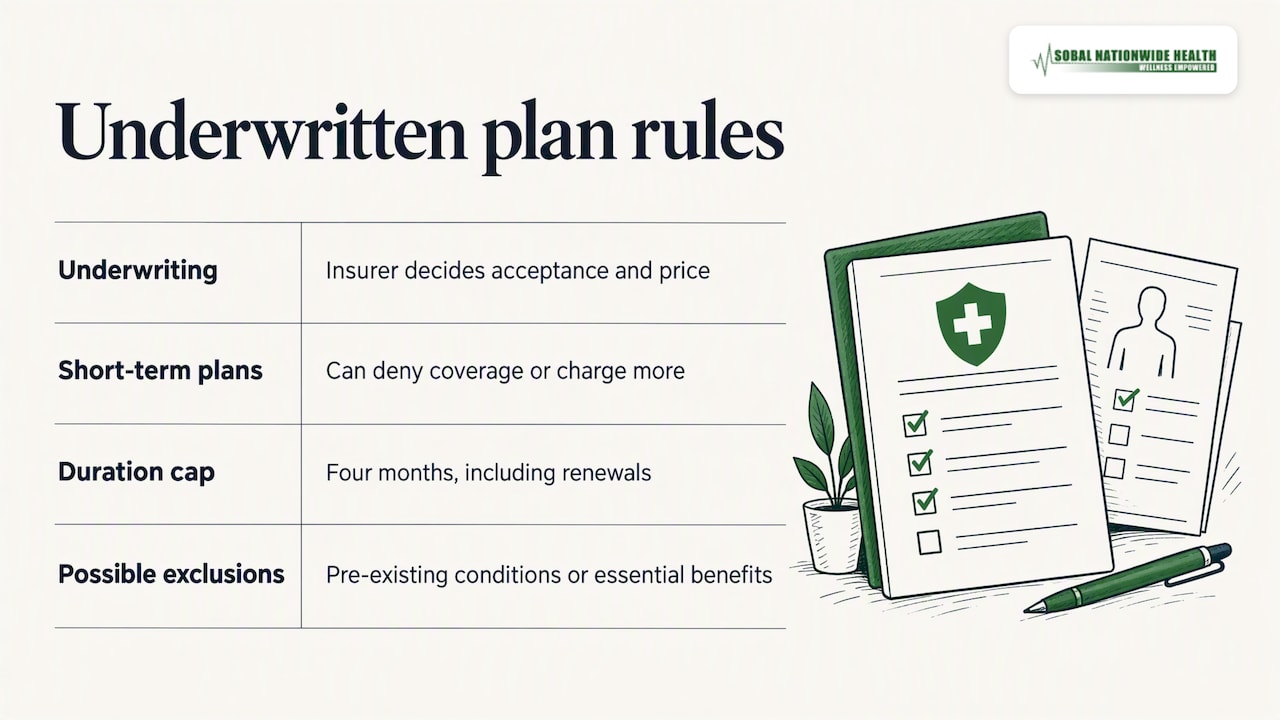
With a medically underwritten plan, you answer health questions, and the insurer decides whether to accept you and at what price. CMS notes that short-term plans, one type of underwritten coverage, aren’t subject to guaranteed issue, so they can deny coverage or charge more based on health status. Federal rules from 2024 also cap short-term plans at four months in total, including renewals. Rules and litigation in this area move, so confirm what is allowed in your state.
Who can benefit? Often people in good health who earn too much for marketplace subsidies, and who would rather pay for a broad PPO network than a narrow one. Who should be careful? Anyone with a chronic condition or a planned procedure. These plans may exclude pre-existing conditions or certain essential health benefits. Our guide on how medically underwritten insurance works and who it fits walks through the details.
Why the network type matters
Many people look for private plans because they want to keep their doctor or see specialists without a referral. That usually points to a PPO. If you’re still sorting out the basics, this PPO vs HMO comparison lays out how the two differ. A broker can then check whether your actual doctors and hospitals are in a given network, which is the step people most often skip.
When a broker is worth it
I’d point to a broker in these situations:
- You’re self-employed or a 1099 contractor and your income swings from year to year, which changes subsidy eligibility.
- You earn too much for marketplace subsidies and want to compare off-exchange options.
- You’re between jobs and weighing private coverage against COBRA.
- You run a small business and want to compare group options.
- You’re confused by plan documents. Plenty of people are. That is the job.
If you’re a confident shopper with simple needs and one marketplace plan in mind, you may not need one. Free help is also available through HealthCare.gov assisters and navigators.
Is it cheaper to buy through a broker?
For Marketplace plans, the price is generally the same whether you enroll alone or with a broker, because the commission is built into the carrier’s premium. The savings come from picking the right plan, not from a special broker rate.
That is where a broker earns the title. A plan with a lower premium and a high deductible can cost more over a year than a plan with a higher premium, if you see doctors often. A good broker runs your real numbers.
Our clients’ reviews mention savings, and some report reductions of up to $400 per month. Your result depends on your age, state, health and what you’re comparing against, so treat that as a possibility and not a promise.
How to check a broker before you share anything
Here is the checklist I’d use for my own family.
- Verify the license. Search your state Department of Insurance website or the NAIC consumer lookup before you share a Social Security or bank account number, as the NAIC advises.
- Ask how they’re paid and whether they represent several carriers.
- Ask for the plan documents and read the exclusions, waiting periods and limits.
- Confirm what kind of product it is. Is it ACA-compliant, medically underwritten, short-term, or a sharing ministry?
- Watch for pressure. The NAIC’s shopping guide says a legitimate professional lets you compare before committing. A deadline of “a few hours” is a red flag, and so is an unsolicited call about “private” coverage.
- Be careful with sites that demand an account before showing any plan details.
Regulators also warn about products that are marketed as health coverage but aren’t regulated as such. Health care sharing ministries are one example. We cover the risks in health sharing vs insurance.
Timing: open enrollment and private plans
Marketplace enrollment is on a calendar. For 2027 coverage, open enrollment runs from November 1, 2026 through January 15, 2027 in most states, and the deadline for a January 1 start is December 15, 2026. Schedules can differ in state-run marketplaces.
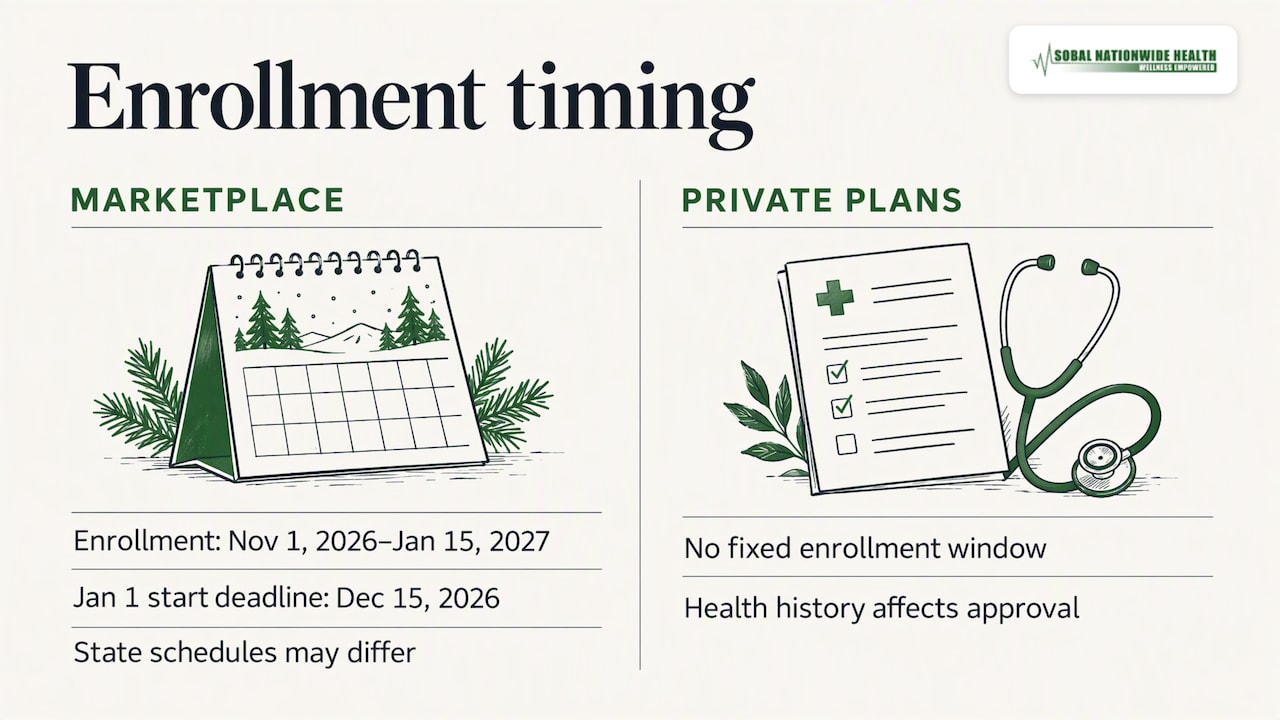
Medically underwritten plans work differently. They are not tied to the same enrollment window, but approval depends on your health history, so applying while you’re healthy matters. If you’re planning a family’s coverage around these dates, our family health insurance options guide covers the December 15 deadline and private plans.
Perspective: what we see after years of sitting across the desk
We’re a licensed independent brokerage serving self-employed people, families and small businesses in 31 states. The most common story we hear is not “I want the cheapest plan.” It’s “I opened the marketplace, saw a premium I couldn’t justify, and had no idea what the deductible meant.”
Here is how we think about it.
Education comes before enrollment. If you leave a call understanding your plan, we’ve done our job, even if you don’t buy from us. We don’t use sales pressure, and you can talk with a broker directly in English or Spanish.
Private isn’t automatically better. For some clients, a subsidized marketplace plan is the smartest answer, and we’ll say so. For others who don’t qualify for subsidies, private medically underwritten PPO plans can offer portable, nationwide coverage with any doctor or hospital in network. The right answer depends on your health, your income and what you need the plan to do.
The fine print is the product. Before anyone enrolls in an underwritten plan, we want them to know what it excludes, how it treats pre-existing conditions, and what happens if their health changes. A cheaper premium that fails you at claim time isn’t a bargain.
— Bernie S
Working with Sobal Health
We help with personal and family coverage, including medically underwritten health insurance, accident, fixed indemnity, dental, vision, critical illness, life and disability income. Small business owners can explore group options too. You can see our personal and family plan categories, or check business health insurance options if you’re covering a team. If you’d like a no-pressure conversation about which type of plan fits you, start at sobalhealth.com.
Questions to bring to your first call
A short list keeps the conversation useful:
- Which of my doctors and prescriptions are covered, and at what cost?
- What is the out-of-pocket maximum, and does it include prescriptions?
- Does this plan cover pre-existing conditions? If it’s underwritten, what could be excluded?
- Are there waiting periods, benefit caps or lifetime limits?
- If I move states or travel, does my coverage follow me?
- What happens at renewal if my health changes?
Write the answers down. A broker who answers clearly and without hurry is telling you how the rest of the relationship will go.
FAQ
Is it worth getting insurance through a broker?
For most people, yes, if the broker is licensed and independent, because the service generally doesn’t add to your premium. You get plan comparisons, help with the application and support afterward. If your situation is simple, you can also enroll yourself or use free assisters.
Are health insurance brokers trustworthy?
Licensed ones are regulated by your state, and you can verify the license and check complaints with your state Department of Insurance. Trust also comes from behavior: clear answers about pay, no pressure, and time to read documents. Walk away from anyone who pushes a same-day deadline.
Is a private plan the same as an ACA plan?
Not always. ACA plans accept everyone and may come with subsidies. Medically underwritten private plans can ask about your health and may deny you or charge more, and they aren’t bound by the same federal consumer protections. A broker should tell you which one you’re looking at.
Do I need a broker if I’m self-employed?
Not required, but it often helps. Variable income affects subsidy eligibility, and you may be weighing marketplace, off-exchange and private options at once. A broker can compare them against your real doctors and budget.
Sources
- Agent and broker (health insurance), HealthCare.gov glossary
- Get help applying for health insurance, HealthCare.gov
- Independent agent, captive agent, insurance broker, NAIC
- What to ask when shopping for health insurance, NAIC
- Health plan options, NAIC
- Producers’ ability to charge fees and collect commissions, NAIC
- Short-term, limited-duration insurance fact sheet, CMS
- ACA open enrollment deadlines, healthinsurance.org
