

Health sharing is not health insurance, no matter what the glossy brochures suggest. A health care sharing ministry can lower your monthly cost, but it comes with no legal promise that your bills get paid. Regulated insurance costs more on paper but guarantees coverage for essential care. If you have a family, a chronic condition, or anything resembling a pre-existing diagnosis, a licensed insurance plan is the safer bet. If you’re young, healthy, and comfortable with real financial risk, health sharing might work for a while.
TL;DR:
- Health sharing plans offer lower monthly costs but lack any legal guarantee of claim payments, unlike regulated insurance that is contractually obligated to cover benefits.
- These ministries often exclude coverage for pre-existing conditions, mental health, or reproductive care and set their own caps, which can leave members liable for large bills.
- Many states exempt health sharing organizations from regulation, reducing consumer protections and leading to inconsistent enforcement and market transparency.
- Subsidies can significantly reduce insurance costs, making ACA plans competitive or cheaper than health sharing for many consumers, particularly those with families or ongoing health needs.
- Before enrolling, individuals should verify benefit guarantees, review official documents, and consider consulting a licensed broker to compare comprehensive, regulated plans with health sharing options.
Table of Contents
- How Traditional Health Insurance Works
- How Do Health Care Sharing Plans Work?
- Insurance vs Health Sharing Plans: A Side-By-Side Look
- What Do U.S. Regulators Say About Health Sharing?
- Costs and Who Tends to Save
- How Do You Choose Between a Health Share and Regulated Insurance?
- Sobal Health Perspective: Regulated Alternatives and How We Help
- What Should You Actually Do Now?
- Compare Regulated Plans With Sobal Nationwide Health
- Where to Read More
- Sources
- FAQ
How Traditional Health Insurance Works
Health insurance is a legal contract. When you pay your premium, the insurer is legally bound to cover the benefits listed in your policy, and state insurance departments enforce that promise. ACA marketplace plans go further: they must cover 10 essential health benefits, including maternity care, mental health treatment, and prescription drugs, and they cannot deny you for a pre-existing condition.
Every marketplace plan also caps your annual out-of-pocket spending, so a bad year can’t bankrupt you the way an uncapped bill could. Insurers negotiate rates with hospitals and doctors in advance, which is why your bill at an in-network provider looks nothing like the sticker price. That negotiated discount, quietly built into every claim, is one of the most underappreciated parts of what you’re actually buying with a premium. You can read a fuller breakdown of how these mechanics fit together in our guide to how health insurance works.
How Do Health Care Sharing Plans Work?
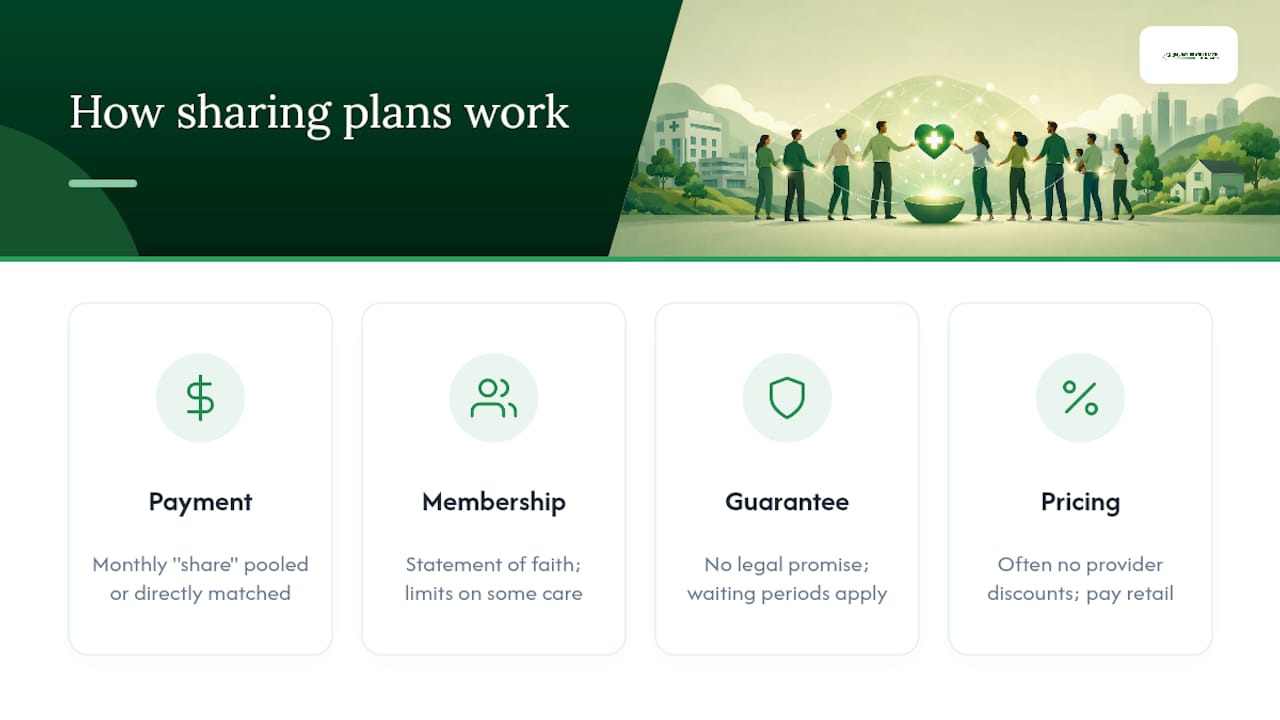
Members of a health care sharing ministry pay a monthly “share” instead of a premium. That money gets pooled or directly matched to cover other members’ eligible medical bills, depending on the organization’s process. Most ministries require you to sign a statement of faith or shared ethical belief, and they exclude any care that conflicts with it, which often means limits on reproductive care, mental health treatment, or substance abuse services.
Here’s the part many members don’t grasp until they’re mid-claim: there’s no legal guarantee that your bill gets shared. HCSMs are not required to pay any specific claim, and most impose waiting periods and exclusions for pre-existing conditions. Provider discounts are frequently absent too, so you may pay closer to the full retail rate for the same procedure an insured patient gets at a fraction of the cost.
Insurance vs Health Sharing Plans: A Side-By-Side Look
The clearest way to see the gap is to line up what each model actually promises.
- Legal guarantee: Insurance is contractually obligated to pay covered claims; health sharing is voluntary and can decline a bill with no recourse beyond an internal appeal.
- Required benefits: ACA plans must cover the 10 essential health benefits; HCSMs set their own eligible-expense lists and are not required to include mental health, maternity, or preventive care.
- Pre-existing conditions: Insurers cannot deny or exclude you; most ministries impose waiting periods or permanent exclusions.
- Out-of-pocket exposure: ACA plans cap annual out-of-pocket costs by law; health shares set their own per-incident or annual caps that can leave you owing the rest.
- Provider pricing: Insurers negotiate network rates; sharing ministries typically don’t, so members often face closer to full billed charges.
Statistic to weigh: the GAO’s review of coverage alternatives found that HCSMs and similar products generally do not comply with Affordable Care Act requirements, and that the marketing and consumer protections attached to them vary sharply from state to state. That inconsistency is exactly why the same health share plan can feel like a bargain in one state and a liability in another.
Subsidies change this math substantially, which we’ll get into below, but the structural gap between “guaranteed” and “voluntary” doesn’t move regardless of your income.
What Do U.S. Regulators Say About Health Sharing?
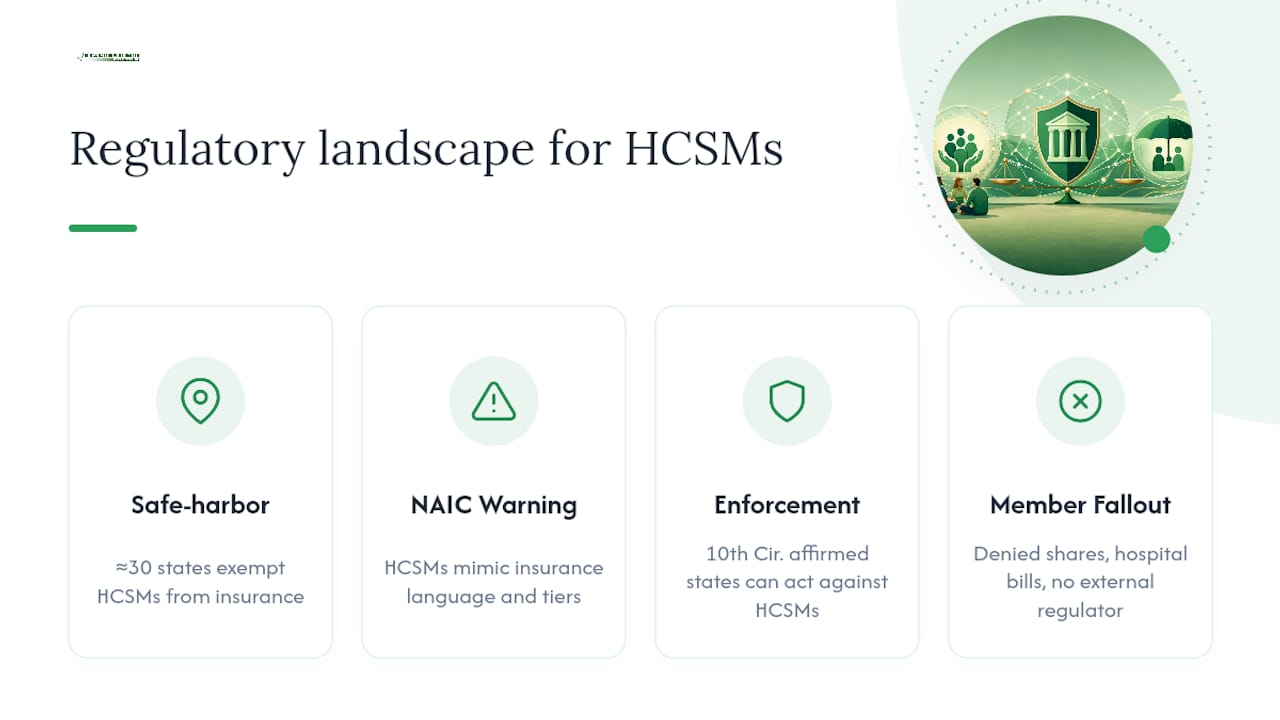
Roughly 30 states have safe-harbor laws that exempt health care sharing ministries from insurance regulation entirely, while others apply a patchwork of rules or none at all. That means your legal protections literally change at the state line.
The National Association of Insurance Commissioners has warned that HCSMs are often marketed using insurance-style language, plan tiers, and enrollment periods that mimic ACA products, which fuels consumer confusion about what’s actually guaranteed. Enforcement isn’t just theoretical, either. Courts have upheld state actions against organizations operating as unauthorized insurance under the Tenth Circuit’s ruling on enforcement authority, confirming that some sharing arrangements can cross the legal line separating them from regulated insurers.
For a member, the practical fallout looks like this: a denied share, a hospital bill in your name, and an internal appeals process with no outside regulator required to step in.
Costs and Who Tends to Save
Monthly shares are frequently lower than unsubsidized premiums, with some published comparisons citing contribution differences as steep as 30 to 50 percent for certain age groups. Take that range with real caution. It depends heavily on age, health status, and whether you qualify for marketplace assistance.
That last variable matters more than most people realize. KFF’s tracking of premium trends shows that subsidy-eligible households often pay far less for ACA coverage than the sticker price suggests, sometimes closing the gap with health sharing almost entirely.
- Unshared amounts: Most HCSMs require you to pay a set amount per incident, similar to a deductible, before sharing kicks in.
- Annual caps: Many ministries cap how much will be shared per condition or per year, an exposure regulated plans don’t have thanks to ACA out-of-pocket limits.
- The catastrophic scenario: A single serious diagnosis can turn a monthly savings streak into a five-figure balance owed directly to a hospital.
If lowering your monthly outlay is the goal, it’s worth exploring ways to reduce insurance costs before assuming a health share is the only path to relief.
How Do You Choose Between a Health Share and Regulated Insurance?
Work through this before you sign anything:
- Ask directly if benefits are guaranteed. If the answer involves “sharing is voluntary” or “not a guarantee of payment,” you’re looking at a health share, not insurance.
- Request the written member guidelines and sharing schedule. These documents spell out exclusions, waiting periods, and per-incident caps in plain terms.
- Ask for the most recent independent audit and any state filings. NAIC guidance flags the absence of independent audits as one of the clearest warning signs of an unstable or opaque ministry.
- Check for provider discount arrangements. No negotiated rates usually means you’re billed closer to full price.
- Watch for insurance-style marketing. Tier names like “gold” or “silver,” open enrollment windows, and commission-driven sales pressure are red flags borrowed straight from the regulated market.
Pro Tip: If a health share representative can’t clearly explain what happens when a claim is denied, or hesitates on providing the appeals process in writing, treat that as your answer.
Sobal Health Perspective: Regulated Alternatives and How We Help
If this comparison has you leaning toward guaranteed coverage, that’s usually the right instinct for anyone with dependents, ongoing prescriptions, or a family history that makes “healthy for now” feel temporary. The company specializes in tailored coverage for self-employed individuals, families, and small businesses across multiple states, including private medically underwritten plans alongside standard ACA marketplace options.
A consultation means a real policy review, side-by-side pricing across carriers, a check for subsidy eligibility you might be missing, and hands-on enrollment support. Some clients have found significant savings once plans were compared properly. There’s no sales pressure attached to that conversation, just clarity.
What Should You Actually Do Now?
Affordability pressure is real, and I won’t pretend health sharing is always the wrong call. For a healthy single adult with no dependents and a genuine willingness to absorb risk, a ministry might be a defensible short-term bridge. But the regulator record here is consistent: guaranteed coverage exists for a reason, and it matters most for exactly the people who assume they’ll never need it.
Run the checklist above before choosing either path. Compare real quotes, not headline shares versus headline premiums, and if the math still feels uncertain, talk to a licensed broker before you commit a year of your health budget to a promise that isn’t legally binding.
— Bernie S
Compare Regulated Plans With Sobal Nationwide Health
There are other routes on the table here, health care sharing among them, but Sobal Nationwide Health gives you something none of those voluntary arrangements can: a licensed broker walking you through actual, contractually guaranteed coverage before you pay a dollar.

The service extends across multiple states, matching self-employed individuals, families, and small businesses with private medically underwritten plans and ACA marketplace options, whichever nets the better price for the situation. A consultation includes a real cost comparison, a subsidy eligibility check, and a plan recommendation with no pressure to enroll on the spot. Some clients have cut their monthly costs significantly once we found the right fit. Start by reviewing how health insurance actually works, then reach out through Sobal Nationwide Health to get a personalized quote and see what a guaranteed plan would actually cost you.
Where to Read More
The NAIC’s consumer guidance covers HCSM red flags in depth. The GAO’s report details state-by-state regulatory variation. The Commonwealth Fund’s analysis examines market-wide risk, and HealthInsurance.org offers a clear consumer primer on how these plans differ from ACA coverage.
This article is general information, not a substitute for advice from a qualified doctor. Consult a qualified healthcare professional about your own circumstances before acting on anything here.
Sources
- What You Should Know About Health Care Sharing Ministries — NAIC
- Private Health Coverage: Alternatives to Health Insurance (GAO-23-106034)
- Health care sharing ministries: What are the risks to consumers and insurance markets? — Commonwealth Fund
- Healthinsurance
FAQ
Is health sharing better than insurance?
Not for most people. Health sharing can cost less monthly, but it carries no legal guarantee of payment, while regulated insurance is contractually required to cover essential benefits.
What are the disadvantages of health share plans?
The main disadvantages are no guaranteed payment of claims, exclusions for pre-existing conditions, waiting periods, missing provider discounts, and limited recourse if a claim is denied.
Does Dave Ramsey recommend Medi-Share?
Some financial personalities have mentioned health sharing programs like Medi-Share as a budget option for healthy individuals, but that endorsement doesn’t change the underlying regulatory risk: sharing ministries still aren’t insurance and still don’t guarantee your bills get paid.
What are the disadvantages of cost sharing?
Cost sharing in a health care sharing ministry means you often face per-incident unshared amounts and annual caps, so a serious diagnosis can leave you owing far more than an ACA plan’s out-of-pocket maximum would allow.
Is health insurance without a subsidy still worth considering?
Yes, especially since subsidy eligibility is often broader than people assume. Talking to a broker before assuming you can’t afford unsubsidized coverage can reveal options, including medically underwritten plans through Sobal Nationwide Health, that cost less than expected.
