

If you’re self-employed, your main coverage paths are a Marketplace/ACA plan (possibly with a premium tax credit), a private medically underwritten plan, a short-term policy for gaps, and supplemental add-ons such as dental or vision. The usual starting point is checking your Marketplace subsidy eligibility on Healthcare, then comparing private quotes if you don’t qualify for savings. Keep Form 7206 in mind too, since your premiums may be tax deductible.
TL;DR:
- Private medically underwritten plans may offer lower premiums and more flexible coverage options if you are healthy, but acceptance is not guaranteed and varies by state.
- Marketplace plans provide guaranteed acceptance regardless of health history and include essential health benefits, with subsidies based on net income and household size.
- Short-term plans are suitable only for short gaps and do not cover pre-existing conditions, essential health benefits, or offer guaranteed renewal, making them unsuitable as long-term coverage.
- Using a Health Savings Account paired with a high-deductible plan can significantly reduce taxable income and help manage higher out-of-pocket costs efficiently.
- Regularly compare both Marketplace subsidies and private quotes annually, and update income estimates promptly to optimize coverage costs amid fluctuating self-employment income.
Table of Contents
- Coverage options: what Marketplace, private, and supplemental plans actually provide
- Private medically underwritten plans: how underwriting works and what to weigh
- Marketplace plans and subsidies: what changes your price and when the ACA is the safer bet
- Short-term and fixed-indemnity plans: useful bridge, real limits
- Costs and taxes: what drives your premium and how the deduction works
- How to choose: a decision flow and the questions to bring to a broker
- Enrollment timing: Open Enrollment, Special Enrollment Periods, and COBRA transitions
- Impact of pre-existing conditions on private insurance eligibility
- Role and benefits of Health Savings Accounts for the self-employed
- Private insurance versus Medicaid and other public options
- Managing premium affordability when your income fluctuates
- Covering family members under a private or self-employed plan
- State rules and high-risk pools that shape your private options
- What most people get wrong about choosing self-employed coverage
- How Sobal Health can make comparing plans easier
- Sources
- FAQ
Coverage options: what Marketplace, private, and supplemental plans actually provide
Each option protects you differently, and knowing the difference upfront saves you from picking the wrong one.
A Marketplace plan guarantees something private plans can’t always promise: acceptance regardless of your health history. Every ACA plan covers the same set of essential health benefits, from hospitalization to maternity care, and if your income qualifies, a premium tax credit can shrink your monthly bill significantly.
Private medically underwritten plans work differently. An insurer reviews your health history before quoting you a price, and if you’re healthy, that review often works in your favor with lower premiums and more flexible plan designs. The tradeoff is that coverage isn’t guaranteed the way it is on the Marketplace.
Then there are the supplemental pieces that round out a plan:
- Dental insurance covers routine and major dental work that medical plans typically exclude.
- Vision insurance helps with eye exams, glasses, and contacts.
- Fixed-indemnity plans pay a set cash amount per service or day of care, useful as a supplement but not a substitute for major medical coverage.
Most self-employed people end up mixing and matching rather than relying on just one of these.
Private medically underwritten plans: how underwriting works and what to weigh
Underwriting means the insurer looks at your health questionnaire, and sometimes your medical records, before deciding what to charge you or whether to offer coverage at all. A history of diabetes, heart disease, or certain chronic conditions can raise your rate or, in some cases, lead to a denial. If you’re generally healthy, though, this same process often gets you a lower premium than you’d find on the Marketplace.
Pros worth knowing about: potential savings over Marketplace rates, more flexibility in deductible and network design, and often faster approval timelines.
Cons to weigh: medical underwriting means no guaranteed acceptance, pre-existing conditions can raise costs, and availability varies by state.
Because underwriting outcomes differ so much person to person, this is where working with a broker actually pays off. A good broker can pull quotes from multiple carriers at once and flag which ones are likely to approve you before you spend time filling out a full application.
Pro Tip: Ask for a preliminary underwriting read before submitting a full application, most brokers can get you a rough answer within a day.
Marketplace plans and subsidies: what changes your price and when the ACA is the safer bet
Your premium tax credit is based on your estimated net self-employment income for the year, not your gross revenue, and it adjusts with household size. If your income swings during the year, you can and should update your estimate on HealthCare.gov to avoid a surprise at tax time.
Metal levels determine how you split costs with your insurer:
- Bronze plans carry the lowest premiums but the highest deductibles, a common pick for self-employed people managing tight monthly budgets.
- Silver plans balance premium and deductible costs, and unlock extra savings if your income qualifies for cost-sharing reductions.
- Gold and platinum plans cost more monthly but cover a larger share of care once you’re using services regularly.
The Marketplace’s biggest advantage stays constant regardless of metal level: no insurer can deny you for a pre-existing condition, and every plan covers the same essential health benefits. That protection matters more than the premium difference for a lot of people.
Short-term and fixed-indemnity plans: useful bridge, real limits
Short-term limited-duration insurance, often shortened to STLDI, was designed to cover brief gaps between other coverage, not to replace comprehensive insurance. Federal guidance is direct about this.
STLDI plans typically do not provide ACA protections and should not be treated as a substitute for comprehensive coverage, according to CMS guidance on short-term plans. That single sentence explains most of the complaints people have after buying one of these plans without reading the fine print.
Common gaps include no guaranteed coverage for pre-existing conditions, no requirement to cover essential health benefits like maternity or mental health care, and renewal terms that can leave you reapplying, and re-underwritten, every few months.
STLDI can make sense for a short window, say between finishing a contract job and starting Marketplace coverage during Open Enrollment. Watch for marketing that makes these plans sound comprehensive when they aren’t; if a short-term plan’s brochure reads like a full ACA plan, that’s a red flag, not a bargain.
Costs and taxes: what drives your premium and how the deduction works
Your premium is shaped by a handful of factors: your age, the metal level or plan design you pick, underwriting results if you go the private route, and how broad the provider network is.
A few tactics help keep costs in check:
- Choose a bronze-level or high-deductible plan if you’re healthy and want to lower your monthly premium.
- Pair it with a Health Savings Account to save pre-tax dollars for the deductible you’re now carrying.
- Get quotes from both Marketplace and private underwritten plans at the same coverage level before deciding, since the price gap can be larger than people expect.
On the tax side, self-employed people can often deduct health insurance premiums for themselves and their family, even without itemizing. Form 7206 instructions from the IRS walk through eligibility, including special rules for S-corporation shareholders and people running more than one business. It’s worth reviewing with a tax preparer since the deduction interacts with your net self-employment income in ways that aren’t always intuitive.
How to choose: a decision flow and the questions to bring to a broker
Start simple: check your Marketplace subsidy eligibility first. If you qualify for a meaningful credit, that’s usually your most cost-effective option. If you don’t qualify, or your health situation makes underwriting look favorable, compare private medically underwritten quotes at the same coverage level. Treat short-term plans as a bridge only, never a long-term answer.
When you get on the phone with a broker or plan rep, bring a specific list of questions:
- What’s my monthly premium versus my realistic annual out-of-pocket cost?
- What’s the deductible, and does it reset every calendar year?
- Which providers and hospitals are in network where I live?
- Is this plan guaranteed issue, or does it require medical underwriting?
- Can I keep this plan if I move to another state?
- Does this plan require prior authorization for specialist visits or procedures?
- What happens to my rate at renewal?
- Are prescriptions covered, and is my current medication on the formulary?
- Is this plan ACA-compliant, or is it short-term or fixed-indemnity?
- What’s excluded that I might not expect?
Pro Tip: Write your answers side by side for each quote, differences that look small on a brochure often turn into hundreds of dollars a year in practice.
Enrollment timing: Open Enrollment, Special Enrollment Periods, and COBRA transitions
Open Enrollment for Marketplace plans runs on a set annual schedule, and outside that window you generally need a qualifying life event to enroll through a Special Enrollment Period.
- Losing job-based coverage, including COBRA ending, triggers a 60 day window to enroll in a new plan.
- Having a baby, getting married, or moving to a new coverage area also qualifies you for a Special Enrollment Period.
- Missing the 60 day window without another qualifying event usually means waiting until the next Open Enrollment.
If your employer coverage or COBRA is ending, start comparing options before your last day of coverage, not after.
Impact of pre-existing conditions on private insurance eligibility
This is where Marketplace and private plans diverge the most. On the Marketplace, a pre-existing condition never affects whether you’re accepted or what you pay. Everyone in the same area, age bracket, and metal level pays the same base rate regardless of health history.
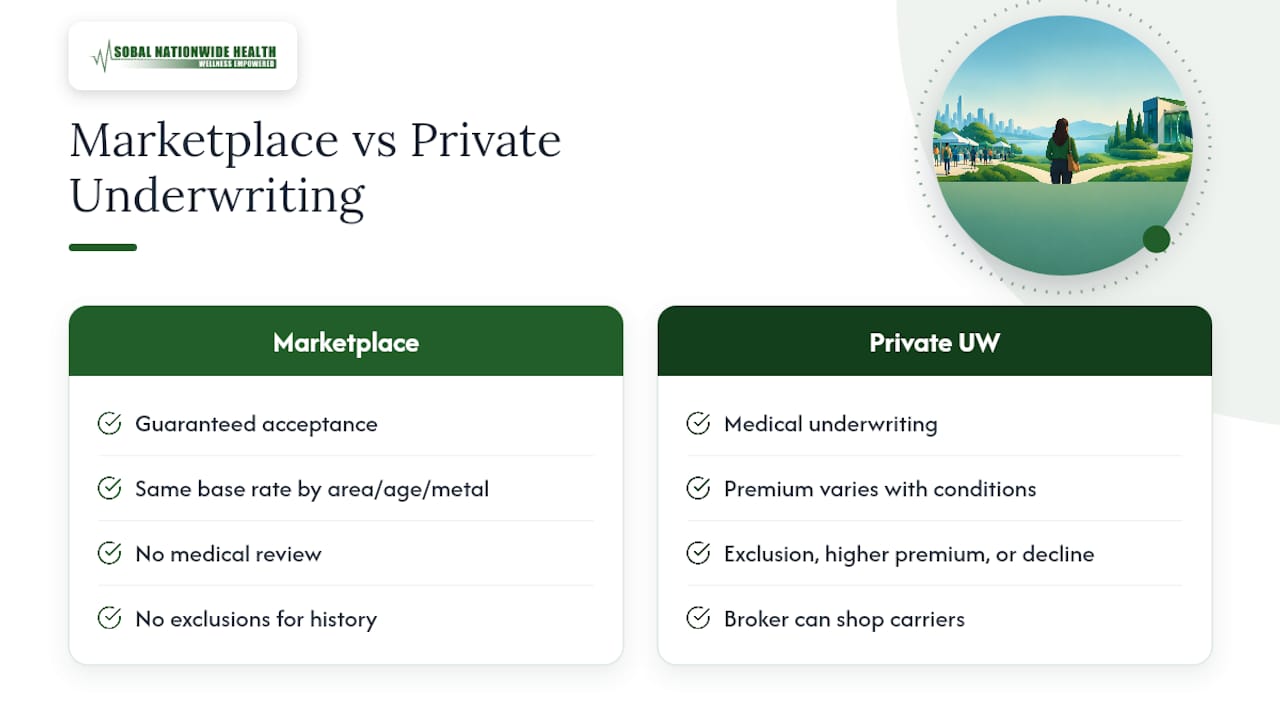
Private medically underwritten plans work the opposite way. The insurer reviews your health questionnaire, and sometimes pulls records, before deciding whether to offer you a policy and at what price. Conditions like diabetes, heart disease, cancer history, or ongoing mental health treatment can lead to a higher premium, a coverage exclusion for that specific condition, or in some cases a declined application.
This doesn’t mean private coverage is off the table if you have a health history. Some carriers underwrite more generously than others, and a broker who works across multiple carriers can often find one that’s a better fit for your specific situation rather than a blanket no. It does mean you should never drop existing coverage before you have written confirmation that a private plan will accept you.
If your health situation makes private underwriting unpredictable, the Marketplace remains your most reliable fallback since guaranteed issue protections apply regardless of your medical history.
Role and benefits of Health Savings Accounts for the self-employed
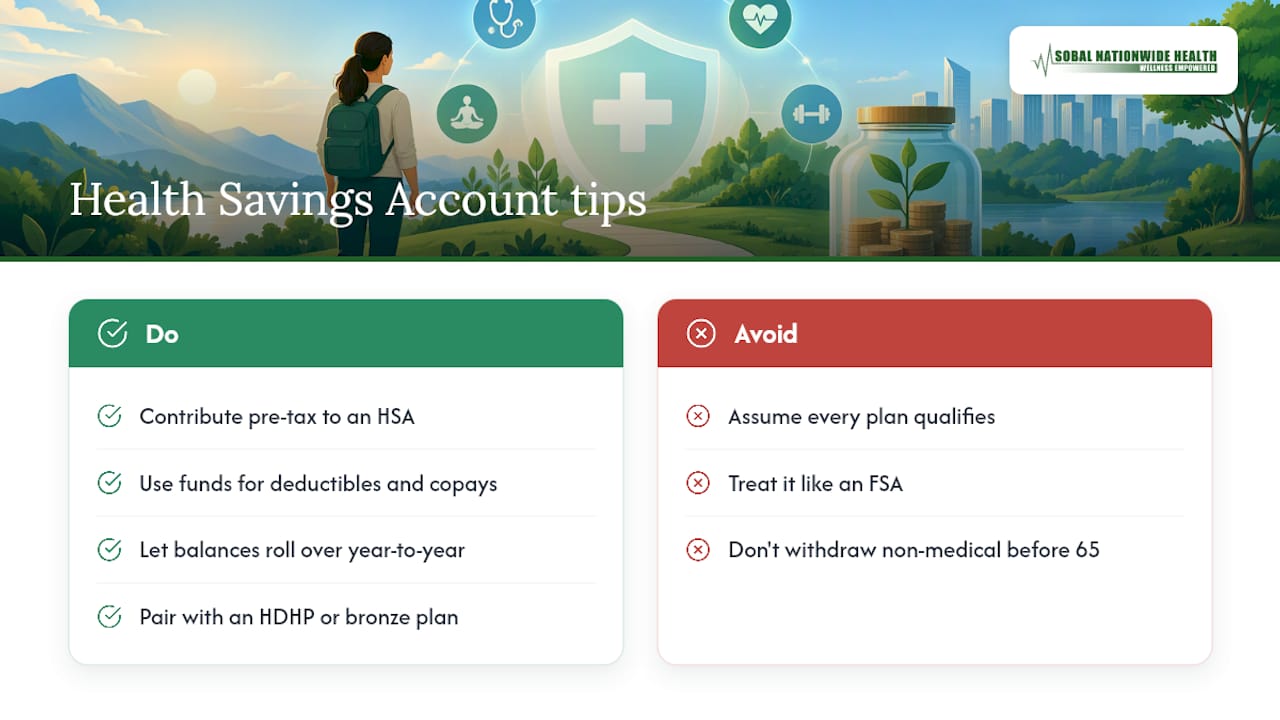
A Health Savings Account, paired with a qualifying high-deductible health plan, lets you set aside pre-tax dollars for medical expenses. For self-employed people, this does double duty: it lowers your taxable income and builds a cushion against the higher deductibles that often come with lower-premium plans.
Contributions roll over year to year, so unlike a flexible spending account, you’re not racing to spend the balance by December 31. Money in the account can cover deductibles, copays, prescriptions, and a long list of other qualified medical expenses, and once you turn 65, unused funds can be withdrawn for non-medical purposes without penalty, though regular income tax still applies.
Pairing an HSA with a bronze-level or high-deductible Marketplace plan, or a similarly structured private plan, is one of the more practical ways to manage the tradeoff between a lower premium and a higher deductible. You’re essentially prepaying your own out-of-pocket costs with money that hasn’t been taxed yet, which softens the blow when a bigger medical bill shows up.
Not every plan qualifies for HSA contributions, so confirm eligibility before assuming you can pair the two. A broker or your plan’s summary of benefits should say clearly whether it’s HSA-compatible.
Private insurance versus Medicaid and other public options
For self-employed people with especially low or unpredictable income, Medicaid eligibility is worth checking before assuming private coverage is your only path. Medicaid eligibility rules and income thresholds vary by state, and some states have expanded eligibility further than others under the ACA.
The practical difference comes down to network and flexibility. Medicaid often comes with no or very low monthly cost, but provider networks can be narrower, and not every specialist or hospital in your area may accept it. Private plans and Marketplace coverage generally offer broader provider access and more predictable plan design, at the cost of an actual premium.
If your income fluctuates near the Medicaid eligibility line, which is common for freelancers and seasonal contractors, you may bounce between Medicaid and a subsidized Marketplace plan depending on the year. That’s not a flaw in your planning, it’s just how the system is built to respond to income changes. Reporting your income accurately and promptly on HealthCare.gov helps make sure you land in the right program rather than paying for coverage you didn’t need to buy, or missing savings you qualified for.
Managing premium affordability when your income fluctuates
Variable income is probably the single biggest headache for self-employed people shopping for coverage, since Marketplace subsidies are calculated on your estimated net income for the year.
The safest approach is to estimate conservatively rather than optimistically. If you expect a slow quarter, don’t assume your best month is your average. Underestimating your income can mean a bigger credit upfront, but overestimating it later can trigger repayment at tax time, so most brokers suggest a middle estimate you can adjust as the year unfolds.
Update your income estimate on HealthCare.gov whenever a major shift happens, a new client contract, a slow season, or a big one-time payment. This keeps your premium tax credit closer to accurate in real time instead of creating a large reconciliation bill in April.
Keep basic bookkeeping evidence for your income estimates, invoices, bank deposits, a simple spreadsheet, since you may need to show your math if your estimate is ever questioned. This habit also makes tax season smoother when you’re calculating your self-employed health insurance deduction.
Covering family members under a private or self-employed plan
Most private medically underwritten plans and Marketplace plans let you add a spouse and dependents, but the mechanics differ. On the Marketplace, adding family members changes your household size, which affects your premium tax credit calculation, sometimes significantly.
On a private plan, each family member you add is typically underwritten separately, meaning a spouse with a health condition could face a different rate or exclusion than you do, even on the same policy. This is worth discussing directly with a broker rather than assuming the whole family gets one blended rate.
If your household has mixed needs, say one spouse is generally healthy and another has an ongoing condition, it sometimes makes sense to split coverage: one family member on a private underwritten plan, another on the Marketplace where guaranteed issue protections apply. It’s not the simplest setup, but it can be the cheaper one.
State rules and high-risk pools that shape your private options
Private medically underwritten insurance isn’t available everywhere, and where it is, the specific plans, carriers, and pricing rules vary by state. Some states regulate short-term and supplemental plans more tightly than federal minimums require, while others largely defer to federal guidance.
A handful of states have historically maintained high-risk pools, programs designed to cover people who couldn’t get private coverage due to health history before the ACA’s guaranteed issue protections took effect. Where these still exist in some form, they typically serve as a last-resort option rather than a primary path, since Marketplace guaranteed issue coverage now fills much of that gap nationally.
Because the private insurance market is this state-specific, a national quote comparison tool won’t always show you the full picture of what’s actually available where you live. This is one of the clearer cases where local broker knowledge earns its keep, someone who works your state regularly will know which carriers are active there and which ones have pulled out.
What most people get wrong about choosing self-employed coverage
Here’s the thing I see trip people up again and again: they treat Marketplace and private insurance as competitors, when really they’re tools for different jobs. The Marketplace is your safety net, guaranteed acceptance, essential benefits, no medical history questions. Private underwritten plans are your cost-saving lever when you’re healthy and want more for less.
The mistake is picking one and never checking the other. Run both numbers every year, because your health, your income, and the market itself all shift.
— Bernie S
How Sobal Health can make comparing plans easier
Some brokers give you access to private medically underwritten plans that aren’t listed on the public Marketplace, alongside ACA plans, dental, vision, and supplemental coverage, available in multiple states. Brokers often work in English and Spanish, and a consultation typically includes a review of your options without a sales pitch.

We’ll walk through your Marketplace subsidy eligibility, pull private quotes at the same coverage level, and explain the tradeoffs in plain language before you commit to anything. If you’re weighing your self-employed coverage options and want a second set of eyes, reach out to Sobal Health to get started.
Sources
HealthCare.gov’s self-employed section covers Marketplace enrollment and income reporting. CMS’s fact sheet on short-term plans explains STLDI’s limits. IRS Form 7206 instructions detail the self-employed health insurance deduction. KFF’s analysis breaks down who buys Marketplace coverage and why.
- Short-term, limited-duration insurance and independent, noncoordinated excepted benefits coverage (CMS)
- Instructions for Form 7206 (Self-Employed Health Insurance Deduction) — IRS
- Healthcare
FAQ
What kind of health insurance can I get if I’m self-employed?
Self-employed people can choose from Marketplace/ACA plans, private medically underwritten plans, short-term limited-duration insurance, and supplemental coverage like dental or vision. Most brokers recommend checking your Marketplace subsidy eligibility first, then comparing private quotes if you don’t qualify for savings.
What is the average cost of self-employed health insurance?
Premium costs vary widely based on your age, location, metal level, and whether you go through the Marketplace or a private underwritten plan, so there isn’t one universal figure. KFF’s analysis notes that many self-employed and small-business-affiliated buyers chose bronze plans in 2026 specifically to manage premium costs.
Can I buy my own private health insurance?
Yes, private medically underwritten plans are available directly or through a licensed broker in many states, separate from the public Marketplace. Approval and pricing depend on underwriting, which reviews your health history before issuing a quote, so availability and cost vary by individual and by state.
Can my LLC pay for my health insurance?
Whether your LLC can pay for your health insurance, and how you deduct it, depends on your business structure and how you’re taxed. IRS Form 7206 instructions cover eligibility rules, including special provisions for S-corporation shareholders, so review them or talk with a tax preparer for your exact situation.
