

Yes, you can get PPO coverage without an employer. Freelancers, 1099 contractors and business owners can buy an individual PPO either through the Marketplace or through private plans that sit outside it. The right choice depends on your income, your health history and how much freedom you want in picking doctors. We’ll walk through each piece in plain English.
TL;DR
- A PPO lets you see in-network doctors at a lower cost and out-of-network providers at a higher cost, usually without referrals.
- Self-employed people can buy PPO-style coverage on the Marketplace or off it. Only Marketplace plans can come with premium tax credits.
- Premiums depend on your location, age, tobacco use and plan level, and a PPO’s broad access can mean a somewhat higher premium than an HMO.
- If you have net self-employment profit, you may be able to deduct your premiums on your tax return.
- Before you enroll, check the actual network, the deductible, the out-of-pocket maximum and how the plan treats your health history.
Table of Contents
- What a PPO actually is
- Can you get a PPO without an employer?
- Marketplace plans vs. private PPO plans
- What a self-employed PPO costs
- Can you deduct your premiums?
- Our view: why a broad PPO deserves a place on your shortlist
- How to check a PPO before you enroll
- When you can enroll
- Who this fits, and who should look elsewhere in our lineup
- Talk to a broker who explains before selling
- FAQ
- Sources
What a PPO actually is
PPO stands for preferred provider organization. Think of it as a plan with a “preferred” list of doctors and hospitals that have agreed to set prices with your insurer. Stay on that list and you pay less. Step off it and you can still get care, but you pay more.
Three features matter day to day:
- No gatekeeper. In most PPOs you can see a specialist without picking a primary care doctor first or getting a referral, according to Fidelity’s self-employed guide.
- Out-of-network is allowed. CMS explains that PPO members generally pay less in network and may use out-of-network providers without a referral, usually at additional cost.
- The balance bill risk. Out-of-network providers can charge more than the plan’s allowed amount, and California’s Department of Insurance notes you may owe that difference on top of your share of the allowed amount.
Out-of-network care also commonly comes with a higher deductible and higher coinsurance, as FAIR Health describes. So “PPO” means flexibility, not a promise that every doctor is covered at the same price. The contracted network and the benefit rules still decide what you pay.
Can you get a PPO without an employer?
Yes. HealthCare.gov confirms that a self-employed person with business income and no employees can buy individual coverage through the Marketplace, and that freelancers, consultants and independent contractors are included. If your business has even one employee besides you, your spouse or family members, the same page says you may use the SHOP Marketplace instead. If that is you, our guide to small business health insurance options is a good next stop.
There are really two doors into individual PPO coverage:
- Marketplace plans. These meet ACA standards. Many are PPO-style, though the network type varies by state and insurer, so always read the plan details.
- Private plans bought off the Marketplace. Some follow ACA rules and some don’t. Private plans that are medically underwritten, meaning the insurer reviews your health history, are a common route for people who earn too much for subsidies. You can read more in our explainer on how medically underwritten insurance works.
Fidelity lists both routes as the main options for self-employed people, and cautions that off-exchange plans may or may not meet ACA standards, so each one deserves a careful read.
Marketplace plans vs. private PPO plans
This is where most people get stuck, so here is a side-by-side view.
| ACA Marketplace plan | Private plan off the Marketplace | |
|---|---|---|
| Subsidies | May qualify for premium tax credits and cost-sharing help | No Marketplace subsidies |
| Health history | Cannot affect your premium or eligibility | ACA-compliant plans protect pre-existing conditions; medically underwritten plans review your history |
| Benefits | Ten essential health benefits | Varies by plan; check each one |
| Network | Depends on plan; PPO, HMO and others | Some offer broad or nationwide PPO networks |
| When you can buy | Open Enrollment or a Special Enrollment Period | Timing depends on the plan; ask |
The subsidy and benefits points come from KFF’s Marketplace FAQ, which explains that Marketplace plans meet ACA standards and may qualify for premium tax credits, while ACA-compliant off-Marketplace plans cover essential health benefits and protect people with pre-existing conditions but receive no subsidies. KFF adds that non-ACA plans may have lower premiums and limited benefits, and may exclude people with pre-existing conditions. Fidelity also notes that ACA-compliant plans must cover ten essential health benefits and cannot charge more because of pre-existing conditions.
None of this makes one door “right.” It means the decision is about your numbers and your health. If you qualify for meaningful subsidies, a Marketplace plan can be hard to beat. If your income is above the subsidy range, or you want a broader network, private options deserve a look. Our piece on private plans vs. Marketplace at higher incomes goes deeper.
How subsidies are figured for the self-employed
If you do go the Marketplace route, your savings are based on estimated net self-employment income for the coverage year, plus household size and other eligibility factors, per HealthCare.gov. It is a forecast, not simply last year’s tax return. Self-employed income bounces around, so build your estimate carefully. Our guide on estimating income first walks through it.
KFF also states that premium tax credits depend on your income and the local cost of a benchmark Silver plan, and can be applied to Bronze, Silver, Gold or Platinum plans but not Catastrophic plans.
What a self-employed PPO costs
Here is the honest answer: it depends, and anyone who quotes you one number before asking your age, ZIP code and health situation is guessing.
For Marketplace plans, HealthCare.gov says premiums are affected by:
- your location
- your age (older people may be charged up to three times more than younger people, subject to state limits)
- tobacco use (up to 50% more, subject to state limits)
- the plan category
- whether dependents are covered
Health status, medical history and sex cannot affect a Marketplace premium.
The plan category matters a lot. The same page explains that Bronze plans usually have lower monthly premiums and higher out-of-pocket costs, while Platinum plans usually have the highest premiums and the lowest out-of-pocket costs. Fidelity adds that PPO premiums may run somewhat higher than HMO premiums because of the extra provider flexibility.
Some reference points
As one data point, a 2026 analysis from MoneyGeek reported an average PPO premium of $789 a month ($9,466 a year) for a 40-year-old self-employed individual, with a $3,402 deductible on one popular PPO. It also stresses that real costs vary with location, income and plan choice, and that tax credits change what buyers pay.
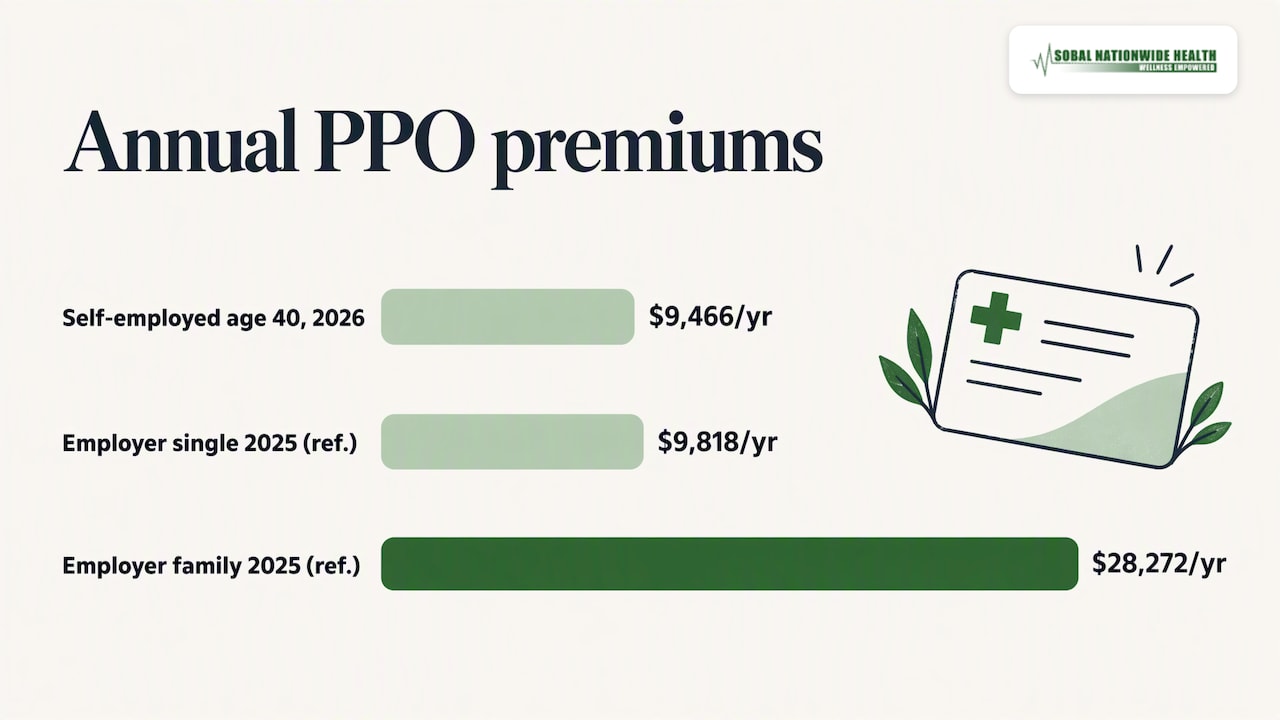
Employer plans give a rough sense of the market, though they are not what you will pay as an individual. KFF’s 2025 Employer Health Benefits Survey found PPO premiums averaged $9,818 a year for single coverage and $28,272 for family coverage. Workers paid on average 16% of the single premium and 26% of the family premium, because employers cover the rest. When you are self-employed, you carry the whole premium yourself, which is why the tax deduction below matters.
Deductibles show the same pattern. KFF reported an average single deductible of $1,886 in 2025 among covered workers with a deductible, and $2,631 at firms with 10 to 199 employees. For families in small-employer PPOs, KFF found the average family deductible topped $3,900 in 2023.
We like to explain it this way: the premium gets you in the door, and the deductible and out-of-pocket maximum decide what happens once you’re inside. The out-of-pocket maximum is your financial safety net, the most you pay in a year for covered in-network care. A low premium with a very high deductible can feel cheap until the year you need care.
Can you deduct your premiums?
Often, yes. The IRS’s draft 2026 Form 7206 provides a deduction for qualifying health insurance premiums for you, your spouse and your dependents, limited by your business’s earned income. It excludes months when you, your spouse or certain family members were eligible for subsidized employer coverage.
Fidelity describes it as an above-the-line adjustment, meaning you can take it without itemizing, subject to month-by-month eligibility, net self-employment profit and an income-based limit. Because the rules have moving parts, confirm your situation with a tax professional. Our guide to sole proprietor health coverage, Schedule 1 and Form 7206 covers how this fits together.
Perspective
Our view: why a broad PPO deserves a place on your shortlist
We spend our days with freelancers, contractors and owners who tell us the same thing: they were not unhappy about paying for insurance, they were unhappy about not understanding what they were paying for.
Here is how we see it. Marketplace plans are the right answer for many people, especially those who qualify for strong subsidies. But we also meet a lot of self-employed professionals who earn too much for those subsidies and end up with high premiums and narrow networks. For them, private, medically underwritten plans can be a real alternative, because they are priced with your health history in view and can offer portable, nationwide PPO coverage with the freedom to use the doctor or hospital you prefer.
That is our approach: we are independent brokers, available in English or Spanish, and we focus on teaching before selling. Some of our clients have reported saving as much as $400 a month after comparing options, though every household’s result is different and depends on age, location and health.
If you have a health condition, tell us early. Medically underwritten plans look at your history, and the best way to avoid surprises is to lay it all out up front so we can point you to plans that fit.
Bernie S
How to check a PPO before you enroll
A plan brochure can sound great and still not fit your life. Run through this list with any PPO you are considering.
- Look up your doctors and hospital by name. CMS notes that, depending on the plan, out-of-network non-emergency care may be paid in full by you. The word PPO does not guarantee your providers are in the network.
- Check the network’s reach if you travel. Ask whether coverage works in the states where you work or spend time, not only where you live.
- Compare the deductible and the out-of-pocket maximum. Add the premium for the full year to the out-of-pocket maximum to see your worst-case cost.
- Ask how out-of-network claims are paid. Find out what the plan’s “allowed amount” means in practice, and whether you could be billed the difference.
- Confirm your prescriptions. Look at the plan’s drug list for the medications you take.
- Understand how your health history is treated. On ACA-compliant plans it cannot raise your price. On medically underwritten plans the insurer reviews it, so answer every application question accurately.
- Check what is not included. Dental, vision and some supplemental benefits are often separate, so ask what you would need to add.
- Ask about renewal. Find out how the plan handles rate changes at renewal and what happens if your income or family changes.
We also put together 10 questions to ask a broker when buying private insurance as a self-employed person. It is a handy list to bring to any consultation.
Once your plan is in place, think about the smaller costs too. If you have an FSA or HSA, there are FSA/HSA eligible products for recovery and wellness that you may be able to cover with those funds, so check your account rules before you buy.
When you can enroll
KFF explains that ACA-compliant individual plans are sold during annual Open Enrollment or during a Special Enrollment Period after a qualifying event such as losing other coverage or having a baby. Financial assistance also requires qualifying income, citizenship or eligible immigration status, and no eligibility for public coverage or access to employer coverage, subject to exceptions.
Open Enrollment dates are set each year, so check HealthCare.gov or ask us for the current window rather than relying on an old date. If you are between jobs, you may be weighing COBRA against an individual plan. A Marketplace plan can be a different cost path from COBRA, and a private plan is another. If your situation changed mid-year, our Florida guides explain special enrollment periods and changing coverage outside open enrollment, and the basic ideas apply in many states.
Who this fits, and who should look elsewhere in our lineup
A self-employed PPO tends to suit you if:
- you earn too much to get strong Marketplace subsidies
- you want to see specialists without referrals
- you travel or split time between states
- you want one plan for your family with a wide choice of doctors
If you employ people, a group plan may be the better fit, and there are tax credits for some small employers. Our guides on Texas small business coverage and Georgia small business options explain how that works in those states.
Talk to a broker who explains before selling
We help self-employed people, families and small businesses in 31 states compare private medically underwritten plans, ACA Marketplace plans, dental, vision and supplemental coverage side by side. You get one-on-one advice without sales pressure, and you can speak with a broker in English or Spanish.
Ready to see what your options look like? Explore our personal and family plans, look at business health insurance, or start at sobalhealth.com and ask for a plan review.
FAQ
Is a PPO better than an HMO for a freelancer?
Neither is better for everyone. A PPO gives you more freedom to use out-of-network providers and usually skips referrals, while HMOs often have lower premiums. Fidelity notes that PPO premiums may be somewhat higher because of that flexibility. Choose based on your doctors, your travel and your budget.
Can I deduct my health insurance if I am self-employed?
Generally, yes. The IRS’s Form 7206 provides a deduction for qualifying premiums for you, your spouse and dependents, limited by your business’s earned income. Months when you could have joined a subsidized employer plan are excluded. A tax professional can confirm how it applies to you.
Will a PPO cover me everywhere in the country?
Not automatically. A PPO’s coverage depends on its contracted network and benefit rules, and out-of-network care usually costs more. Some plans offer broader or nationwide networks, so ask about the specific plan’s reach before you enroll.
Do I need a PPO if I qualify for Marketplace subsidies?
Not necessarily. Marketplace plans can come with premium tax credits, and some are PPO-style. Compare the network, deductible and out-of-pocket maximum of each plan you are considering, then weigh the subsidy against any private option.
Can I get a PPO if I have a pre-existing condition?
ACA-compliant plans cannot charge more or limit coverage because of a pre-existing condition. Non-ACA and medically underwritten plans may review your history and can decline or limit coverage. A broker can help you match your history to the right type of plan.
Sources
- HealthCare.gov: Health care insurance coverage for self-employed
- HealthCare.gov: How Marketplace plans set your premiums
- CMS: What you should know about provider networks
- California Department of Insurance: What is a PPO?
- FAIR Health: Types of health plans
- Fidelity: Health insurance options if you’re self-employed
- KFF: Frequently asked questions about the ACA’s Health Insurance Marketplace
- KFF: 2025 Employer Health Benefits Survey
- KFF: Family health insurance is no longer affordable through small employers
- MoneyGeek: Best health insurance for the self-employed
- IRS: 2026 Form 7206 (draft)
- FSA/HSA eligible products
Recommended
- Self-Employed Health Insurance in Florida: 7 Options Every 1099 Worker Should Know (2026 Guide)
- Self-Employed Health Insurance in Florida: 7 Options Every 1099 Worker Should Know (2026 Guide)
- 10 Broker Questions When Buying Private Insurance for Self Employed
- Avoid Surprise Bills: Compare POS vs PPO Using the SBC (U.S.)
