

True nationwide PPO health insurance is common in the employer market, but if you’re buying on your own, availability depends entirely on your ZIP code. The trade-off is real flexibility for a higher premium and, sometimes, more paperwork when you go out-of-network. Your next move: check Healthcare for your area, or talk to a broker who can check private options too.
TL;DR:
- True nationwide PPO plans often only provide multi-state coverage through employer-sponsored or self-funded plans, not individual market options.
- If you frequently see multiple specialists or split your time across states, a nationwide PPO can justify higher premiums by offering reliable in-network care wherever you travel.
- Confirm provider directories and telehealth options in both your home and destination ZIP codes, and ask carriers directly whether their network is truly nationwide before enrolling.
- Out-of-network expenses typically require upfront payments and claims submission, but protections under the No Surprises Act help limit billing surprises in emergency or out-of-area situations.
- Working with a broker can clarify network actual coverage, compare private and marketplace options, and potentially save hundreds of dollars by finding plans tailored to multi-state needs.
Table of Contents
- What “Nationwide PPO Health Insurance” Actually Means
- Who Actually Needs This Kind of Flexibility
- Where Multi-State PPO Coverage Is Actually Sold
- What a PPO Really Costs You
- What Happens to Your Coverage When You Travel
- Your Pre-Purchase Checklist for True Multi-State Access
- How a Broker Helps You Skip the Guesswork
- Comparing How Major Insurers Structure Nationwide PPO Access
- What “Nationwide” Doesn’t Cover: Common Exclusions
- Prescription Drug Coverage Doesn’t Always Travel the Same Way
- Filing Claims for Out-of-State, Out-of-Network Care
- Getting Help When You’re Not in Your Home State
- When to Call a Broker Instead of Shopping Alone
- Let Sobal Nationwide Health Verify Your Coverage Before You Commit
- Sources
- FAQ
What “Nationwide PPO Health Insurance” Actually Means
A PPO, or preferred provider organization, gives you two core freedoms an HMO doesn’t: no referrals needed to see a specialist, and at least partial coverage even when you step outside the network. That flexibility is exactly why PPOs tend to cost more than HMOs, and it’s the whole reason people go looking for one in the first place.
Here’s where it gets confusing. “Nationwide” can mean the carrier sells policies in many states, or it can mean the network itself gives you real, everyday access to doctors across state lines. Those are two different things, and a plan can technically qualify for the first while falling short on the second.
Employer-sponsored and self-funded plans usually deliver the second kind. Because self-funded plans fall under federal ERISA rules rather than state insurance law, employers can build one consistent, multi-state PPO design instead of stitching together 31 different state products. That’s a big part of why true national PPO networks concentrate in the employer market.
Who Actually Needs This Kind of Flexibility
Not everyone needs a plan built for multi-state life, and paying extra for portability you’ll never use is money left on the table. A nationwide PPO earns its premium for specific situations:
- Frequent travelers and remote workers who need reliable in-network care wherever they land that week
- Snowbirds and seasonal residents splitting the year between two states
- People managing a chronic condition through an out-of-area specialist they don’t want to give up
- Anyone regularly seeing two or more specialists, especially across different cities or states
A rough decision rule that holds up well: if you see two or more specialists on a regular basis, or your care genuinely happens across state lines, the flexibility usually justifies the cost. For lighter users, an HMO can end up cheaper over a full year even after factoring in referral hassles. A snowbird splitting six months between Florida and a summer home elsewhere might pay $150 more a month for a PPO, but that premium beats scrambling for an urgent care visit with zero in-network options nearby.
Where Multi-State PPO Coverage Is Actually Sold
Three channels carry different odds of landing you a genuinely portable plan.
Employer-sponsored and self-funded plans are your best bet, including the Federal Employees Health Benefits program for government workers. These plans lean on the ERISA structure mentioned above to offer one design nationwide, and PPOs remain a dominant plan type in employer-sponsored coverage.
The individual Marketplace is a mixed bag. Insurers choose which plan types to offer in each rating area, so PPO availability swings widely by location, sometimes several options, sometimes none. Use the “Plan type” filter on HealthCare.gov with your exact ZIP code, since even neighboring counties can show different results.
Private, medically underwritten plans and broker channels fill the gap the Marketplace leaves open. These aren’t sold on the exchange, but they can offer broader network access, particularly if you’re self-employed and don’t qualify for subsidies anyway. A comparison of health insurance factors beyond premium alone helps you weigh this route fairly.
What a PPO Really Costs You
The premium is only half the math. PPOs typically carry higher monthly premiums and, in many cases, higher deductibles than HMOs, precisely because you’re paying for the freedom to go outside the network.
Here’s the number that trips people up: when you use an out-of-network provider, you often have to pay the bill upfront yourself and then file a claim for reimbursement. That’s a meaningfully different experience from handing over a copay and walking out the door.
Two legal layers matter here too. The No Surprises Act limits balance billing in many emergency and certain out-of-network situations, which protects you more than most people realize. And whether your plan is fully insured or self-funded changes which rules apply. Understanding your deductible structure before you enroll saves you from an unpleasant surprise at the pharmacy counter or the ER.
What Happens to Your Coverage When You Travel
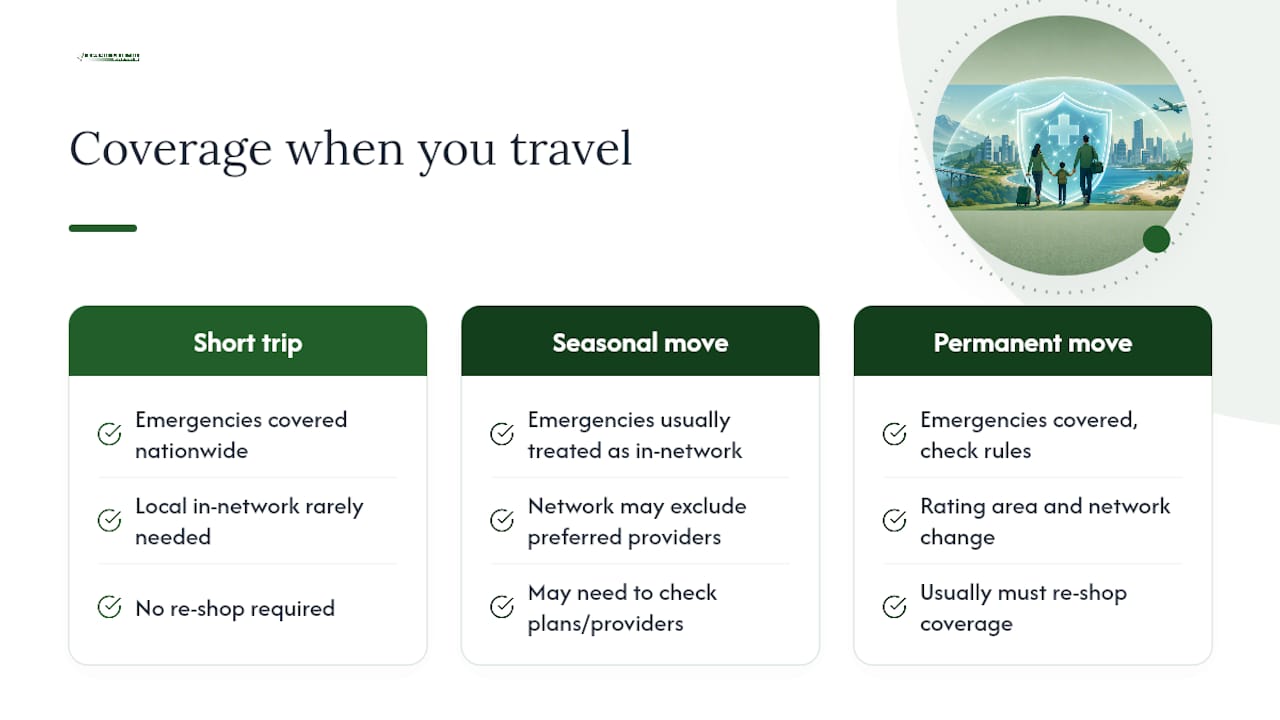
A weekend trip, a six-month stay, and a permanent move each test your PPO differently.
For short trips, emergency care is protected almost everywhere, and many PPOs treat true emergencies as in-network regardless of location. Seasonal relocation is trickier: your plan’s network might technically extend to your second state, but the specific doctors and facilities you’d actually want to use may not be in it. A permanent move usually means re-shopping entirely, since your rating area, and possibly your whole plan lineup, changes.
The most common mistake isn’t a coverage gap. It’s an outdated provider directory that lists someone as in-network who dropped the plan months ago.
Your Pre-Purchase Checklist for True Multi-State Access
Before you commit to a plan on the promise of “nationwide” coverage, run through this:
- Search the provider directory using both your home ZIP code and any destination ZIP codes where you spend real time.
- Ask the carrier directly whether the plan uses a genuine national network product, and whether it’s fully insured or self-funded.
- Confirm telehealth availability and prior authorization rules, since these vary more by plan than people expect.
- Call your regular providers’ billing offices to confirm they currently accept the plan, since directories lag reality more often than carriers admit.
- Get written confirmation of anything a phone rep tells you, and test a hypothetical out-of-state claim scenario with member services before you enroll.
Pro Tip: Ask the carrier rep to spell out exactly what happens if you need to care in a state where their “national network” has thin coverage. Their answer, or their hesitation, tells you more than the marketing brochure ever will.
How a Broker Helps You Skip the Guesswork
This is where a lot of people either lose hours or lose money. A broker working across multiple states matters when you’re trying to figure out whether a plan’s network actually holds up where you live, work, and travel.
A broker’s job here is concrete: verify the provider network against your specific doctors and ZIP codes, compare private medically underwritten plans against Marketplace options, and walk you through enrollment or appeals if something goes sideways. Some clients have reported savings of up to $400 a month by finding coverage that matched their actual needs instead of a generic Marketplace default. That’s the kind of gap between “sold nationally” and “works for me” that’s hard to catch alone.
Comparing How Major Insurers Structure Nationwide PPO Access
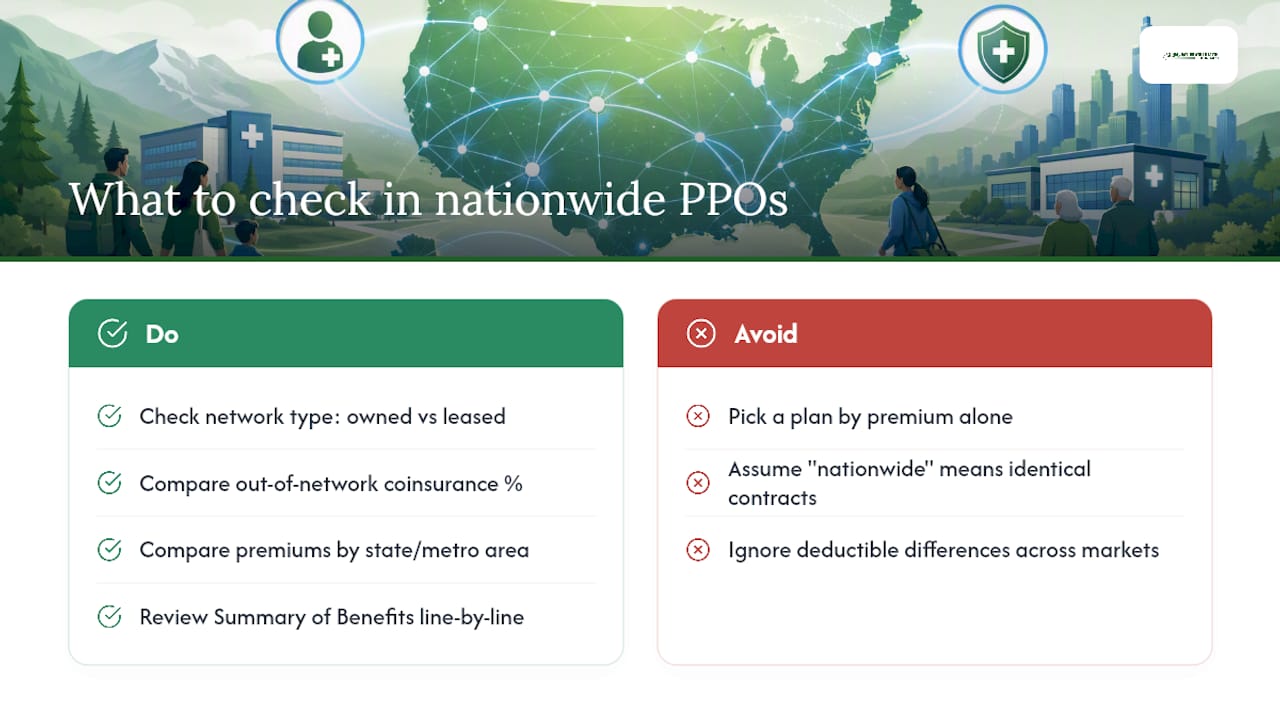
No two “nationwide” PPO products are built the same way, and the differences show up fast once you look past the label. Some carriers run their national PPO through a single owned network, while others lease access to a third-party network aggregator to reach states where they have no direct footprint. That distinction affects your negotiated rates, since a leased network sometimes reimburses providers at different levels than the carrier’s home-state contracts.
Premiums vary by more than just plan design. A PPO priced in a low-cost-of-care state can run noticeably less than the same carrier’s PPO in a high-cost metro area, even under one nationwide brand name. Deductibles follow a similar pattern: employer-sponsored PPOs, backed by ERISA’s uniform structure, tend to offer more consistent deductible and out-of-pocket maximum figures across states than individual-market PPOs, which get filed and priced separately in each state.
Coverage breadth is the other variable worth checking line by line. Some nationwide PPOs cover a wide range of specialists and facilities out-of-network at a reduced coinsurance rate. Others technically allow out-of-network care but set the reimbursement so low it barely helps. The only reliable way to tell the difference is to pull the plan’s Summary of Benefits and Coverage and compare the actual out-of-network coinsurance percentage, not just the premium.
If you’re weighing more than one option, a side-by-side look at factors that matter beyond price will save you from picking a plan on premium alone and finding out later that the “nationwide” part was thinner than it sounded.
What “Nationwide” Doesn’t Cover: Common Exclusions
Even a genuinely broad PPO network has edges, and running into one mid-treatment is worse than knowing about it beforehand.
Elective procedures scheduled purely for convenience, like getting a routine surgery done near a vacation home instead of your home network, often get treated as out-of-network even on a national plan. Some nationwide PPOs also carve out specific service categories, like certain behavioral health facilities or specialty infusion centers, that run on a narrower sub-network than the rest of the plan.
Geographic gaps are the quiet problem. “Nationwide” rarely means “every county.” Rural areas and smaller metro markets frequently have thinner provider rosters even under a national brand, which is exactly why the Marketplace shows different plan options by rating area instead of one uniform national list.
Prior authorization requirements can also apply unevenly. A procedure that needs no pre-approval in one state’s provider network might require it through a different regional affiliate of the same national plan, depending on how that affiliate’s utilization review is structured.
And out-of-network coverage, while real on a PPO, is never unlimited. Most plans cap out-of-network reimbursement at a percentage of a benchmark rate rather than the provider’s actual billed charge, which can leave you owing the difference even after the plan pays its share. That gap is one of the biggest reasons out-of-network PPO bills surprise people who assumed “partial coverage” meant “mostly covered.”
Prescription Drug Coverage Doesn’t Always Travel the Same Way
Your medical network might be genuinely nationwide while your pharmacy benefit works on entirely different rules. Most PPOs use a national pharmacy benefit manager, which means your prescription formulary, the list of covered drugs and their cost tiers, typically stays consistent no matter which state you’re standing in when you fill it.
Where things get more complicated is retail pharmacy access. A drug might be on your formulary everywhere, but if your regular specialty pharmacy or a particular retail chain isn’t in-network in the state you’re visiting, you could pay full price. This matters most for specialty medications requiring a designated specialty pharmacy, since not every one of those pharmacies operates in every state.
Prior authorization on medications adds another layer. A prescription that’s pre-approved on your home state’s formulary can occasionally require fresh authorization if a prescriber in a different state writes it, especially for controlled substances or high-cost specialty drugs. Mail-order pharmacy benefits, by contrast, tend to be the most reliably portable piece of the puzzle, since the prescription ships to whatever address you give it regardless of which state you’re in.
If prescription costs are a major factor in your decision, it’s worth asking the carrier directly whether the formulary and pharmacy network apply uniformly nationwide or vary by state affiliate. That single phone call clears up more confusion than any plan brochure will.
Filing Claims for Out-of-State, Out-of-Network Care
When you use an out-of-network provider in a different state, you’re usually the one managing the paperwork, not the office staff. Out-of-network billing generally requires you to pay upfront and submit your own claim for reimbursement, so understanding the process before you need it matters.
Save everything: the itemized bill, the receipt, and the specific CPT and diagnosis codes the provider used. Insurers rely on these codes to process reimbursement, and a claim missing proper coding gets kicked back or delayed far more often than one submitted complete the first time.
Most carriers give you a standard claim form, downloadable from their member portal, along with a filing deadline that’s usually somewhere between 90 days and a year from the date of service. Missing that window can mean losing the reimbursement entirely, so don’t let paperwork sit in a drawer.
If the visit was a genuine emergency, remember that the No Surprises Act limits how much you can be balance-billed in many of these situations, regardless of which state you were in when it happened. That protection doesn’t erase the need to file a claim, but it does cap how bad the financial surprise can get.
One practical habit: call member services before you leave the provider’s office, while you still have the visit details fresh. Ask them to confirm exactly what documentation they’ll need and where to send it. That five-minute call often prevents a stack of resubmitted paperwork three weeks later.
Getting Help When You’re Not in Your Home State
Customer service quality becomes a bigger deal the moment you’re standing in an unfamiliar city trying to find an urgent care center your plan actually covers. Nationwide PPO members should expect a few baseline capabilities from their carrier’s support team.
A live representative should be able to search the provider network for any state, not just your home state, and confirm in real time whether a specific provider or facility is in-network. Many carriers also offer 24/7 nurse lines or telehealth access built into the plan, which matters most exactly when you’re traveling and don’t have a local doctor to call.
Response time on claims questions is worth testing before you ever need it. Call the member services line listed on your card and ask a hypothetical question about an out-of-state claim. How long you wait on hold, and how confidently the rep answers, tells you a lot about what real support looks like once you actually need it.
For plans that route through a broker, that relationship becomes an extra layer of support. A broker who helped you enroll can often intervene faster than a call center when a claim gets stuck or a provider’s network status is in dispute, since they understand your specific plan design rather than reading from a general script.
When to Call a Broker Instead of Shopping Alone
If your situation involves multiple states, a private plan search, or you’re simply short on time, broker help pays for itself fast. If your area shows clear PPO options on the Marketplace and your care is straightforward and local, shopping solo is perfectly reasonable. Either way, a second set of eyes on network fine print catches mistakes most people never see coming.
— Bernie S
Let Sobal Nationwide Health Verify Your Coverage Before You Commit
A licensed broker can check provider directories across multiple states for you, against your actual doctors and ZIP codes, before you sign anything.
Reach out and a broker can walk through your ZIP code, verify whether the plans available to you offer real multi-state access, and compare private medically underwritten options against what the Marketplace shows for your area. Self-employed individuals in particular often assume the Marketplace is their only option, when a private plan built for freelancers and gig workers sometimes delivers broader network access for a comparable price. Contact a broker today to get a personalized quote and find out what your multi-state coverage actually looks like before you’re stuck testing it in an emergency room.
Sources
- HMO vs. PPO: Which Is Best for You?
- Health insurance plan & network types: HMOs, PPOs, and more
- National PPO Plans: How They Work, Costs, and Coverage – LegalClarity
FAQ
What is a disadvantage of a PPO plan?
The biggest drawback is cost: PPOs generally carry higher premiums and often higher deductibles than HMOs, and out-of-network care can leave you paying upfront and filing your own claim.
Is nationwide health insurance good?
It depends on your situation. Nationwide PPO coverage is genuinely valuable if you travel frequently, split time between states, or see multiple specialists, but it’s an unnecessary expense if your care is local and simple.
Is a PPO health plan worth it?
A PPO tends to be worth the extra cost when you regularly see two or more specialists or need care across state lines; for lighter, local care needs, an HMO often costs less over a full year.
What is the best PPO health insurance?
The best plan depends on which specific doctors and states you need covered, not just the carrier’s name on the card. Working with a broker like Sobal Nationwide Health helps you verify that a plan’s network actually covers your providers before you enroll, rather than assuming “nationwide” on the label means nationwide in practice.
