

For 2026, you generally need a household income between 100% and 400% of the federal poverty level to qualify for an advance premium tax credit. That’s a return to the original ACA rules after several years of expanded eligibility. If your income sits above 400% FPL, expect to pay full price this year, since enhanced subsidies expired at the end of 2025. Run the numbers now, before open enrollment closes.
TL;DR:
- Households earning between 100% and 400% of the federal poverty level are eligible for premium tax credits in 2026, with income limits ranging from approximately $15,960 to $132,000 depending on family size.
- Income above 400% FPL no longer qualifies for subsidies in 2026, leading many previously subsidized enrollees to face higher premiums with the expiration of enhanced subsidies.
- Eligibility is based on Modified Adjusted Gross Income, which includes specific add-backs like untaxed foreign income and non-taxable Social Security benefits, not gross income or wages alone.
- Accurate income estimation, frequent updates, and reconciling final income at tax time are vital to avoid surprises, especially since recent policy changes restrict assistance for higher-income households.
- Private, medically underwritten plans offered by brokers might be more suitable for some consumers, especially those who lose subsidy eligibility or need personalized coverage options.
Table of Contents
- 2026 Income Limits: What They Mean in Real Dollars
- How the Marketplace Calculates Your Eligibility
- What Changed for 2026 and Why Your Premium Might Be Higher
- If Your Income Changes: Updating, Reconciling, and Avoiding a Tax Surprise
- Medicaid, State Wraps, and Other Special Situations
- Estimating Your 2026 Subsidy Before You Enroll
- When a Broker or Private Plan Makes More Sense Than the Marketplace Alone
- What I’d Do First This Enrollment Season
- Where to Check the Official Numbers Yourself
- Sources
- FAQ
2026 Income Limits: What They Mean in Real Dollars
Let’s put real numbers behind that 100 to 400% range, because percentages don’t pay bills, dollars do. The 2026 federal poverty level for a single person in the 48 contiguous states and D.C. is $15,960. For a family of four, it’s $33,000. Everything else flows from those two figures.
Here’s how that translates into the income band where premium tax credits are generally available, using the 100% to 400% FPL range:
- 1 person: $15,960 to $63,840
- 2 people: $21,560 to $86,240
- 3 people: $27,160 to $108,640
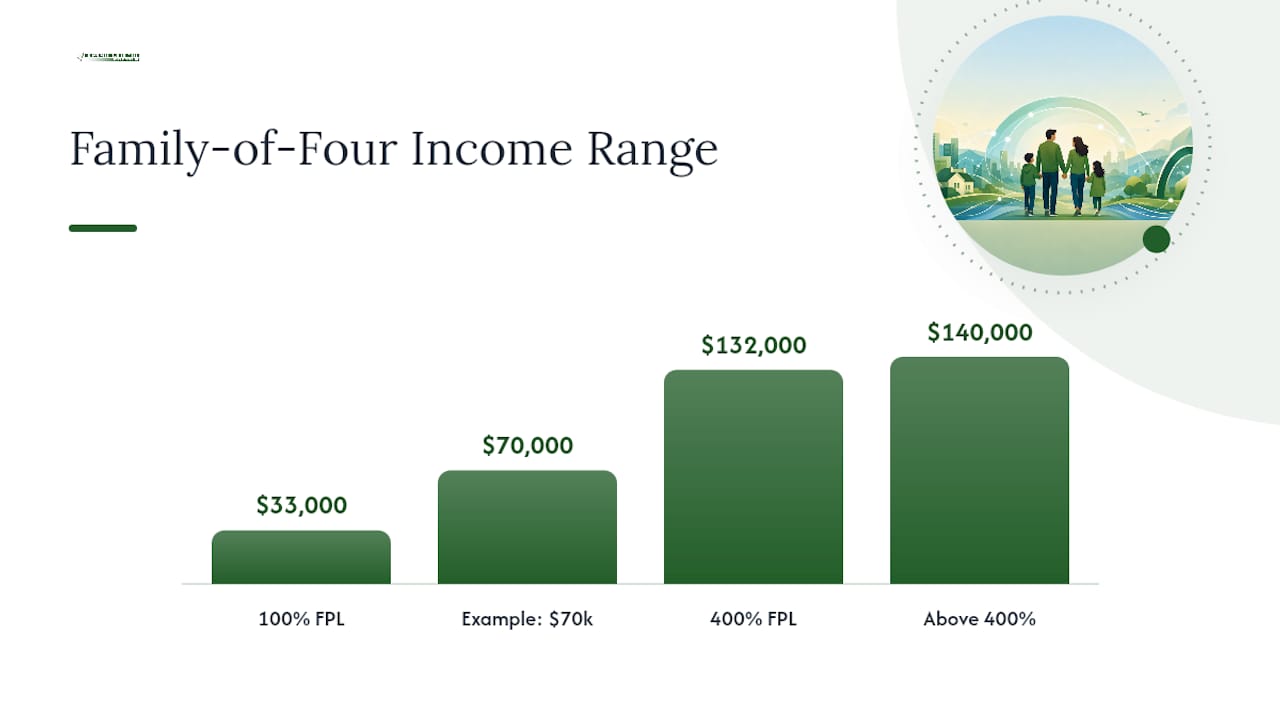
- 4 people: $33,000 to $132,000
- 5 people: $38,600 to $154,400
- 6 people: $44,200 to $176,800
Pro Tip: If you live in Alaska or Hawaii, don’t use these numbers. Both states have their own, higher FPL figures, and applying the wrong table will throw off every estimate you make. Check the ASPE 2026 poverty guidelines for your state’s exact figures before you calculate anything.
Let’s say you’re a family of four earning $70,000 a year. That lands comfortably inside the $33,000 to $132,000 range, so you’re a candidate for a premium tax credit, though the size of that credit depends heavily on where in the range you fall. A household of four at $70,000 sits much closer to the bottom of the range than the top, which generally means a larger credit and a smaller monthly bill. A similar household earning $140,000, on the other hand, has crossed above 400% FPL and would need to pay the full, unsubsidized premium.
One more thing worth remembering: these thresholds change slightly every year as the federal poverty level is updated, so a household that qualified in 2025 needs to recheck its status for 2026, not assume it carries over.
How the Marketplace Calculates Your Eligibility
The number that actually determines your subsidy isn’t your salary. It’s your Modified Adjusted Gross Income, or MAGI, and the difference between the two trips up a lot of applicants.
Think of MAGI as your Adjusted Gross Income (the number on your tax return) with a few items added back in. Here’s how the calculation generally builds:
- Start with your Adjusted Gross Income (AGI) from your most recent tax return or your best estimate for the coverage year.
- Add back any untaxed foreign earned income you excluded from your taxes.
- Add back tax-exempt interest, the kind you’d report even though it isn’t taxed.
- Add back the non-taxable portion of Social Security benefits, in the specific cases where it applies.
Once you have MAGI, the Marketplace wants to know which income sources to count. Wages, self-employment profit, unemployment compensation, retirement distributions, and rental income all count toward your household total. Child support and most loan proceeds do not. If you’re self-employed, your estimate should reflect your expected Schedule C net profit for the year, not your gross revenue, and it’s worth documenting how you arrived at that number in case your income shifts later.
Household composition matters just as much as the income figure itself. The Marketplace counts you, your spouse if you file jointly, and any tax dependents you claim, even if a dependent has their own income. Get this part wrong and every downstream calculation is off. HealthCare.gov’s household rules walk through edge cases like shared custody and adult children still on a parent’s return.
What Changed for 2026 and Why Your Premium Might Be Higher
The biggest shift this year is the one drawing the most attention: the enhanced subsidies created under the American Rescue Plan and extended through the Inflation Reduction Act expired at the close of 2025. Those temporary rules had let households above 400% FPL qualify for tax credits and had capped premiums at a lower percentage of income across the board. Neither of those provisions carried into 2026.
Practically, that means a few things for people renewing coverage this year:
- Households above 400% FPL are, generally, no longer eligible for any premium tax credit.
- Many enrollees who previously paid $0 or close to it for a benchmark plan will now see a real monthly bill, since premiums rise once the enhanced credit structure disappears.
- CMS reporting shows enrollment concentrating more heavily in the 100 to 150% FPL band for 2026, with the Open Enrollment report noting that share remains higher than it was back in 2021.
CMS has also tightened program integrity rules around income verification and reconciliation, and issued a statement on failure to file and reconcile requirements for plan years 2026 and 2027. If you’ve skipped reconciling your tax credit in a prior year, that’s no longer something to put off.
If Your Income Changes: Updating, Reconciling, and Avoiding a Tax Surprise
The credit you receive each month, the advance premium tax credit, is really just an estimate based on the income you reported when you enrolled. The real number gets settled at tax time using Form 8962, which compares what you actually earned to what the Marketplace assumed. Get the estimate wrong in either direction and you’ll feel it on your tax return.
Here’s the practical sequence to follow:
- Update your Marketplace application the moment your income or household changes, rather than waiting for renewal season, since HealthCare.gov requires this for accurate savings calculations.
- Estimate conservatively if your income is unpredictable, leaning slightly higher rather than lower.
- Keep documentation of self-employment income, freelance contracts, or any irregular earnings throughout the year.
- Reconcile at tax time using Form 8962, comparing your advance credits to your actual final income.
- Adjust your monthly APTC through your Marketplace account if you see a shift coming, rather than absorbing the full impact in April.
If you overestimated, you’ll get the difference back as a refund. Either way, the earlier you catch the gap, the less it costs you.*
Medicaid, State Wraps, and Other Special Situations
In the states that expanded Medicaid to 138% of FPL, households below that threshold typically qualify for Medicaid instead of a Marketplace plan, which changes both the cost and the coverage entirely.
A few other wrinkles worth knowing about:
- Noncitizens and DACA recipients face their own specific eligibility rules for premium tax credits, and recent legislative changes, including provisions tied to the Working Families Tax Cut Legislation, have adjusted who qualifies.
- Several states run their own subsidy programs on top of the federal credit, a “wrap” that lowers net premiums beyond what the federal formula alone provides. States including California, Colorado, New York, and Maryland offer these added savings through their own exchanges.
- If you’re in one of the states where some brokers operate, checking your specific state marketplace matters, since wrap programs and Medicaid expansion status vary widely by state.
If you’re unsure which category applies to you, that’s exactly the kind of question worth running past someone who reviews these situations daily rather than guessing.
Estimating Your 2026 Subsidy Before You Enroll
Before you commit to a plan during open enrollment, run your numbers through a calculator so you’re not guessing at your monthly bill. The HealthCare.gov subsidy estimator gives you the most direct, official read on what you’ll qualify for. The KFF Health Insurance Marketplace Calculator is worth a second look too, especially for modeling different income scenarios side by side.
Before you sit down with either tool, gather:
- Your estimated MAGI for 2026, not last year’s tax return figure.
- Household size and the age of each member (age affects premium pricing directly).
- Your ZIP code, since benchmark plan costs vary by county.
- Whether anyone in the household has access to employer coverage, Medicare, or Medicaid, since that can disqualify a person from a Marketplace subsidy entirely.
The output you’ll get back includes your estimated APTC, your expected monthly premium after that credit, and the benchmark plan it’s based on. Treat that number as a strong estimate, not a locked-in guarantee, since your final credit still gets reconciled against your actual income.
When a Broker or Private Plan Makes More Sense Than the Marketplace Alone
Some households don’t fit neatly into the Marketplace’s assumptions, and that’s where Sobal Nationwide Health tends to get the most useful calls.
Sobal Nationwide Health offers personalized advisory across 31 states, including access to medically underwritten private plans that aren’t listed on the public Marketplace. For someone who’s lost subsidy eligibility entirely, a private plan can sometimes deliver better value than an unsubsidized Marketplace policy, depending on health status and coverage needs. That’s a conversation worth having before you assume the Marketplace is your only option.
What I’d Do First This Enrollment Season
If I were sitting across from you, I’d start with your MAGI estimate, not the plan menu. Check your state for a subsidy wrap, run both the HealthCare.gov and KFF calculators, and update your Marketplace application the moment your income shifts. Compared to the 2021 through 2025 window, 2026 is a tighter, less forgiving subsidy environment, so precision now saves you a surprise bill later. If your household is complicated, a broker conversation costs you nothing and might save you real money.
— Bernie S
Where to Check the Official Numbers Yourself
Skip the guesswork and go straight to the source. HealthCare.gov covers enrollment rules and how to report income changes. ASPE’s poverty guidelines confirm your exact FPL figure. The IRS premium tax credit Q&A explains reconciliation, and CMS’s Open Enrollment report shows how enrollment patterns are shifting nationwide.
This article is general information, not a substitute for advice from a qualified financial advisor. Consult a qualified financial professional about your own circumstances before acting on anything here.
Sources
- IRS — Questions and answers on the premium tax credit
- Healthcare
- CMS — Health insurance exchanges: 2026 open enrollment report
- ASPE — 2026 Poverty Guidelines: 48 Contiguous States
FAQ
What Income Qualifies for ACA Subsidies in 2026?
For a family of four, that’s between $33,000 and $132,000 using the 2026 FPL baseline for the 48 contiguous states and D.C.
Who Will Lose ACA Subsidies in 2026?
Households above 400% FPL generally lose eligibility for any premium tax credit in 2026, since the enhanced subsidies that covered that group expired at the end of 2025. Many enrollees who previously paid $0 for coverage will now see a monthly premium as a result.
What if I Overestimate My Income for Obamacare in 2026?
If you overestimate your income, the Marketplace gives you a smaller advance premium tax credit than you actually qualify for during the year. You’ll get the difference back as a refund when you reconcile using Form 8962 at tax time.
Is the ACA Subsidy Based on Gross or Net Income?
Neither, exactly. It’s based on Modified Adjusted Gross Income (MAGI), which starts from your Adjusted Gross Income and adds back items like untaxed foreign income and tax-exempt interest, not your gross paycheck or take-home pay.
