

Most small employers pay a few hundred dollars to several hundred dollars a month per enrolled employee for single coverage, with family plans running notably higher, and most cover around three-quarters of that premium. If you qualify for the Small Business Health Care Tax Credit, your net cost can drop substantially. Your next move: count your full-time equivalent employees and get quotes built on identical benefit designs.
TL;DR:
- Premium costs depend heavily on employee age, health, location, plan design, and network breadth, making direct comparisons between quotes essential.
- Employers eligible for the Small Business Health Care Tax Credit can reduce premiums by up to 50%, but strict rules on FTEs, wages, and timing affect eligibility.
- Actual expenses can be significantly less if fewer employees enroll, or if family plans are chosen, which often double or triple per-person costs.
- Administrative fees, broker commissions, and compliance costs may increase total expenses and are often bundled into the premium or invoiced separately.
Table of Contents
- Small Business Health Insurance Cost: Benchmarks You Can Trust
- What Actually Drives Your Premium Quote
- SHOP and the Tax Credit That Can Cut Your Bill in Half
- How to Calculate Your Real Annual Cost
- Getting Quotes You Can Actually Compare
- Timing, Participation, and the Pitfalls That Blow Up a Quote
- The Costs That Never Show Up on the Premium Sheet
- When the Math Gets Complicated, Call Someone Who Does This Daily
- Get a Tailored Quote Before You Commit to a Plan
- Where These Numbers Come From
- Sources
- FAQ
Small Business Health Insurance Cost: Benchmarks You Can Trust
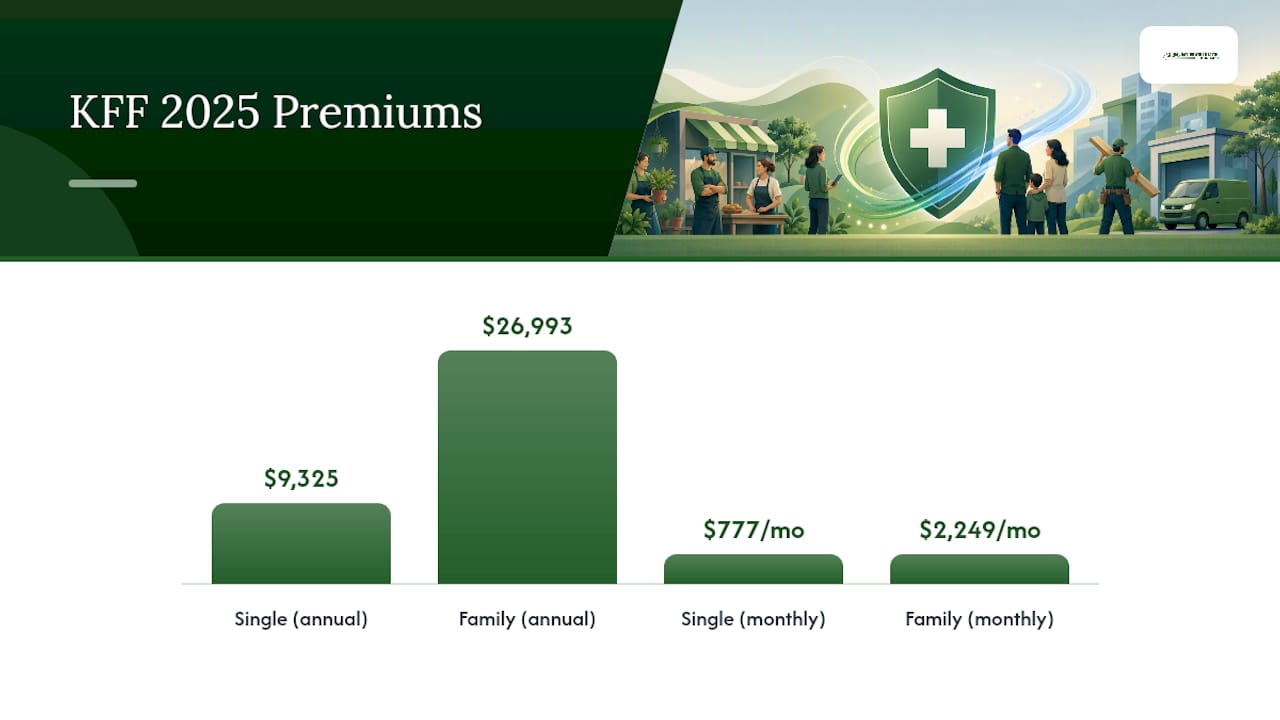
The most current benchmark comes from the 2025 Employer Health Benefits Survey from KFF, which found average annual premiums of about $9,325 for single coverage and $26,993 for family coverage. Break that into monthly numbers and you get roughly $777 a month for one person, $2,249 for a family plan.
Employees are not footing that whole bill, and neither are you. That leaves the employer covering the bulk of the premium in most arrangements.
Here’s how that plays out for a business with 10 employees, assuming half choose single coverage and half choose family plans, with the employer paying the full average employer share:
Quick benchmark: A single employee costs you roughly $657 a month on average; a family enrollee costs roughly $1,679 a month, based on KFF’s 2025 employer survey.
Your actual numbers will move based on your industry, your state, and who you’re insuring. But these figures are the reality check every quote should be measured against.
What Actually Drives Your Premium Quote
Think of your quote as a puzzle with several moving pieces, and each one shifts the price independently. The age and health profile of your team matters most in states that allow age rating. An office of twenty-five-year-olds will almost always get a friendlier quote than a team averaging fifty, simply because claims risk rises with age.
Where you’re located changes things too. Insurers set “rating areas” that reflect local medical costs, provider networks, and state regulation, and two businesses with identical employees in different zip codes can see meaningfully different premiums.
Plan design is the lever you control most directly:
- A Bronze-tier plan with a high deductible costs less per month but shifts more risk onto employees.
- A Gold or Platinum plan with a low deductible costs more upfront but reduces surprise bills later.
- Broader provider networks and richer drug formularies both push premiums higher.
- More employees enrolling in family coverage versus employee-only coverage raises your blended average cost per person.
As KFF explains, there’s no universal small-business rate. Premiums reflect projected claims plus administrative costs, and that projection changes with every variable above.
Pro Tip: Ask every carrier to quote the exact same metal tier, deductible, and network. A “cheaper” plan that’s secretly a narrower network or a higher deductible isn’t actually cheaper, it’s a different product.
SHOP and the Tax Credit That Can Cut Your Bill in Half
SHOP, the Small Business Health Options Program, generally serves employers with 1 to 50 full-time equivalent employees and lets you buy coverage year-round rather than during a single open enrollment window, according to Healthcare. The bigger financial lever, though, is the Small Business Health Care Tax Credit.
Eligible small employers can claim a credit worth up to 50% of premiums paid (35% for tax-exempt employers) if they meet FTE and average wage limits, according to the IRS.
That’s not a small discount. But the IRS treats this as a qualification exercise, not an automatic perk, and a few rules trip owners up every year:
- Count your full-time equivalents carefully. The credit phases out as FTEs and average wages rise, so a handful of extra hires can shrink or eliminate it.
- Pay at least 50% of employee-only premiums through a uniform contribution structure across your workforce.
- Know the two-year limit. The credit generally applies for only two consecutive tax years, so timing when you claim it matters.
- File Form 8941 and keep documentation, since the IRS’s draft instructions walk through the worksheets and phase-out math in detail.
Small changes in headcount or wages can swing eligibility more than owners expect, so run the numbers before you assume the credit applies.
How to Calculate Your Real Annual Cost
The math itself is simple once you have a quote: monthly employer contribution × number of enrolled employees × 12 = annual employer cost. The complexity comes from the assumptions hiding inside that formula.
Here’s how it scales across common small-business sizes, assuming an employer pays 75% of a $700 average monthly premium per enrolled employee:
- 5-employee firm: $525 employer share × 5 × 12 = $31,500 a year.
- 10-employee firm: $525 × 10 × 12 = $63,000 a year.
- 20-employee firm: $525 × 20 × 12 = $126,000 a year.
Three variables can move that number significantly, and every owner should stress test them before budgeting:
- Not every employee will take up your offer. If only 80% enroll, your actual cost drops proportionally.
- Family plans roughly double or triple the per-person cost versus employee-only coverage.
- Administrative fees and any broker commissions embedded in the quote add to the premium total, not on top of a separate invoice.
Getting Quotes You Can Actually Compare
The single biggest mistake owners make is comparing quotes that aren’t actually comparable. A structured comparison approach starts with locking every variable except price.
Ask every carrier or broker for the identical benefit design: same metal tier, same deductible, same out-of-pocket maximum, and the same drug formulary. Then request the full cost picture, not just the sticker premium:
- Total monthly premium and the employer versus employee split
- Payroll deduction amount per employee
- Renewal methodology (how the carrier calculates next year’s increase)
- Any administrative or participation fees baked into the quote
- The assumed participation rate the quote depends on
Recent research on employee health investment points to a related risk: a quote that looks cheap because it assumes low employee take-up can fall apart, and get re-priced, the moment actual enrollment comes in higher.
Pro Tip: Require every quote in writing with the same effective date. Verbal ballpark numbers from a broker are not the same as a locked quote, and they can move once underwriting actually runs your census.
Timing, Participation, and the Pitfalls That Blow Up a Quote
SHOP coverage can be purchased year-round, but participation rules still shape what you’re offered. Many states require roughly 70% participation among the employees you offer coverage to, and HealthCare.gov’s SHOP eligibility guidance notes that requirement can vary by state and by insurer’s enrollment window.
A handful of practical missteps cause real damage:
- Accepting a quote without confirming the participation rate it assumes, since low actual enrollment can invalidate the pricing.
- Surveying employees about current coverage too late to catch a participation shortfall before it derails your timeline.
- Failing to keep FTE and wage documentation, which matters if you plan to claim the tax credit later and need to prove eligibility.
- Missing the window to lock a renewal rate, leaving you exposed to a bigger increase than expected.
The Costs That Never Show Up on the Premium Sheet
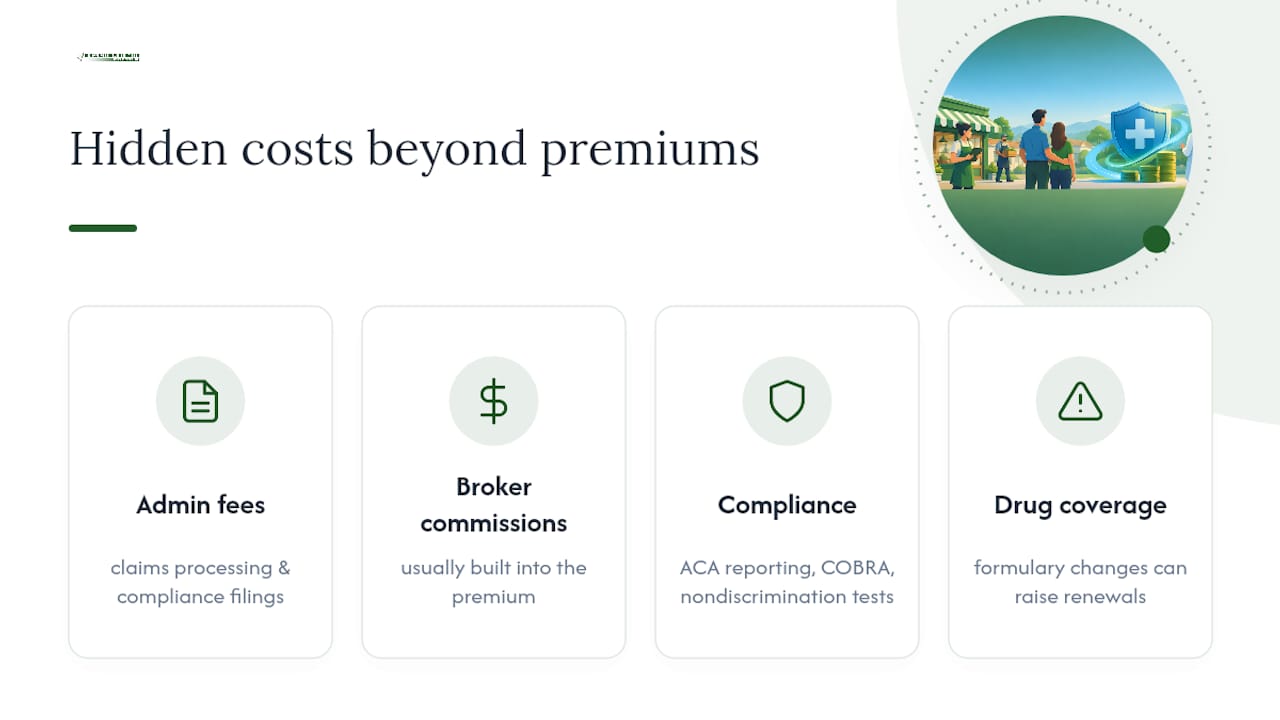
The premium is the number everyone quotes, but it is rarely the whole bill. Administrative fees are one of the most common additions, and they typically cover claims processing, plan documentation, and compliance filings tied to the Affordable Care Act. Depending on the carrier and plan structure, these fees show up either bundled into your monthly premium or itemized separately on your invoice, so ask which one you’re looking at before you compare two quotes side by side.
Broker commissions are another layer worth understanding, even though they rarely cost you anything extra directly. Carriers typically build broker compensation into the premium itself, which means a broker-assisted quote and a “direct” quote from the same carrier usually land at the same price. The real value of working with a broker isn’t a discount, it’s the guidance on plan design and eligibility that can save you far more than any commission would cost.
Compliance costs are the quiet third category. If you’re offering group coverage, you may owe annual reporting under the Affordable Care Act, COBRA administration if an employee leaves, and nondiscrimination testing if you offer different contribution levels to different employee classes. None of these show up as a single line item on a premium quote, but they show up eventually, usually as a bill from your payroll provider or benefits administrator.
Finally, drug coverage decisions increasingly affect renewal pricing. Insurers are adjusting formularies and coverage rules for high-cost medications, and those shifts can move your renewal premium even if your workforce and plan design stay exactly the same.
When the Math Gets Complicated, Call Someone Who Does This Daily
The tax-credit rules and participation math trip up even careful owners, and a wrong assumption about FTEs can cost you thousands. Some insurance brokers provide one-on-one advisory to help small businesses surface plan designs they might otherwise miss, and clients sometimes report savings once a proper comparison is done.
— Bernie S
Get a Tailored Quote Before You Commit to a Plan
Small business owners benefit from working with licensed brokers who can run actual FTE numbers, check tax-credit eligibility, and line up quotes on matching benefit designs for meaningful comparison.

Our business health insurance support covers brokerage assistance, SHOP enrollment help, and a plain-English walkthrough of whether the Small Business Health Care Tax Credit applies to you. There’s no sales pressure and no cost to ask. If you’re staring at a quote that doesn’t quite add up, or you haven’t gotten one yet, request a tailored quote and FTE calculation through our small business team and find out what your real number looks like before you sign anything.
Where These Numbers Come From
Every benchmark figure in this article traces back to primary sources, not secondhand estimates. The IRS’s Small Business Health Care Tax Credit guidance and Form 8941 instructions cover eligibility and filing. HealthCare.gov’s SHOP pages explain enrollment and participation rules, and the KFF Employer Health Benefits Survey provides the premium benchmarks used throughout.
This article is general information, not a substitute for advice from a qualified financial advisor. Consult a qualified financial professional about your own circumstances before acting on anything here.
Sources
- 2025 Employer Health Benefits Survey | KFF
- Small Business Health Care Tax Credit and the SHOP Marketplace | Internal Revenue Service
- Healthcare
FAQ
How much do small businesses pay for health insurance?
Small employers typically pay premiums averaging $9,325 a year for single coverage and $26,993 for family coverage, based on the 2025 KFF Employer Health Benefits Survey. Most employers cover the majority of that cost, with workers contributing an average of $1,440 for single plans and $6,850 for family plans.
Can an LLC pay for owners’ health insurance?
It depends on how the LLC is taxed and whether the owner is treated as a common-law employee for SHOP purposes, since SHOP generally requires at least one employee besides the owner. A licensed broker or tax professional can confirm your specific eligibility based on your entity structure.
How much is $1,000,000 liability insurance a month?
Liability insurance is priced separately from health insurance and depends on your industry, revenue, and claims history, so there’s no fixed monthly figure that applies broadly. This falls outside health coverage entirely and requires a quote from a commercial liability carrier.
What is the best health insurance for small business owners?
The best option depends on your workforce size, budget, and whether you qualify for the Small Business Health Care Tax Credit, which can offset up to 50% of premiums for eligible employers. Working with a broker like Sobal Nationwide Health helps you compare plan designs and confirm eligibility before you commit to a carrier.
