

If your regular doctors are already in-network and you rarely travel for care, an EPO usually saves you money every month. If you see out-of-network specialists, split time between states, or want the flexibility to walk into almost any doctor’s office without a referral, a PPO’s higher premium is often worth paying. The right call comes down to one question: how much is flexibility worth to you compared to what you’d save with a tighter network?
TL;DR:
- An EPO is typically cheaper but only covers in-network care, making it suitable for those with trusted local providers and minimal out-of-network visits.
- A PPO costs around $113 more monthly on average but offers greater flexibility, especially for travelers, those who split between states, or frequent out-of-network care.
- Confirming your current providers’ network status directly with their offices and hospital systems is essential before choosing a plan type.
- Most emergency services are protected under federal law from surprise bills, but out-of-network visits outside emergencies can still be costly without careful planning.
- If you rarely go out of network, the premium savings of an EPO usually outweigh the benefits of a PPO; otherwise, assess your likelihood of needing out-of-network care before deciding.
Table of Contents
- EPO vs PPO at a Glance
- What Does “In-Network Only” Actually Mean?
- How Much More Does a PPO Really Cost You?
- Do You Need a Referral to See a Specialist?
- What Happens After an ER Visit?
- How Do I Actually Choose Between EPO and PPO?
- How Sobal Health Helps You Compare Plans
- Get a Free Plan Check From Sobal Health
- Where This Information Comes From
- Sources
- FAQ
EPO vs PPO at a Glance
Here’s the short version before we get into the weeds.
- Network rules: EPOs cover in-network care only, except true emergencies. PPOs cover out-of-network care too, just at a higher cost to you.
- Referrals: Neither typically requires a referral to see a specialist, though some EPOs vary.
- Premiums: EPOs tend to run cheaper month to month.
- Out-of-pocket risk: EPOs carry more risk if you accidentally go out-of-network. PPOs cushion that risk.
- Travel: PPOs travel better since you’re not locked to one local network.
- Best for: EPOs fit people whose providers are already in-network. PPOs fit people who value choice or live between two locations.
PPOs remain the most common plan employers offer, with a large share of covered workers enrolled in one in 2025, according to KFF’s employer benefits survey. That popularity doesn’t mean it’s the cheapest option for everyone. It often just means people default to what’s familiar.
What Does “In-Network Only” Actually Mean?
An EPO, or Exclusive Provider Organization, pays for care only when you stay inside its network, except for genuine emergencies. Step outside that network for a routine visit, and you’re typically on the hook for the entire bill, not just a higher copay. A PPO, or Preferred Provider Organization, still pays something when you go outside the network. It’s less, and your cost-sharing jumps, but you’re not carrying the full cost alone. Healthcare lay out this distinction clearly, and it’s the single biggest difference between the two plan types.
Before you enroll in either plan, run this quick check:
- Pull up the insurer’s online provider directory and search for every doctor you currently see.
- Note each provider’s contract status. Directories occasionally lag behind reality, so don’t assume a listing is current.
- Call the provider’s office directly and ask if they’re still contracted with that specific plan, not just the parent insurance company.
- Confirm which hospital system the plan considers in-network, since your doctor’s hospital privileges matter as much as the doctor’s own status.
Pro Tip: Request written confirmation of network status for any specialist you rely on regularly. Screenshots and confirmation numbers protect you if a directory turns out to be wrong.
How Much More Does a PPO Really Cost You?
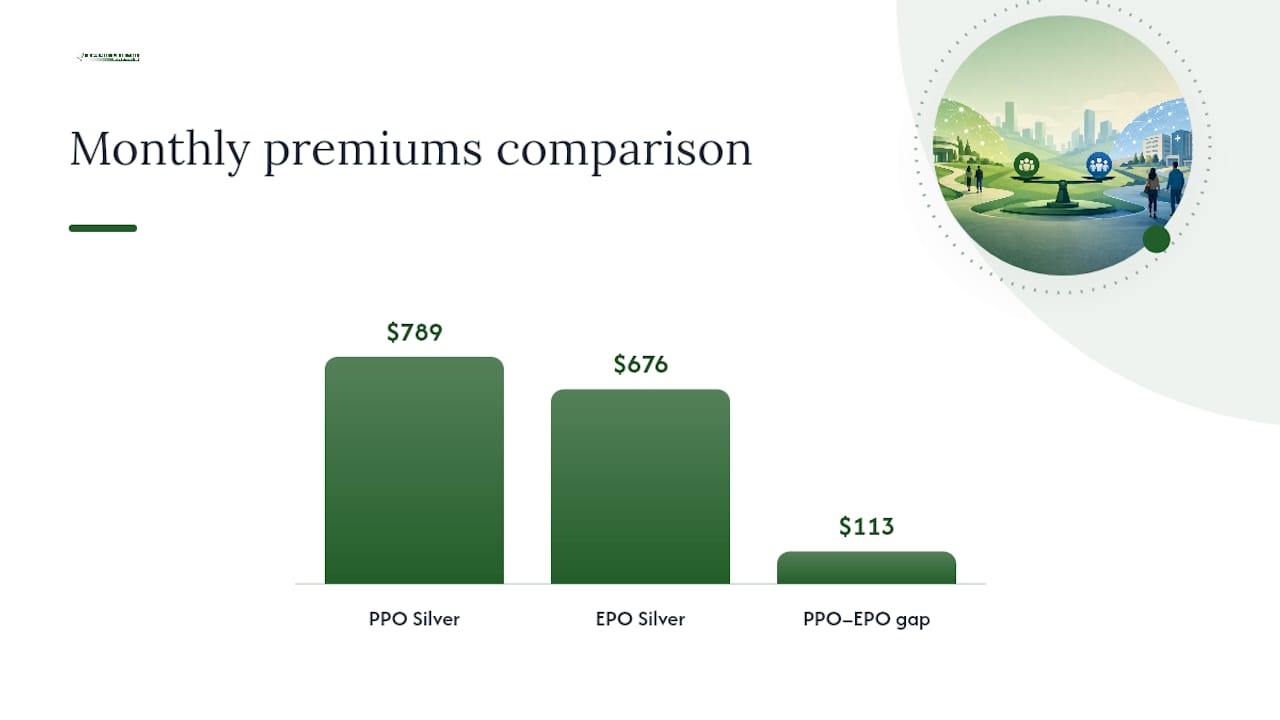
Money is usually what tips this decision one way or the other. MoneyGeek’s 2026 analysis of CMS Marketplace data found average monthly premiums of around $789 for PPO Silver-tier plans versus about $676 for EPOs in a sample of 31 to 45 year olds. That’s a $113 monthly gap, or roughly $1,356 a year, just for the option to go out-of-network.
Whether that gap is worth paying depends on how you’d actually use it:
- Deductible: what you pay before insurance kicks in.
- Copay: a flat fee per visit or prescription.
- Coinsurance: your percentage share of the bill after the deductible.
- Out-of-pocket maximum: the ceiling on what you’ll pay in a plan year, after which insurance covers 100%.
Marketplace out-of-pocket maximums are capped by federal rule, with a sample individual cap near the typical federal maximum and a family cap near the typical federal maximum for 2026 according to HealthCare.gov. That cap matters because it defines your worst-case scenario, but only for in-network care on most EPOs. One out-of-network specialty visit can erase months of that premium savings in a single afternoon. If you’ve needed even one out-of-network visit in the past year, run the math before assuming the EPO is the deal it looks like on paper.
Do You Need a Referral to See a Specialist?
Most EPOs and PPOs skip the referral requirement that older HMO plans built their reputation on. You can typically book a specialist directly under either plan type, though it’s worth confirming with your specific plan since exceptions exist.
- Referral requirements vary by plan, not just by plan type, so check your policy documents rather than assuming.
- If you already rely on an out-of-network specialist, a PPO dramatically lowers your risk of an unpaid claim.
- Confirm each specialist’s in-network status separately from your primary doctor’s, since one office can carry multiple contracts.
- Ask about continuity-of-care rules. When a provider drops out of network mid-treatment, some plans allow a continuity period of up to 90 days to finish an existing treatment plan without penalty.
That last point matters more than people realize until it happens to them. Losing a specialist mid-treatment, whether it’s an oncologist or a physical therapist, is one of the more stressful surprises in health insurance, and knowing the continuity rule ahead of time takes some of that panic off the table.
What Happens After an ER Visit?
Emergencies are the one place where EPOs and PPOs behave almost identically, thanks to federal law. The No Surprises Act, in effect since January 2022, protects you from many surprise out-of-network bills for emergency services and certain facility-based care, regardless of which plan type you carry, according to CMS guidance.
That protection isn’t absolute, though. Notice-and-consent exceptions let some non-emergency providers ask you to waive protections in writing, which can reopen your exposure to a bigger bill. Read anything you’re asked to sign in an ER waiting room twice.
If you end up in an out-of-network emergency room, take these steps:
- Document every charge on your itemized bill as soon as you receive it.
- Once you’re stable, ask your care team about transferring to an in-network facility to limit further out-of-network charges.
- Dispute any bill that looks like it violates the No Surprises Act through your insurer or the federal independent dispute resolution process.
Pro Tip: Requesting a transfer to an in-network facility right after stabilization is one of the simplest ways to cut your remaining exposure.
How Do I Actually Choose Between EPO and PPO?
Run through this before you sign anything:
- Confirm every current provider’s network status under the specific plan you’re considering, not the insurer’s brand name in general.
- Count how many out-of-network visits you had in the past 12 months. Zero or one usually favors the EPO. Several favors the PPO.
- Estimate how often you travel or split time between states, since PPOs travel better.
- Compare the premium gap against a real sample bill for an out-of-network visit you might need.
When you talk to HR or an insurer directly, ask these questions:
- How broad is the network in the counties where I actually live and work?
- What’s the exact reimbursement formula for out-of-network care?
- What are the continuity-of-care rules if my doctor leaves the network?
- How often is the provider directory updated?
Pro Tip: If your answer to “how many out-of-network visits did I have last year” is zero, the EPO’s premium savings usually win. If it’s more than one, price out the PPO before you decide.
As a simple rule: EPOs save money when your provider list matches the network closely. PPOs earn their premium back the moment you need flexibility they’re built to provide.
— Bernie S
How Sobal Health Helps You Compare Plans
Reading through network rules and premium tables is one thing. Confirming that your actual doctor, in your actual county, is actually in-network on a specific plan is another. That’s the piece we spend most of our time on with clients.
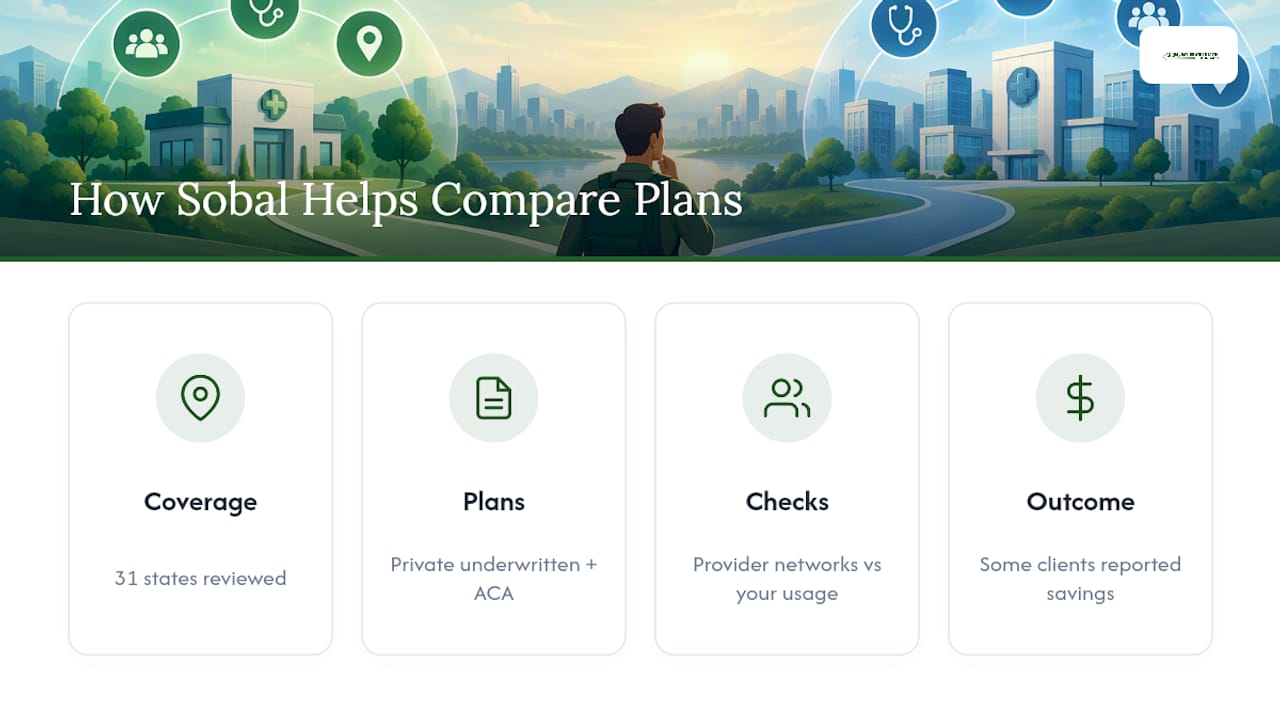
Sobal Health reviews plan options across 31 states, including private medically underwritten plans that aren’t listed on the public marketplace, alongside standard ACA plans. We check provider networks against your real usage, not guesswork, and walk you through the premium versus out-of-pocket trade-off in plain terms. Some clients have reported savings after being matched to the right plan design. A guide like this one gets you most of the way there. A quick conversation usually settles the rest.
Get a Free Plan Check From Sobal Health
If you’ve made it this far, you already know the EPO versus PPO decision isn’t really about which plan sounds better. It’s about matching a plan to the doctors you already trust and the way you actually live. That’s exactly the kind of check Sobal Health does for you, without any pressure to buy something that doesn’t fit.

We’ll walk through your current providers, estimate your realistic out-of-network exposure, and show you plan options, including private medically underwritten health insurance plans that never show up on the public marketplace. If you run a small business and are weighing group coverage instead, our business health insurance page breaks down what that looks like for employers. There’s no obligation and no sales script. Head to Sobal Health to request a free plan check and get a straight answer about which plan actually fits your situation.
Where This Information Comes From
This guide draws on KFF’s 2025 Employer Health Benefits Survey for enrollment trends, MoneyGeek’s 2026 plan-cost analysis for premium figures, CMS guidance on the No Surprises Act, and HealthCare.gov’s plan-type definitions for federal terminology. Each source is a primary government or industry authority on U.S. health coverage rules.
This article is general information, not a substitute for advice from a qualified financial advisor. Consult a qualified financial professional about your own circumstances before acting on anything here.
Sources
- 2025 Employer Health Benefits Survey | KFF
- EPO vs. PPO: Key Differences, Costs and How to Choose | MoneyGeek
- Know your rights with insurance | CMS
- Healthcare
FAQ
Is an EPO as good as a PPO?
An EPO can be just as good as a PPO if your current doctors and hospital are already in its network, since you’ll get similar in-network coverage for a lower premium. It falls short only when you need out-of-network access, which an EPO generally won’t cover except in emergencies.
What are the disadvantages of an EPO?
The main disadvantage is the lack of out-of-network coverage for anything but true emergencies, meaning a mismatched provider can leave you with the full bill. EPOs also require more diligence upfront to confirm every provider you use is actually contracted with the plan.
Who is an EPO best for?
An EPO fits people whose doctors, specialists, and preferred hospital are already confirmed in-network, and who don’t travel often for work or family. It’s also a strong fit for self-employed individuals and small business owners looking to lower monthly premiums without sacrificing quality care, which is something Sobal Health helps confirm before you enroll.
Do doctors prefer HMO or PPO?
Doctors don’t have a uniform preference between HMO and PPO, since acceptance depends on each practice’s individual contracts with insurers rather than the plan type itself. What matters more to a provider is whether they’ve signed a contract with your specific plan, which is why confirming network status by phone still beats relying on a directory alone.
