

Coordination of benefits (COB) is the process insurers use to decide which plan pays first so combined payments never exceed the total allowable cost of your care. Your primary plan pays its share according to its rules, then your secondary plan can pick up some or all of what’s left, up to its own limits. Medicare follows its own ordering rules, which we’ll walk through below, and both the Centers for Medicare & Medicaid Services (CMS) and Healthcare publish official guidance you can lean on.
TL;DR:
- Primary plans usually pay first based on rules like employment status, birthday, or divorce court order, with Medicare’s rules depending on employer size.
- Medical providers process claims sequentially, with the primary insurer paying first and the secondary covering remaining costs if applicable.
- Medicare can pay before the primary insurer when certain conditions are met, leading to conditional payments that may require repayment.
- Tracking and responding promptly to COB questionnaires and keeping detailed records prevent claim delays and reduce billing confusion.
- Having two plans can lower costs for frequent or high medical expenses but often involves paying two premiums, so evaluating financial benefit depends on individual usage and coverage overlap.
Table of Contents
- How Coordination of Benefits Works Behind the Scenes
- Who Pays First? The Ordering Rules That Decide It
- Medicare, Medicaid, and the Rules That Trip People Up
- Your COB Checklist: What to Do With Two Plans
- Timelines, Conditional Payments, and Avoidable Mistakes
- When It’s Time to Call a Broker Instead of Figuring It Out Alone
- How COB Affects Claim Denials and the Appeals Process
- Does Having Two Plans Actually Save You Money?
- What I Tell Clients Who Are Confused About Two Plans
- Get Help Sorting Out Your Coverage
- Where to Verify the Rules Yourself
- Sources
How Coordination of Benefits Works Behind the Scenes
Here’s the part most people never see: your insurers are talking to each other, or at least they’re supposed to be. When you have two health plans, the claim doesn’t get paid twice in full. It moves through a sequence.
Think of it like paying for dinner with a gift card and a credit card. The gift card (primary plan) gets used first, up to its balance. Whatever’s left goes on the credit card (secondary plan), and you’re only on the hook for what neither one covers.
In practice, the flow looks like this:
- Your provider bills the primary plan first, following the plan’s contracted rates.
- The primary plan processes the claim and sends you an Explanation of Benefits (EOB) showing what it paid, what it denied, and what’s left over.
- The provider (or you) submits that remaining balance to the secondary plan, often along with the primary’s EOB attached.
- The secondary plan applies its own coverage rules to whatever the primary didn’t pay, up to its allowable amount.
Your EOB is the single most useful document in this whole process. It shows the billed amount, the allowed amount, what insurance paid, and what’s left as your responsibility. If the numbers on your secondary plan’s EOB don’t reflect what the primary already paid, that’s your first sign something didn’t coordinate correctly.
Many carriers handle this automatically once both plans are on file, often using benefit-tracking features to monitor plan offers and enrollments. Others still require you to submit paperwork or confirm coverage details before the secondary plan will process anything, which is why insurers periodically send COB questionnaires asking what other coverage you have.
Who Pays First? The Ordering Rules That Decide It
Insurance companies don’t guess at who pays first. They follow a standard set of rules, and most of them trace back to the NAIC model regulation that states have adopted in some form. Here’s how the order typically shakes out.
- The policyholder’s own plan pays first. If you’re covered as an employee on one plan and as a dependent on your spouse’s plan, your own employer plan is primary for you.
- The birthday rule decides for kids. When a child is covered by both parents’ plans, the plan of the parent whose birthday falls earlier in the calendar year (month and day, not the year itself) pays first.
- Custodial parent rules override the birthday rule after divorce. If a court order specifies which parent must provide coverage, that parent’s plan is primary regardless of birthdays.
- Active employment beats continuation coverage. A plan tied to your current job outranks COBRA continuation coverage from a former job, even if you enrolled in COBRA first.
- The longest-enrolled plan wins when no other rule applies. If two plans can’t be ordered by the rules above, the one that’s covered you the longest usually becomes primary.
A quick example: say you’re covered under your own employer’s plan and also as a dependent on your spouse’s plan. Your employer plan pays first for your claims. Now flip it. Your kids are covered on both parents’ plans, mom’s birthday is in March and dad’s is in July. Mom’s plan pays first for the kids, every time, regardless of which parent enrolled them first.
Medicare, Medicaid, and the Rules That Trip People Up
Medicare’s ordering rules get complicated fast, mostly because they hinge on employer size. If you’re 65 or older and still working at a company with 20 or more employees, your group plan is usually primary and Medicare pays second. Drop below that 20-employee threshold, and Medicare often becomes primary instead. Medicare walks through these scenarios in detail, and it’s worth checking against your specific employer situation rather than assuming.
Medicaid works differently. It’s designed to be the payer of last resort, meaning if you have any other coverage at all, that coverage pays first and Medicaid picks up what’s left, within its own limits.
When Medicare pays before the primary plan has settled the claim, that’s called a conditional payment. CMS can later recover that money once the primary payer’s responsibility is confirmed, sometimes from the provider, sometimes from you directly.
- Providers occasionally bill Medicare when a primary insurer is slow to pay, triggering exactly this kind of conditional payment.
- If you get a notice about a conditional payment or a coordination dispute, call the Benefits Coordination & Recovery Center at 1-855-798-2627. That’s the direct line for sorting out who owes what.
Your COB Checklist: What to Do With Two Plans
Coordination mostly happens without you, but a few gaps are yours to close. Skipping them is how claims stall for weeks.
- Tell both insurers about each other before you need care, not after a bill shows up.
- Give your provider’s office both insurance cards at every visit, even if one seems secondary.
- Respond to COB questionnaires the moment they arrive. Ignoring them is the single most common reason claims freeze in place.
- Keep your plan ID numbers and coverage effective dates somewhere you can find them fast.
- Compare your primary and secondary EOBs side by side, and forward the primary’s EOB to the secondary insurer if the claim stalls.
If a provider bills you directly for an amount you believe should’ve gone to insurance, call the provider’s billing office first and ask them to rebill with both plans attached, then follow up with your secondary insurer to confirm they have everything they need.
Pro Tip: Keep a single folder, physical or digital, with both insurance cards, your plan ID numbers, and every EOB you receive. When a claim gets confusing, that folder is the fastest way to prove what should’ve happened.
Timelines, Conditional Payments, and Avoidable Mistakes
Primary plans generally process claims within a few weeks, but delays of weeks aren’t unusual, especially when paperwork is incomplete. That gap is exactly when conditional payments and billing confusion tend to happen.
- A conditional payment is money Medicare or another plan pays before the primary payer’s share is finalized, understanding it’s provisional and may need to be paid back once the real primary payer settles up.
- The most common member mistake isn’t a form filled out wrong. It’s not answering the COB questionnaire at all, which leaves the claim in limbo and can trigger a chain of conditional payments that someone eventually has to unwind.
- Missing deadlines to submit secondary claims is the other frequent trap. Most secondary plans have their own filing windows separate from the primary’s.
When It’s Time to Call a Broker Instead of Figuring It Out Alone
A lot of COB issues resolve with a phone call and a little patience. But when Medicare’s employer-size rules intersect with a group plan, or when out-of-pocket exposure is climbing while two carriers point fingers at each other, a broker’s review can save weeks. Some brokers take an education-first approach, walking clients through exactly how their specific plans interact rather than handing over a generic script. If your situation is straightforward, a call to your insurer usually suffices. If it isn’t, a second set of eyes that already speaks insurance is worth the conversation.
How COB Affects Claim Denials and the Appeals Process
A denied claim doesn’t always mean your care wasn’t covered. It often means the coordination step broke down somewhere. If a secondary plan doesn’t know you have primary coverage, or the primary’s EOB never made it into your file, the secondary insurer may deny the claim outright, not because the care wasn’t eligible, but because it couldn’t confirm what the primary already paid.
This is one of the more frustrating parts of managing two plans, because the denial letter rarely explains the real issue in plain terms. It’ll cite a code, not “we didn’t get your other insurance’s EOB.” If you get a denial and you know you have secondary coverage, your first move should be checking whether the secondary insurer actually has your primary plan’s payment information on file, not assuming the care itself was rejected.
Appeals for COB-related denials tend to move faster than appeals over medical necessity, because the fix is usually administrative. Submit the missing EOB, confirm both plans have accurate coverage dates, and resubmit. Most insurers have a specific appeals window depending on the plan, so don’t sit on a denial letter assuming it’ll sort itself out. It won’t. And every week you wait is a week closer to that filing deadline closing on you.
If a pattern of denials keeps happening across multiple claims, that’s usually a sign one of your plans has outdated information about your other coverage. Worth a call to fix at the source rather than appealing every claim individually.

Does Having Two Plans Actually Save You Money?
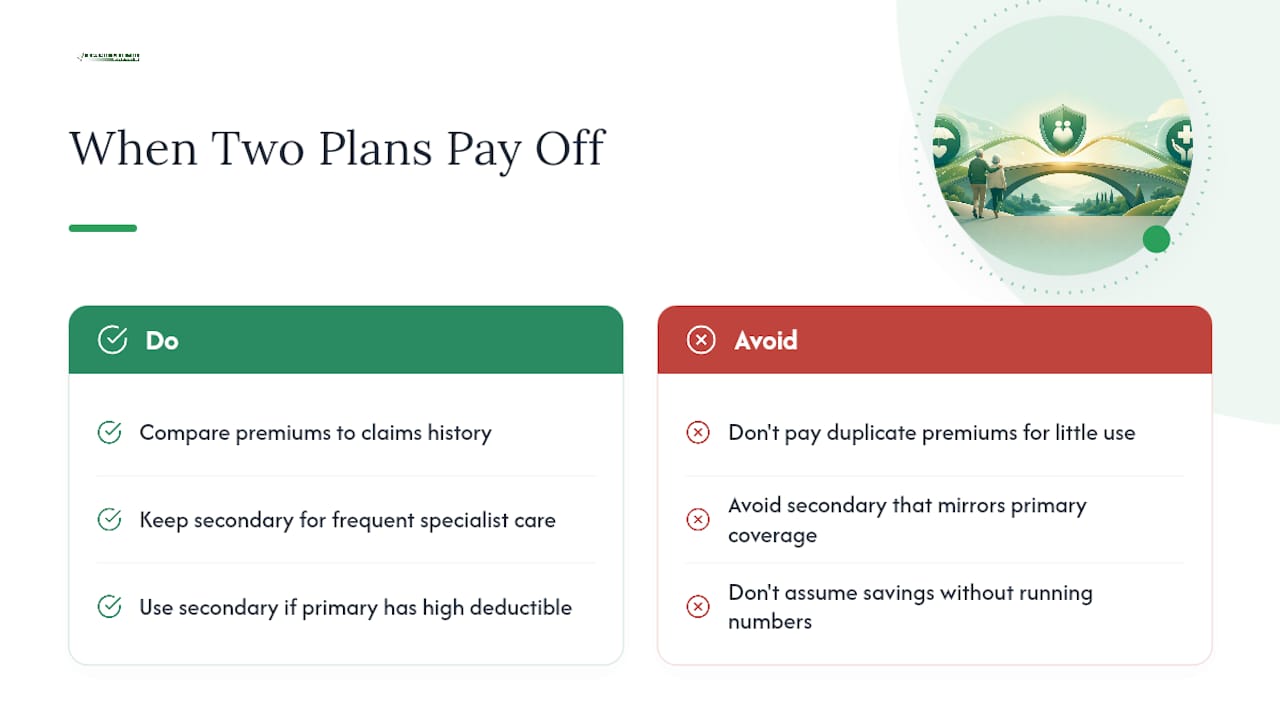
Here’s the honest answer: sometimes, and sometimes not as much as people expect. Having a secondary plan can meaningfully lower your out-of-pocket costs on big claims, since it picks up copays, coinsurance, or deductible amounts the primary plan left you owing. For someone managing a chronic condition or a family with frequent pediatric visits, that secondary coverage can be the difference between a manageable bill and a painful one.
But dual coverage isn’t free. You’re paying two premiums, and depending on your plans, the second one might duplicate coverage you barely use. If your secondary plan mostly covers costs your primary plan already handles well, you could be paying a monthly premium for a safety net that rarely activates.
The real question isn’t whether coordination of benefits saves money in theory. It’s whether your specific combination of plans, premiums, and typical medical usage makes financial sense for your household. Someone with a high-deductible primary plan and frequent specialist visits benefits far more from a secondary plan than someone with low medical usage and a plan that already covers most costs well. Running the numbers on your actual premium costs against your actual claims history tells you more than any general rule about multiple insurance benefits.
What I Tell Clients Who Are Confused About Two Plans
The mistake I see most often isn’t a coordination error. It’s silence, someone ignoring a COB questionnaire because it looks like junk mail, and then wondering months later why a claim never got paid. Keep one folder for every EOB and plan ID you own. That single habit prevents most of the headaches this article covers.
— Bernie S
Get Help Sorting Out Your Coverage
If juggling two plans, or Medicare alongside a group plan, has you double checking every EOB, you don’t have to untangle it solo. Sobal Nationwide Health reviews your actual coverage, at no cost to you for the consultation, and explains in plain terms which plan should be paying for what, without a sales pitch attached.

Many brokers work with self-employed individuals, families, and small businesses across multiple states, helping to make sense of the kind of coordination confusion this article walks through. A broker can’t change how your plans are written or override Medicare’s ordering rules, but we can help you understand them, catch a documentation gap before it becomes a denial, and figure out whether a second plan is actually worth its premium for your situation. If you’re weighing whether dual coverage makes financial sense, our family plan cost guide is a useful starting point. When you’re ready to talk through your specific plans, reach out to our team and we’ll walk through it together, no pressure, just a clear answer.
Where to Verify the Rules Yourself
For plan-specific rulings, always check your own summary of benefits, plus CMS and the Mayo Clinic COB patient guide.
